Nicholas Roerich Museum

Skeleton Pete reports on a visit to The Nicholas Roerich Museum in New York City. More photos on Flickr. Lovecraft knew Roerich’s work and something of his ideas, and presumably met other Theosophists in New York, although he was never a believer. Indeed, he seems to have lumped most of the theosophists in with charlatan quackery like spiritualism. In a letter to Willis Conover, Lovecraft wrote of… “The crap of the theosophists, which falls into the class of conscious fakery”. His use of whacky ideas from Theosophy is explored in Robert M. Price’s 1982 article “HPL and HPB: Lovecraft’s Use of Theosophy” (available online). He did have good words to say about Roerich however…

“Possibly I have mentioned to you at various times my admiration for the work of Nicholas Roerich — the mystical Russian artist who has devoted his life to the study & portrayal of the unknown uplands of Central Asia, with their vague suggestions of cosmic wonder & terror … surely Roerich is one of those rare fantastic souls who have glimpsed the grotesque, terrible secrets outside space & beyond time, & who have retained some ability to hint at the marvels they have seen.” — 21st/22nd May 1930 to Lillian D. Clark.

“…old Nicholas Roerich, the Russian painter whose weird Thibetan landscapes I have so long admired” — Selected Letters: 1932-1934.

“…good old Nick Roerich, whose joint at Riverside Drive and 103rd Street is one of my shrines in the pest zone [New York City]” — letter to James F. Morton, March 1937.

Roerich lived to 1947, so the date on the latter letter suggests Lovecraft may have known him well in the mid 1930s, when he often visited New York just after Christmas. “Good old” was usually a Lovecraft-ism used for things like cinemas or old men or old cats, meaning they were “reliable” in their warm welcome and hospitality.


Above: Nicholas Roerich, “Armageddon, 1936”.

Crysis mod: The Worry of Newport

The Worry of Newport is a new Lovecraftian Crysis mod. Ok, let’s translate that into English for those who don’t play videogames. CryEngine 3 is a wonderful cutting-edge game engine, the thing that puts the visuals and audio and game mechanics on the screen. The Crysis games are some of the biggest games out there, although not to my taste. Now there’s a new free mod (i.e.: a free fan-made modification or ‘makeover’) for the game. You buy the game, you apply the mod, you get a new game. All part of the crazy remix culture, m’lud.

The naff choice of fonts for the trailer, and the title (“The Worry…”?) are both initially very discouraging. But the game is getting taken seriously by the genuine and respected reviewers, such as Rock, Paper, Shotgun which writes…

“Although it’s small and imperfectly formed, The Worry of Newport is as authentic a Lovecraft experience as I’ve ever played. That’s not to say it’s the best Lovecraft-inspired game I’ve ever had my hands on, it’s just the most true to the man himself. […] it’s slow, wordy and takes itself very seriously indeed. However, it’s also atmospheric, creepy and mysterious.”

Here’s the creator’s description of the mod/game…

The Worry of Newport is a two part horror/mystery mod for Crysis built around immersion and story telling, rather than combat or action. Both parts span a story arc that concerns a nameless protagonist awakening in the ocean outside of the island of Newport, a fictional [island] colony in the Atlantic. Upon exploring the port nearby and uncovering a little bit of the backstory, it is on his (and your, the players) shoulders to pursue the truths behind the dark secrets on the island.”

[youtube http://www.youtube.com/watch?v=GgKDb-jYsSg&w=640&h=390]

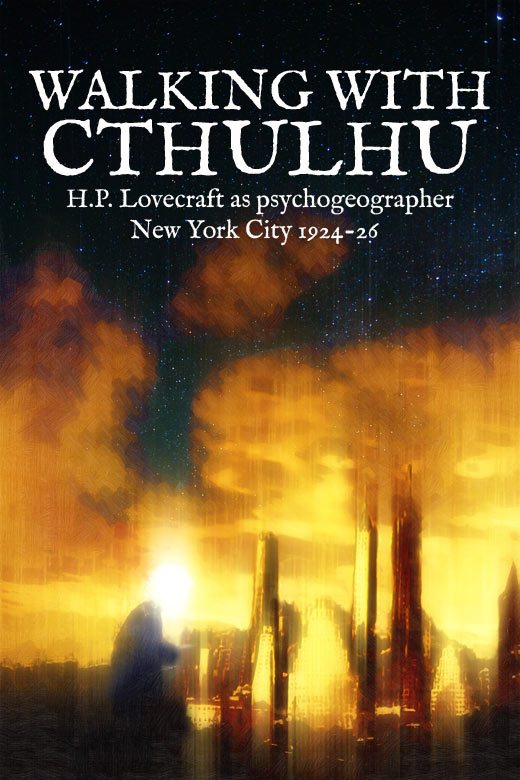
Published: Walking With Cthulhu : H.P. Lovecraft as psychogeographer, New York City 1924-26

My new book is here! Walking With Cthulhu : H.P. Lovecraft as psychogeographer, New York City 1924-26. 55,000 words, 198 pages. Illustrated.

Another good haul of new discoveries! Including two new possible sources for Cthulhu. All heavily referenced and footnoted.

Buy a new paperback copy here! Kindle user? It’s also on the USA Kindle Store and the U.K. Kindle Store.


CONTENTS:

Timeline of Key Dates.

Introduction: A Walk in New York.

SURFACE: Walking the Streets of the City:

1. H.P. Lovecraft and the psychogeographers.

2. H.P. Lovecraft’s night walks in New York: psychogeographic techniques

3. The nature of the New York streets.

4. A note on H.P. Lovecraft and immigrants.

5. H.P. Lovecraft’s New York coffee houses and ice-cream parlours.

UNDERGROUND: On the Monstrous, Occult, and Hidden:

6. H.P. Lovecraft and the subway.

7. It emerged from the subways!

8. On mystical and occult New York.

9. On H.P. Lovecraft and Franz Boas

10. New York as R’lyeh, sunken city of Cthulhu.

“Nyarlathotep” annotated.

Bibliography.

Index.

Teaching literature as history

Scott Herring calls for a new academic approach that might ferry the study of English Literature back from the land of limbo. It’s an approach that the history-venerating Lovecraft would have approved of…

History gives us the facts, sort of, but from literary works we can learn what the past smelled like, sounded like, and felt like, the forgotten gritty details of a lost era. Literature brings us as close as we can come to reinhabiting the past. […]

The past is not another country; it is another life. The texture of daily living is different now than in the past, more different the further back we look, until we find people whose experiences created a psychology we might find baffling or rude. Many details that once made up the daily round are lost to us because people considered them too trivial to write down. […]

Let the dead French theorists lie. Instead, literary scholars can become guides to the physical reality of the past. If you think about it, that’s what we’ve been doing in class for the last hundred years […] Once ordinary people note that we’re doing something useful again, they might stop looking at us like we’re nuts.

That seems fine when the literature in question directly describes that re-imagined past. Such an apparently straightforward approach and lack of obscurantist clutter might well appeal to both students and administrators, if not to many English Lit academics. Although I can imagine the historical approach morphing into ‘Political Correctness 101’ in many left-leaning classrooms, with the life of the author wheeled in as Exhibit A for the prosecution. I can also see a great many authors being avoided altogether, to ‘avoid offending’, if one had to focus as much on the history as on the text.

A more interesting approach might be cross-disciplinary and tailored to each student. Let each student start by discovering their specific family history and tree, gaining basic research skills along the way — then spiral out from there into the relevant fiction, social histories, economics, topography, frameworks of ideas, visual representations, etc.

But what of science fiction? One might run into problems there, with a historical approach. Not because one can’t show that these forms and stories arise partly from the events and concerns present in their time-of-writing. But it seems a tall order to ask students to discover such factors independently, as a part of answering assigned essay questions. Students would need to be: pretty good historians already; able to read widely across many books (each with only a small nugget that tangentially illuminates the story in question); and generally have top-notch online search and information-handling skills. That level of ability is unreachable for all but the top 10% of dedicated students, at a time when history is being dropped in many (UK) schools, when the USA is playing tug-o-war with history in the classroom, and when online search-skills are only very cursorily taught (if at all) in the English-speaking world.

Conferences on the monstrous, 2011-2012

Some forthcoming conferences that may interest…

Monsters and The Monstrous 2011 (Oxford, UK, Sept 2011)

Monstrosity and Humanity conference (English Midlands, UK, Nov 2011)

Vampires: Myths of the Past and the Future (London, UK, Nov 2011)

The Monstrous Fantastic (Florida, March 2012)

The Monstrous City (New York, USA, March 2012) (See also the forthcoming Urban Monstrosities book)

Urban Fantasies: Magic and the Supernatural (Prague, Eastern Europe, March 2012)

Bram Stoker and Gothic Transformations (Hull, North of England, UK, April 2012)

Weird Tales sold to new owner

The modern Weird Tales magazine has been sold by Wildside Press to a new owner/editor. Or at least, the rights to use the brand name for a magazine. The new owner is Marvin Kaye, whose first issue of the magazine will apparently be a Cthulhu special in Feb 2012. SF Scope writes of Kaye…

“The 73-year-old Kaye edited the anthology Weird Tales, The Magazine That Never Dies, which Doubleday published in 1988. He is the author of 16 novels and six nonfiction books, in addition to plays and play adaptations. He has edited at least 30 anthologies, and won the World Fantasy Award for best anthology in 2006 for The Fair Folk.”