Sean Hartter takes a different angle on the Lovecraft graphic remix meme, by re-imagining Lovecraft as a playwright — who had his plays published in vintage paperback form in the 1960s…

Hartter’s blog has a lot of similar faux re-imaginings.

30 Monday Jan 2012
Posted in Lovecraftian arts
Sean Hartter takes a different angle on the Lovecraft graphic remix meme, by re-imagining Lovecraft as a playwright — who had his plays published in vintage paperback form in the 1960s…
Hartter’s blog has a lot of similar faux re-imaginings.
29 Sunday Jan 2012
Posted in Odd scratchings
While Google chases an anti-trust suit with Google+, search doesn’t seem to be getting better. Even with personalisation turned on, and my heavy record of years of searching for Lovecraft items, my top ten results for “Lovecraft” include links to: a craft shop in the UK; and sex shop in Totonto.
28 Saturday Jan 2012
Posted in Lovecraftian arts
Melding Joseph Cornell with a Lovecraftian vision, Oscar Sanmartin‘s box “Diorama 3″…

28 Saturday Jan 2012
Posted in Historical context, Lovecraftian arts
27 Friday Jan 2012
Posted in Lovecraftian arts
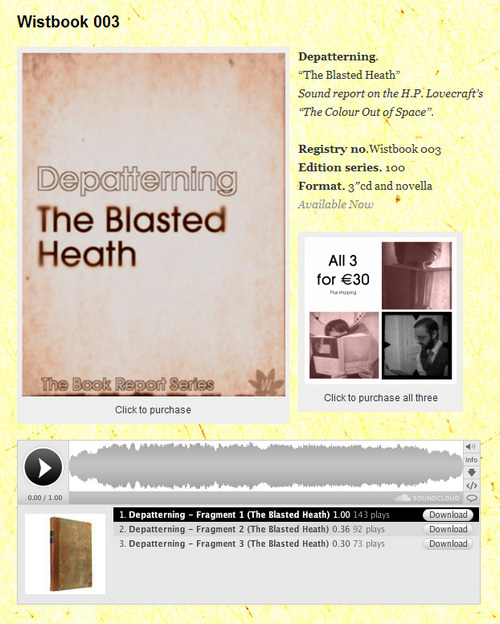
Nice concept. WistRec‘s “sound report” (soundtrack) is specially designed for listening while reading H.P. Lovecraft’s “The Colour Out of Space”, in the form of a 3″ CD and a printed booklet of the story. Limited to 100 copies. WistRec is a niche Irish label.
27 Friday Jan 2012
Posted in Scholarly works
Sandro D. Fossemo. “Cosmic terror from Poe to Lovecraft: the fear of unknown from the abyss of the soul to cosmic chaos“. (Seems to have been published online Dec 2010. No traces found suggesting it has been made available other than online).
[ Hat-tip: Francesco Salvatore ]
26 Thursday Jan 2012
Posted in Odd scratchings
Astrowright muses today on what Lovecraft got right from the perspective on xenoarchaeology (the scientific imagining of the archaeological discovery of physical remains of alien civilisations).

Above: Jack Kirby depicting archaeologists discovering evidence of ancient space travelers, The Eternals #1.
25 Wednesday Jan 2012
Posted in Scholarly works
A nice new footnotes plugin for WordPress, which may be of interest to blogging Lovecraft scholars. It uses simple square brackets, which must have a number at the start of them. It accepts HTML links inside the brackets. I’d love to see this plugin come as standard with the free WordPress.com -hosted blogs…

To have the smaller font size on the footnotes, paste this CSS into your theme’s styles CSS, probably at the foot of the font section. The plugin doesn’t add this CSS automatically.
25 Wednesday Jan 2012
Posted in Lovecraftian arts
A super new digital painting by Thomas Debitus…

See it full-size here. Looks as though it could be fairly easily expanded to the right, to make it the right size for a book cover.
25 Wednesday Jan 2012
Wilum Pugmire takes a look at the kind of sumptious production values we can expect from the just-announced New Annotated Lovecraft edition — set to be published by W.W. Norton in 2015…
[youtube http://www.youtube.com/watch?v=AQEvx_Zd9n8&w=640&h=360]
How far Lovecraft’s work has come, from being published only ephemerally and on the cheapest woodpulp paper of the pulp magazines. Although I guess Norton will have to use the public domain texts, and not Joshi’s revised and corrected texts?
24 Tuesday Jan 2012
Posted in Scholarly works
A couple of new academic full-text works of interest, freely available online…
* Joakim Bengtsson. Tentative outline: the Ending and the Solution of Conflicts in [? name truncated, title not on document – probably “…the Fiction of H.P. Lovecraft”]. 10,000 words, seems to be a Masters dissertation? Sweden, but in English. The author appears in the cast list for the Swedish Lovecraftian short movie “Fyren” (‘Keeper of the Light’, 2009).
* Johan Wijkmark. “One of the Most Intensely Exciting Secrets”: The Antarctic in American Literature, 1820-1849. Karlstad University, 2009. Seems to be a PhD thesis, prettified as a monograph by the university press. In English.
24 Tuesday Jan 2012
Posted in New books
A Sherlock Holmes specialist named Leslie S. Klinger has reportedly announced he is working on a New Annotated H.P. Lovecraft volume, for mainstream publisher W.W. Norton, due out in 2015. He’s a U.S. lawyer who has previously crafted The New Annotated Sherlock Holmes: Vols. 1 & 2, The Short Stories, and Vol. 3, The Novels (2004), and The New Annotated Dracula (2008), both published in sumptious-but-affordable doorstopper editions by W.W. Norton. I’m a fan and not a scholar of the Holmes stories, and I have little interest in vampires, so I have to say that Klinger is a name that has passed me by until now. I haven’t delved into it very deeply, but there appears to be some controversy around his annotated volumes. Wilum Pugmire reports on Facebook that… “S.T. [Joshi] figures that most of the annotations in the [Klinger] Lovecraft volume will be culled from his own commentary”.
