Ratcliffe

An amusing little bit of additional evidence, re: my recent essay that uncovers a key source for “The Rats in the Walls”. ‘Viscount Ratcliff’ was one of the titles belonging to Dilston, and Ratcliffe was the family name of James Ratcliffe, Earl of Derwentwater…

— from William Berr’s Encyclopaedia heraldica or complete dictionary of heraldry, Volume 2 (1828)

— from Stephen Whatley’s England’s Gazetteer (1751)

— from Thomas Rose’s Westmorland, Cumberland, Durham, and Northumberland (1832)

There is also a tantalising note from Notes and Queries of 1914, perhaps relevant to the idea of some long-absent descendant coming to claim Exham Priory, but I am unable to get more…

“the following extracts from The Times and contemporary journals:— ” Great excitement was caused at Hexham and the western parts of Northumberland on Tuesday by a lady who claims to be a descendant of Ratcliffe … The lady first appeared upon the scene … in 1865, and a year or so later took possession of Dilston more or … to be a descendant of Ratcliffe, the last Earl of Derwentwater, taking possession of Dilston Castle, about three miles from Hexham, and claiming all the estates once belonging to that unfortunate [Earl]”

Clockwork Empires (PC game)

I have fond memories of a few of the best of the isometric-view strategy videogames, and once greatly enjoyed Sid Meier’s Civilisation II and later his Railroads and others. Also Titan Quest [review], although that was more Diablo-like. So the new PC Gamer magazine’s pre-release coverage of the moddable PC game Clockwork Empires sounds very interesting. Especially as it’s apparently a…

“Lovecraft-laden steampunk city-builder” [in which the player is a Civilisation-style] colony-builder amid the grand idealism of Victorian discovery [but] with horrors, madness, wild species, and volatile science.”

Sounds awesome, but sadly it’s all very much “under development”. It looks like we’ll have to wait until around Sept/Oct 2013 before we can play it.

Further Lovecraftian places that really exist

Further Lovecraftian places that really exist:


Eye of Africa (the Richat Structure), Mauritania.


‘Sentinels of the Arctic’ (wind/snow formations, Finnish Lapland) — picture by Niccola Bonfadini.


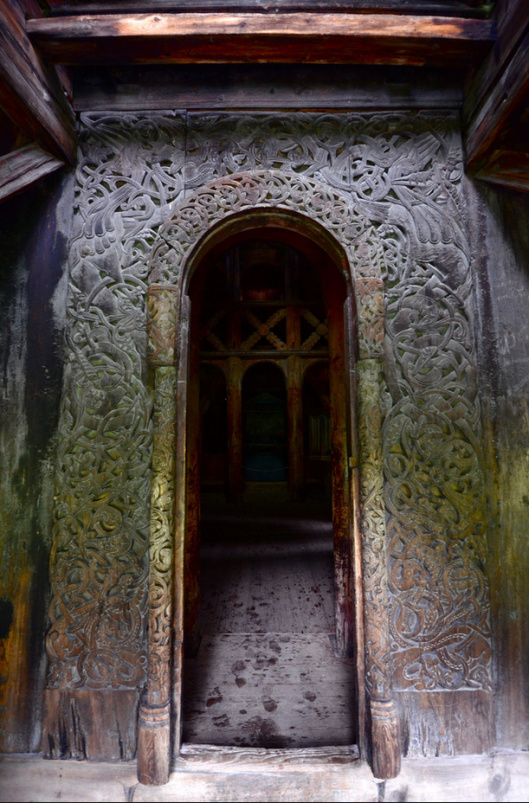
Entrance to the Borgund Stave Church, Norway — picture by Lightbender.


Catholic convent catacombs, Lima in Peru.


Basalt cave entrance, Akun Island — picture by Steve Hillebrand, U.S. Fish and Wildlife Service.


Stephen Whitney crypt entrance, Greenwood Cemetery (Lovecraft visited this cemetery while in New York).

More Open Lovecraft

Added to the Open Lovecraft page:

* Marek Wilczynski (2008), “Secret passage through Poe: the transatlantic affinities of H.P. Lovecraft and Stefan Grabinski”, Studia Anglica Posnaniensia, 44, 2008.

* David Farnell (2007), “In a mirror, darkly”: finding ourselves reflected in the aliens of Melville, Lovecraft, Dick, and Butler”, Fukuoka University Review of Literature & Humanities, Vol.39, 1, 2007, pp.105-127.

* Malotcsy Kalman (2004), “The Innsmouth “Thing”: Monstrous Androgyny in H.P. Lovecraft’s “The Thing on the Doorstep”, Gender Studies, Vol.1, No.3, 2004.

Lovecraft and his Puritans

An M.A. thesis from a religious university, currently only available via Google “Quick View”…

Geoffrey Reiter (2005), “A Dark Poem”: Lovecraft and his Puritans.

“This work examines the fiction and letters of H.P. Lovecraft […] and seeks to explore the way in which he incorporated Puritanism into his works and artistic philosophy, despite the fact that his materialistic worldview would not permit him to accept Puritan doctrinal tenets.”

It can be found with a Google “Quick View” link, via the following Google Search query:

   lovecraft “Puritanism and Christianity” filetype:pdf

The Age of Lovecraft: Cosmic Horror, Posthumanism, and Popular Culture

Call for Proposals for academic book chapters: “The Age of Lovecraft: Cosmic Horror, Posthumanism, and Popular Culture”.

Editors: Carl Sederholm at csederholm@byu.edu / Jeffrey Weinstock at Jeffrey.Weinstock@cmich.edu

250-word proposals are sought for chapters for an edited scholarly collection on H.P. Lovecraft and his place in 21st century literature, film, media, and popular culture. This collection will consider the late 20th and early 21st century as “The Age of Lovecraft”, as he achieves unprecedented levels of cultural saturation. In short, we will be asking ‘why Lovecraft, why now’?

Deadline for proposals: 31st October 31st 2012. Chapters of approximately 6,000 words due one year later.