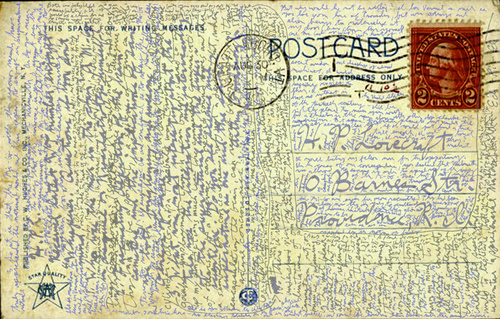
New additions to my Open Lovecraft page…
* Cecile Colin (2012), “La maison hantee dans l’oeuvre de H.P. Lovecraft: l’homme, la mort, l’univers”, Transatlantica, 1, 2012. (In French. Part of the crime pulps special issue of Transatlantica. Title in English: “The Haunted House in the work of H.P. Lovecraft: man, death, and the universe”. Freely available mid Dec – mid Jan 2013, but since redacted? A link to the corrupted PDF is included here, in the hope the error is simply technical in nature).
* Rachel Mizsei Ward (2010), “Plushies, My Little Cthulhu and Chibithulu : The Transformation of H.P. Lovecraft’s Cthulhu from Horrific Body to Cute Body”. Presented at Cine Excess IV: International Conference on Cult Film Traditions, Brunel University (UK), April 2010.
* Didier Kahn (2005), “La question de la palingenesie, de Paracelse a H.P. Lovecraft en passant par Joseph Du Chesne, Agrippa d’Aubigne et quelques autres, Journee Francois Secret : Les Muses Secretes : Kabbale, alchimie et litterature a la Renaissance, Verona Italy, 2005. (In French. English title: “The question of palingenesis [i.e., reincarnation, and] Paracelsus in H.P. Lovecraft…” Summary at HAL: “In this short history of early modern palingenesis [western beliefs in reincarnation] experiences, we discuss in depth the conceptions of Paracelsus and Joseph Du Chesne before turning to the literary fortune of palingenesis, notably in Agrippa d’Aubigne’s Les Tragiques, but also in a work by H.P. Lovecraft inspired by the seventeenth-century alchemist Pierre Borel.”).


 , Palgrave, Dec 2012.