Good old Mac

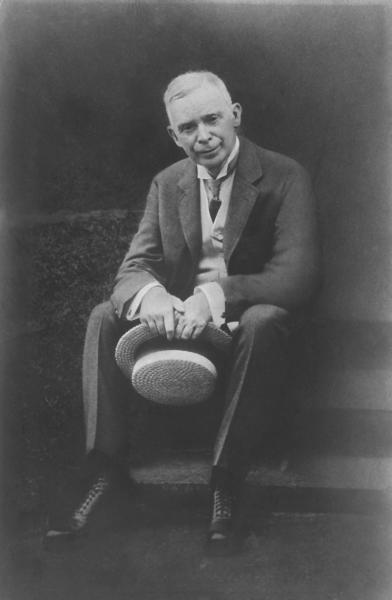
Coming soon, a new book: Good old Mac: Henry Everett McNeil, 1862-1929. A Collection and Biographical Essay.

It opens with my new 10,000-word biographical essay on the core member of the Kalem Club and Lovecraft’s good friend in New York. Followed by a selection of his previously uncollected articles and stories. Judging from Joshi’s Lovecraft bibliography, this will be the first ever scholarly essay/book on McNeil’s life and career.

If anyone has unpublished information on him, that’s perhaps been sitting in a drawer for years, I’d welcome seeing it.

goodoldcover-thumb

Club of 7 Dreamers “found” (or not)

A comment from Robert, here at this blog, which I think deserves to be worked up as little guest post…


Robert of Innsmouth Mania in France, writes:—

Here is a Web link to details of a very strange event which occurred in France over a decade ago, in 2001. The article is at http://clefargent.free.fr/wb_7rev.php. It is in French, but I will summarize it for you. It’s about an email which circulated on the Web for a few weeks, accompanied by a picture (which you can see on the website). This email said:

“Mail to all Lovecraft fans. It has been discovered recently in a Parisian bookseller, a copy of an unknown novel of Lovecraft, translated in French! This is the cover. Translation was made by Gabriel Lautrec, correspondent of R.H. Barlow, who has translated it at the end of the 1930’s. You will find the entirety of the text soon, on our website, which is under construction at the moment. The address will be given to you in another email soon.”

And then there was silence…

The title was the Club of 7 Dreamers, a book that Lovecraft thought of writing at some point (S.T. Joshi and others have noted it), but which he never did it. Gabriel Lautrec really existed and was indeed a known translator. The deep analysis of the cover showed that it was not a cut-and-paste made in Photoshop — it seems that the guy really printed the cover. But there was no trace of any such book in the catalog of the editor, nor in the archives of the French National Library, which is the equivalent of your British Library or Library of Congress.

It’s a fake, but a really good one, since in those days it would have taken months for people to search and get all the information, and then eventually conclude it was a prank. But during this time France had produced an unknown book by HPL! Like the title, we dreamed…

wb_7rev

Goodenough’s farmhouse in colour

A colour painting of the farmhouse of Arthur H. Goodenough, the elderly amateur press man and friend of Lovecraft living near Brattleboro…

From the auctioneer: “D. POWERS: PASTEL PAINTING OF A COLONIAL HOME IN BRATTLEBORO VT (GOODENOUGH FARM)”

lot153

lot153-2

From the same auctioneer: “BERT G. AKLEY, OIL ON ARTISTS BOARD OF AN INDIAN MAIDEN PADDLING A BIRCH BARK CANOE BY MOONLIGHT 1917”. This is by the rustic naif artist-recluse Bert Gilman Akley (1871-1946) who Lovecraft visited at his farm and who gave his name to Akeley in “The Whisperer in Darkness”. Although a local article suggests…

“For Akeley’s home, however, Lovecraft seems to have drawn from his experience visiting another isolated Vermonter, the poet Arthur Henry Goodenough.”

A monstrous Prospect Street

A monstrously large scan of a sharp 8″ x 10″ photographic negative showing Prospect Street in 1906, in which you can almost see every pebble and leaf.

4a13603apreview

From the same super-large set, Brown University and the Crawford St. Bridge one the bridges Lovecraft would have crossed from the East Side into the city centre. Anyone know if there are more from this set online?

Chris Perridas has postcard views showing the views of the commercial river from Crawford St. Bridge.

[ Hat-tip: Robert ]


Update: I colorised it…

prospect_st_providence_1906

Update: Postcard version from eBay, also dated 1906 thus confirming the date…

Free InDesign 6″ x 9″ book template

Here’s my new free quick-start template, for self-publishing authors starting to use Adobe InDesign CS6. I couldn’t find one at all that was in the classic book style, so I made one.

It’s a simple 6″ x 9″ book template, with a style modeled on vintage book design.

It’s set up with the correct margins for the Lulu.com print-on-demand service. Autoflow of pasted text is already fully set up for you, and footnotes are fully set up and spaced. Should accommodate about 55,000 words or so, in its 104 pages. You may want to remove the auto-hyphenation of some words at the end of lines.

promo-small

Download.

It’s freeware. Small donations are welcome, if you find it useful.

Those wanting to import a scholarly book or dissertation into InDesign from a straight Word file might also take a look at this useful tutorial on importing a Word document with footnotes intact and correctly placed, and still “dynamic”.

Lovecraft’s librarian

Just before his return to Providence from his sojourn in New York City, in discussing his threadbare finances, Lovecraft notes in a letter that his Providence library card is set to expire. He notes that his stacks card (presumably the card that grants him access to the library stacks, meaning the storeroom) for the library has already expired, but that the librarian…

   “good old William E. Foster has been tolerant of lapses before” (Lord of a Visible World, p.286)

The proximity to the discussion of money appears to suggest that a small annual fee was paid for membership of the public library?

There’s a detailed short biography of Lovecraft’s librarian heading the description of the William Eaton Foster Papers collection. It turns out that William Eaton Foster (1851-1930) was the driving force of the Providence Public Library from its inception, and a pioneer in many aspects of the modern library. He once even rivalled Dewey in devising a general classification system. The biography omits that he was also… “an admirer of the Roman poet Horace and collector of his works”, something which would have endeared him to Lovecraft-the-Roman. Foster retired February 1930, the same year as this photograph of him…

William_E_Foster_Providence_1930

And as he may have looked to the young Lovecraft…

His book The first fifty years of the Providence public library, 1878-1928 is now available free online.

Everett McNeil in the movies

More on Lovecraft’s good New York friend and Kalem Club anchor member Everett McNeil, specifically his career as a movie scriptwriter in New York circa 1912-1917, before the movie industry shipped out to California. I previously briefly identified this possibility in my book Walking with Cthulhu.

Moving Picture World credited him as writer with Selig Polyscope Co. 1913; and Eclair Film Co., Inc, 1914; and also has an article by him on “How to Write a Photo-Play” (i.e.: a cinema script) in July 1911 which a contemporary book on movie history called a “prescient” anticipation of the later film-writing manuals. The date of this suggests he may have had a career in the movies that began before 1912. This appears to be confirmed by a comment about the length of his career in The Writer’s Monthly (Jan 1916)…

    “For an example of careful work in scenario writing — resulting in the director’s following each scene almost exactly as written — I should like photoplay fans and photoplaywrights to keep an eye open for the forthcoming Heine-Edison five-reel feature drama, “The Crucifixion of Philip Strong.” [aka The Martyrdom of Philip Strong, a Paramount feature-film] It is founded on the well-known novel of that name by Rev. Charles M. Sheldon, and is what I call a thoroughly well prepared script. Through an error, credit for the screen adaptation was given to Francis M. Neilson. Full credit for the screen version is due to Everett McNeil, a photoplaywright and fiction writer of long experience, who has been selected by Mr. L. W. McChesney to devote himself exclusively to the production of adaptations and original stories for director Richard Ridgely.” [my emphasis]

This led me to find what has now become a fairly full listing for Everett McNeil’s movie credits on IMDB, which I’m pretty sure wasn’t there when I was writing Walking with Cthulhu:

1917 A Lucky Slip (short) (scenario)
1917 Builders of Castles (picturizer)
1917 The Master Passion (scenario / as Everett MacNeil)
1916 The Martyrdom of Philip Strong (story)
1916 When Hooligan and Dooligan Ran for Mayor (short) (story)
1915 The Making Over of Geoffrey Manning (story)
1914 The Price Paid (short) (story)
1913 The Beaded Buckskin Bag (short) (writer)
1912 A Messenger to Kearney (short) (story)
1912 When the Heart Rules (short) (story “The Sealskin Overcoat”)
1912 A Cowboy’s Best Girl (short) (scenario)

So when Lovecraft knew him in New York, McNeil was less than ten years away from a fairly long movie career. Which, one assumes, ended (just as McNeil was about to break into regular features work) due to the effects of the First World War and/or the move of the New York movie industry out to California?

New York and R’lyeh

I argued recently — in an essay in my book Walking with Cthulhu (free as a PDF) — that New York itself was the metaphorical ‘alchemical base’ from which Lovecraft imaginatively transmuted his conception of the city of R’lyeh. Sadly I hadn’t then stumbled on the following superb quote from the Selected Letters (III, p.122), which would have served as further good evidence. To Moe in 1930, Lovecraft remembers the New York he had seen when first being guided around it by Everett McNeil, seemingly an expert in negotiating the slum and rough areas (probably due to his contact with the boy-life of the city, especially around Hell’s Kitchen). Here, for Lovecraft, is the city seemingly poised between his first Dunsanian dream-vision of it, and the darkly monstrous fever-dream of alienage that it later became for him…

    “… Cyclopean phantom-pinnacles flowering in violet mist, surging vortices of alien life coursing from wonder-hidden springs in Samarcand and Carthage and Babylon and Ægyptus, breathless sunset vistas of weird architecture and unknown landscape glimpsed from bizarrely balustraded plazas and tiers of titan terraces, glittering twilights that thickened into cryptic ceilings of darkness pressing low over lanes and vaults of unearthly phosphorescence, and the vast, low-lying flat lands and salt marshes […] winds stirred the sedges along sluggish inlets brooding gray and shadowy and out of reach of the long red rays of hazy setting suns. […] Morbid nightmare aisles of odorous Abaddon-labyrinths and Phlegethontic shores — accursed hashish-dreams of endless brick walls budging and bursting with viscous abominations and staring insanely with bleared, geometrical patterns of windows — confused rivers of elemental, simian life with half-Nordic faces twisted and grotesque in the evil flare of bonfires set to signal the nameless gods of dark stars — sinister pigeon-breeders on the flat roofs of unclean teocallis, sending out birds of space with blasphemous messages for the black, elder gods of the cosmic void — death and menace behind furtive doors […] fumes of hellish brews concocted in obscene crypts …” (Selected Letters III, p.122)

the-bay-nyc-pennell

pennell-night-lights-nyc

towers_at_night

from_courtland_st._ferry

tumblr_mc6c0zK0EU1rxckino1_500

pennellbbnight

Above, from top: Joseph Pennell (1858-1926), “The Bay, New York”; “Night lights of Manhattan”; “Towers at Night”; “From Cortlandt Street Ferry”, “The Things that Tower” (New Yorker earlier version of “From Cortlandt Street Ferry”); “Brooklyn Bridge at Night”.