S.T. Joshi’s blog has an online review of the book A Look Behind the Derleth Mythos: Origins of the Cthulhu Mythos (2012).
Joshi reviews A Look Behind the Derleth Mythos
01 Thursday Aug 2013
Posted in Scholarly works

01 Thursday Aug 2013
Posted in Scholarly works
S.T. Joshi’s blog has an online review of the book A Look Behind the Derleth Mythos: Origins of the Cthulhu Mythos (2012).
01 Thursday Aug 2013
Posted in NecronomiCon 2013
Only 22 days to go before NecronomiCon Providence 2013. It’s super to see that Lovecraftians can fill four (or is it five now?) hotels, and that the con tickets have sold strongly. There are still a few tickets left though. I can’t be there, but I plan to provide a daily digest posting — of Web links to news items, online photo/videos, and any reports from the convention.
01 Thursday Aug 2013
Posted in Odd scratchings
Bloomberg review and New York Times review of the just-opened Brooklyn exhibition Divine Felines: Cats of Ancient Egypt.

01 Thursday Aug 2013
Posted in Historical context, New discoveries
There’s an interesting early use of the idea of ‘ley lines’ in supernatural fiction, in Lovecraft’s “The Lurking Fear” (written November 1922)…
“Now, in the light of that low moon which cast long weird shadows, it struck me forcibly that the various points and lines of the mound system had a peculiar relation to the summit of Tempest Mountain. That summit was undeniably a centre from which the lines or rows of points radiated indefinitely and irregularly…”
The idea of “the light of that low moon which cast long weird shadows” is also indicative that Lovecraft had some basic knowledge about British archaeological methods. Before modern archaeological tools, detecting ancient earthworks such as small ploughed-out tumuli through fieldwork was something best done in a low-angled light casting long shadows.
So either Lovecraft independently lit upon this wrong-headed but seminal ‘earth mysteries’ concept, or else he must have had it from a review of Alfred Watkins’s book Early British Trackways, Moats, Mounds, Camps and Sites. This book had appeared in early 1922, some nine months before “The Lurking Fear”. It attempted to show that ancient British trackways, evidenced millennia later only by their associated ancient barrow mounds and standing stones, hill-forts and the like, were often constructed onto dead-straight lines. Watkins further suggested that these straight lines radiated from certain key points in the British landscape.
It seems likely that a review of Watkins in the scientific journal Nature (5th August 1922, 110, pp.176-177) would have been Lovecraft’s source for the idea. There Early British Trackways was briefly reviewed without skepticism. The Nature review charitably overlooked the bumbling place-name blunders which had caused howls from British reviewers at The Spectator and The Times Literary Supplement. This oversight at Nature was perhaps due to editorial recall of one Sir Norman Lockyer (founder and first editor of Nature until 1920) and his groundbreaking idea in Stonehenge and Other British Stone Monuments Astronomically Considered (1906, 1909) about the astronomical alignment of early British sacred sites. Findings which implied that a sacred nature might indeed be inferred for straight lines and lines-of-sight in early British cultures, and over a very long period. Lockyer’s work was the start of the broadly-sound (although loon-haunted) research on archeoastronomy. This earliest archeoastronomy was something which Lovecraft may also have become aware of in passing, since he was an astronomer who was also interested in ancient British topography and archaeology. Possibly the Theosophist journals may also have picked up early on Lockyer and Watkins, providing another route by which Lovecraft could have learned of the new ideas before late 1922.
To anyone familiar with the close-packed and topsy-turvy nature of the hilly topography of Watkins’s own English Midlands and Welsh Marches, the ‘ley lines’ idea might have seemed as loopy as the traditionally rambling English road. Yet Watkins found a hearing in some quarters because the Ancient Romans had actually done it, incontrovertibly paving much of Britain with their dead-straight roads. Some of which were indeed founded on or alongside earlier ancient British trackways. Yet most reputable archaeologists were skeptical, and the idea simmered and drifted to the fringes where it became entangled with occultism and UFOs. In the late 1960s and early 1970s ‘leys’ were assiduously researched by mushroom-munching hippies during the British counterculture’s rural retreat from the heroin-blighted cities, but the notion was brought to a juddering halt by the abundant computer power of the late 1970s and early 80s. Long-distance leys were shown to be the result of statistical chance, plus dodgy place-name derivation and the indiscriminate lumping together of disparately-aged points — rather than the result of druids with pointy sticks standing on hilltops.
 “We’re out of a job, lads! Right, straight down the pub and let’s get at that mistletoe wine…”
31 Wednesday Jul 2013
Posted in Lovecraftian places
Another set in my Lovecraftian Places that Really Exist series of blog posts…
 Abandoned Ta Prohm temple, Cambodia.
 South Pole Galaxy Detector, Antarctica.
 Rockland Lighthouse, Maine, USA.
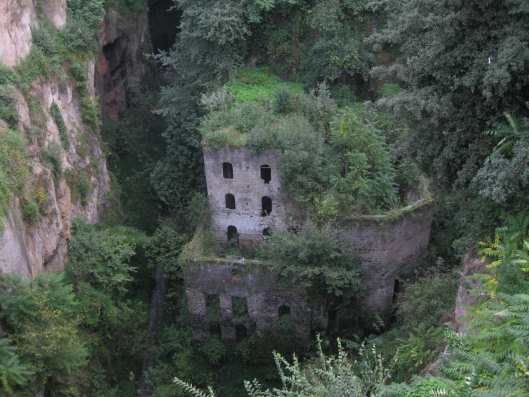 Abandoned mill, Sorrento, Italy.
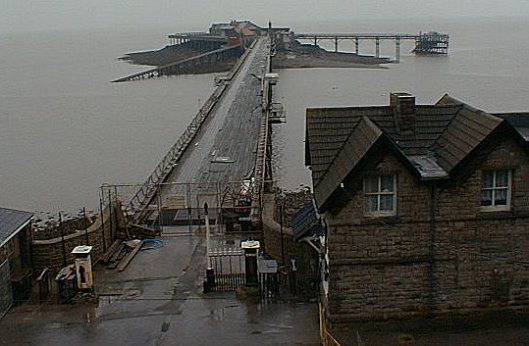 Birnbeck Pier (abandoned), Somerset, UK.
 Old Bookshop, Laugharne, Wales, UK.
 Dry valley, Antarctica.
 Underwater ancient temple, Bali.
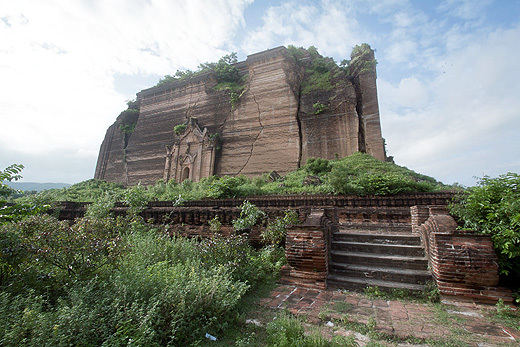 Abandoned temple, Mingun, Burma.
31 Wednesday Jul 2013
Posted in Lovecraftian arts, New books
Hernan Rodriguez of Uruguay in South America has a complete free comic adaptation of “Nyarlathotep” in English, from his two Spanish-language comics collections containing his Lovecraft adaptations…


31 Wednesday Jul 2013
Posted in Odd scratchings
I’ve often thought that the psychedelic orator Terence McKenna (1946-2000) was influenced by Lovecraft and, now we have his new biography from his brother The Brotherhood of the Screaming Abyss
“We knew we were on a quest; we knew we were seeking something unknown, transcendent, and possibly quite terrifying. So, we were setting out to explore the Screaming Abyss, and we became, humorously, the Brotherhood of the Screaming Abyss. I think the genesis of it came from H.P. Lovecraft, the early 20th century horror writer that Terence & I both read extensively as teenagers.”
My impromptu jotting of a few similarities:
* Cosmicism: McKenna presented a positive human-centred version of cosmicism (mp3 link) and transcosmicism, in which enlightened humans are the pinnacle and whole point of the cosmos’s “conservation of novelty”. This bit of his thought certainly makes for an interesting answer to Lovecraft. Although this point could be reconciled with Lovecraft, by stating that: although the human brain appears to be the pinnacle of the universe’s ever-ramifying complexity, that doesn’t therefore mean the cosmos cares about us.
* Dimensions just out of reach: McKenna perhaps channels Machen here, a little more than Lovecraft. What Terence called “self-transforming machine elves” are deemed to be beside us, in hidden dimensions only visible on drugs… “Right here and now, one quanta away, there is raging a universe of active intelligence that is transhuman, hyperdimensional, and extremely alien.” (McKenna). Compare with the Necronomicon‘s “Their hand is at your throats, yet ye see Them not; and Their habitation is even one with your guarded threshold.”; the dimensional intersections of “Dreams in the Witch House”; and “From Beyond” etc.
* Cthulhu calls his cultists: McKenna conceived of time as a wave rather than a linearity. With a being-like “dwell-point” or “hyperdimensional object” ahead of us in this “manifold” of time, a point that is attracting the enlightened portion of humanity toward a singularity-like transformed state — beyond which all will be unspeakable and unknowable. Only sensitive dreamers and artists get the psychic call about this coming apocalypse of ultimate-complexity, especially if they use visionary psychedelics.
To this he added a here-and-now kicker that recalls the Cthulhu cult: before the end-of-time arrives, psychedelically-enlightened humans can best survive the stressful “dominator culture” end-times by retreating into an “Archaic Revival” that involves orgiastic sex, psychedelic drugs, electronic music, and shamanic ritual, indulged in in natural settings — all with the aim of dissolving ego-boundaries and so preparing for the coming end-of-time. Nice work, if you can get it.
If you haven’t heard him compellingly explaining all this, it all sounds very whacky. It is, although he was also scientifically trained so it’s usually unpinned with levels of rationality and interesting ideas about an evolutionary symbiosis of ethno-botany and language/culture. It’s best to think of Terence rather as Lovecraft probably thought of the Theosophists. As a set of extremely well-presented and rather fun tripped-out beliefs to mine for use in weird fiction.
30 Tuesday Jul 2013
Posted in Lovecraftian arts
Young Tabbystardust gives Caspar a makeover…

Incidentally, if you’re interested in the differences between the textbook sublime and Lovecraft’s version of it, there’s an excellent article on that in Lovecraft Annual 2011.
30 Tuesday Jul 2013
Posted in Lovecraftian arts
I’m not sure that the Horny Tolkien Love-nymphs are strictly mythos, but here’s the poster for an annual Lovecraft art-show in August 2013…

30 Tuesday Jul 2013
Posted in Podcasts etc.
A recent BBC Radio 3 documentary, relevant to Lovecraft’s fear of the cold: A Cultural History of Being Cold, available online (44 mins, 20th Jan 2013).
 Archive photo of heavy snowfall in Prospect Park, New York City.
30 Tuesday Jul 2013
Posted in Scholarly works
News of a new conference in London, 1st-3rd November 2013: Monstrous Antiquities: archaeology and the uncanny in popular culture…
“This conference aims to study and celebrate this long and productive relationship [between archaeology and the uncanny]. We are keen to hear from scholars and aficionados of the fictional world of uncanny archaeology including archaeologists, historians, writers and artists. The programme will include all genres where the ancient meets the ghastly including music, television, literature, film, and art. The conference will be held at UCL on 1st—3rd November 2013.”
Three days, so I expect there’s probably going to be a book or an open set of online conference proceedings coming out of this one?
For those who can also afford to spend a further five nights in the UK after the conference, this event segways nicely with the one-day London research conference The Weird: Fugitive Fictions/Hybrid Genre, on 8th November 2013.
 Above: Pyramid in the Ruins of Ancient Rome, copper engraving by Piranesi.
30 Tuesday Jul 2013
Posted in NecronomiCon 2013
The Brown University Library’s Lovecraft collection will apparently be closed during NecronomiCon Providence 2013, but Brown has just announced…
“a two-part exhibit this summer in partnership with the Providence Athenaeum … “The Shadow Over College Street: H.P. Lovecraft in Providence,” will be on exhibit 19th August through 22nd September in the Philbrick Rare Book Room of the Providence Athenaeum [251 Benefit St., and] a smaller satellite exhibit will be on view in the lobby of the John D. Rockeller, Jr. Library [10 Prospect St., their main arts and humanities student library] from 19th August through 24th October. … Both parts of the exhibit feature materials from the John Hay Library [at Brown]. Explores Lovecraft’s youth in Providence and the city’s role in shaping his career as a master craftsman of weird fiction.”
