More of Lovecraft’s favorite books, Richard Green Parker’s Aids to English Composition and Progressive exercises in English composition. The latter he sent to at least one promising revision client (Zealia Bishop).


19 Thursday Sep 2013
Posted in Historical context, Odd scratchings
More of Lovecraft’s favorite books, Richard Green Parker’s Aids to English Composition and Progressive exercises in English composition. The latter he sent to at least one promising revision client (Zealia Bishop).
19 Thursday Sep 2013
Posted in Odd scratchings
The Private Papers of Henry Ryecroft (1903), by George Gissing. Apparently one of H.P. Lovecraft’s favorite books, and one on which he based his personal philosophy of life. Sonia stated that she received a copy of it early in their courtship, with instructions to read it to better understand him.

Curiously the book isn’t listed in Lovecraft’s Library. My guess on that would be that S.T. Joshi had to weigh Sonia’s solo revelation about the book, against Lovecraft’s apparent utter silence on Gissing in all his other walks of life and voluminous correspondence. And the similar silence of his bibliophile friends on the book. But if you’d like to take a look, the book is available here: Dutton U.S. first edition online digital facsimile and as .mobi for Kindle.
19 Thursday Sep 2013
Posted in Odd scratchings
Hot on the heels of the Junior Burials at Brown I’ve found another Rhode Island tradition of weird parading. Lovecraft and George Kirk took a ten-mile trolley ride from Providence to Chepachet on 4th July 1926 to see the first of the modern ‘Parade of Ancients and Horribles’. This parade was the U.S. Sesquicentennial (150th) anniversary revival of an annual satirical Parade of Ancients and Horribles, an event which had first been recorded in New England in 1851. The visit was mentioned in Kirk’s diary…
This essay has been replaced by the essay in my new book of revised, expanded, and footnoted versions of my recent Tentaclii essays, Lovecraft in Historical Context: fifth collection.
18 Wednesday Sep 2013
Posted in Lovecraftian arts, Podcasts etc.
Wayne June reads “The Crawling Chaos” (.mp3 link)…

18 Wednesday Sep 2013
Posted in Lovecraftian arts
The Weird Tales Lovecraft front-cover that should have been…

Modern faux cover courtesy of Ground to Pulp.
18 Wednesday Sep 2013
Posted in Historical context, Odd scratchings
It’s interesting to learn that there was once a weird end-of-term tradition among junior Brown University students in Providence. In early July each year they would parade in a boisterous throng from the University to the Seekonk River by flaming torchlight, in order to “bury Whately”. This appears to have been done from 1833-8, then again from 1853-9 — when the tradition ended due to the advent of the Civil War.
Whately is of course rather a similar name to Whateley, the famous name from Lovecraft’s story “The Dunwich Horror”. Wilbur Whateley ends up horribly dead in the “reading-room” of a university library, you’ll remember. He evaporates, and so cannot be buried.
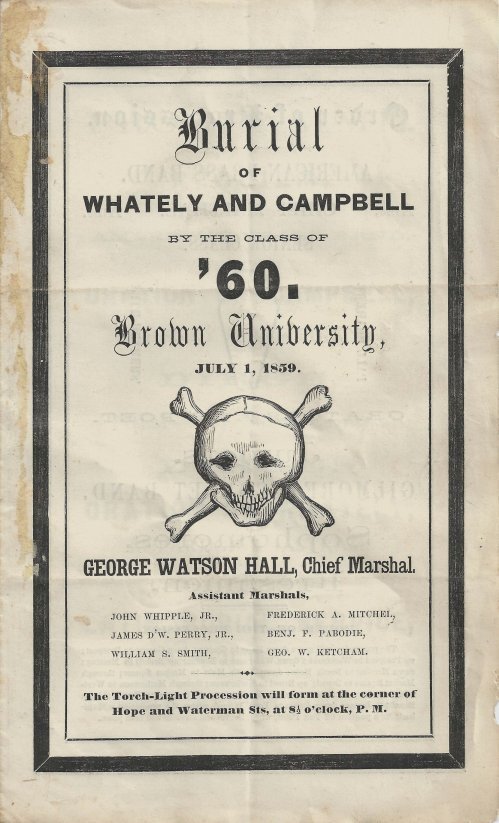
“…[the] earliest known program [for the “Junior Burials”] being for the year 1853. On these occasions there was a procession through the city streets with a brass band, banners and burning torches, as the rhetoric textbooks of Richard Whately, George Campbell, and William Spalding were conveyed in a coffin to Ferry Wharf [Fox Point, Providence, at the confluence of the Seekonk and Providence Rivers]. There the students embarked in boats to an offshore spot where the funeral ceremonies were conducted, complete with orations on the textbook authors, a poem and an ode, and the books were thrown overboard [sealed in a coffin].” (Encyclopedia Brunoniana)
According to Encyclopedia Brunoniana the tradition was taken up again in the 1870s, without the books of Whately but with more ghoulish costumes — and this time a burning of the books rather than a burial-at-sea…
“They were later revived as a “cremation,” and the textbook authors singled out [as] Elias Loomis on analytical geometry and Thomas B. Shaw’s Manual of English. The later processions did not head for the boats, but paraded across Red Bridge (and, once across, opened the draw bridge with the approval of the appropriate authorities) and burned the offending books. The cremation held in 1875 was described in rhyme in a local newspaper under the heading, “Brown Boys ‘On the Rampage’”:
“Thursday, by early candle light,
appeared a strange and grotesque sight,
upon the College Campus green,
a sight as queer as e’er was seen.
It was the Brown boys, out in force,
to celebrate in usual course,
their Class Day eve, with mock display,
and mimic funeral pageantry.
The Juniors, in outlandish guise,
bedecked themselves to strike surprise
to all who saw them thus arrayed,
on their accustomed street parade.
Some wrapped in winding sheets were ‘most
too noisy for a sober ghost,
and some wore horns, in travesty
of his Satanic majesty,
The latter seemed, upon the whole,
familiar with the title role,
and many, as the train went by,
inclined to Darwin’s theory.
From street to street the cavalcade,
with blatant hand, its progress made;
red robes, a skull and cross-bones bare,
looked hideous in the torches’ glare.
Beyond the [River] Seekonk’s further shore,
the strange procession marched, and bore
an English text-book, with Greek fire,
burned on a mock funeral pyre.
This frolic o’er, each Junior sped
at midnight to his little bed,
ending in peace this revel queer,
which comes, thank God, but once a year.”
The tradition had its last year in Providence in 1884, when the books documenting the university marking-system were buried (the Brown lecturers had started to complain that the students were becoming embarrassingly likely to burn textbooks written by Brown staff).
What of Whately? Richard Whately (1787-1863) was not actually a Professor at Brown University, but was rather the British free-market intellectual and nominal churchman who was the author of the hugely influential Elements of Rhetoric (1828) and Elements of Logic (1826), and also the editor of Bacon’s Essays with annotations (1857). Lovecraft’s use of the name Wilbur for Wilbur Whateley is a red herring if one looks for it in the real Richard Whately — since it is an obvious nod to Wilbraham, the topographical inspiration for “The Dunwich Horror”.
Could Lovecraft, so ardent a student of his city’s history and of ghoulish burials, have known of the Whately burial tradition? Possibly, although there is no evidence in the surviving letters that I know of. Nor is it in the city histories. A city prefers to forget many things about itself.
17 Tuesday Sep 2013
Posted in Historical context, New books, New discoveries
New on the Kindle store at Amazon, David Acord’s The Other Mr. Lovecraft: A True Story of Tragedy and the Supernatural From H.P. Lovecraft’s Family Tree
“In this original [10,000 word] non-fiction monograph, author David Acord (When Mars Attacked: Orson Welles, The War of the Worlds and The Radio Broadcast That Changed America Forever) shines a light on a forgotten aspect of Lovecraft’s family tree: the troubled life of his [father’s] cousin Frederick [1850-1893], a once-prosperous businessman in 1890s New York City. When Frederick committed suicide in [6th Oct] 1893, it caused a sensation, with wall-to-wall coverage in all of the major papers, including The New York Times. His death triggered a pitched battle over his estate and revealed a secret romance with one of the most beautiful actresses in America [May Brooklyn], who took her life several months later. After her death, a tragic story of grief, spiritualism and obsession with the supernatural was revealed.”
I haven’t yet seen this new work, but the blurb seems factually correct. Although I suspect any spiritualist aspect of the case may be a new discovery(?). How much H.P. Lovecraft knew of the truth of the case is not known, or even if he knew of it at all. Those were the pre-microfilm and pre-Web days when even yesterday’s newspapers were hard to get hold of, still less the newspapers from twenty years before. But there may well have been family stories around the event.
Frederick Lovecraft was a treasurer of Palmer’s theater in New York, and May Brooklyn was its leading lady. Shortly before his death he had lost around $100,000 in…
“numerous schemes which loaded him down with worthless stocks” … “Day by day he grew worse and was finally seized with nervous prostration. Mr. Lovecraft’s delusion was that all his money was gone and that he was a poor man. Col. Kearney went over his friend’s fund account and found $60,000 of his fortune remained, but it was impossible to get Lovecraft to believe this.” (Evening Star, October 27 1893).
Possibly this $100k was the bulk of money he had in the jewellery trade, as he was also… “a partner in the firm of Williamson & Co., 26 Union Square, and a director in the Essex Watch Co.” (Jewelers’ Circular and Horological Review, 1893). The New York Times stated that “he owned outright” Williamson & Co. which was a “jewelry manufacturing concern”. Perhaps he also felt he had let down, or even ruined, other men involved in one or more of these jewellery businesses? Was his cousin, Winfield — Lovecraft’s father — perhaps even one of those men, since there was a vague memory that he had once worked in jewellery? Winfield had gone mad in April 1893, six months before Frederick Lovecraft’s suicide.
His 1894 probate hearing concurred with the diagnosis of acute depression…
“He seemed to be in a very depressed condition,” said Dr. Robertson. “He took no interest apparently in anything that was transpiring, when spoken to, he answered in monosyllables, He was exceedingly pale, and complained of insomnia and nervousness. He said he was hardly able to attend to his business.” Dr Robertson said that Lovecraft was “suffering from melancholia, following delusions.
“What was the condition of his eyes?” asked a lawyer. “Were they vacant or full of life as in ordinary men?”
“I couldn’t tell. I could hardly induce him to look up. He kept his head bowed down. Everything indicated acute melancholia.”
I wonder if the author of this new monograph has discovered that Frederick Lovecraft’s “warm personal friend” in the theatre, Mr. W.B. Palmer, also committed suicide by the same method as Frederick, two years later in early September 1895?

17 Tuesday Sep 2013
Posted in Historical context, Lovecraftian arts
The Golden Age blog has a new gallery of the pulp art of Howard V. Brown, the artist who gave Lovecraft his Astounding cover and interior illustrations for “The Shadow Out Of Time”…

16 Monday Sep 2013
Posted in Odd scratchings
Michael Johnson muses on the Summer of Lovecraft coverage and its mainstream media idiocies. Joseph Laycock muses on the weird prank which topped off that summer, in “Claiming the Land for Azathoth: Lovecraftian pranks and the post-modern sacred”.

16 Monday Sep 2013
Posted in Lovecraftian arts, Scholarly works
The Library of Congress Collections Conservation Section is preserving 600 pulp magazine covers…

16 Monday Sep 2013
Posted in Lovecraftian arts
Lovecraft scholar and theologian Robert M. Price gets his own documentary film, The Gospel According To Price. On the filming…
“Day one was good, but we were kicked out of our location after the church manager Googled Robert. We were literally about to roll camera when she came running down the aisle with a printout of the Doctor’s Wikipedia page.”
16 Monday Sep 2013
Posted in Historical context
In Lovecraft Remembered Kleiner mentions a New York friend of Lovecraft, Ernest La Touche Hancock (b. Shanghai, 1857 — d. NYC 1926). Lovecraft knew Hancock in New York, and liked him enough to lend him his own books. But then Hancock died suddenly in 1926. The address at which the precious books were kept was not known to the Lovecraft circle, so Kleiner surmises that they were probably never returned to Lovecraft.
Hancock was an accomplished and long-standing commercial light comic versifier, at a time when one could actually make a living in that manner through syndication in newspapers. He once even managed to land a comic poem in the Hog Fancier’s Gazette. He was also sometimes a humorous lyric writer for musical theatre, and an occasional light music critic.
Lovecraft may not have initially known Hancock’s verse from various popular magazines such as Judge’s Library: a monthly magazine of fun, Harper’s, Lippincott’s, and Puck etc. — since Lovecraft didn’t confess to reading such magazines in his youth. But on meeting Hancock he may have recalled the name and poetry from his old copies of Railroad Man’s Magazine (1906-), a Munsey magazine of which he had once been an avid cover-to-cover reader and subscriber. Hancock had also published in Munsey magazines such as The Cavalier, and Argosy All-Story Weekly.
Hancock would have greatly interested Lovecraft because he was uncompromisingly British and Imperialist. He was a member of the St. George Society around 1921. A flavour of their Anglo-American fervour was once given by the New York Times…
ST. GEORGE SOCIETY ANNUAL BANQUET; Three Hundred Guests Gather at Anglo-American Love Feast. Patriotic Songs of Both Nations Sung and Cheers Given for King Edward and President McKinley. (New York Times c.1900)
One wonders if Hancock may have invited Lovecraft along as a guest, circa 1924-5?
Hancock had been born in British Shanghai, China, the son of Herbert Matthews who was an attache to the British Embassy there. Hancock schooled at a public school in England, and was later to be found in British India as the editor of The Rangoon Times 1879-c.1880. Hancock had traveled extensively in Egypt, perhaps shortly after leaving The Rangoon Times, and one wonders if this experience meant that he might have been consulted by Lovecraft on the accuracy of the local colour used in “Under the Pyramids”?
Around that time he wrote a book for boys, A Mesmeric Ordeal (c.1880), now incredibly obscure but seemingly published under the name “E.L.H.” Mermerism means hypnotism, so one wonders if he had once had an interest in the subject?
He then returned to England and lived in Marylebone, central London, during the mid-late Victorian period. There he was editor of The Windsor Gazette 1882—?. So he would have been able to vividly describe to Lovecraft the great London fogs of the 1880s, and probably many details of London high-society and the literary/artistic life of that time.
In 1877 he married a Jersey City socialite’s daughter, Charlotte Youlin, against his family’s wishes. They settled in New York City in 1890 or 1891, thus missing the decadent “Yellow ’90s” period in English literary life. Hancock settled down in NYC as a journalist and newspaper editor, living at West 133th Street, Manhattan. He would have been able to tell Lovecraft many tales of the poets of New York in the 1890s.
Hancock was also something of an early historian of the comic arts around that time, publishing in 1902 a multi-part history “American Caricature and Comic Art”. Those were the days of The Yellow Kid, and Krazy Kat, and the pungent satirical editorial cartoon. Hancock could have no doubt given Lovecraft a decent ten-minute history lesson on the American proto-comics, if he had so wished.
Hancock had moved to the “Bronx Assembly District 34” by 1910, having been divorced with public bitterness in January 1903 (unfaithfulness with unspecified others was given by newspapers as the cause). In the 1909 Who’s Who in New York Hancock was recorded at 134 West, 37th St., New York City, about a mile south of Central Park. He appears to have known Brooklyn well, and perhaps before 1910. He was a key member, from the early years of the twentieth century, of the Brooklyn Press Club and the Blue Pencil Club of New York (not to be confused with the later amateur journalism club of the same name, of Brooklyn). The latter was a well equipped private gentleman’s club just along the street from the Brooklyn Citizen offices. His catch phrase at the Brooklyn Press Club was a roaring call to the Club’s head assistant, George: “More typewriter paper, George!” He later had an office above 5 Willoughby Street, the Brooklyn Press Club premises.
By 1916 he was recorded at 170 Nassau St, NYC, a half-mile NW of the Brooklyn Bridge — although that was also the address of New York Sun, so it was probably simply a convenient mailing address. At around this time his two sons were in the silent movie newsreel business in New York City, being key founders of Fox News (1919–1930).
Hancock was certainly living in the Kings/Flatbush section of Brooklyn when Lovecraft knew him, c.1925-6. At that time he was in his 60s, and was probably semi-retired. But the exact address still remains unknown.
Back in the spring of 1911 he had been made the Editor of the new society weekly The Sandpiper, which covered the summer season on “the Rockaway peninsula” (Rockaway, Queens, a ten mile strip of resort coast more popularly known as The Rockaways). The Sandpiper was published from there, at Arverne. One might suspect that he was chosen as Editor because that was where he chose to holiday in the summer. One of his poems runs…
You will find that it will pay
To invest down Arverne way
A Brooklyn almanac of 1912 confirms an Arverne address for Hancock, though does not specify the street and number. Possibly Lovecraft’s lost books were left in one of the summer cottages there, some time in 1926?
This appears to be the only online image of him…

It appears that only the Harvard University scan of Desultory Verse has this front picture (there are two other scans online, from other libraries), but it is currently locked down by Google Books and is unavailable except as a thumbnail.