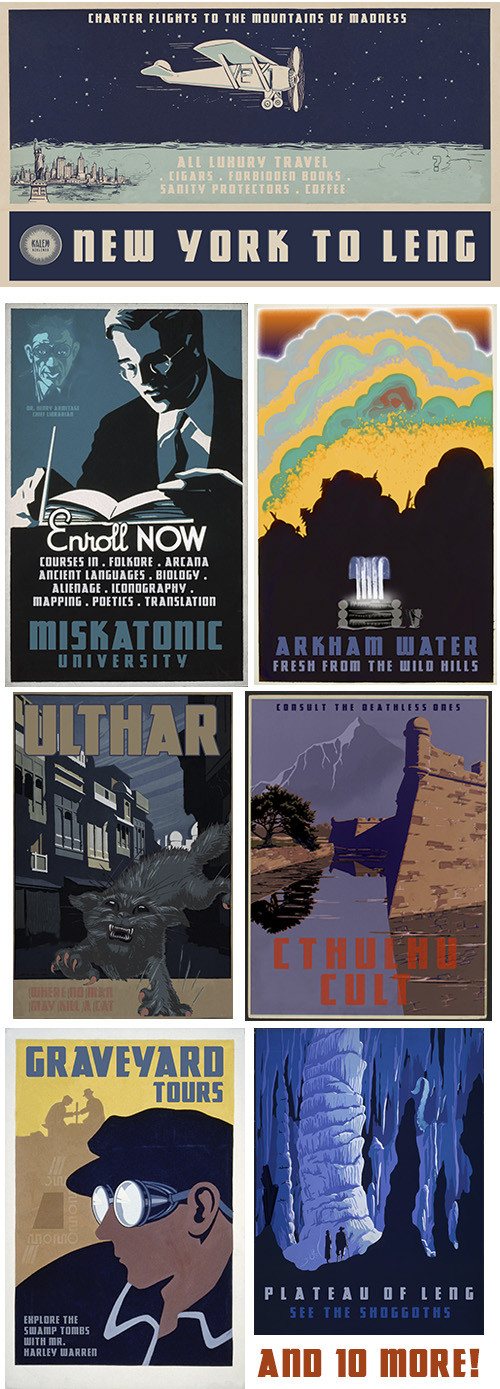
The eldritch peaks

Hathi has announced that bookworm and other free tools can now worm merrily across the full-text from all of Hathi’s 16.7-million items. Previously the tools were restricted only to the public domain holdings, but they now also include the locked-down texts.

One can now easily do cool searches, for instance, to discover that 1808 was the year of “peak eldritch” in literary books. And that the arrival of the mass-market browser-based Internet in late 1995 probably caused the “Lovecraft bounce” which began then.

Lovecraft’s Southern Vacation

I spotted a scholarly ebook that’s new to me, Brian Leno’s Lovecraft’s Southern Vacation (2015). The title essay originally appeared in The Cimmerian, noting some of the concepts and ideas that Robert E. Howard absorbed during his Lovecraft correspondence, and then deftly wove into his fiction. It goes on to suggest that Howard’s “Pigeons from Hell” (written late 1934) was a story intended as a semi-satire and one-upmanship of HPL’s themes…

“Pigeons From Hell” was surely meant to be Howard’s response to HPL’s claims that New England was the setting for horror. By recalling his earlier exchanges with Lovecraft, he set out to prove that an old southern house, peopled with his distinctly southern imagination, can become much more terrifying than Lovecraft’s New England home in “The Picture in the House,” with its not-so-scary occupant’s ramblings about cannibalism.”

I’m fairly sure I read this essay some years ago, when it was free on The Cimmerian. I thought it broadly plausible — but rather doubted the strong suggestions that Lovecraft would have been ‘offended’ by reading the story. Amused and itchily tickled to occasional laughter, more likely.

I’ll pass on the book’s middle essay, on Howard’s comedic westerns. But the third and last essay has some interest, examining the possible sources of Howard’s “The Frost Giant’s Daughter”. My forthcoming book on some of Tolkien’s earliest sources has led me deep into such northern materials.

According to the blurb for Lovecraft’s Southern Vacation there’s also discussion in the book on “Did he [R.E. Howard] or did he not see the 1933 film King Kong before his death in 1936?”, but I can’t see that on the contents page on Amazon ‘Look Inside’. Presumably it emerges as part of one of the essays?

Also of note, in recent Howard ebooks, is Don Herron’s 630-page The Dark Barbarian That Towers Over All. I see that was released on the cusp of 2014/15. This packages the former essay books The Dark Barbarian and The Barbaric Triumph — both on Robert E. Howard of course — as a new $5 ebook. For good measure there are also another half dozen or so new essays. It looks promising.

Was there a Lovecraft?

A curious reader enquires of Amazing Stories, “Was there a Lovecraft?”

His letter was published in the October 1951 issue.

On transcribing the letter for publication, “H. P.” becomes “F. P.”, so we have to assume that the office-boy who typed up the hand-written letter was also unfamiliar with the “H. P. Lovecraft” name. Despite working at a leading science-fiction magazine. And that his error was not caught by the Editor before printing.

Lovecraft’s library and ‘Atlantic culture’

There’s a new “Knowledge in Books” special issue of the Italian journal Nuova informazione bibliografica, and it has an interesting-looking article by a bibliophile on Lovecraft’s personal library in the context of the ‘Atlantic culture’ of the time, presumably meaning the 1890s-1930s cultural interplay between the east coast of America and Britain / Spain and Portugal. However it appears to be in a paywalled journal, and all they have is the front page. So I can’t grab it and do a quick summary translation. Still, it may be of interest to some readers…

New revised edition of the Arthur C. Clarke biography

There’s a new revised edition of the definitive biography, Arthur C. Clarke: Odyssey of a Visionary, which was slipped out at the end of December 2017. Clarke was ‘Lovecraft inspired’ in a number of ways. Though these days the phrase ‘Lovecraft inspired’ is devalued by a tidal wave of cash-in and axe-grinding dross, to the extent that it’s now almost an insult. Which means I’m forced to qualify the phrase by saying that Clarke did it before others, subtly and in the best possible way. For discussion of the Lovecraft influence on Clarke see, for instance, “2001: A Lovecraft Odyssey” in the latest Lovecraft Annual journal (2018), and parts of Robert H. Waugh’s fine chapter on Lovecraft’s influence on science-fiction, in Lovecraft and Influence (2013).

Sadly the release of this new ‘500-page monolith’ edition of the Clarke biography has had the effect of erasing the previous Kindle ebook edition, and the book is now only available in paperback. Hopefully there will be a new Kindle edition in due course.

I recently edited a bumper Clarke tribute edition of Digital Art Live, the magazine for science fiction artists, which brought him back into my range of current interests. The magazine was published a while ago but I still find Clarke a fascinating personality in his own right, not simply because of the mild Lovecraft influence. Nearly everything he wrote before about 1977 is still very readable and enjoyable. His later work does tend to become more ponderous, discursive and technical, and for a first-timer to start on Clarke with the likes of the Rama books would be a mistake. But I recently heard Imperial Earth, The City and the Stars, Dolphin Island and a number of other novels and stories in unabridged audiobook readings, and they’re all still excellent. I had of course read all of Clarke, to about 1984, long ago — but on revisiting I was pleased to find that his stories were still fresh and lively.

For interested readers I should note that Clarke also published autobiographical books: Astounding Days is his fannish autobiography and has much to say on the era of the pulps and their fandom (also available as an audiobook); his Ascent to Orbit is the scientific autobiography, woven among a collection of his engineering and scientific articles; and his The View from Serendip includes a number of autobiographical pieces on his tropical home in Ceylon, scattered among various articles he wrote for magazines and a general audience. There are also several self-penned books specifically on his reef diving, including The Coast of Coral (Australia), The Reefs of Taprobane (Ceylon), and The Treasure of the Great Reef (treasure diving). There are even a couple of biographical books by others which are studies of the making of the famous movie 2001, of which the most recent is Space Odyssey: Stanley Kubrick, Arthur C. Clarke, and the making of a masterpiece (2018). So far as I’m aware there’s not yet an annual Journal of Arthur C. Clarke Studies, but there probably should be in the next few years.

I’m especially fascinated by Clarke’s writing on one his great loves, the ocean. Personally I’d welcome a new book collection, along the lines of ‘the best of Clarke’s writings on oceans and coasts in his non-fiction, autobiography and topographical fictional descriptions’. And ideally as an audiobook read over music and ambient environmental sound FX. And perhaps with a few new biographical essays on things like: his ocean diving and expeditions; his place in the historical context of that time (Jacques Cousteau, the Sea-lab missions, use of the sea by NASA to train astronauts for space weightlessness, etc); and his apparent behind-the-scenes involvement in shaping the early marketing profile for Ceylon’s coastline among western tourists and divers. Such a book might have had a tiny audience a few years ago, but today it might get a little more traction in our newly emerging era of advanced ocean exploration and sustainable coastal aquaculture.

Julian S. Krupa

Cover for Mark Reinsberg’s Ad Astra fanzine, January 1940, by Julian S. Krupa. Newly colourised.

Julian S. Krupa (b. 1913) was an American illustrator from a Polish family. He trained at the Bauhaus in Germany, but left for America with his family. There he produced a science-fiction “serial illustration” titled Adventures of Richard Arnold / Przygody Ryszarda Arnolda which appeared in a Polish newspaper. He worked with the Ziff Davis Publishing Company from 1938, and had a good deal of artwork in Amazing Stories circa 1939. He also contributed to Ad Astra and probably other fanzines. He served in the Marines during the Second World War. In 1946 he was noted in the press as having the “JSK Recording Studio” in his basement at home. His grandson has left a short memoir of him which reveals he was also a talented violinist, performed at a World Fair, and did a radio show from his basement. After the war he worked for a company that made illustrations for training films used by the Navy and NASA. He later moved into doing marketing work for Radio Shack’s audio equipment, before retiring.

Science Fiction Pulp Magazines from the Beginning to 1950

Free on Archive.org, Mike Ashley’s overview book The Time Machines : The Story of the Science Fiction Pulp Magazines from the Beginning to 1950 (2000, University of Liverpool Press). I assume the University of Liverpool Press have unlatched it via the ‘Knowledge Unlatched’ programme. Amazon USA wants amazingly high prices for it in print, though Amazon UK has more reasonable prices.

There’s also a follow-on book for the 1950-1970 period.

Crypt of Cthulhu 111

Crypt of Cthulhu 111 (Michaelmas 2018) is now on pre-order.

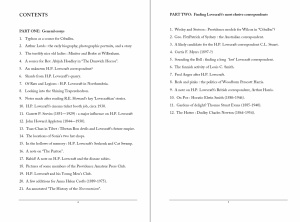
Contents:

Disturbing and Disquieting Editorial Shards by Robert M. Price.

Sadiva’s Lover by Gary Myers.

The Many Worlds of Clark Ashton Smith by Scott Connors.

Asperger Syndrome in R. H. Barlow’s “The Summons” by Charles D. O’Connor III.

Through the Gates of the Prepositional Phrase by Donald R. Burleson.

H. P. Lovecraft and the American Stonehenge: Hokum, Pseudo-archaeology, & the Imagination by Darrell Schweitzer.

The Muddle in High Street by Timothy Burall.

Maal Dweb of Xiccarpth by Will Murray.

R’lyeh Reviews.

Mail Call of Cthulhu.

Poems by Randall D. Larson and Charles Lovecraft.