New books

New books. A new page on hplovecraft.com details Miskatonic Missives, Volume I, numbers 1–3 and exactly what’s in the volumes.

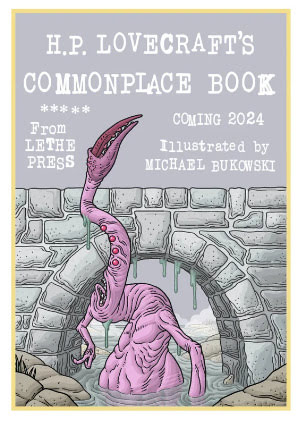
Also, listed a recent on PS Publishing’s site is the new-ish The Weird Tales Boys (September 2023), billed as an…

exploration of the influence of H.P. Lovecraft, Robert E. Howard and Clark Ashton Smith and the iconic pulp magazine Weird Tales

… and apparently with a focus on unravelling the complex interactions of these three greats at the time the tales were being written.

The Shadow out of Surrealism?

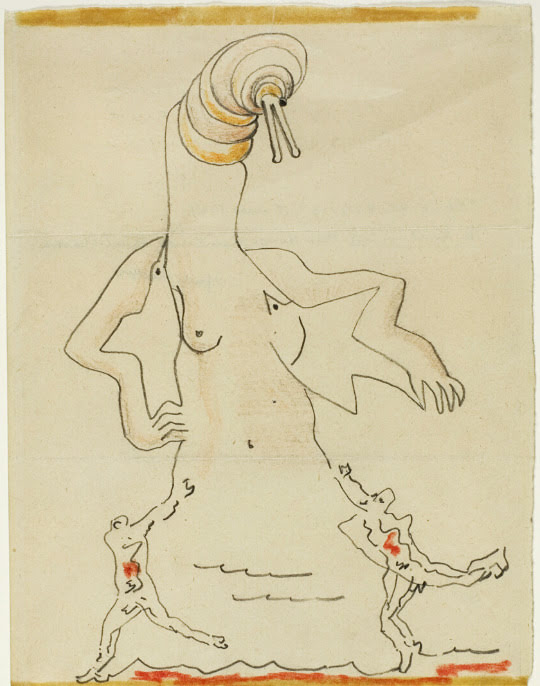
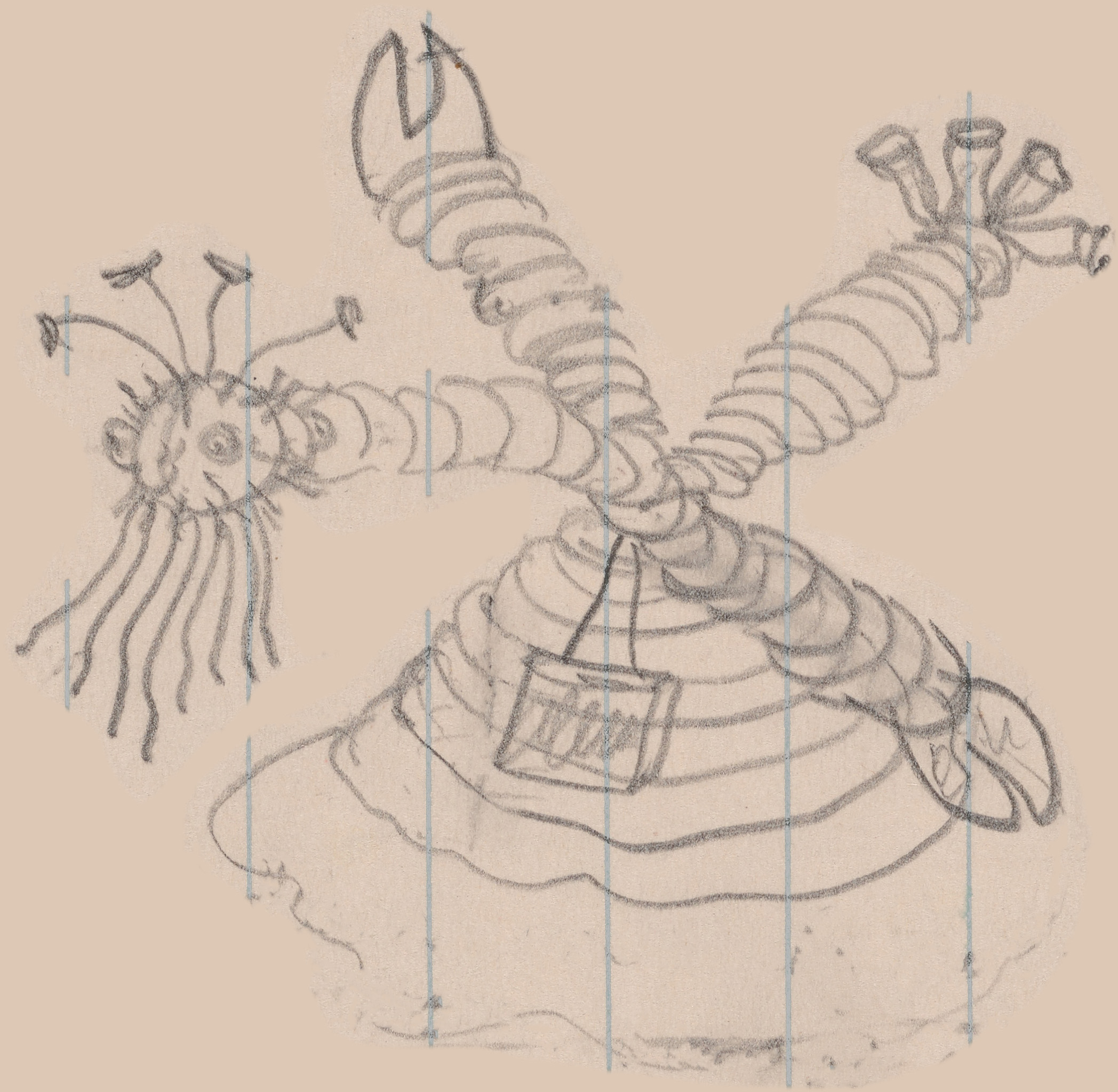
At the end of January 2024 on John Coulthart’s blog, he showed an early surrealist drawing “Exquisite Corpse (1927) by Andre Masson, Max Ernst, Max Morise”. The result of three-person collaborative ‘art game’, derived from a children’s game. He doesn’t mention this, but it struck me how similar this is to how later artists have depicted the basic idea of Lovecraft’s bibliophile ‘Great Race’ in “The Shadow Out Of Time”. Including the scale with humans.

The “Exhibition History” (the University of Chicago currently holds the original) only reveals a 1984 showing, but one wonders if Lovecraft might have seen it before “Shadow” (1934-35).

For comparison, however, here is Lovecraft’s own at-the-time drawing of the Great Race…

Not so similar, though admittedly the viewing angle is different. So perhaps it is some later artists who have chosen to accentuate the apparent borrowing from a surrealist experiment?

AnyTxt for Scholars

The software AnyTxt Searcher has come a long way since I last looked at it in 2020. It is still being actively developed, and the changelog shows it had a lot of attention in 2023. Useful for scholars, it’s genuine Windows freeware to build an index of the text inside likely file types (.PDF, .DOC, etc, including .ePUB) and then it very quickly searches for keywords inside these. The latest Christmas 2023 version can also index the contents of .ZIP files and even .ISO disk images. It can also OCR documents that don’t have copy-able text.

The old screenshots are offputting. Seen above is what mine looks like, with dark mode and an Advanced search run (which allows search “by phrase” and more). The indexing / results / opening speed, and the ranking of results, are all very pleasing.

For coders such as myself, scripts (e.g. .PY Python scripts or .BAT files) can be indexed by adding the file type from a huge list: Options > Index Manager > Index Rules > Add > Select > double-click on .PY, Add.

All that AnyTxt seems to be lacking for scholars of the fantastic is the ability to proximity search. For instance Newport w/20 tower (find instances of the word Newport if it occurs within 20 words of the word tower), which is the syntax the expensive $250 dtSearch Desktop uses in Boolean mode. The $40 Docfetcher Pro also has proximity, though in a clunkier format and Docfetcher Pro lacks a dark mode.

AnyTxt Searcher does has some basic advanced search operators, but not the NEAR that would partially emulate a proximity search.

Update: It can do proximity, though only with a very clunky regex: \b(?:hobbits\W+(?:\w+\W+){1,6}?supper|supper\W+(?:\w+\W+){1,6}?hobbits)\b

Still, in 2024 AnyTxt Searcher is now a nice free solution for Windows, assuming you want an alternative to whatever search the newer versions of Windows offer as standard. Pleasant and very fast to use, and you’d only need to go to the much uglier dtSearch Desktop, or Docfetcher Pro, for an occasionally-needed proximity search.

A good advert for supporting the lone freeware developer who’s trying to do something you want done. He may get there eventually, and in this case it’s taken the developer some five years to get close to perfection. As the veteran freeware sniffers at Major Geeks say of the software, “a really nice piece of programming”.

The Newport Tower

There’s a still-mysterious tower in Lovecraft’s favourite ‘visiting town’ of Newport, Rhode Island.

Lovecraft would have been aware of several theories about the tower: that it was a simple colonial stone windmill modelled on a British example (possibly originally built as an astronomical observatory, interestingly); or was part of a colony of shipwrecked medieval Portuguese sailors; perhaps it was built by Irish or Welsh sailors prior to later colonists; or was actually part of a late Viking colony in what the Vikings called Vinland the Good (an idea first elaborated in Antiquitates Americanae, 1837). The latter was the more romantic notion and caught the public’s imagination, as one can see from this postcard…

‘Built by the Norsemen’

Early Viking visitors to America were not proven by hard evidence in Lovecraft’s time, though many sought hard evidence for them and sometimes fabricated it. Nevertheless the Viking theory was taken seriously into the 1940s, evidenced by the book The Newport Tower: Norse Church or Stone-Built Windmill? (1942). Today there is incontrovertible hard evidence of both Viking logging and a settlement, albeit much further north along the coast than New England. The climate being more favourable back then, at the end of what is generally known as the ‘Medieval Warm Period’.

There might appear to be mention of the Newport tower in a letter by Lovecraft. Since in a stream of consciousness riff for Morton (Selected Letters III) we have…

sheep on the hills behind Newport … the Gothick tower …

However this was not the tower in question. Rather it was the imposing and lovely gothic tower of St. George’s Chapel at Newport, able to be seen from a great distance in and around the town and one of the architectural highlights of the place. Lovecraft wrote about this tower in a poem, see page 307 of The Ancient Track (2nd Ed.) He was thus not talking about the mysterious ‘old’ tower, by then set in a placid park where Lovecraft liked to sit and write letters.

But one can suggest that Newport’s ‘old’ tower, a key antiquarian attraction of a town that Lovecraft visited many times in the mid 1930s, proved to be a stimulus for his imagination. For instance, the story-idea from circa the mid 1930s known as “The Tower”…

S. of Arkham is cylindrical tower of stone with conical roof — perhaps 12 feet across & 20 ft. high. There has been a great arched opening quarter way up, but it is sealed
with masonry. […] Tales of fate of persons climbing into tower before opening was sealed. Indian legends speak of it as existing as long as they could remember — supposed to be older than mankind. Legend that it was built by Old Ones (shapeless & gigantic amphibia) & that it was once under water. Dressed stone masonry shew odd & unknown technique. Geometrical designs on large stone above sealed opening utterly baffling.

This could well have been inspired by his musing on the Newport Tower.

His latter sentence “Geometrical designs on large stone above sealed opening utterly baffling” is interesting, since in 1946 investigators found…

a Swedish-Norwegian runic inscription on the west side of the [Newport] tower, 14 feet above the ground. The inscription included a date: 1010.

Most likely this was a slow-burning hoax by an antiquarian, as is said to be usually assumed. But it’s interesting that a decade before the discovery Lovecraft hints at something similar for his tower. One has a sudden vision of him sneaking up to the tower at dusk, with a step-ladder and a small hammer-and-chisel and a mischievous grin on his face. But probably not, even though he was fond of hoaxes.

His possibly related story-idea from the same period, known as “The Rose Window”, has a similar tower…

Very ancient house on Central Hill, Kingsport, inherited […] In back garden, ruins of a brick tower 12 ft in diameter. Rumours of evil annual use — lights — signalling — answered. Doorway now bricked up. Ivy-clad. Windowless — 30 ft standing — once 50 [ft] with windows and flat railed roof.

I’d suggest that a letter to Jonquil Leiber of November 1936 might help to date “The Rose Window”, as Lovecraft wrote…

I am greatly interested in your reference to your grandfather […] & his menacing cone-topped Devil-Tower — & the strange whistles blown by no human lips & doubtless designed as signals to the Dark Ones of Outer Space. […] I’d surely enjoy hearing of “Old Master Stebbins” daemon-chasing & other-world-communing in the Dark Tower!” (Writers of the Dark)

He later suggests an Ancient Roman stone near St. Michael’s Mount in Cornwall, as a good site for a tale inspired by her grandfather’s recollections…

not very far from your St. Michael’s Mount — at St. Hilary on the mainland — there is a stone with a Roman inscription […] dating from A.D. 307 & bringing the region vividly into the stream of classical history. Truly, a fitting locale for Adrian Stephens & his Devil-Tower! (Writers of the Dark)

As for the ‘old’ Newport Tower, Lovecraft would not have known about later theories suggested after his death: the wild claim that it was built by a massive Chinese fleet sailing around the world; the occultist claim it was built for Doctor Dee on a secret Elizabethan voyage to the New World; that it was a Templar temple; or rather more plausibly that it was built for astronomical observations by a local gentleman.

I’m no expert but so far as I can tell none of the evidence available is conclusive for any of the theories.

Further reading:

One can also find lone towers in Lovecraft’s poetry. See pages 41, 78, 96, 307 of The Ancient Track (2nd edition).

The Price is right

I’ve released a minor updated version of my 2022 ‘Lovecraft birthday present’, a readable edition of the previously uncollected letters of E. Hoffmann Price to H.P. Lovecraft. The 350-page ebook of the scans complements the recently-published edited volume of the letters from Lovecraft to Price. The 2024 update was just to fix a couple of silly-but-annoying typing errors, nothing major. It’s available free on Gumroad, as a PDF.

Download: Get the .PDF free on Gumroad. For the most stable download I’ve put it on Gumroad. If you downloaded it there before, you should have had an email about the free update.

Metropolis LORA

Some recent and new style-guidance plugins (‘LORAs’) for Stable Diffusion AI image generator, of possible interest to Tentaclii readers. Both free…

Metropolis Movie Style. Stylish b&w ‘retro-future’.

Something Strange: dark fairy, warm and weird. Could possibly be pushed in the direction of cute weird Lovecraftiana. Has a Japanese file-name that you probably want to rename into English before you install.

Tanabe’s “Call” dated

There’s a date for Gou Tanabe’s chunky graphic novel adaptation of Lovecraft’s “The Call of Cthulhu” in English. Set for the end of July 2024, in a Dark Horse paperback of 288 pages.

Also of possible interest, Monster Cats at the end of May, an anthology of “comic strips about fantastic felines”. Not to be confused with a Mutant Cats graphic novel due at the end of April. In which a ‘green’ energy project gets botched, which unleashes mutant cats from another dimension. Sounds kitty-tastic!

Tentaclii in January

Well, that’s January done with. How fast it goes each year. But let’s recap what it held here at Tentaclii

I posted a long and fairly comprehensive overview of Lovecraft related activity in 2023 in various fields.

In my regular ‘Picture Postals’ posts I took a look across the city of Providence in 1896; shivered in the New York weather of January 1925; poked into Lovecraft’s letter-box; and even gazed into Lovecraft’s Eyes (purely in the interest of scientific research). I also found what must be the exact location for “Martin’s Beach”, along with a picture postcard.

In scholarship the only big book news this month was the discovery that the substantial book L’Affaire Barlow: H.P. Lovecraft and the Battle for His Literary Legacy had slipped out just before Christmas 2023. Two journals also appeared, the new Dead Reckonings: A Review of Horror and the Weird in the Arts, and The Dark Man: Journal of Robert E. Howard and Pulp Studies (13.2). In individual scholarly articles, I dug up a number of new items in languages other than English.

In comics the publisher Dark Horse announced a ‘Deluxe Edition’ of Gou Tanabe’s adaptation of “At The Mountains Of Madness”. I found a peep inside the new graphic novel Le Dernier Jour d’Howard Philip Lovecraft.

Not much in audio but I was pleased to belatedly spot a multi-voice unabridged The Case of Charles Dexter Ward, available for free.

In events the passes and tickets for NecronomiCon Providence went on sale in mid January 2024. The London Lovecraft Festival (stage theatre) also started booking.

I noted and linked several artbooks, such as Called by Cthulhu: The Eldritch Art of Dave Carson; the forthcoming illustrated Annals of the Jinns (Barlow), some forthcoming Chaosium product (RPG sourcebooks, but they kind of count as artbooks), plus Francois Baranger’s Innsmouth (due 2025). I also noted several small end-of-career art exhibitions which might otherwise have been overlooked.

The craft and technology of AI image making continues to hurtle forward at full speed, and I brought readers some of the best and most interesting LORAs for AI powered image generation. Including a new Solomon Kane character LORA, for R.E. Howard’s Kane. I imagine your AI would also obligingly clothe Lovecraft in the same vintage Puritan togs, if prompted. I also perfected a ‘Moebius emulating’ Stable Diffusion 1.5 workflow, or as close as you can get to ‘perfected’ with the wayward SD. Elsewhere I continued to update my directory of worthy AI LORAs for artists and makers of comics.

My Tolkien Gleanings #8 is underway, a round-up and ‘zine for Tolkien scholars. Expect it in a few weeks.

I’m pleased to report that I’ll soon have a bit more money to buy Lovecraft and Tolkien books, since I have a part-time job at last. I clean and clean toilets early each morning, which is all I could get after a year of no professional interviews, but it’s regular and it pays. Many thanks to all those who have donated or helped via Patreon over the last 18 months. The new job does mean I’ll have less time and energy, and as a result certain time-sinks will have to go. But Tentaclii won’t be one of them. On the plus side, the job means I can restore the flow of ginger beer to the taps of Tentaclii Towers, at last. I’ve even discovered that the little ‘Caribbean food’ nook in my supermarket holds an “extra fiery” version of the regular ginger beer can. This rare type is not on the usual shelf and I didn’t know it even existed.

Lovecraft Lore, dated

The German Lovecraftians have a “new newsletter format” for members under the title Lovecraft Lore… “In which we send daily emails about events in H.P. Lovecraft’s stories.”

That sounds interesting. I guess one could now have an AI extract any ‘date like strings’ from within the Lovecraft fiction corpus, covert them to a consistent date format and then sort them into a per-month year list. And alongside each, the story title and a snippet of the original context. The Python-based open source datefinder looks like it’s half way towards that.

The booklet The Chronology Out of Time (1986) made a first try at a simple megalist of dates in Lovecraft’s fiction. But it is now well out-of-print, and not on Archive.org. Perhaps time for a new AI-assisted expanded edition?

Mansions of Madness

When in Providence Lovecraft greatly enjoyed visiting nearby Newport, although the trip involved a long and sometimes chilly boat trip. One of the attractions of the place was its antiquities and perhaps its many grand mansions. Including a monstrous castle which could have come straight from one of Lovecraft’s tales…

The vast structure was however wryly called a “Cottage” by the inhabitants of this isolated shoreline castle. It was demolished in 1924, but Joshi has Lovecraft visiting Newport as early as 1915. He also went to Newport with Sonia just prior to the New York years, which gave rise to the joint tale “The Horror at Martin’s Beach”. The above mansion was still there at that time. In the tale such structures offer a key setting…

It was in the twilight, when grey sea-birds hovered low near the shore and a rising moon began to make a glittering path across the waters. The scene is important to remember, for every impression counts. On the beach were several strollers and a few late bathers; stragglers from the distant cottage colony that rose modestly on a green hill to the north, or from the adjacent cliff-perched [Wavecrest] Inn whose imposing towers proclaimed its allegiance to wealth and grandeur.

Now, Lovecraft’s “Inn” is hardly rustic, since it is described as having an ornate balcony and a “sumptuous ballroom” inside. It operates as a very upmarket “hotel”. The setting is then similar to that of the mansion on the postcard. More so when one knows that this real-world monstrous “Cottage” castle was apparently adjacent across the water to a far more alluring “cottage colony” of writers, as in the story. The name is also similar, the mansion being dubbed ‘Breakwater’ in reality, and ‘Wavecrest’ in the tale. All this suggests that the postcard shows the setting of a Lovecraft tale, albeit a joint tale.

There are two illustrated books on the topic, free on Archive.org, A Guidebook to Newport Mansions and Newport mansions: the Gilded Age, each giving views inside such structures as survived into the 1980s.

Lovecraft: Knowledge and terror

Italian philosopher and SF story writer Eric Marschall takes a look at Lovecraft: Knowledge and terror in a new ebook. Marschall looks at… “the fear of knowing and the love of knowledge that are both present in Lovecraft’s stories”. Amazon will send you a free 10% sample. In which one finds that the book starts from general philosophical ideas about such matters and then tries to map these onto aspects of Lovecraft’s fiction.

Also new in philosophy, the book Fragmentos filosoficos de horror. 25 essays in Portuguese, and it seems the well-regarded author has an interest in Lovecraft. Though I can find no table-of-contents for the book, which might reveal any specific essays on Lovecraft or his circle.