Thrifty prices

Wormwoodiana has a fine article on charity shops today, and specifically on “Why the net is not a good guide to book prices” for such shops…

Readers who spend any time in charity bookshops will quite often hear the manager or volunteers explain, when a customer queries a price, that they “value” their collectible books “using the Internet.

Wormwoodiana posits one plausible possibility for the ludicrously high prices often seen online. Money laundering…

A book is listed at a ludicrous price: a buyer pays it; shady money is transferred in a seemingly innocuous transaction. Who could possibly suspect second-hand bookselling of involvement with dark money?

Small sub-$150 payments, unlikely to draw notice, and with the excuse that “the robot did it” if the police start sniffing around. Seems plausible to me.

In the U.S. such physical shops are called ‘thrift stores’, or they were the last I heard. Possibly there’s now some trendy new hipster-ised name for them.

In my neck of the woods there are plenty of such charity shops and even a couple of second-hand bookshops (‘used bookstores’) left. But the days of bargains are long gone in either type of shop, as the proprietors think they know the value of everything, and add £3/$5 on top.

The other problem with charity shops is that they are so relentlessly professionalised and commercialised. Big charities now have a small army of professionalised retail managers and regional managers. Pop in to hand over your bag of donated books, and you will be immediately slammed with a robo-request from the poor volunteer staff member to “sign up to a direct debit” etc. They have to ask that of every customer, but it just means that, next time I have a bag of books to donate I’ll be stepping into another charity shop.

The exceptions to rampant commercialisation are the ‘out of town-centre’ shops, often run by a delightfully haphazard cat-lady hoard-minder for a local independent cat-rescue charity. Still the best kind of old-school charity shop. Still the best kind of charity too. If Lovecraft had made his fortune, I suspect he’s have left it all to the local cat charity.

Friday “picture postals” from Lovecraft: Crown Hotel

“She [Sonia] visited Lovecraft in Providence on 4-5 September, staying at the Crown Hotel.” — S.T. Joshi, I Am Providence.

“Having entertained Lovecraft and his aunt for lunch at the Crown Hotel, Sonia suggested inviting several leading amateurs [to town]…” — L. Sprague deCamp, Lovecraft: A Biography.

One wonders if Sonia treated Lovecraft to a ‘Deep One’ ice-cream sundae at the Hotel’s ‘Deep Sea Cocktail Lounge’, in lieu of something alcoholic… though perhaps it wasn’t opened until the 1930s…

Rootwork

Now free on Archive.org, a huge encyclopaedic compendium of folk-beliefs about the ‘active supernatural’, that could still be found being expressed by folks in America during the 1930s. The beliefs are exhaustively categorised by type, in the manner of the theme-sorting ethnographic folklorists and fairy-tale sifters of the period (sadly, sci-fi has never had a similarly completist look-up volume containing an index of all of its themes and concepts).

Many of the book’s ‘folklore collecting points’ overlap with areas encompassed by Lovecraft’s annual summer travels.

My red dots, for clarity. South Carolina is a probable dot as well, but I can’t be sure.

This defunct historical lore is possibly most useful, these days, as a set of Oblique Strategies-like ideas which writers can use to inspire new works. Open at random three times, pick an idea randomly from each of the three pages, then think of a setting that might contain and combine them all in some way. Add characters, and devise the skeleton plot framework.

Chaosium on the Call of Cthulhu videogame

Chaosium surveys the recent reviews of the Call of Cthulhu videogame, which attempts to put on the screen the essence of their famous Call of Cthulhu tabletop RPG. The first surveys picks comments about how the game compares to the tabletop RPG, and the second picks up comments and scores from more reviews of Call of Cthulhu.

Also of note is the four-star review in the respected Empire magazine, which praised the setting and faithfulness to Lovecraft’s vision…

“the game’s spot-on setting. Unfolding in 1924, on the fictional New England island of Darkwater, the game sees Pierce investigating the untimely, mysterious deaths of the Hawkins family. The decaying whaling town – wonderfully brought to dreary life by a host of eccentric inhabitants – and the Hawkins’ secret-filled estate provide the perfect stage for Call of Cthulhu’s disturbing, deliberately-paced plot.” … “Call of Cthulhu’s gameplay offers a surprisingly fresh take on the fright-filled genre.”

Javier Olivares does Lovecraft

The noted Spanish artist Javier Olivares has produced a heavily illustrated Spanish edition of Charles Dexter Ward. It’s just been published by Anaya in 200-pages, and there’s a free sample in PDF.

Alternate covers? Or made less scary in the hope of a few extra sales to school librarians?

He’s also done Poe, Dracula, and The Hound of the Baskervilles, in a similar format.

The Horror of Lovecraft: Deluxe Edition

Possibly of interest, a new book of Lovecraft in Italian, illustrated by leading Italian illustrators. The Horror of Lovecraft: Deluxe Edition (Lulu, 2018). Squinting at it through Google Translate, I can’t quite figure out what it is: a set of illustrated translations of Lovecraft; or an anthology of Lovecraft pastiches / Mythos stories, illustrated. Mention is made of at least one translation, of “The Dunwich Horror”, so perhaps it’s a mix of Lovecraft originals and stories from Italian writers.

This is how you do a stylish cover. There’s also an affordable ebook PDF version, which will likely be a better medium than Lulu’s interior print for viewing the colour illustrations. Lulu is fine for paperback covers, re: colour quality, but my experience with their colour for interior pages and calendars has been less satisfactory.

Also of interest in Italian and with an equally elegant cover, GARDENS OF THE FANTASTIC: The wonders of botany from myth to science in literature, cinema and comics (2017). A brisk survey across history, including Lovecraft, and with about 40 illustrations. It might make someone the basis of an expanded and more heavily-illustrated English translation?

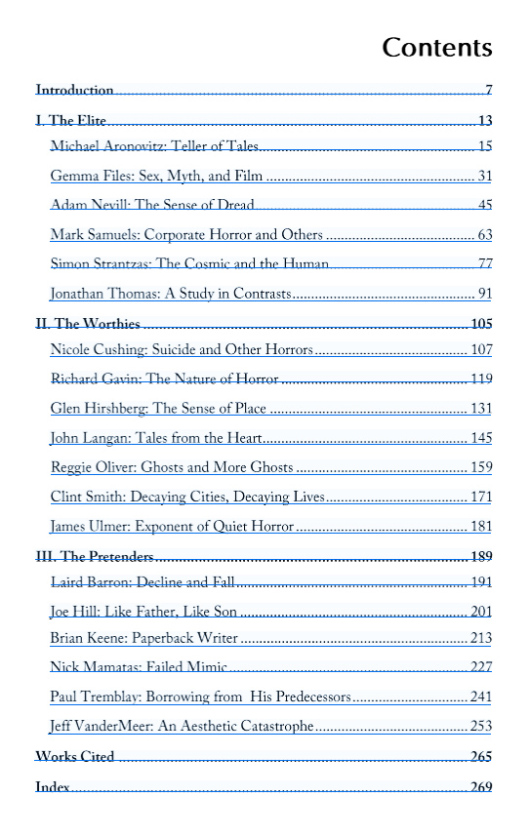
New book – 21st-Century Horror: Weird Fiction at the Turn of the Millennium

S.T. Joshi’s new book 21st-Century Horror: Weird Fiction at the Turn of the Millennium is now available in paper. It’s had to be self-published, in order to beat leftist threats of a ‘boycott’ of any publisher who dared publish the book. The threats simply had the effect of moving the title from a limited-edition PS Publishing niche hardback, to an affordable mass-market paperback on Amazon. No Kindle edition is yet visible to Amazon UK, but I expect there will also be a Kindle ebook edition soon, hopefully with a more appealing front cover. (Update: £3 Kindle edition now available).

The book surveys recent weird fiction with the usual Joshi straightforwardness, familiar to readers of similar books such as The Rise, Fall, and Rise of the Cthulhu Mythos (2015).

And, by silent implication… “The Unmentionables”.