Visit R.I.

Visit Rhode Island has a new page, “Sci-Fi + RI = H.P. Lovecraft” promoting Lovecraft tourism for 2019. Although it repeats the questionable local claim about the… “Providence Athenaeum, where Lovecraft frequented”. The Athenaeum claim appears to be slowly becoming one of those dubious ‘Claims That Will Not Die’ which are often to be found in a city’s marketing to unknowing tourists. He included it on the whirlwind tour of Providence he gave friends, due to the Poe connection, and late in his life he had to consult some scarce books there which gave the history of Nantucket, but so far as I know that was the extent to which he “frequented” it. I know of nothing to suggest he used it as a regular library. Why would he, when the Providence Public Library was free, huge, and one of the best in the USA?

Perhaps the wider tourism industry needs a recognisable brand-mark/stamp for tourism materials: “All Claims Vetted For Authenticity by an Independent Panel of Local Historians”? Although that would be the whole of Stratford-upon-Avon kaput, as only Mary Arden’s House (located a few miles outside Stratford) has any real claim to a provable connection to Shakespeare.

If you’re travelling to Providence and New England in 2019, perhaps for research or for NecronomiCon 2019, here are a couple of handy and authoritative guide-books you might find useful. Which it’s possible you might not be able to pick up locally, not even in the Arts & Sciences Council shop to be seen in the above Visit Rhode Island article.

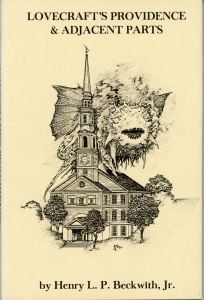
* Henry Beckwith’s Lovecraft’s Providence & Adjacent Parts (second edition, revised and enlarged). Paper only, about $50 used. Unless someone has a garage full of paper copies still to shift, this could probably use a $6 ebook edition in time for NecronomiCon 2019. Anyone care to contact the copyright holder about doing that?

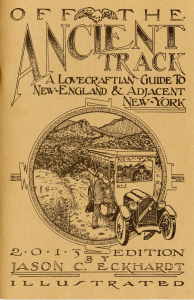
* Off the Ancient Track: A Lovecraftian Guide to New-England & Adjacent New-York (2013, revised and enlarged). Paper only, but a very reasonable $10 from Necronomicon Press.

You may also want my free map of Lovecraft’s Providence.

Ave atque Vale

A full contents listing for the forthcoming Ave atque Vale: Reminiscences of H. P. Lovecraft. Being effectively the equivalent of a new edition of Lovecraft Remembered, with new annotations by S. T. Joshi and David E. Schultz of the texts. A collectable used copy of Remembered will currently set you back £140 for a “Good” hardback copy on Amazon UK. Maybe I should list my hardback copy, only slightly stained by the butter-drips from crumpets…


Update: Thanks to Martin A., who points out that copies of Lovecraft Remembered can still be had direct from Arkham Press at a much more affordable price.

Lovecraft encounters a maker of bas-reliefs in Salem

Readers will of course remember the mysterious bas-relief in “The Call of Cthulhu”. Interestingly, Lovecraft had a memorable encounter with a professional maker of bas-relief tablets in Salem, just a few years before. No dragon-squid-octopus clay tablets were involved, but he met the artist and discovered that they shared a mutual interest in the weird and macabre.

The local artist was Sarah W. Symonds (1870-1965) aka Sarah Symonds. Lovecraft had seen her bas-relief plaque of Marblehead on an earlier visit, but had then been penniless and unable to buy it. In mid-February 1923 he returned to Salem. It was a memorable winter visit to a Salem with snow on the ground and bitter winds blowing o’er the hilltop burying-grounds. On this chilly visit to Salem he did have money to spend, and thus he returned to the “Symonds Shop in Brown-Street” [Bray House, 1 Brown St., abandoned and derelict by the 2000s] in search of her “haunting plaque of Marblehead”. Thus we know he visited her here, and not at her tourist focused harbour gift-shoppe in Turner Street.

The shop in later years.

A younger Symonds in her studio, circa 1904 when she launched her business?

He intended to purchase the Marblehead plaque together with one of… “the Salem Witch House, brooding under its horrible overnourished oak tree” [which] “now adorn my walls, and I gaze with a shudder at that Witch House glowering under its terrible oak-horror stalks there.” Most likely the plaque was this one…

“… and by rare good fortune [I] discover’d the artist herself in charge [of the shop, seen above]. Mistress Symonds is a plain, stoutish, elderly person who brilliantly refutes the fallacy of some little boys I know, that artists must be decadent, bohemian, hecktick, dissipated idiots; for to a genius of the most undoubted sort, she adds the homely and wholesome personality of an old New-England conservative aristocrat. She has dwelt always at Salem in the conventional manner of an old Salem gentlewoman, and lives in a house that knew the tread of an ancestor’s buckled shoes. When I enter’d the shop she knew who I was, for her clerk had describ’d me as one who not only admir’d the bas-reliefs but loved all things old and weird. And thereupon I struck an ideal fountain of antique Salem lore, for Mistress Symonds has hunted up every ghost and ghoul in the town, and is on familiar terms with most of the daemons. In 1692 she wou’d have been hung as a witch, but in 1923 she is safe in expressing an undying devotion to Poe and all that is antient and sinister. From her I learnt of new sources of wild tales […] Thence conversation inclin’d toward weird tales, and I mention’d that I had written some. [Her plaques] now adorn my walls, and I gaze with a shudder at that Witch House glowering under its terrible oak-horror stalks there. And beside it rise the mad maze of gables, vanes, and chimney pots that form hoary Marblehead! Truly, my travels have come home with me, for the scenes live poignantly in those vividly fashion’d bas-reliefs.”

Lovecraft’s description of his (now lost) Marblehead plaque suggests a wide panorama of Marblehead’s roof-scape, but may have been either a close-up or a wider view akin to these…

But the sparse online pictures of Symonds’s work that has come up for sale recently suggests only a few twee doorways and lane scenes for Marblehead. Symonds was a savvy businesswoman and she had a very long career. I’d suspect that her earlier work from the Poe-loving era of 1915-1925 is quite rare in terms of coming up for sale, in comparison to the chintzier 1945-65 work she appears to have made for her hotel-lobby booth in Salem and the ‘hotel trade’.

Lovecraft also purchased two small circular ‘witch plaques’ as presents for his aunts. One of the larger oblong witch plaques by Symonds shows the same figure as was on the small medallions the aunts acquired.


Lovecraft’s vivid letters clearly show that his Salem experience became part of the basis for his story “The Festival”. They are also interesting for their winter timing. This shows Lovecraft could set off on his travels in a bitter mid-winter, and trek about in such weather, if he really wanted to and if he felt well enough. But there may have been another reason. My guess is that Salem in the summer was insufferably rammed with tourists, and thus midwinter was the optimal time for an antiquarian gentleman to visit.

[In Salem] “I several times paused to stroke cats, which abound in all parts of the town; whether or not left there by witches, none may say. At last I reached bleak Boston-Street on the western rim of the town, and walkt north toward Gallows-Hill. Here the houses were greyer and more uncommunicative, and the cold wind made sounds I had not before notic’d. A very old man told me where to find the approach to Gallows-Hill, and hobbled beside me a while as if knowing that I was, like himself, in some way strangely linkt to the spectral past. When the ascent became steep he left me, but not without hinting that Gallows-Hill is not a nice place to visit at night.

On and on I climb’d, crunching under my heavy over-shoes the crushed, malignant snow. The wind blew and the trees tossed leaf-less branches; and the old houses became thinner and thinner. […] overhanging gables and latticed windows which told me that they had been standing there when the terrible carts rattled with their doomed load from the gaol in Federal Street. Up…. up… up…, Damn that wind — why can’t it sound less articulate?

At last I was on the summit, where in the bed rock still lurk the iron clamps that held the witch gallows. It was getting on in the afternoon, and the light was reddish that glow’d over all the outspread town. It was a weird town in that light, as seen from that hill where strange winds moaned over the untenanted wastes on the westward. And I was alone on that hill in that sepulchral place, where the allies of the devil had swung… and swing… and hurled out curses on their executioners and their descendants. […]

Silently I descended past the leering houses with their centuried small-paned bleary windows, and as I did so my fancy brought vividly to my eyes a terrible procession going both up and down that hill beside me — a terrible procession of black-cowled things bearing bodies swathed in burlap. And so ample were the cowls, that I could not see the face of any of the things…. or whether they had any faces.”

Trends in imaginative genre fiction

From the ebook coal-face, “Through a Glass Darkly: The Trends of 2018 and 2019” among commercial fantasy and science-fiction writers. Trends that interest me…

* “publishing a million words and more a year … is becoming standard practice [for fiction] … some will publish a fantasy pentalogy on a weekly basis.”

So… presumably they’ve got some kind of flash-card system that runs off a coded script that semi-randomises a canned-plot formula, and then the author does an improvised speech-to-text riff to each flash card?

* indie “audiobooks are now the fastest growing segment of the book market” and moving toward “full cast recording”, music etc.

Great! The gold-standard for that is free, Phil Dragash’s magnificent full-cast unabridged reading of LOTR, with FX and the movie music expertly woven in.

* illustrated episodic “Web novels”.

Cool, I’ve not seen any… but apparently they’re huge in China and I’ll keep a look out for English ones. Although anything episodic (other than podcasts) is a huge turn off these days. Give me a complete finished story.

* apparently there’s a growing “American market for giant robot battlefields and taut political manoeuvrings”.

Good old fashioned knights-in-armour, as mecha-tech, by the sound of it. Not my thing, and del Toro got to the ‘giant mechas vs. Lovecraftian-looking monsters’ thing several years ago, and possibly there’s something similar going on in current Mythos fiction that I don’t know about. But… interesting for being yet another way to twist the stock medieval warfare adventure into a future-tech setting. Presumably there must be public domain novels from the 1920s, where the plots and descriptions can be re-purposed to become that type of science-fiction?

New for my patrons

Now available to my Patreon patrons, a picture of Marblehead at sunset, in my cleaned and adjusted b&w version. It should be printable at large size, such as a 12-inch wide print. The technical details are: 3,700 pixels at 300dpi, as a .JPG, saved at 100% with no compression.

Lovecraft was of course greatly enamoured of Marblehead at sunset, and while there are some postcards this is perhaps the best artistic picture of such and dates from Lovecraft’s time. The seagulls even resemble night-gaunts! Patrons also get the colour original public domain version (partially cleaned by me), which they can tweak and sharpen to their own tastes. Artists may even want to have a go at replacing the sail boat with a newly-risen Tentacled One. There’s a white dot in the sky on the left which I’ve left uncleaned, as I think it’s a star emerging from the sky.

New book: L’antre de l’horreur

I see that Richard Corben’s recent Poe and Lovecraft horror adaptations are set to be collected in French translation as L’antre de l’horreur, with a “large format” print book due for publication by Panini on 9th January 2019. According to one blurb this edition…

Contains the U.S. comics Haunt of Horror: Edgar Allan Poe #1-3 and Haunt of Horror: Lovecraft #1-3, previously published in a Marvel collection [Haunt of Horror, 2008] and three unreleased comics.

An Amazon review usefully explains that his Lovecraft strips were only very loose and basic adaptations…

Contains a [comics] story loosely ‘inspired by’ Poe or Lovecraft in the comic medium followed by the original text [of Poe or Lovecraft].

Useful to know, as it’s the Lovecraft art that many will probably be buying this for rather than for the potted stories, which they’ll already know well. In that case you might be looking at the 112 pages stated for the 2008 book by Amazon, and expecting to get 112 pages of Corben art. But it sounds like you might get a lot less art.

I see that Amazon currently has Marvel’s collected Lovecraft English-language volume of 2008 as a $10 used print hardcover, or individually as $2 Kindle ebook downloads: #1, #2 and #3.

Friday ‘Picture Postals’ from Lovecraft: Departures and Arrivals

The interior concourse or ‘Promenade’ of the main train station in Providence.

This opened when Lovecraft was about age 8, in 1898. Then the station was expanded for platform-length in 1910. Since Lovecraft preferred to travel to places such as Boston and New York by rail, rather than the ocean-going steam ships, the station concourse and platforms were a familiar place to him. He would also have met friends there, when they arrived.

So far as I know he never took a steam-ship to New York from Providence, at least not as an adult. But he did go down to the ocean-going ship jetties at Fox Point (at the foot of the East Side) to ‘see off’ visiting friends such as Morton who were going home to New York by ship. Presumably he also went there to meet occasional arrivals from New York and other points, such as when Samuel Loveman travelled to Providence by sea in the mid 1930s. There was apparently also a service from Fox Point to Great Britain, so the Anglophile Lovecraft may have wistfully perused the timetables board for British departures while there…

He was not averse to smaller-scale sea-travel when the rates were low…

I myself have taken advantage of phenomenally cheap boat rates (50¢ round trip) & have visited ancient Newport repeatedly this summer…

This was presumably the Providence to Newport boat trip which Long mentions in his memoir of Lovecraft. It was taken, at least once, along with Long and Morton.

Since he was not averse to sea travel, I assume that it was the cost of a regular passenger fare ticket from Providence to New York which deterred him. This is rather suggested by a letter of 1922 in which he whimsically considers stowing away on the New York boat, presumably due to being unable to afford the fare, in order to be with Samuel Loveman…

… a possible Lovemanic [Loveman] move to N.Y. [New York] … then Grandpa’d get there if he had to be a stowaway on the New-York Boat!

Here we see the circa 1919 prices…


Update: Fox Point is not to be confused with the central dockside in Providence, from which smaller ships departed. Here is the north end of the city’s central docks circa the end of the 1900s.

Clifford Ball

Having yesterday found “The Dealings of Daniel Kesserich” as an early example of an early strongly Lovecraft-influenced tale of substantial length, today I also found something similar for R.E. Howard.

The first writer to closely follow Robert E. Howard into sword and sorcery was apparently one Clifford Ball. Having been an avid young reader of Weird Tales magazine since 1925 he produced six stories for Weird Tales from 1937-1941. Wikipedia has it that…

The setting of the first three is vaguely like Howard’s Hyborian Age of warring kingdoms, and features the barbarian adventurers Duar, an amnesiac king protected by a guardian sprite, and Rald the thief and mercenary.

Interesting, but is he worth a look today? Well, he was good enough to be published in Weird Tales in the 1930s… and I see from Archive.org search snippets that the sentiment from readers of Weird Tales was that he was a “neat craftsman” for “Duar” and that “Thief” was “the best story” of the issue.

All three Howard-alike stories are available to read as scans on Archive.org. In order of publication:

“Duar the Accursed”.

“The Thief of Forthe”.

“The Goddess Awakes”.

I can’t immediately find anyone stating that he added much to the roots of sword and sorcery other than the hero’s “guardian sprite”, and his other later stories are said to be fairly conventional fantasies. But he obviously did his bit to help preserve for a few more years the sword and sorcery approach Howard had developed with Conan, and showed other writers that there was demand and payment for it. He dropped from sight circa 1938.

‘We’re gonna need a bigger letter-box!’

S.T. Joshi has a new blog post that announces he has finished work on…

“His Own Most Fantastic Creation, an original anthology of stories using Lovecraft (or a Lovecraft-like figure) as a fictional character.”

And the post has the contents list for this. It’s PS Publishing, so I expect it will probably be an expensive paper edition to start with. It’s set for “later this year” according to Joshi.

Hippocampus books of Lovecraft letters, said to be expected for early in 2019, are also noted by Joshi…

“the compilation of the letters between Smith and August Derleth; Lovecraft’s Letters to Family and Family Friends (a 1200-page book!); Letters to Wilfred B. Talman and Helen V. Sully; Letters to Donald Wandrei and Others”