It spooled from the 80s…
17 Thursday Jan 2019
Posted in Lovecraftian arts
17 Thursday Jan 2019
Posted in Lovecraftian arts
16 Wednesday Jan 2019
Posted in New books, Scholarly works
The new issue of the open access journal Brumal has appeared. Vol 6, No 2 (2018) is ‘Horror and the Fantastic’. English abstracts, then Spanish, Portugese or French texts. On a first pass, the specifically Lovecraft items are:
* “Towards a classification of space in fantastic horror texts”. In which… “we outline three sorts of spatial categories: the natural, the supernatural, and the preternatural spaces, and take incomparable English-speaking authors as a starting point, such as H. P. Lovecraft” before moving on to consider Spanish writers.
* And a review in Portuguese of the book O Fantastico: Procedimentos de Construcao Narrativa em H.P. Lovecraft (2017). [trans: The Fantastic: H.P. Lovecraft’s Procedures of Narrative Construction]
The book can be obtained from Brazil and I see it was also reviewed recently in Revista Abusoes. It appears to be a two-volume Masters dissertation from 1979, which gathered dust for nearly 40 years before being rediscovered, hailed as something special, and published.
15 Tuesday Jan 2019
Posted in Films & trailers, Lovecraftian arts
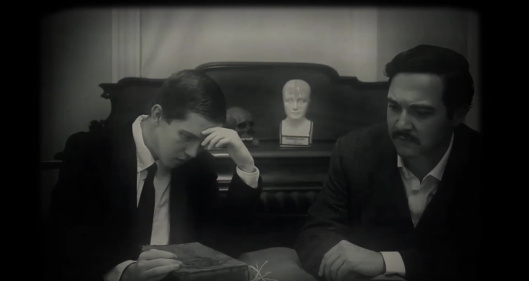
The short film “Miskatonic 1927” in full, a selection for the H.P. Lovecraft Film Festival 2018. “H.P. Lovecraft & Clark Ashton Smith begin an English translation of the dreaded tome The Necronomicon.”
14 Monday Jan 2019
Posted in New books
Marvel comics veteran Roy Thomas has an auto-biography of his life in Conan comics, and his wider fascination with the Conan character. DMR Books has a good review of the 296-page Volume One, which quietly scaled the walls of the Elephant God of Amazon just before Christmas…
Barbarian Life: A Literary Biography of Conan the Barbarian (Volume One), by Roy Thomas. In this book, Roy shares not only his memories of writing the first 53 issues of the comic book (Volume Two will cover the rest of his more than 100 issue run), but his own obsession with Conan and his creator.
I expect this book might be usefully paired with Barry Windsor-Smith’s The Freebooters, for an insight into the role of the artist in sword-and-sorcery comic-book making. Despite the publisher pitching this as simply a trade paperback collecting the Freebooter stories from the BWS: Storyteller magazine, it’s far more.
The IGN review explains…
This collection is unlike anything I have ever read. Part comic, part behind-the-scenes article, Barry Windsor-Smith’s The Freebooters is definitely unique. […] Most trades* these days give a slight glimpse into the creative process, but not like this. Readers will see unfinished pages, progressive pieces showing rough sketches to final, colored pieces. We also get a narrative that guides us through the thoughts and decisions that BWS made.
* = a trade paperback book collecting a series of comic books or strips, usually formerly issued in episodic pamphlet comic form to comics shops and collectors. Also abbreviated to ‘tpb’.
14 Monday Jan 2019
Posted in Historical context, REH, Scholarly works
“Conan and the Little People: Robert E. Howard and Lovecraft’s Theory”, another fascinating new ‘correlate all the contents’ essay by Bobby Derie.
14 Monday Jan 2019
Posted in Scholarly works, Unnamable
A new paper “The sounds of plants”. The researchers…
demonstrate, to our knowledge for the first time, that plants emit sounds that can be recorded from a distance. We recorded ~65 dBSPL ultrasonic sounds …
Since certain fungi also attract night-insects, it would be interesting to know if some of those also produce sound.
H.P. Lovecraft on the sounds emitted by the Mi-Go fungus race in the woods of Vermont, in “The Whisperer in Darkness” (1931)…
It is more than two years now since I last ran off that blasphemous waxen cylinder [sound recording]; but at this moment, and at all other moments, I can still hear that feeble, fiendish buzzing as it reached me for the first time.
13 Sunday Jan 2019
Posted in New books, REH, Scholarly works
Forthcoming books from McFarland, picked from their new Spring 2019 catalogue:
* Journeys to the Underworld and Heavenly Realm in Ancient and Medieval Literature. (Seems relevant to an understanding of the wider context of The Dream-Quest of Unknown Kadath and others) (Already published)
* The Detective and the Artist: Painters, Poets and Writers in Crime Fiction, 1840s-1970s. (First sections likely to be relevant to an understanding of the context of “The Call of Cthulhu” and others) (February)
* The Horror Comic Never Dies: a Grisly History. A short history of 150 pages, seemingly fannish but deeply informed. (February)
12 Saturday Jan 2019
Posted in Historical context, Lovecraftian arts, New discoveries
From William Gerold’s b&w photobook College Hill; a photographic study of Brown University in its two hundredth year (1965). Gerold seems unaware of Lovecraft — and anyway couldn’t have photographed 66 College St. circa 1960-65, H.P. Lovecraft’s old house, as it had been moved from the site in 1959. Though he photographed some of the architectural details and sculpted animals and suchlike, and along the way managed to record this Cthulhu-idol like detail from the John Carter Brown Library (1904) at Brown University.
“My aunt is well acquainted with Mr. Champlin Burrage, an Oxford man, who is librarian of the John Carter Brown library at Brown. (I hope to meet him very soon.)” — letter from Lovecraft to Rheinhart Kleiner, April 1917.
Circa 1910 postcards of the Library frontage…
“Exhibitions to which the public are welcome are held throughout the year [at the JCB Library]” (1916).
And how it looked by the 1940s, becoming grow-over…
Update: Another photo has surfaced. This ironwork Cthulhu was not inside but outside the Library.
11 Friday Jan 2019
Posted in Historical context, Picture postals
The exterior of the Rhode Island School of Design, Providence, in 1908. Opened on the site in 1893, and known as the Waterman Building, at 11 Waterman St.
When Lovecraft was a young boy, at his own fervent request his parents…
took him in 1897 to see a recently opened exhibit of Greek antiquities at the Rhode Island School of Design
The “entire first floor” was initially dedicated to the public exhibitions, in addition to the adjacent colonial-life Museum house (‘entrance through Waterman St.’) seen on the above map. But in 1897 the construction of the Metcalf exhibition galleries behind the Waterman building was completed. When these new galleries opened, the inaugural show is reported to have been an extravaganza of American and European paintings. But there was also a dedicated Greek and Roman Sculpture gallery with originals, casts and photographs. The opening of the latter gallery was accompanied by… “a course of seven lectures on the History of Greek Art before the students of the Rhode Island School of Design in the Winter of 1897-98” given by the President of Brown University. This Sculpture gallery was presumably what Lovecraft ‘the little Ancient’ saw when it first opened. Possibly it was the same as the sculpture court, seen here, that flanked the entrance to the School’s galleries…
The boy Lovecraft became a “constant” visitor in “1897-8-9″…
before long I was fairly familiar with the principal Grecian myths and had become a constant visitor at the classical art museums of Providence and Boston
Evidently the entrance hall was only a taster and there was far more statuary downstairs. This…
was an enchanted world” for him, with its “basement” museum of Greek and Roman reproduction sculpture.
Of course in Lovecraft’s famous story “The Call of Cthulhu” young Wilcox is… “studying sculpture at the Rhode Island School of Design”.
A later additional Eliza G. Radeke Building was opened for RISD exhibitions at 224 Benefit Street, dropping down the hill at the back. Lovecraft attended its grand opening in late April 1926. That was about four months before he wrote “The Call of Cthulhu”. The new building included a collection of Greek and Roman art, and a large new collection of Greek coins, although I’m uncertain if this was a relocation and augmentation of the original Waterman St. Sculpture Gallery, or if it had contents that would have been wholly new to both Providence and Lovecraft. One imagines the curious Lovecraft peering into the probably-new coin cases, and spotting remarkably tentacular designs on the ancient coins…
11 Friday Jan 2019
Posted in Historical context, Lovecraftian arts, New books, Scholarly works
I see that Sargasso #2 and Sargasso #3 have appeared since I noted #1 in summer 2013. Sargasso: journal of William Hope Hodgson Studies, is the quality scholarly journal devoted to Hodgson.
A scholarly article in #2 may be of tangential interest to Lovecraft scholars. A full review of #2 usefully summarises…
Scott Conner’s ‘Dust and Atoms: The Influence of William Hope Hodgson on Clark Ashton Smith’. The long-held belief that ‘The Night Land’ [1912] was a major influence on Smith’s Zothique stories is more or less conclusively disproved by the evidence that he hadn’t read any Hodgson books until two years after the first Zothique tale [1932] was published. On the other hand, Scott Conner provides very convincing evidence that ‘The House on the Borderland’ [1908] was definitely a great influence on the writing of Smith’s story, ‘The Treader in the Dust’ [1935].
Lovecraft himself only made… “the discovery, in the summer of 1934, of the forgotten work of William Hope Hodgson.” (I Am Providence, S.T. Joshi) and felt the work was rather conventional in terms of the philosophy it worked in. Lovecraft considered that…
He is trying to illustrate human nature through symbols & turns of idea which possess significance for those taking a traditional or orthodox view of man’s cosmic bearings. There is no true attempt to express the indefinable feelings experienced by man in confronting the unknown. … To get a full-sized kick from this stuff one must take seriously the orthodox view of cosmic organisation — which is rather impossible today.
10 Thursday Jan 2019
Posted in Odd scratchings
Ah, wonderful, I see I had another $20 donation to Tentaclii which came in two days ago. Again, many thanks… you know who you are.
10 Thursday Jan 2019
Posted in Odd scratchings
Scenes from Lovecraft’s New York City in the 1930s by Wortman — a news-stand, a cheap cafe, and a burgled studio. Wortman was a syndicated single-panel cartoonist with whose work Lovecraft was familiar by the early 1930s.
The Walforf being an exclusive upmarket hotel.
In one such Wortman cartoon, Lovecraft wrote in early 1933…
… our old friend George Willard Kirk & his Chelsea Book Shop are very plainly delineated. G K is shewn leaning against the wall in a very characteristick posture, & even his face is distinctly suggested despite certain departures from line-for-line realism.
A 280-page book on Wortman appeared in 2010, Denys Wortman’s New York: Portrait of the City in the 30s and 40s, during the writing of which the author found 5,000 drawings that were in a hazardous state of preservation. There was also an exhibition, “Denys Wortman Rediscovered: Drawings for the World-Telegram and Sun, 1930-1953″.
I can’t immediately find out where the Wortman archives are held now, though The Center for Cartoon Studies will know. Somewhere in among the 5,000 drawings, from circa 1930 – early 1933 is likely to be the good pencil portrait of Kalem member Kirk as mentioned by Lovecraft in his letter. Possibly someone with access to a U.S. newspapers archive for that period might pick up a good scan of the syndicated printed version. The title was the New York World from 1930 to 1931, then became the New York World-Telegram thereafter, but ‘syndicated’ means that other newspapers also reprinted the same cartoons.