The Grill collection and the location of the Binkin bookshop

Douglas A. Anderson’s A Shiver in the Archives has a good new article on The H.P. Lovecraft Collection of Jack Grill and (later) Irving Binkin.

According to Wetzel, Grill “collected HPL photos, letters written to and by HPL; he interviewed HPL acquaintances, visited many of the Middle Atlantic and New England towns to which HPL had made antiquarian tours, and accumulated many other odds and ends of Lovecraftiana.” An odd, shy man, Grill wished he was “a writing fellow,” but his only writings were letters — in an execrable hand-writing, without paragraphs and mostly without dates.

The collections was purchased by Binkin in New York…

Having seen the photographs [of Lovecraft in the collection], Binkin realized that Lovecraft had been a regular customer at his bookstore, just off Red Hook in Brooklyn, over forty years earlier.

Wetzel, in his memoir of Grill, quotes a letter from Grill (circa June 1957) stating he’d acquired unpublished stories by Hazel Heald, “The Basement Room” (5 pages) and “Lair of the Fungus Death” (25 pages), from Heald herself.

Given the clunky titles, I’d expect that the Heald stories were not ones revised by Lovecraft.

But the Binkin bookshop is an interesting new point of street-level data about Lovecraft’s time in New York City in the 1920s. One wonders if an address can be pinned on it and a photo found?

54 Willoughby Street (1961 —)

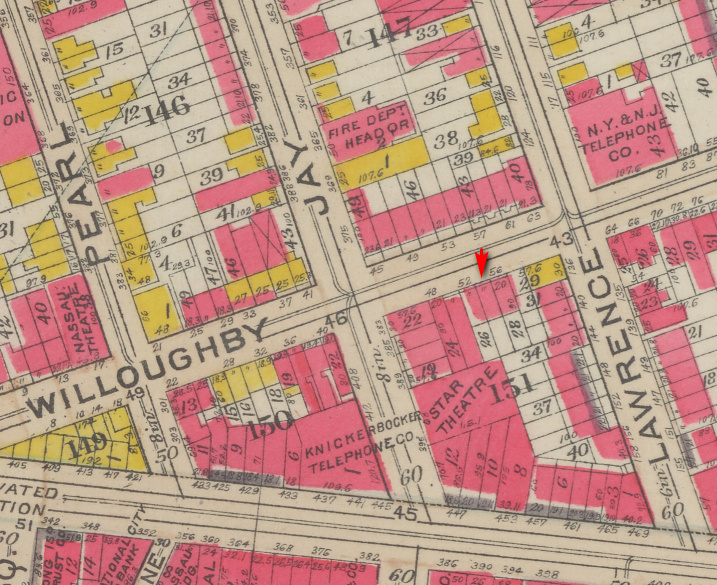
A Directory of the early 1980s lists “Binkin’s Book Center, 54 Willoughby Street, Brooklyn”. The address is off Fulton St. and certainly fits the description of “just off Red Hook in Brooklyn”. A Bargain Hunter Guide of 1990 noted that “Binkin’s is the oldest bookstore [in the city]”. There is however a problem in assuming that this was always his location. For the Antiquarian Bookman for 1961 has…

“IRVING BINKIN. NEW LOCATION — ENTIRE BUILDING – FIVE FLOORS OF BOOKS. BINKIN’S. BOOK. CENTER. 54 Willoughby St., Brooklyn”

Thus it appears he only moved there circa 1961. Where Wally Dobelis remembered him in the 1960s…

Irving Binkin, in the back of Brooklyn Heights and the courthouse, on Willoughby Street, had a four-story building, the ground floor of which was devoted to making a living. Irving’s heart was really in ballroom dancing, of which he was a champion. He liked to go to Hispanic dances, and had a small Spanish book stock for his dance partners. Upstairs, he held residues of good Brooklyn estates, unpriced and unevaluated, books, paintings and ephemera. After much negotiating, Irving had decided that we were trustworthy and would not stuff our pockets, and could be permitted to make selections and bring them down for pricing. Irving was not knowledgeable, but prided himself on being able to divine, from our body language, things about the value of our selections. It did work out, since he asked for our scholarship, and we were not out to steal high value items for pennies. It was fun. I found some Elihu Vedder lithographs…

Hunting this erroneous location, however, did lead me to two evocative photos from the fringes of Red Hook…
This eBay picture is from 1927, looking east along Willoughby with No. 54 ahead in the near middle-distance on the right of the street…

The sign on the far right states “Baked Beans”, a Lovecraft staple. He refers in his letters to “Red Hook’s modestly priced bean-bureaus”. A 1928 photo of Jay and Willoughby shows the same distinctive building on the corner, and the cafe and its distinctive corner-sign on the other corner…

We know that Lovecraft frequented a cafe on this street…

John’s — the Italian joint around the corner in Willoughby St.

We can also see that this picture is looking down Jay St toward the Star Theatre as seen on the map, and the theatre is advertising Burlesque girlie shows with its signage. This picture and its identification as ‘Jay’ clearly confirms the location of the other 1927 photo and that it just-about shows No. 54 in the middle distance on the right.


162 Pierrepont Street (later 1950s-1961)

However, we must step back further in time to Binkin’s earlier book store. This was on Pierrepont Street, the address given by Book Dealers in North America, 1956. Photographs of this store dated 1958 are on the Brooklyn Historical Society website. Obviously he was getting ready for his move to Willoughby Street, appearing to be a ’25-cents a book’ guy and thus generating a big low-cost stock that he could sell for higher prices at Willoughby Street in a few years’ time…

But again it’s hazardous to assume that this was the same as the store he had since the early 1930s.

We do however know that Lovecraft’s best friend Samuel Loveman knew Binkin. Also in the book trade, Loveman evidently once had a copy of Clark Ashton Smith’s poems Ebony and Crystal (1922). This is currently for sale by L.W. Currey and “a presentation inscription by Samuel Loveman, the book’s dedicatee, to bookseller Irving Binkin is present on the title page.” However, what date this book might have been gifted has to be uncertain. Perhaps the 1930s, when Binkin first set up in the book trade? Or perhaps a friendly gift in the 1970s, on rescuing the Grill collection? We shall probably never know.


252 Fulton Street.

A kind credit in Richard Morris’s scholarly book Reading Finnegans Wake (1959), and a book trade directory entry, shows that he was at 252 Fulton Street before Pierrepont Street…

The Bookshop of Isei Binkin
252 Fulton Street.

Fulton Street is of course a name well known to those who have read up on Lovecraft in New York in the 1920s, and especially his epic pursuit of a new suit at a cheap price. The dedication usefully give us Binkin’s Jewish name, which may help someone to track down where exactly he was selling books in Brooklyn, and thus where he might have been patronised by Lovecraft.

One ad Binkin placed stated that his business was “Established 1932”. So even if the 252 Fulton Street address in Brooklyn is his first such store, that would mean that Lovecraft would not have been a frequent customer there in the 1920s when he was living in New York.

And even here we can’t quite even be sure that this was where Binkin was trading from 1932 to perhaps the mid 1950s when Morris knew him. Until circa 1913 the address appears to have been a cheap and rather notorious flop-house hotel for sailors. Then after the War it appears to have been renovated into apartments and boutique shops. For instance, the American Florist for 1922 has… “S. Mastir, 256 Fulton Street, Brooklyn. We found in addition to his fine stock of cut flowers, an excellent collection of palms and other foliage plants.”

Thus a book store there from 1932 onward seems not unlikely. We know from Frank Belknap Long that the antiquarian shops along Fulton Street were not unknown to Lovecraft… “[Roman coins and] baked-clay Roman lamps, and he [Lovecraft] once helped me pick out magnificent examples of both ‘coinage and lampage’ at an old-coin shop on Fulton Street.” (Dreamer on the Nightside) Although it might be that this was the other Fulton St., to be found across the Brooklyn Bridge.


Of course, it is just possible that Binkin was ’embroidering history’ after he purchased the Grill collection, and was only claiming that he remembered having Lovecraft browsing in his shop back in the 1920s or 30s. Possibly he mis-remembered circa 1970 and another customer conveniently ‘morphed into Lovecraft’ in his memory, when hazily recalled over the distance of more than 40 years. But then there is also the possibility that Belkin had started in the book trade in the mid 1920s as a youthful assistant in someone else’s book store, and it was from that period that he genuinely remembered Lovecraft’s distinctive face.

New Derleth letters found, to be published

S. T. Joshi has a new blog post. Yet another truck-full of Joshi books is announced. Among which…

* “Eccentric, Impractical Devils [is] the whimsical title we have affixed to the collected letters of Clark Ashton Smith and August Derleth. Recently a previously unknown batch of Derleth’s letters to Smith came to light, causing us to refashion the book almost in its totality”.

* Joshi’s own “collected mystery and horror fiction” is now in one volume as The Recurring Doom: Tales of Mystery and Horror. These include his detective stories, but not the ‘Lovecraft as character’ novel The Assaults of Chaos (2013) which seems to be languishing in a limited-edition hardback.

* Also… “a complete edition of the fiction of Arthur Machen. This will appear in a three-volume trade paperback edition from Hippocampus Press very shortly”. One completely new very short story, never before published, and the excised final chapters of The Secret Glory.

Added to Open Lovecraft

Added to Open Lovecraft…

* P. J. Snyder, “Dreadful Reality: Fear And Madness In The Fiction Of H. P. Lovecraft” (2017) (Undergradate dissertation. Had a ‘Honors College Award: Excellence in Research’)

Also, though not on-topic enough to be on the Open Lovecraft page, this 2012 thesis may interest some…

* S. J. Berry, Seeking God by strange ways : cults and societies in fin de siecle literature (2012, PhD thesis).

Weird Tales, April/May 1931

New on Archive.org today, a fine crisp scan of Weird Tales, April/May 1931. Lovecraft, Howard, Smith, and Farnsworth Wright at the helm. Wright announces that Lovecraft’s “The Whisperer in Darkness” will be printed very soon, along with new Solomon Kane stories from Howard.

For some reason the 10Mb PDF looks terrible, compared to the Archive.org viewer. You’ll probably want the .JP2 scans, batch convert with IrfanView to .JPG, and then save into a .CBR file. Talking of .CBR, everyone needs to upgrade their WinRAR to the latest version, as earlier versions have a huge security hole. Strike that: Archive.org now offers “Comic Book Zip” format (.CBZ) which is to be vastly preferred over the muddy PDF.

Dream Quest in audio

Lovecraft’s The Dream Quest of Unknown Kadath, in an unabridged 2014 reading made by Martin Reyto and kindly made available as a free Public Domain recording.

It’s the best free reading I could find, though slightly sibilant when heard with good headphones. That can be cured in AIMP thus…

You may also want to boost the Bass, and I ramped it up quite a bit. The MP3 doesn’t take kindly to real-time pitch shifting, though.

There’s another fairly good one I’ve heard, which is to be found in the Eldritch Tales: A Miscellany audiobook, although this is paid and appears to only be available in the USA. There’s also a reading of Kadath in the $20 USB stick from the H.P. Lovecraft Historical Society, from the Joshi corrected text and apparently with some music. Unlike Amazon, the Society seem willing to ship Kadath around the world.

It would be great to crowd-fund to pay someone like Phil Dragash to tackle this as a semi-dramatised unabridged reading with his voices, full sound effects, environmental ambience and music.


The zebra seen on the book cover above only appears for a short while, but is ridden by Carter. Later he takes to a yak. I wonder if this was a reflection of Lovecraft’s boyish desire to ride on some of the animals seen at Roger Williams Park in Providence, during his boyhood?

But perhaps it more likely reflects the boy Lovecraft’s ardent desire to get the zebra at the Roger Williams Park merry-go-round, rather than one of the more mundane horses…

New facsimile of “The Lurking Fear”

Necronomicon Press now has a reprint of Lovecraft’s “The Lurking Fear” in something close to its original Home Brew magazine serial format from 1923. For this edition Robert H. Knox has revivified the illustrations done by Clark Ashton Smith, although the colourizing seems to me to be a bit too garish for the tone of the story. Still, for collectors of Smith’s art this will probably be rather desirable.

Major Lovecraft auction – catalog coming in mid-March

Windy City Pulp and Paper Convention is holding a Lovecraft collection auction…

the first part of the Robert Weinberg Estate Auction being held at the 2019 Windy City Pulp and Paper Convention … the auction will be held on the evening of Friday, April 12, 2019. […] The catalog and all images will be available on our website (www.windycitypulpandpaper.com) in mid-March, and we’ll also have instructions there for how you can place absentee bids if you can’t make it to the show.

One of the forthcoming auction items is shown, a Lovecraft postcard to Galpin from October 1922. Galpin has obviously written something negative about Loveman to another of the circle, and Lovecraft chides him for it, and suggests Galpin’s indiscretions could damage his whole circle.

A likely inspiration for Lovecraft’s Akeley?

In Lovecraft’s “The Whisperer in Darkness” (1930), Henry Wentworth Akeley is the man who engages in investigative photography and phonograph recording of the alien Mi-go in “the wild domed hills” of Vermont.

What appears to have been overlooked by Lovecraftian scholars is that there really was an Akeley doing rather similar work, and that he had died only a few years previously. This Akeley had been world famous, a great ‘living hero’ to the boys of America. Thus the readers of Weird Tales would not have failed to make a connection between the real Akeley and Lovecraft’s Akeley.

Akeley with his field camera.

Carl E. Akeley (1864-1926) was a staff explorer of the New York Museum of Natural History, and he went on extended scientific / hunting expeditions to explore the jungles of Africa. Like Lovecraft’s Akeley, frustrated with the inadequacies of traditional methods of recording field-work, Carl E. Akeley famously turned to new technologies to record both animals and ethnographic material. He became well-known among field workers for inventing the ‘Akeley Film Camera’ (1915). This was a one-man tripod camera designed ‘from the ground up’ to be portable when travelling on foot. It came complete with easy-loading film canisters for near-instant set up and filming. Twin-lenses enabled a framed and focussed preview of what was being recorded on film. The researcher could thus instantly tell if the object being filmed was going out of focus, and subtly adjust the main lens accordingly.

Admittedly Lovecraft’s Akeley uses only a mundane Kodak camera able to do ‘time exposures’, of the sort Lovecraft himself owned…

His reply came almost by return mail; and contained, true to promise, a number of kodak views of scenes and objects illustrating what he had to tell. Glancing at these pictures as I took them from the envelope, I felt a curious sense of fright and nearness to forbidden things; for in spite of the vagueness of most of them, they had a damnably suggestive power which was intensified by the fact of their being genuine photographs—actual optical links with what they portrayed, and the product of an impersonal transmitting process without prejudice, fallibility, or mendacity.

Another photograph — evidently a time-exposure taken in deep shadow — was of the mouth of a woodland cave…

Yet Carl E. Akeley also made many audio phonograph recordings, one of which has even slowed down and claimed by a Lovecraftian prop-maker to be ‘the’ phonograph recording of the Mi-go made by Lovecraft’s Akeley.

He doesn’t appear to have been inventive in portable phonograph technology, but his work can be seen in his ‘Akeley Camera’ patent applications from the 1910s and 20s…

He is also credited with having invented modern taxidermy as such, since he was an avid big-game hunter in Africa in the golden age of such things and wished to preserve the trophy heads. Which in a way gives perhaps a slight satirical edge to the ending of “The Whisperer in Darkness”, in which Akeley himself becomes a ‘trophy head’, expertly preserved and set to be shipped to Yoggoth.

Carl E. Akeley’s invention of a useful field camera partly emerged from this big-game hunting, since as an intelligent man he probably realised that the big-game hunting era of the 1920s would not last indefinitely. He is on record in the mid 1920s writing that he wanted to encourage a new generation of ‘camera hunters’ alongside the ‘gun hunters’…

… camera hunters appeal to me as being so much more useful than the gun hunters. They have their pictures to show — still pictures and moving pictures — and when their game is over the animals are still alive to play another day. Moreover, according to any true conception of sport — the use of skill, daring, and endurance in overcoming difficulties — camera hunting takes twice the man that gun hunting takes.” — Carl E. Akeley, In Brightest Africa (1927).

He knew what he was talking about as he had made such documentaries, and in 1921 filmed the first documentary sequences of living gorillas in the wild, using his special field camera. Later the Komodo Dragons were given the same treatment with an Akeley Camera (Lovecraft later also saw the Komodo Dragons in captivity in New York). Given documentary material like this, undoubtedly shown in cinema newsreels in Providence, and the hero-worship of Akeley to be found in magazines such as Popular Science, it seems to me inconceivable that Lovecraft would not have been aware if the implications of naming his ethnographic folklorist photographer/recorder “Akeley”. Nor, thus, of the final section in which he has Akeley himself become a preserved ‘trophy head’ akin to those of the big-game hunters of the 1920s.


An exhibition, “Mr Akeley’s Movie Camera” is on now at the Field Museum in Chicago and closes 17th March 2019.

Fantastico Mediterraneo

Fantastico Mediterraneo, a video of a one-hour panel on Italian Sword & Sorcery. In Italian, but it may interest those looking for a fanzine article and who are willing to translate.

Aren’t they nice and smart? Good to see they still do things properly in Italy, and don’t look like tramps.

Evidently they also still know how to do fine typography and design, even for a flyer for an evening talk — this is also in Italy, the event being Aperitivo filosofico: Machen, Merritt, Mito, Immaginario, 12th March 2019.

“Among the most important precursors of Howard Phillips Lovecraft, Abraham Merritt and Arthur Machen were among those who made the fantastic into a real vision of the world, combining modernity with ancient suggestions drawn from myths and legends. If beings of Gaelic mythology and Mesopotamian divinities, their message is basically the same, and testifies to the irruption in the modernity of ancestral forces, awakened from their sleep of millenia. We talk about this with Giuseppe Aguanno, director of the series “I Tre Sedili Deserti” (the Palindromo) and translator of Merritt, and with Andrea Scarabelli, author of the afterword to “Il Vascello di Ishtar” by Merritt.”