Lulu say “no”

In my day, a book by H. P. Lovecraft was in the school’s official ‘book pick’ brochure for 12 year-olds with pocket money to spend. In fact that was how I first encountered him…

Today, on Lulu.com, the hand-wringing prudes say “no” to accessing any book tagged with ‘Lovecraft’, even scholarly works…

Entwined: Botany, Art and the Lost Cat Swamp Habitat

Entwined: Botany, Art and the Lost Cat Swamp Habitat in Providence. A major joint project of the Brown University Herbarium and the Rhode Island Historical Society. There’s the new online website for it, and there was a just-gone exhibition.

Here’s H.P. Lovecraft…

My home was not far from what was then the edge of the settled residence district, so that I was just as used to the rolling fields, stone walls, giant elms, squat farmhouses, and deep woods of rural New England as to the ancient urban scene. This brooding, primitive landscape seemed to me to hold some vast but unknown significance, and certain dark wooded hollows near the Seekonk River took on an aura of strangeness not unmixed with vague horror. They figured in my dreams — especially those nightmares containing the black, winged rubbery entities which I called “night-gaunts” — from “Some Notes on a Nonentity”.

Where were Lovecraft’s childhood “hollows”? I wrote a detailed extended essay which delved into the likely sites. It can be found in my book Lovecraft in Historical Context: fourth collection as “In the hollows of memory: H.P. Lovecraft’s Seekonk and Cat Swamp” (in Historical Context #4). Cat Swamp was one of the sites I investigated and considered.

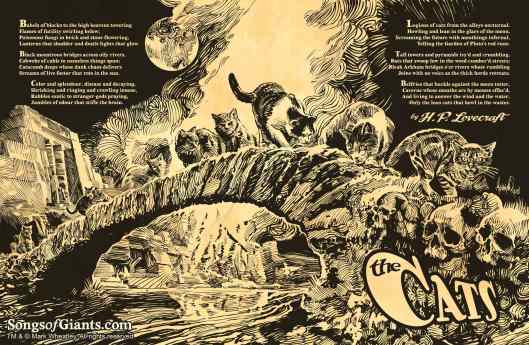
It was one of the oldest named places in the area, named as such in a document of 1667. It would be delightful to imagine it being named because it was a haunt of escaped cats brought by the settlers, and thus to imagine the possibility that the boy Lovecraft was once followed homeward at sunset by an Ulthar-like army of kitties. But that vision of Cat Swamp must be left to the fancy of a future graphic-novelist, as it seems equally likely that the swamp was named for the supply of useful ‘cat-tail’ rushes that grew there.

Before extensive drainage Cat Swamp started about a third of a mile north of Angell Street, and ended about a mile north of Angell Street where it formed the ‘Great Swamp’. This whole area (if unbuilt on) appears to have been open to children in Lovecraft’s childhood, as was the way in the era of free-range childhoods. The undergraduates from Brown would also go there to skate on the ice during freezing weather. Much of it appears to have been drained between about 1903 and 1907, i.e. after Lovecraft reached age 12-13, part of it going under housing and part to Brown University for sports use such as playing fields and a new gym. Given the close proximity to his home, the swamp may well have featured in Lovecraft’s younger exploratory boyhood, but he and his fellows seem to have gravitated to the riverside and by the time of his maturing middle childhood his “hollows” seem more likely to have been around York Pond by the Seekonk river. Possibly on a northern flank later taken for sand and gravel. That he often returned to the surviving southern wooded rise above York Pond in later life, to write letters in the open air, seems confirmatory evidence of his attachment to the place.

Cumbrian Cthulhu: Complete Short Stories in hardback

I normally just chuckle at new themed anthologies of new Lovecraft stories, as they reach for ever-more obscure and outre topic hooks on which to hang the anthology. But I’ll make an exception for a valiant effect to incorporate Cumbria, in northern England, into the Mythos.

Cumbrian Cthulhu Complete Short Stories Volumes 1-4 is a 650-page hardback whopper, newly listed in Lulu. Perhaps in a new edition, since Google Books has it at 2015 but perhaps that was a paperback. In the book…

“all the stories are set somewhere in the Cumbrian region and are based around the themes of H.P. Lovecraft’s Cthulhu Mythos. The stories are a tribute to both the mythos of H.P.Lovecraft and the awesome beauty and rich history of the Lake District.”

“All profits from the publishing of the Cumbrian Cthulhu book will be donated to LDSAMRA, the Lake District Search and Mountain Rescue Association.”

If you want to try some of the stories, several are free on the Cumbrian Cthulhu blog.

So far as I know, Lovecraft had no ancestral connection with Cumbria, as he did with its neighbouring Northumbria (Hexham and district). Although he does have the Curwens as hailing from there…

“the Curwens were of the most ancient armigerous [i.e.: a recognised Scots clan] Cumbrian lineage, probably descended from the early Kings of Scots”.

Friday Picture Postals from Lovecraft: the lost railway worlds

An especially nice view of the main railway station in Providence, showing its relation to the trolley (tram) interchange and park. The design of the cars date it to Lovecraft’s time, perhaps the mid 1930s. In style and mood it evokes Lovecraft’s eventual and joyous return to his home city from his 1920s sojourn in New York, but in its perspective view and sweep it also evokes something of his boyish love of his own home-made miniature railways. And of surveying their layouts and terrains, from just this sort of vantage point.

“The trains fascinated me [as a small boy], & to this day I have a love for everything pertaining to railways.”

He appears to have read vast numbers of early Munsey proto-pulp story magazines that dealt with railroads, including the entire run of Railroad man’s Magazine. This mixed rip-roaring adventure, ‘tall tales of the rails’ from old-timers, true-life accounts and short non-fiction.

One of his own early ‘household and friends’ publications was The Railroad Review. In middle-childhood he made his own systems, seemingly (though not mentioned by him below) in the large coach-house / stable which had previously housed the family carriage and horse…

[Alongside my early love of the 18th century … ] “my parallel fascination with railways & street-cars led me to construct large numbers of contemporary landscapes with intricate systems of tin trackage. I had a magnificent repertoire of cars & railway accessories — signals, tunnels, stations, &c — though this system was admittedly too large in scale for my villages. My mode of play was to construct some scene as fancy — incited by some story or picture — dictated, & then to act out its life for long periods — sometimes a fortnight—making up events of a highly melodramatic cast as I went. These events would sometimes cover only a brief span — a war or plague or merely a spirited pageant of travel & commerce & incident leading nowhere — but would sometimes involve long aeons, with visible changes in the landscape & buildings. Cities would fall & be forgotten, & new cities would spring up. Forests would fall or be cut down, & rivers (I had some fine bridges) would change their beds. […] Horror-plots were frequent, though (oddly enough) I never attempted to construct fantastic or extra-terrestrial scenes. […] There was a kind of intoxication in being lord of a visible world (albeit a miniature one) & determining the flow of its events.”

Such activities are common to many intelligent and craft-minded boys in middle-childhood, but the difference here is the sustained storytelling and development of such over several weeks per miniature layout.

A railroad track in decay famously features in his later work, as the line out of Innsmouth. In this he might be seen as nodding to other writers who had earlier used a ‘follow the railway lines’ plot point in post-apocalyptic settings, but it was more likely just the obvious route of escape required by the story.

Underground tram-ways also feature elsewhere in his work, in either real-world form (“Nyarlathotep”, in which only the subway entrances appear) or in disguised horror-fantasy forms (“The Festival”, in which the descent echoes the manner of going down into a subway in company with a shuffling crowd, whereupon the celebrants then mount a line of indeterminate ‘creature-vehicles’ which arrive, and are carried away into the darkness — much like entering and being carried away by subway cars).

Lovecraft Collectors Library, Volume VI: Commentaries

New on Archive.org, from 1955, The Lovecraft Collectors Library, Volume V: The Amateur Journalist and The Lovecraft Collectors Library, Volume VII: Bibliographies, both now superseded but possibly of interest for those without Joshi’s Bibliography and the Collected Essays.

But The Lovecraft Collectors Library, Volume VI: Commentaries places online short works previously been available in the now expensive print volume Lovecraft Remembered

Idiosyncrasies Of H.P.L., by E. A. Edkins.
A Few Memories, by James F. Morton.
Ave Atque Vale!, by Edward H. Cole.
The Cthulhu Mythos: A Study, by George T. Wetzel.
The Lord Of R’lyeh, by Matthew H. Onderdonk.

Added to Open Lovecraft

Added to Open Lovecraft, my page of public open access scholarly works. I don’t add all undergraduate dissertations I find, as some are obviously rather basic or flawed. But these two seem worthy and will be useful to others writing in the Game Studies field…

* V. Gergo, Representing the “Unnameable” in Lovecraftian Video Games (2018 undergraduate dissertation for SZTE in Hungary. In English).

* M. Simicevic, Lovecraftian Horrors: Space and Literature in Silent Hill (2018 undergraduate dissertation for Sveuciliste u Zadru in Hungary. In English).

Monochrome Mapping Competition

A “Monochrome Mapping Competition” is on now. Three entries, any medium. Deadline: 15th June 2019.

Seems to fit well with the old-school zine aesthetic, which is why I’m posting it here. I’m thinking something like… a big flowchart map of Lovecraft entities + geography, as if painstakingly typed into a waxed stencil sheet and hand-printed by Gestetner stencil duplicator across two sheets of A4.

Lovecraft Archive updates

The H.P. Lovecraft Archive has had an update…

5th April 2019: Overhauled the “Periodicals” section of the site, adding all tables of contents of all issues of Lovecraft Annual to the database; consolidating the search engines for Lovecraft Studies, Crypt of Cthulhu, and Lovecraft Annual; and adding the table of contents for Crypt of Cthulhu issue 112 to the database. These were some significant changes, so please contact us if you notice any problems.