New book: A Place of Darkness

An interesting sounding new book of cultural history from Kendall R. Phillips, A Place of Darkness: The Rhetoric of Horror in Early American Cinema (Spring 2018). It steps beyond the movie industry’s early history and surveys the wider currents which each distinct cultural milieu both drew on and drew around itself…

“He shows how early cinema [1890s onward] linked monsters, ghosts, witches, and magicians with Old World superstitions and beliefs, in contrast to an American way of thinking that was pragmatic, reasonable, scientific, and progressive. Throughout the teens and twenties [1910s and 20s], Phillips finds, supernatural elements were almost always explained away as some hysterical mistake, humorous prank, or nefarious plot. The Great Depression of the 1930s, however, constituted a substantial upheaval in the system of American certainty and opened a space for the reemergence of Old World gothic within American popular discourse in the form of the horror genre [the famous Universal monster movies, 1931 onwards], which has terrified and thrilled fans ever since.”

It’s being well reviewed. Sublime Horror has a sturdy review, and also a free one-hour podcast interview with the author.

The White Tree

It’s interesting to see that the H.P. Lovecraft Historical Society / Dark Adventure Radio Theatre are branching out into new HPL-alike audio adventures. Their The White Tree runs 72 minutes with their usual full-cast and full-FX approach, and the story sees…

The police inspector who once probed the mysteries of the Cthulhu cult on a case that leads him once again into the foreboding bayous of Louisana.

It’s © 2016 and on release seems to have been CD-only with a prop-pack. But I’ve now noticed it because it’s been released to Audible for download, dated “26th March 2019”.

Added to Open Lovecraft

* E. Berndtson, Mortal Minds and Cosmic Horrors: A Cognitive Analysis of Literary Cosmic Horror in H.P. Lovecraft’s “The Shadow Out of Time”. (Undergraduate dissertation for Halmstad University, Sweden, February 2019. In English).

* Y. Garcia, “Monstros Sagrados e Ciberculturais: H. P. Lovecraft e sua mitologia na cultura contemporanea”, Galaxia No. 39, September-December 2018 (In Portuguese with short and rather basic English abstract, title translated as “Sacred and Cybercultural Monsters: H. P. Lovecraft and his mythology in contemporary culture”).

* J. Engle, “Cults of Lovecraft: The Impact of H.P. Lovecraft’s Fiction on Contemporary Occult Practices”, Mythlore, Vol. 33, No. 1, 2014.

Lovecraft’s Public Library

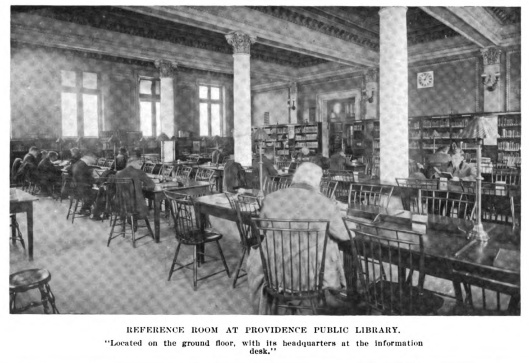
My new-found picture of the reference section of the Providence Public Library, in use by patrons. Published April 1916, so perhaps made 1915. It’s from one of the early Google Books scans and has bad un-correctable moire. I can’t get it larger or less fuzzy.

One could almost imagine that the lad seen on the far right of the picture is a 25 year-old H.P. Lovecraft. The hair-parting and the look of the ear are both correct. Lovecraft’s obvious lantern jaw might be there, but it might not. Lovecraft wore eyeglasses at this time, but it’s difficult to tell if this lad is wearing glasses or not. The feature that suggests this may not be the young Lovecraft is the dark shade and cut of the collar on his camel coat or jacket, which thus becomes two-tone — this being rather too jaunty and not sober enough for his known tastes in menswear. Although we do know that in 1915 Lovecraft became enamoured of ‘the dandy’, a figure he later associated with Edwardian frock-coats and their velvet collars, so who knows now if that phase of his interests temporarily affected his taste in clothing?

Still, even as a ‘stand in’ this young man is a close match, and thus very indicative of Lovecraft’s undoubted youthful presence in the room at other times.


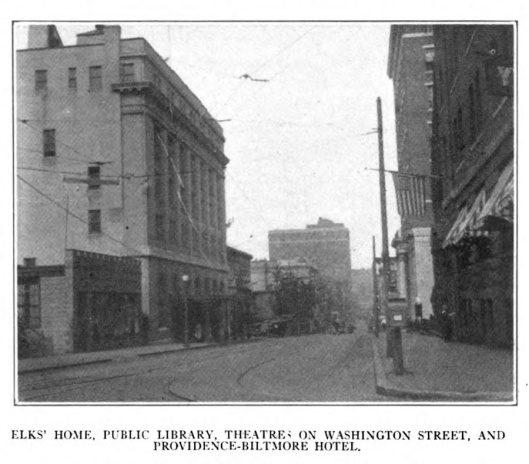
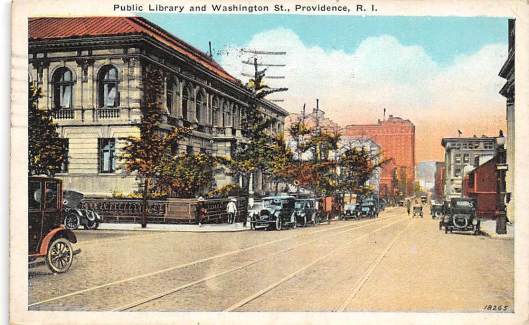
I also found a later picture of the Public Library exterior in its urban context. The library is in the middle-distance on the left, with the Biltmore Hotel in the far distance, and what looks like a small theatre in the foreground on the left. One can just about see that there were young trees around the library, by circa the early 1920s.

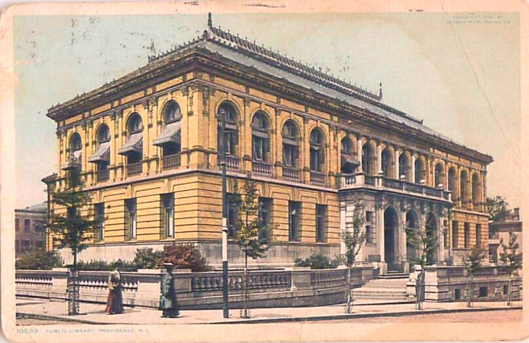
The trees can be better seen here in cards. They look fine at the start when small, but look rather spindly and struggling circa 1927…

New book: Letters with Donald and Howard Wandrei and to Emil Petaja

S. T. Joshi’s blog has updated. Among the Lovecraft-related news in his latest long post, the Lovecraft Annual for 2019 is done and is thus presumably forthcoming later this summer, as are “volumes of Lovecraft’s letters to Donald Wandrei and Emil Petaja; to Wilfred B. Talman and Helen V. Sully”. Joshi now flies to France to participate in events there surrounding the publication of Je Suis Providence, the French-translation of his monumental H.P. Lovecraft biography.

No sign of a listing yet for the contents for the new Lovecraft Annual, but Hippocampus has H. P. Lovecraft: Letters with Donald and Howard Wandrei and to Emil Petaja listed at $25 after a small pre-publication discount. There’s also an explanatory note that this book has the same content as the older and now-expensive Mysteries of Time and Spirit: The Letters of H. P. Lovecraft and Donald Wandrei (2005) but adds…

120 new pages of Lovecraft’s letters to Howard Wandrei and Emil Petaja. … In addition, a rare interview of Donald Wandrei is included, along with poems, essays, and stories by Petaja.

Map of the Providence parks and green spaces circa 1910

From The southern gateway of New England, 1910. Map possibly drawn up 1903, when H.P. Lovecraft would have been about age 12 to 13, and still roving far on his bicycle.

And the 1916 update, less visually pleasing but with new additions and with the colour key explained in the small-print. Lovecraft now a young man of about age 25, having long since given up his bicycle and row-boat in favour of zipping about on trolley-cars (trams).

The Seekonk: York Pond makeover

One of Lovecraft’s favourite places in both childhood and adulthood, York Pond in Blackstone Park on the banks of the Seekonk, appears to be set for a pedestrian path makeover. The proposals are dated April 2019 and plan to add…

“pedestrian improvements along the Boulevard to link the adjacent community to the Seekonk River and incorporate a network of paths along York Pond [to the Seekonk]”

I’m not sure if the paths have backing from the city or not. Possibly they’re just a proposal to help greenwash a development? But if they do go ahead, then is there an opportunity here to site the Lovecraft statue as part of these changes? Or some similar memorial? Poe also haunted the shoreline here, which might suggest an artistic plaque or bas-relief depicting Poe and Lovecraft together. At the very least some temporary inaugural installations in wicker-sculpture might be sited around the completed paths, which could use themes drawn from the work of Poe and Lovecraft. Here’s an example of the sort of wicker-sculpture I mean, to be seen each spring near me in my local woods here in the UK…

Friday Picture Postals from Lovecraft: The Seekonk and Blackstone Park

The lower Seekonk shoreline does not seem to have been much photographed for postcards, and there are few postcards of it online and only one of York Pond itself (after the grading and extraction works). This is the largest I have of this particular card.

Here’s H.P. Lovecraft on the Park and shoreline…

“Scarce a stone’s throw from the house lie the nearest parts of that beautiful rustick reservation known as “Blackstone Park” — wherein I have been wont to wander some twenty or more years [i.e. since about age eight]. Here Nature unadorn’d displays a multiplicity of agreeable phases; ravines, groves, brooklets, thickets, & Arcadian stretches of river-bank — for the park borders on the wide & salty Seekonk. The Seekonk is call’d a river, but in truth ’tis but a bay or inlet. The river proper doth not begin till four miles to the north, where (changing its name successively to the Pawtucket & the Blackstone) its fresh streams flow over the mill dam at the Great Bridge of the city of Pawtucket. How beauteous indeed is untainted Nature as beheld in so idyllick a spot as Blackstone Park! […] I think this park would explain why such a born & bred town man shou’d possess such a taste for rural musings & Arcadian themes!

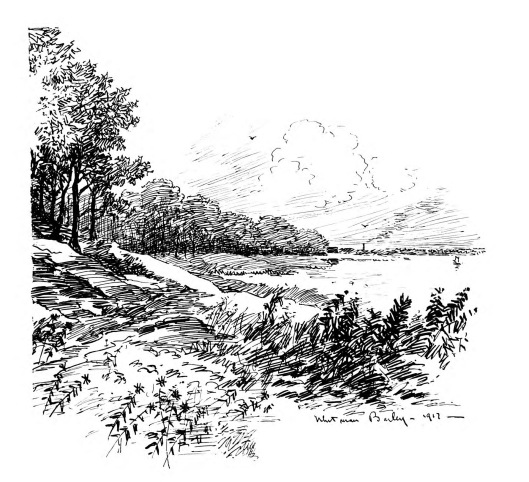
Here’s a Blackstone Park sketch made by Whitman Bailey in 1916. Looking down a sylvan path and ride, toward the glinting of the distant Seekonk.

The young Lovecraft also had a view of the Park and the Seekonk from his home…

“The roof of 598 Engelstrasse is approximately flat, and in the days of my youth I had a set of meteorological instruments there. Hither I would sometimes hoist my telescope, and observe the sky from that point of relative proximity to it. The horizon is fair, but not ideal. One can see the glint of the Seekonk through the foliage of Blackstone Park, and the opposite bank is quite clearly defined.”

One can glimpse a house with a flat roof and just such a view here (from The southern gateway of New England, 1910). The picture-maker looks across at the shore ride, from near Red Bridge…

The shoreline structure seen here is the Boat Club boathouse, thus by looking at maps one can see that the house glimpsed in the trees is likely to be one of those lining Lovecraft’s Angell St.

As one can also see above, the shoreline road was relatively low. No attempt seems to have been made to preserve the shore drive from being covered by the inevitable ten-year winter flood-surge. Indeed, Lovecraft dreamed of such things, but weirdly inverted and horribly revealing rather than covering…

“I was standing on the East Providence shore of the Seekonk River, about three quarters of a mile south of the foot of Angell Street, at some unearthly nocturnal hour. The tide was flowing out horribly — exposing parts of the river-bed never before exposed to human sight. Many persons lined the banks, looking at the receding waters & occasionally glancing at the sky. Suddenly a blinding flare — reddish in hue — appeared high in the southwestern sky; & something descended to earth in a cloud of smoke, striking the Providence shore near the Red Bridge — about an eighth of a mile south on [of?] Angell Street. The watchers on the banks screamed in horror — “It has come — It has come at last!” — & fled away into the deserted streets. [Blind panic ensues] By this time the river-bed was fully exposed — only the deep channel filled with water like a serpentine stream of death flowing through a pestilential plain in Tartarus.” (1920)

There evidently were floods but the natural inundations of winter were brief, expected and subsided. In summer he would often sit all day on the surviving southern bluff above York Pond, reading and writing. In 1927, a letter was headed as from… “High Wooded Bluff Above the Seekonk River – a mile East of 10 Barnes St.” He sometimes even shared his childhood haunt with close friends. Here is an instance from 1927…

“the next day we [he and Cook and Munn] lounged about the Blackstone Park woods beside the Seekonk — agrestick haunt of my earliest infancy, and true genesis of my pastoral soul.”

In a letter of 1934 he remarks…

Almost every warm summer afternoon I take my work or reading in a bag & set out for the wooded river-bank [on the Seekonk] or the fields & woods north of Providence — spending the time till dusk in one or more favourite rustic spots.


A year after Lovecraft passed away, a terrific natural flood struck Providence…

This must surely have also swept up the Seekonk and around his cherished wooded bluff in Blackstone Park, but understandably there seems to be no photo made of the Park shoreline at that time. Evidently the foliage and wildlife of the ponds at that point must be used to such occasional inundations.

The Seekonk: Lovecraft afloat on the Seekonk

H. P. Lovecraft was once something of a waterman on the Seekonk River, seen above in a Whitman Bailey drawing made on the Poe-haunted west shore at Blackstone Park…

“I used to row considerably on the Seekonk … Often I would land on one or both of the Twin Islands — for islands (associated with remote secrets, pirate treasure, and all that) always fascinated me.” — Lovecraft letter to Rimel, April 1934.

The islands are locally known as Cupcake Island and Pancake Island, indicating their respective shapes. Though these may be modern post-1945 names. There appears to be no vintage photograph, sketch or postcard of them, available online. But one can see them on this map…

They can also be seen on some of the earliest maps of Providence, c. 1650…
From where and how would the young Lovecraft row? One imagines that, once old and strong enough to row alone on a large river, he might have been allowed to take out a row-boat from the Boat Club boathouse (opened c. 1884). The name of his grandfather probably still had some sway with Club, and he might have avoided the sort of hire-fee he could have had to pay at Red Bridge. The boathouse can be seen here…

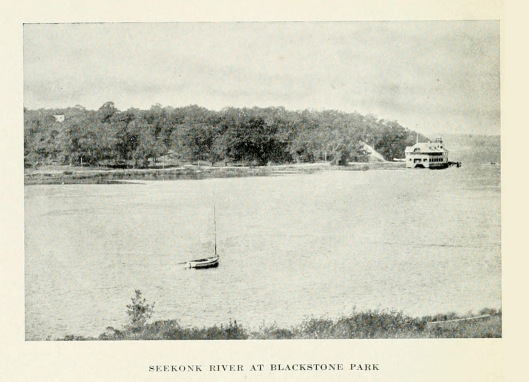
The residential house seen through the trees is one in Angell St., so that indicates Lovecraft’s proximity to the boathouse. The boathouse had an interesting gothic look from a certain angle…

Lovecraft must have been no puny stripling at this time, for the Seekonk could be a dangerous river and the city Report noted that a rescue crew patrolled the river on Sundays and holidays circa 1912. Today the Brown University men’s rowing team notes that…

The Seekonk is known for its difficult rowing conditions, particularly heavy wind and waves, as well as a strong current.

Thus perhaps we can assume a Lovecraft who was aged 14 or 15, circa 1904 or 1905? Lovecraft might not have encountered the Brown rowing team’s twice-daily training (they apparently had another boat-house nearby). As evidenced by the statement… “The Brown Alumni Monthly has been for years in favor of the resumption of rowing at Brown” (1915), implying that the team might have been moribund for a number of years prior to 1915.

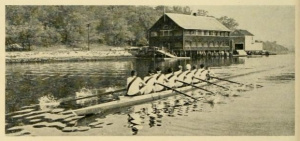
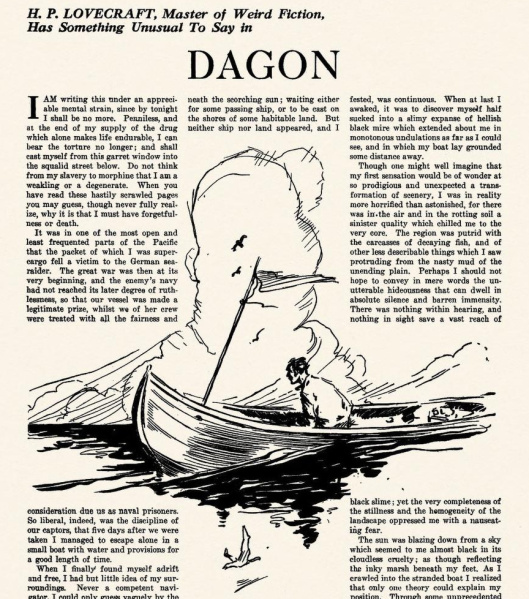
In his row-boat experience, and the island encounters amid the shifting sediments, do we glimpse the personal roots of his famous story “Dagon” (July 1917)? His nightmare of the Seekonk River draining away to reveal primal ooze was recounted in a letter of May 1920 (“the river-bed was fully exposed — only the deep channel filled with water like a serpentine stream of death flowing through a pestilential plain in Tartarus”), but Lovecraft called this a “typical dream” — thus there may have been similar pre-“Dagon” dreams. Indeed we know there were, as he later wrote of “Dagon” that… “I dreamed that whole hideous crawl, and can yet feel the ooze sucking me down!” If this latter dream was of the drained Seekonk or not, must now remain unknown. But the likelihood is that it was.

The flow of the river was probably faster then, because its main flow was in a far narrower and shallower navigation channel of 12 feet, this being “the deep channel” referred to by Lovecraft. Only in 1927 did a U.S military dredging project dredge a longer and deeper… “3.4-mile-long channel, 16 feet deep” all the way from East Providence to Pawtucket. “The channel is 150 feet wide from the Red Bridge to an area opposite Goose Point where it widens further to 230 feet.” (U.S. Army, Seekonk River Navigation Project).

His ‘considerable’ rowing experience on the Seekonk may also help explain his extreme delight in the header illustration he had in Weird Tales, for “Dagon”, since he would then see in it not only an illustration of the story, but also a reflection of his own experience of rowing on the Seekonk…
Presumably such things were cast off along with his bicycle, which he ceased using altogether in the summer of 1913, long past the point when he was expected by local convention to shed such boyish activities. As his family descended into poverty, he may anyway have lacked the hire-fee for such a boat.


See also: the mysterious river island in “Dreams in the Witch House”…

She had told Judge Hathorne of lines and curves that could be made to point out directions leading through the walls of space to other spaces beyond, and had implied that such lines and curves were frequently used at certain midnight meetings in the dark valley of the white stone beyond Meadow Hill and on the unpeopled island in the river. […] He [later] rowed out twice to the ill-regarded island in the river, and made a sketch of the singular angles described by the moss-grown rows of grey standing stones whose origin was so obscure and immemorial.