Friday ‘picture postals’ from Lovecraft: Around Brattleboro

H.P. Lovecraft’s correspondents were sent not only ‘picture postal’ postcards, but also lightweight brochure-leaflets from specific places. As America’s ‘visitor trade’ grew, in the late 1920s and early 1930s, Lovecraft could pick these leaflets up in stores, museum foyers, YMCA lobbies and the like. Presumably a keen visitor would be permitted to take a handful, if he promised the attendant he would ‘send them on to interested friends’. As Lovecraft became increasingly poor, such small items could have occasionally saved him the cost of buying pictorial postcards.

Above is a 1940 tourist map of the attractions and notable places around the town of Brattleboro. However, the map is identical to that on the reverse of this c. 1930 leaflet…

It may be of use to those trying to follow Lovecraft’s excursions out from the Goodenough farm in West Brattleboro, and the nearby Vrest Orton place. Such overview maps may be especially useful once we get the mammoth volume of Lovecraft’s complete ‘letters to the aunts’, due for publication soon. My guess is that we can probably expect to read there of a good many visits to obscure antiquarian shrines and remote mountain-vistas, all lovingly detailed. Possibly there may also be some mention of the 1927 Vermont floods at Brattleboro, though Lovecraft only saw the floods in pictures…

Lovecraft visited Vermont for the first time in the summer of 1927, returning in the summer of 1928. He did not actually witness the Vermont floods (a real event) [which gave rise to the story “The Whisperer in Darkness”], but they received extensive coverage in newspapers throughout the East Coast, and Lovecraft no doubt heard some first-hand accounts of them from several friends in Vermont including Vrest Orton and Arthur Goodenough”. — S.T. Joshi, A Subtler Magick.
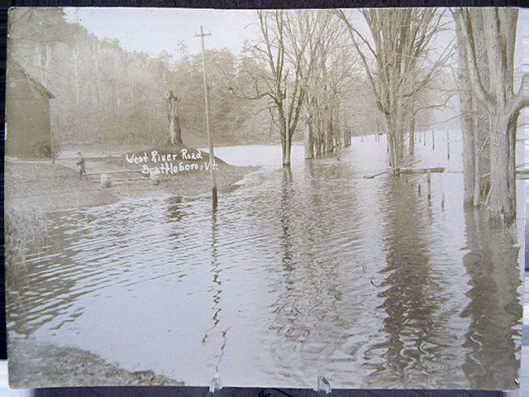
Pictures: the subsiding 1927 floods at Brattleboro.

Readers will recall Lovecraft’s “The Whisperer in Darkness”, opening with lines such as…

… country folk reported seeing one or more very bizarre and disturbing objects in the surging [1927 flood] waters that poured down from the unfrequented hills, and there was a widespread tendency to connect these sights with a primitive, half-forgotten cycle of whispered legend …

Spurred by finding the above Brattleboro map, I went looking for an update on the conservation and restoration of the Goodenough farmstead at Brattleboro. Apparently the farmhouse has a covenant on it which states that it’s to be preserved intact in its original form. The Goodenough Farmstead Trust began in 2004 and they spent $65,000 on the place in 2006. Most likely on the excellent new roof, to be seen below. The last online report from the place appears to be that of the Lovecraft fan Dakota Rodeo and friends, who visited in summer 2014 and found the house looking good but interior works still ongoing…
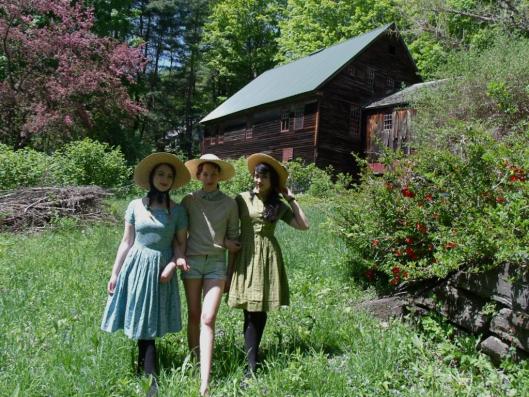
GEDC2989_zps8777848cPicture: local girls at the farmstead in 2014, visiting for Lovecraft’s birthday.

Also, where exactly is it? Joshi in A Subtler Magick places Orton just outside Brattleboro itself, and states that Goodenough’s farm was “further to the north”. Yet the local historical society has it that Goodenough’s hillside farmstead is on “the Goodenough Road in West Brattleboro”, which would place it west of Brattleboro. Lovecraft himself states that Goodenough… “dwells not much above a mile from Orton’s”, Orton having… “hired a delightful farm some miles out of Brattleboro, in Vermont” (Orton had recently fled New York and the south Windham County house was on a long all-summer lease, not just a week’s holiday-let). Given this, Joshi’s “further to the north” must indicate “to the north” of Orton’s place, not north of the town itself.

While looking for Orton’s actually address I found additional interesting confirmation that that he and Lovecraft would have chimed politically. The author of a 1989 tourist book on Vermont had looked through Orton’s famous mail-order publications and noted their politics…

Vrest Orton, whose tartly conservative political views punctuated the [his] enormously successful mail order catalogue Voice of the Mountains“. — The roadside history of Vermont, 1989.

Voice was issued by Orton’s business the Vermont Country Store, and a collection of his columns were later published as the book The Voice of the Green Mountains: a collection of phillipics, admonitions & imponderables (1979). Orton’s late recollection of Lovecraft, first published 1982, also made a passing remark on Britain’s increasingly sorry state under socialism. This implies that i) his political views had not changed over time, and that ii) his memoir was likely penned some years earlier, perhaps in 1976-79, when Mrs Thatcher had not yet been elected.

But… back to finding the precise location(s) of Goodenough and Orton in the 1920s. If the Goodenough farmstead’s location is the address at which the Goodenough Farmstead Trust is formally registered today (and satellite photography in Google Earth suggests it is, offering the same building layout, roof shape, and arrangement of of the grounds) then that puts it about five miles directly west of Brattleboro itself. This further suggests that Orton’s springwater-fed and oil-lit “eighteenth-century” place may have been in the hills somewhere off Akley Road, about a mile south of the Goodenough farmstead. Orton’s late memoir of Lovecraft actually puts his rented place at “ten miles” from town, but no doubt Orton recalled every hairpin bend and switchback in that tally, as the neighbour’s Ford rattled along the back-roads through the hills. Here is Lovecraft, recalling the journey up into the backroads…

“The nearness and intimacy of the little domed hills become almost breath-taking — their steepness and abruptness hold nothing in common with the humdrum, standardized world we know, and we cannot help feeling that their outlines have some strange and almost-forgotten meaning, like vast hieroglyphs left by a rumoured titan race whose glories live on in rare, deep dreams.”

Picture: Brattlboro is the large town seen along the river on the right of the picture, and Guilford / Old Guilford straddles the road that runs south out of it. The curious line seen marching across the landscape near the farmstead, like an ancient Roman wall, is presumably a forest fire-break to protect the town? Despite being marked on the old tourist map as forest it probably would not have been quite so thickly wooded back then, because there has been massive forest ‘re-growth from farmland’ in the eastern USA since the 1930s, along with a general global greening since the 1990s.

There is a slightly curious place-name puzzle here. Orton’s newspaper report “A Weird Writer Is In Our Midst” (1928) states that Lovecraft’s 1928 visit was at “Guilford”, which the modern maps mark at about a mile and a half south of the centre of Brattleboro. He is “stopping with us in Guilford”, writes Orton in the newspaper. This is apparently confirmed by the title of “Literary Persons Meet in Guilford” Brattleboro Daily Reformer (18th June 1928). And yet Orton’s later memoir of Lovecraft clearly states that the location of the 1928 visit was his rented summer house, near the Goodenough farmstead, and that this was “ten miles from Brattlboro”.

But we know that the “Literary Persons Meet in Guilford” meeting was definitely held at the Goodenough farmstead. The local newspaperman was at the farm in person and reported… “Half a dozen literary persons met for a discussion yesterday at the home of Arthur Goodenough”. Lovecraft himself reported to fellow amateurs that… “there was a literary assemblage of much interest at the poet’s abode”.

The solution to this small riddle must be that, to local people, the place was considered to be part of Guilford. Even though Guilford/Old Guilford was many miles east-away toward the river, through the rolling hills. Indeed, looking more closely at the maps one can see a “West Guilford” area extending out toward the Goodenough farmstead.

Picture: Typical covered bridge and packed-dirt road, of the type then found in Guilford and Brattleboro.

Lovecraft’s Diary: a project proposal

As we head toward the anniversary of “Dagon” (The Vagrant Nov 1919, first appearance of “Dagon”) it strikes me that there’s an imminent opportunity for starting a new diary blog, possibly to be named The Compleat Diary and Almanak of Mr. H. P. Lovecraft, Gent.

In which one blog post per day would briefly summarise Lovecraft’s doings (and thoughts or dreams) on that particular day in history. Or simply note the location at which he resided, or what the weather of the day was, if he was otherwise unknown at that point in time. The Diary might be written in the fairly brief and straightforward ‘dashed note’ manner of his 1925 Diary, with additional placenames and personal names.

Such a blog would take some 17-18 years to complete, if run at one post per day. But, if done correctly and diligently each day, it would soon become a very fine achievement.

It might be reduced to a 10-12 year project if there were two posts per day, staggered by a decade, e.g.:

  1st November 1919
  1st November 1929

I’m not sure such a Diary could be made to progress more quickly that that, due to the levels of research involved on some posts. Some days in New York would be very complex, others very easy. Though even determining the exact weather and night-sky at a particular spot on a particular day can be quite a challenge, more so if one also looks beyond the simple meteorological tables. Such things become even more difficult after the mid 1920s, due to the copyright lock-down. The authors of the blog would need to be solid Lovecraftians, and have access to all the letters published to date, and vast amounts of the scholarship.

The staff roster would probably need to be:

  * Chaser of weather, stars, migrations, moon and tides.
  * Collator of news events that Lovecraft may have noted.
  * Letter archivist and search wizard.
  * Letter reader and highlighter.
  * General Admin Assistant (who chases and feeds the above through to…)
  * The blog post summary-writer (who also notes sources, via footnotes).
  * Proofreader and hyper-linker of names/places in the resulting blog post.
  * Perhaps a quick-fire pen-&-ink sketch artist and sketch-mapper.
  * The Project Producer, a heavyweight scholarly oversight and backstop.

  * Editor of the 1890-1919 weekly/monthly summary, something on which someone might work alone.

Initially there might be a role for a graphic designer, perhaps working to evoke something of the feel of the old Almanacs which Lovecraft collected and enjoyed. Photos would probably be best left out, to be added judiciously in a final print edition, since really good picture research would be a very tough task on a daily basis.

Onslaught of the Ancient Gods

No fireworks for the 4th July, but a good heavy-rock album seems like the Lovecraftian equivalent.

Getting good reviews from metal-heads, the new metal album Onslaught Of The Ancient Gods (mid June 2019) from an Armenian band.

Track samples available on Bandcamp.

“Combining blackened death metal with elements of melo-death, tech-death, … orchestration and sci-fi synths, [the album] certainly stands apart form much of the extreme metal scene [and] for the most part [the band’s leading light] Erskine pulls everything together expertly. Lovecraft is no rarity in extreme metal lyrics, but where many simply pay lip service to the father of cosmic horror, [the band] Temple of Demigod is a project fully immersed in the Eldritch chaos. Not a flawless album, but to suggest Onslaught Of The Ancient Gods is anything other than a blindingly fun trip into the void would be criminal. Score: 8/10“. — Distorted Sound magazine.

Onslaught of the Ancient Gods was a surprise hit for me; I was expecting to have some fun with it, but I’ve been addicted to it since its release. It’s exactly the right balance of sinister and cheesy, complex and catchy. It’s a great album if you like tech death but need a reprieve from the noodly side of the genre.” — Toilet ov Hell.

Kittee Tuesday: cats from the Twilight Zone

Celebrating H.P. Lovecraft’s interest in our fascinating felines.

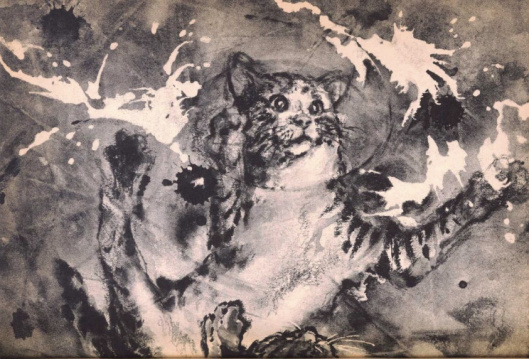
In August 1983 Twilight Zone magazine treated its readers to H.P. Lovecraft’s “Something about Cats”, with a brief introduction and some explanatory notes by S.T. Joshi. While the essay is now found in better form elsewhere as “Cats and Dogs”, there were illustrations by Jason Eckhardt and two of these featured Lovecraft himself.

Behold, this dreamer (1939)

Here’s the opening illustration by Barnett Freeman for Walter de la Mare’s 1939 British anthology Behold, this dreamer: of reverie, night, sleep, dream, love-dreams, nightmare, death, the unconscious, the imagination, divination, the artist, and kindred subjects.

The book contains de la Mare’s perceptive introduction and what are effectively a long set of mini-essays, followed by the master anthologist’s judicious mix of selected poetry, prose and other texts. It’s deemed perhaps the best of his five anthologies, and is currently free on Archive.org via one of those basic Public Library of India scans. These scans, while welcome as readable freebies of post-1923 long-out-of-print works, regrettably all use such harsh contrast that they ruin any artwork or photography in a book.

Spine art…

1984 British paperback reprint cover by what might be another artist mimicking the style of the original art…

June 2019 on Tentaclii

It’s time for another monthly summary. Here in the UK the delightful sunny Maytime weather vanished for nearly all of the month. To be replaced by a typically English cool and ‘moist’ June. This ‘settled in’ and offered many a misty and mizzling dawn, attenuating away into a grey distance. 15,000 words were launched into this grey aether from Tentaclii Towers, opening with the popular post “Lovecraft’s bloody fingerprint”. In which a new partly-unpublished postcard from Lovecraft was noted and a fingerprint spotted on it. Despite the resulting big boost in traffic, my Patreon is still at only 16 people, though they kindly give $51 a month.

I’m pleased to report that a little bit of the Patreon helped me to bag a very cheap first-edition hardback of the de Camp Lovecraft biography, having previously only had the Gollancz ebook reprint which appeared on Amazon a few years ago. The 1975 hardback is said to have 20,000 more words than all later editions, and also has scholarly endnotes which pinpoint which letter or source he used. A bonus is that despite its price it isn’t a mauled-about ex-library copy. It’s in rather nice crisp condition in un-yellowed mylar wrapper, with only a corner-clipped dust-jacket to indicate it was probably once in a remaindered bookstore in the late 1970s. It’s a fat book, but despite my ‘small letter-box, block-of-flats’ delivery hurdle I was able to get the book via a hassle-free route.

This month my blog noted many books newly published or new-in-ebook included Frank Belknap’s Long memoir Dreamer on the Nightside in ebook via Amazon, Joshi’s expanded Weird Fiction in the Later 20th Century, and precise details of what’s in Joshi’s new The H. P. Lovecraft Cat Book. Plus a rich crop of new journal-books such as Windy City Pulp Stories #19, Lovecraftian Proceedings #3, Dead Reckonings #25, and the new Lovecraft issue of the academic journal Brumal. I also posted advance news of reprints such as 1991’s H.P. Lovecraft: Against the World. In the archives, I found a free scan of Index To The Verse In Weird Tales, plus a rare on-the-spot article by someone who met the bookseller Irvin Binkin (who saved so much Lovecraft material in the early 1970s) and had visited his final bookstore.

Various scholarly items and notes were posted here, including calls, an essay contest and research fellowship opportunities for 2020. Three more items were found and added to the Open Lovecraft page.

Several items of Lovecraft comics news appeared here. I’m now editing a monthly publication for comics-makers, as well as Digital Art Live magazine, so my interest in the better type of comic is higher than usual. I’ll be interviewing comics-makers for the new publication, so please comment and suggest names of non-gore comics makers you may know. We’re especially interested in people who use digital workflows, possibly involving 3D models.

Various art scans were posted, plus the call for the Ars Necronomica art-show to be staged at NecronomiCon 2019 later this year. A big Beardsley show at the Tate in London was noted, as was the release of the major Lovecraftian videogame The Sinking City.

I instituted a new regular themed post here: “Kittee Tuesday”. This will feature artistry involving fantasy, sci-fi and horror cats, and these will often be forlorn kittees I’ve rescued from the stygian blackness of forgotten archives.

In music and audio, noted items included the CD Sonnets of the Midnight Hours; the release of Dark Adventure Radio Theatre’s The Lurking Fear; Graham Plowman’s Lovecraftian classical music; and Lovecraft’s Murray Ewing’s retro sci-fi soundtrack album, Future City. Also linked where a couple of podcast episodes, and the first of the Howard Day videos.

My post “Whose work is entering the public domain in 2020?” was, I hope, a useful post for readers who are also publishers or artists.

My archival investigations led me into Lovecraft’s Red Hook, and I discovered that the real demographics of the place fitted those that Lovecraft described. In all but one respect. Having one of his protagonists in the story be Irish, he thus switched the Irish in the Red Hook population to ‘Spanish’ in his introductory scene-setting. Otherwise, Lovecraft’s Norwegians, Syrians and others were not figments of his overheated imagination, as some have claimed. Maps and pictures of the area were uncovered, and this post was followed by the 1,700-word Patreon-only post “Lovecraft and The Cult of the Peacock Angel”. That was on the topic of Lovecraft’s use of the Yazidis in the story “Red Hook”, and the surrounding historical context in the 1920s.

Other new discoveries this month were the address of the store where Lovecraft concluded his epic hunt for a cheap suit, after his clothes were stolen, and the location of a photo of the store interior (though not the photo itself). I also found a 1933 photo of a “biggest selection in the city” “50,000 magazines” store on Fulton St., Brooklyn — I can’t imagine this place was unknown to the Lovecraft Circle. If just one of the Circle had spotted it, then he would have told all the others.

New historic pictures made inside the Ladd Observatory were also noted, found over on the Observatory’s blog.

More importantly, in terms of influence Lovecraft’s major stories, I discovered that the Cloisters had been a significant antiquarian site for Lovecraft while in New York. This post led to a similar finding to that of my Yazidis essay, namely that mainstream academic scholarship was narrowing the scope that Lovecraft had for reader-friendly stories of devil-worshippers and the medieval gothic, and thus that ‘the times’ were pushing him to be radically more inventive by 1925/26. “Cthulhu” was a response not only to modernism, or to the new scientific discoveries, but also to strong and sudden shifts in ethnographic and medieval scholarship in the mid 1920s.

Password-protected Patreon-only posts, this month, were:

* “Lovecraft and The Cult of the Peacock Angel” (Lovecraft’s use of the Yazidis in “Red Hook”, and surrounding historical context in the 1920s).

* The Plot Genie (on a ‘plot-writing machine’).

* My Patrons on Patreon will also find a large printable version of “H.P.L. in N.Y.C.” (showing Lovecraft in Puritan garb, with the Brooklyn Bridge in the background), on the Patreon blog.

Giving just $1 a month both supports Tentaclii, and also gets you access to posts like these. You can also support my work simply by telling your friends about Tentaclii, especially if you know them to be generous with their Patreon account! There must surely be some people out there with a stash of $13k bitcoins in their wallet, and who are thus feeling just a bit more generous than usual.

Artwork: Lovecraft and astronomy

Here’s a potential cover for a non-fiction history book on Lovecraft and astronomy. I’ve taken off the pre-existing text (it was the cover for an old booklet from India), fixed an obscuring label, and also re-coloured. It’s 2,900px on the longest size and thus should work for a cover / back-cover on a Lulu.com 6″ x 9″ book.

The space on the right could potentially host a Fivver-commissioned cameo done in the same style, featuring Lovecraft’s face. Or perhaps the Lovecraft silhouette in cameo, with a holding line added around it.

Irvin Binkin meets H.P. Lovecraft

Uploaded to Archive.org in February 2019, The Alien Critic #5 (May 1973). It has the article “Irvin Binkin meets H.P. Lovecraft”, by Jack Chalker, in which Chalker meets and hears from Binkin. Reprinted from Chalker’s ‘zine Viewpoint #1 (February 1973).

… he’s decided that owning the world’s largest collection of Lovecraft is better than collecting the huge sums he could sell it for (he’s already turned down $30,000).