Call: The Dark Man journal

The Dark Man: Journal of Robert E. Howard and Pulp Studies, call for the Vol. 10, No. 2 issue…

Note that during their Howard Days presentation the editors said they were also interested in Lovecraft and wider pulp magazine history of the period. Though I’d imagine that papers on these would probably be most welcome if they featured themes and concerns found in Howard’s work and/or life.

I wonder if “The Small Town” might be such a theme, and if it might even make a special themed issue, with essays on the early pulp-magazine use of the theme by Howard, Lovecraft, Simak, Bradbury and others. Possibly also an examination of the demographics and spread of the readership, to determine how ‘remote’ and small-town some of the readers were, and what the pulps meant to them in that context.

Added to Open Lovecraft

* P. Israelson, The Vortex of the Weird: Systemic Feedback and Environmental Individuation in the Media Ecology of Ito Junji’s Horror Comics”, Orientaliska Studier, No. 156, 2018. (Illustrated. Possibly not safe for download at work or college, depending on regime. A study of noted Japanese manga artist Ito Junji in relation the literary horror of H. P. Lovecraft).

* J. Norman, ‘Sounds Which Filled Me with an Indefinable Dread’: the Cthulhu mythopoeia of H.P. Lovecraft in ‘extreme’ metal (Short chapter from the book New Critical Essays on H.P. Lovecraft, 2013. ‘Metal’ = metal rock music).

* L. Sorensen, A weird modernist archive: pulp fiction, pseudobiblia, H.P. Lovecraft, Modernism/modernity, Vol. 17, No. 3, September 2010. (In “The Shadow out of Time” the archive is “possessed of disturbing agency”, and this idea counters the high modernist ideal for such things. Also has some useful observations on Lovecraft’s stance on the familiar and the unknowable, and notes that Boas shared much the same sentiments).

Kittee Tuesday: Kreativity for Kats

Celebrating H.P. Lovecraft’s interest in our fascinating felines.

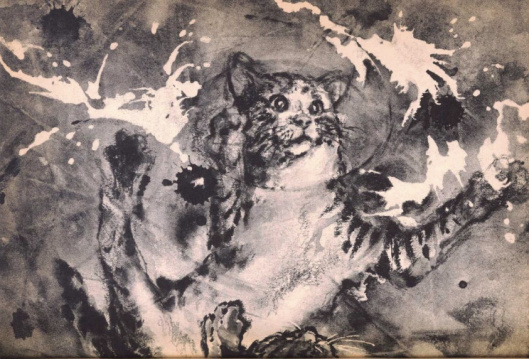
This week’s kitty is a Dick Francis illustration for the story “Kreativity for Kats” (Galaxy, April 1961), anticipating the now-lost Catscan website by some 40 years. “Kreativity for Kats” was Fritz Leiber’s sequel to his acclaimed “Space Time for Springers” science-fiction cat story.

Over time “Space Time” became the first of a series of ten super-kitten and other cat stories by Leiber, which were collected together in the limited-edition illustrated hardback Gummitch and Friends (1992). I’d guess a new audiobook for that might Kickstart quite well, today, with the permission of the Leiber estate?

Crypt of Cthulhu #113

Crypt of Cthulhu #113, now with a pre-order page and table of contents. This double-sized jumbo book edition should out by the 1st August 2019, according to the page.

Looking interesting…

* “Memory” Re-membered, by Donald R. Burleson. [Presumably re-visiting Lovecraft’s “Memory”]

* A Heritage of Hubris: Sources for “The Doom That Came to Sarnath”, by William Fulwiler.

* Atmosphere and the Qualitative Analysis of “The Colour Out of Space”, by Steven J. Mariconda. [Presumably the “Colour” essay mentioned, but not included, in his recent book collection]


Also, elsewhere DMR blog has a new A Shout-Out to Robert M. Price, Crypt editor, on his 65th birthday.

Providence Tales #4

The Italian magazine Providence Tales #4 (Spring/Summer 2019) is a special tribute to Italian Lovecraft scholar and publisher Giuseppe Lippi, who was one of the leading Italian Lovecraftians. The magazine features a fine portrait of him on the cover, framed by pleasingly lively typography. Inside there are two memoirs. He passed away before Christmas 2018, after a short illness.

Translating the contents page for the magazine’s back-issues, I see it also has other non-fiction articles. #3 has an article on Lovecraft’s appearances in the Weird Tales letters pages, and the magazine has five such letters translated into Italian.

Toward an ‘Open Cthulhu’

Tabletop gamers have been having some interesting discussions re: which of Lovecraft’s monsters could be ‘safely’ included in a new ‘open’ RPG. Cthulhu Reborn has a hankering for an open tabletop RPG based on pure Lovecraft, and has three posts which usefully summarise this recent debate. He also does some additional useful digging.

1. Can Cthulhu Be Open?

2. The Safewords of Cthulhu

3. Can Cthulhu Be Open? Part 2.

In the post at link 2, he notes that the debate made him aware of a…

Lovecraftian [‘open game’] RPG in German called FHTAGN. [for which the maker] spent a long time researching the various named beings and gods that are mentioned in short stories to find which are truly Public Domain [in Europe]. … in the interests of making the results of his/her research more accessible to English-speaking audiences, I have extracted the list of “safe” Mythos Entities and translated the relevant names back to English.

This seems useful, re: being researched for the public domain rules in the UK and Europe, and not the USA. One could probably include some of the early Long additions to the Mythos, which are or will shortly be in the public domain by 2020/21.

For cultists and clans one might add…

* The Martense clan (“The Lurking Fear”, with a story setting on a river that ultimately flows down to empty at Red Hook).

* Cthulhu cultists, and also the “undying leaders of the cult in the mountains of China” claimed by Castro.

But assuming the German list wants monsters and ‘rites’ only, then The Haunter of the Dark could probably still appear in a game. It would just have to be unnamed as such, but with the same characteristics (lots of sinister lurking silence in darkness, then a sudden single explosive killer fear-lightning release during a storm). It would just have to be used under a more generic name, such as ‘The Dark’ or ‘The Unnamed Dark’, if there really are copyright worries in the UK and Europe.

Looking at ‘published pre-1924’ Lovecraft, I’d also suggest adding to the German list…

* Erich Zann (though not a monster he might have been deemed to have become one, in a new game).

* The Terrible Old Man (ditto).

* The Street (as a monster ‘character-entity’ in its own right).

* The Cats of Ulthar (inexplicably missing from the German list, perhaps because not considered to be monsters).

Alternatively, Zann, The Old Man, the Street and the cats could all be deemed ‘ally class’ elements of the game, helping the players in various ways.

The remaining Howard Days videos for 2019

I don’t see more of videos coming online from the 2019 Howard Days, so below are links to what I take to be the final tranche.

Previous posts here at Tentaclii have already covered Howard Day 2019 – the first videos (trailer, keynote, and a main panel) and More Howard Days (“What’s new with REH”, and an excellent “History of Project Pride” which gives a fine insight into how just a few dynamic can-do people make all the difference to a small town).

The remains videos to be linked are:

* The Writers of REH, a 58 minute panel during which “Biographers of Howard answer biographical questions”.

* Glenn Lord Symposium 2019: Nicole Emmelhainz, giving a 40 minute talk about Howard’s letters and correspondents.

* Glenn Lord Symposium 2019: Ralph Norris, giving a short 20 minute talk about Howard’s Kull character.

* Fists of the Ice House 2019 is a 48 minute talk on Howard’s boxing stories, given dynamically in the very place where the author used to box. Followed by a 50 minute panel on Sailor Steve Costigan of the boxing stories.

Many thanks to Ben Friberg for the uploads and (I assume) he was also the one to be thanked for the clear audio and professional recordings.

Others? Unfortunately YouTube has near-enough turned off their ‘sort by date’, to the extent that it’s now very difficult to get a comprehensive slate of ‘most recently posted’ videos in the results for any keyword or phrase. So my apologies if someone else has also posted a Howard Days 2019 video, but I wasn’t able to find it. Nothing pops up on ListenNotes either, which is the best podcast search-engine. Sadly it’s 2019 and the world still lacks a ‘timely blog-post search’ engine like the old Technorati, but using the general search-engines to approximate that didn’t turn up anything in the form of .MP3s or video.

* The Abeline Reporter local newspaper has a good long write-up and crisp photos, “Howard Days celebrates Cross Plains writer’s legacy”. I’m pleased to see that this is accessible outside the USA (many small town newspapers block outsiders now). It includes the interesting news that…

At this moment, Howard is way bigger in France than he is the [United] States,” said French scholar Patrice Louinet, who regularly travels to Cross Plains to present at Howard Days. “He’s everywhere [in France].”

The local cemetery website also has a nice look at the excellent promotional poster for 2019, along with the artist’s details if you’d care to commission him for something similar for your town…

Friday ‘picture postals’ from Lovecraft: Around Brattleboro

H.P. Lovecraft’s correspondents were sent not only ‘picture postal’ postcards, but also lightweight brochure-leaflets from specific places. As America’s ‘visitor trade’ grew, in the late 1920s and early 1930s, Lovecraft could pick these leaflets up in stores, museum foyers, YMCA lobbies and the like. Presumably a keen visitor would be permitted to take a handful, if he promised the attendant he would ‘send them on to interested friends’. As Lovecraft became increasingly poor, such small items could have occasionally saved him the cost of buying pictorial postcards.

Above is a 1940 tourist map of the attractions and notable places around the town of Brattleboro. However, the map is identical to that on the reverse of this c. 1930 leaflet…

It may be of use to those trying to follow Lovecraft’s excursions out from the Goodenough farm in West Brattleboro, and the nearby Vrest Orton place. Such overview maps may be especially useful once we get the mammoth volume of Lovecraft’s complete ‘letters to the aunts’, due for publication soon. My guess is that we can probably expect to read there of a good many visits to obscure antiquarian shrines and remote mountain-vistas, all lovingly detailed. Possibly there may also be some mention of the 1927 Vermont floods at Brattleboro, though Lovecraft only saw the floods in pictures…

Lovecraft visited Vermont for the first time in the summer of 1927, returning in the summer of 1928. He did not actually witness the Vermont floods (a real event) [which gave rise to the story “The Whisperer in Darkness”], but they received extensive coverage in newspapers throughout the East Coast, and Lovecraft no doubt heard some first-hand accounts of them from several friends in Vermont including Vrest Orton and Arthur Goodenough”. — S.T. Joshi, A Subtler Magick.
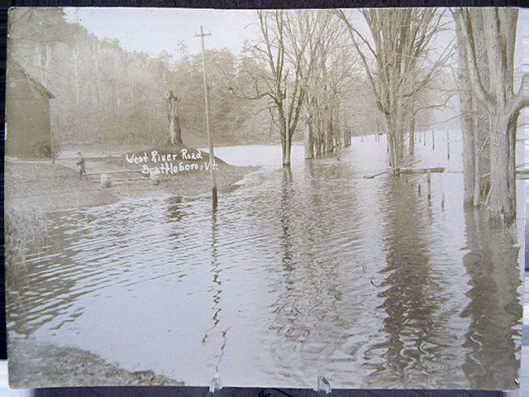
Pictures: the subsiding 1927 floods at Brattleboro.

Readers will recall Lovecraft’s “The Whisperer in Darkness”, opening with lines such as…

… country folk reported seeing one or more very bizarre and disturbing objects in the surging [1927 flood] waters that poured down from the unfrequented hills, and there was a widespread tendency to connect these sights with a primitive, half-forgotten cycle of whispered legend …

Spurred by finding the above Brattleboro map, I went looking for an update on the conservation and restoration of the Goodenough farmstead at Brattleboro. Apparently the farmhouse has a covenant on it which states that it’s to be preserved intact in its original form. The Goodenough Farmstead Trust began in 2004 and they spent $65,000 on the place in 2006. Most likely on the excellent new roof, to be seen below. The last online report from the place appears to be that of the Lovecraft fan Dakota Rodeo and friends, who visited in summer 2014 and found the house looking good but interior works still ongoing…
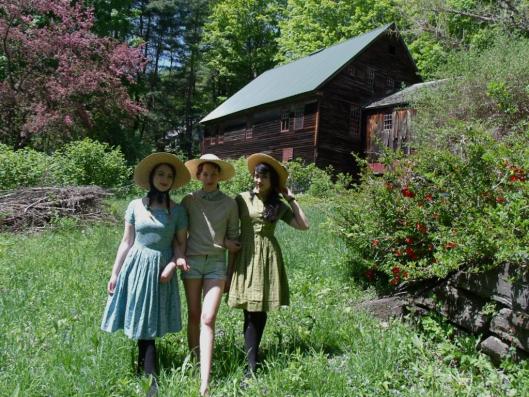
GEDC2989_zps8777848cPicture: local girls at the farmstead in 2014, visiting for Lovecraft’s birthday.

Also, where exactly is it? Joshi in A Subtler Magick places Orton just outside Brattleboro itself, and states that Goodenough’s farm was “further to the north”. Yet the local historical society has it that Goodenough’s hillside farmstead is on “the Goodenough Road in West Brattleboro”, which would place it west of Brattleboro. Lovecraft himself states that Goodenough… “dwells not much above a mile from Orton’s”, Orton having… “hired a delightful farm some miles out of Brattleboro, in Vermont” (Orton had recently fled New York and the south Windham County house was on a long all-summer lease, not just a week’s holiday-let). Given this, Joshi’s “further to the north” must indicate “to the north” of Orton’s place, not north of the town itself.

While looking for Orton’s actually address I found additional interesting confirmation that that he and Lovecraft would have chimed politically. The author of a 1989 tourist book on Vermont had looked through Orton’s famous mail-order publications and noted their politics…

Vrest Orton, whose tartly conservative political views punctuated the [his] enormously successful mail order catalogue Voice of the Mountains“. — The roadside history of Vermont, 1989.

Voice was issued by Orton’s business the Vermont Country Store, and a collection of his columns were later published as the book The Voice of the Green Mountains: a collection of phillipics, admonitions & imponderables (1979). Orton’s late recollection of Lovecraft, first published 1982, also made a passing remark on Britain’s increasingly sorry state under socialism. This implies that i) his political views had not changed over time, and that ii) his memoir was likely penned some years earlier, perhaps in 1976-79, when Mrs Thatcher had not yet been elected.

But… back to finding the precise location(s) of Goodenough and Orton in the 1920s. If the Goodenough farmstead’s location is the address at which the Goodenough Farmstead Trust is formally registered today (and satellite photography in Google Earth suggests it is, offering the same building layout, roof shape, and arrangement of of the grounds) then that puts it about five miles directly west of Brattleboro itself. This further suggests that Orton’s springwater-fed and oil-lit “eighteenth-century” place may have been in the hills somewhere off Akley Road, about a mile south of the Goodenough farmstead. Orton’s late memoir of Lovecraft actually puts his rented place at “ten miles” from town, but no doubt Orton recalled every hairpin bend and switchback in that tally, as the neighbour’s Ford rattled along the back-roads through the hills. Here is Lovecraft, recalling the journey up into the backroads…

“The nearness and intimacy of the little domed hills become almost breath-taking — their steepness and abruptness hold nothing in common with the humdrum, standardized world we know, and we cannot help feeling that their outlines have some strange and almost-forgotten meaning, like vast hieroglyphs left by a rumoured titan race whose glories live on in rare, deep dreams.”

Picture: Brattlboro is the large town seen along the river on the right of the picture, and Guilford / Old Guilford straddles the road that runs south out of it. The curious line seen marching across the landscape near the farmstead, like an ancient Roman wall, is presumably a forest fire-break to protect the town? Despite being marked on the old tourist map as forest it probably would not have been quite so thickly wooded back then, because there has been massive forest ‘re-growth from farmland’ in the eastern USA since the 1930s, along with a general global greening since the 1990s.

There is a slightly curious place-name puzzle here. Orton’s newspaper report “A Weird Writer Is In Our Midst” (1928) states that Lovecraft’s 1928 visit was at “Guilford”, which the modern maps mark at about a mile and a half south of the centre of Brattleboro. He is “stopping with us in Guilford”, writes Orton in the newspaper. This is apparently confirmed by the title of “Literary Persons Meet in Guilford” Brattleboro Daily Reformer (18th June 1928). And yet Orton’s later memoir of Lovecraft clearly states that the location of the 1928 visit was his rented summer house, near the Goodenough farmstead, and that this was “ten miles from Brattlboro”.

But we know that the “Literary Persons Meet in Guilford” meeting was definitely held at the Goodenough farmstead. The local newspaperman was at the farm in person and reported… “Half a dozen literary persons met for a discussion yesterday at the home of Arthur Goodenough”. Lovecraft himself reported to fellow amateurs that… “there was a literary assemblage of much interest at the poet’s abode”.

The solution to this small riddle must be that, to local people, the place was considered to be part of Guilford. Even though Guilford/Old Guilford was many miles east-away toward the river, through the rolling hills. Indeed, looking more closely at the maps one can see a “West Guilford” area extending out toward the Goodenough farmstead.

Picture: Typical covered bridge and packed-dirt road, of the type then found in Guilford and Brattleboro.

Lovecraft’s Diary: a project proposal

As we head toward the anniversary of “Dagon” (The Vagrant Nov 1919, first appearance of “Dagon”) it strikes me that there’s an imminent opportunity for starting a new diary blog, possibly to be named The Compleat Diary and Almanak of Mr. H. P. Lovecraft, Gent.

In which one blog post per day would briefly summarise Lovecraft’s doings (and thoughts or dreams) on that particular day in history. Or simply note the location at which he resided, or what the weather of the day was, if he was otherwise unknown at that point in time. The Diary might be written in the fairly brief and straightforward ‘dashed note’ manner of his 1925 Diary, with additional placenames and personal names.

Such a blog would take some 17-18 years to complete, if run at one post per day. But, if done correctly and diligently each day, it would soon become a very fine achievement.

It might be reduced to a 10-12 year project if there were two posts per day, staggered by a decade, e.g.:

  1st November 1919
  1st November 1929

I’m not sure such a Diary could be made to progress more quickly that that, due to the levels of research involved on some posts. Some days in New York would be very complex, others very easy. Though even determining the exact weather and night-sky at a particular spot on a particular day can be quite a challenge, more so if one also looks beyond the simple meteorological tables. Such things become even more difficult after the mid 1920s, due to the copyright lock-down. The authors of the blog would need to be solid Lovecraftians, and have access to all the letters published to date, and vast amounts of the scholarship.

The staff roster would probably need to be:

  * Chaser of weather, stars, migrations, moon and tides.
  * Collator of news events that Lovecraft may have noted.
  * Letter archivist and search wizard.
  * Letter reader and highlighter.
  * General Admin Assistant (who chases and feeds the above through to…)
  * The blog post summary-writer (who also notes sources, via footnotes).
  * Proofreader and hyper-linker of names/places in the resulting blog post.
  * Perhaps a quick-fire pen-&-ink sketch artist and sketch-mapper.
  * The Project Producer, a heavyweight scholarly oversight and backstop.

  * Editor of the 1890-1919 weekly/monthly summary, something on which someone might work alone.

Initially there might be a role for a graphic designer, perhaps working to evoke something of the feel of the old Almanacs which Lovecraft collected and enjoyed. Photos would probably be best left out, to be added judiciously in a final print edition, since really good picture research would be a very tough task on a daily basis.

Onslaught of the Ancient Gods

No fireworks for the 4th July, but a good heavy-rock album seems like the Lovecraftian equivalent.

Getting good reviews from metal-heads, the new metal album Onslaught Of The Ancient Gods (mid June 2019) from an Armenian band.

Track samples available on Bandcamp.

“Combining blackened death metal with elements of melo-death, tech-death, … orchestration and sci-fi synths, [the album] certainly stands apart form much of the extreme metal scene [and] for the most part [the band’s leading light] Erskine pulls everything together expertly. Lovecraft is no rarity in extreme metal lyrics, but where many simply pay lip service to the father of cosmic horror, [the band] Temple of Demigod is a project fully immersed in the Eldritch chaos. Not a flawless album, but to suggest Onslaught Of The Ancient Gods is anything other than a blindingly fun trip into the void would be criminal. Score: 8/10“. — Distorted Sound magazine.

Onslaught of the Ancient Gods was a surprise hit for me; I was expecting to have some fun with it, but I’ve been addicted to it since its release. It’s exactly the right balance of sinister and cheesy, complex and catchy. It’s a great album if you like tech death but need a reprieve from the noodly side of the genre.” — Toilet ov Hell.