Friday ‘Picture Postals’ from Lovecraft: In the Stacks

H.P. Lovecraft once had a ticket allowing him to freely access the lower “stacks” or “stack house” of the Providence Public Library, to browse among shelves inaccessible to the general public. If the public ever overheard librarians talking of “the stacks”, they probably vaguely imagined tottering towers of books stacked up in some mouldering basement. But by the time of Lovecraft’s youth the nation’s libraries employed more modern methods of bulk storage for their little-consulted items. The picture above shows what the Providence “stacks” looked like when first installed, before being filled with books and journals. They appear to have been of the usual tall sliding-case type, where the shelves are on sliders and can be compressed together to save space. The usual situation for access is that one then turns a knobbed and wheeled device at the end of certain cases, which then cracks open a walkway sufficiently large to allow entry for book or journal retrieval. One doesn’t linger, as one feels there could be another browser cranking a wheel elsewhere that could close the cases. Many such “stacks” must still exist behind the scenes, though I suspect that not many students encounter them today on the open library floors.

The young Lovecraft may well have had “behind the scenes access” to the public library, and a “stacks” card. He certainly became very fond of a Cataloguing Room Messenger & Stacks boy of about his own age, Arthur J. Fredlund. Arthur was a young and slight Swedish boy, the newly arrived Swedes then forming the largest immigrant group in Providence. Such a flood of blond beauty into the city, at such a formative time for Lovecraft, no doubt permanently influenced his conception of ‘the nordic’ in physical form. According to the Library Report Fredlund was a Messenger Boy in 1905, but Lovecraft talks of him working in the ‘stacks’ in 1906…

I came across a superficially bright Swedish boy in the Public Library. He worked in the ‘stack’ where the books were kept and I invited him to the house to broaden his mentality (I was fifteen and he was about the same, though he was smaller and seemed younger.) I thought I had uncovered a mute inglorious Milton (he professed a great interest in my work), and despite maternal protest entertained him frequently in my library. … But ere long he uncovered qualities which did not appeal to me … I never saw him more…” (21st August 1918, letter to Alfred Galpin)

Other data points for Lovecraft’s life show that their friendship lasted only from Spring to Autumn 1906, and had followed Lovecraft’s… “nervous breakdown (winter ’05-’06)” (Lord of a Visible World, page 32).


By the mid 1920s we know that Lovecraft definitely carried not only a regular Public Library borrowing card, but also a further card that would allow him to access the ‘stacks’. This was probably due to the goodwill of the head librarian, “good old William E. Foster”.

The stacks, and perhaps others like them in New York, probably contributed to Lovecraft’s idea of the library in “The Shadow Out of Time”…

These cases were stored in tiers of rectangular vault — like closed, locked shelves — wrought of the same rustless metal and fastened by knobs with intricate turnings.

I thought of the locked metal shelves, and of the curious knob-twistings needed to open each one. My own came vividly into my consciousness. How often had I gone through that intricate routine of varied turns and pressures in the terrestrial vertebrate section on the lowest level! Every detail was fresh and familiar. If there were such a vault as I had dreamed of, I could open it in a moment.

My feelings toward these shelves cannot be described — so utter and insistent was the sense of old acquaintance. … My [human] fingers, half-numb from climbing, were very clumsy at first; but I soon saw that they were anatomically adequate. And the memory-rhythm was strong in them. Out of unknown gulfs of time the intricate secret motions had somehow reached my brain correctly in every detail — for after less than five minutes of trying there came a click whose familiarity was all the more startling because I had not consciously anticipated it. In another instant the metal door was slowly swinging open with only the faintest grating sound. Dazedly I looked over the row of greyish case-ends thus exposed, and felt a tremendous surge of some wholly inexplicable emotion. Just within reach of my right hand was a case whose curving hieroglyphs made me shake with a pang infinitely more complex than one of mere fright. Still shaking, I managed to dislodge it amidst a shower of gritty flakes, and ease it over toward myself…

The insistent need for silence in opening the cases in “Shadow” may reflect something of the need to prevent creaking and rumbling when using the stack cases of the Providence Public Library. Incorrect or fumbling openings and slamming closings might have caused annoying sounds to be heard by the patrons of the silent Library above. In those days public libraries were real libraries, not children’s centres with a computer circle and a few books in one corner. A hushed silence was strictly enforced.

Another point of comparison suggests itself. Look again at the picture above an notice these items…

The lower cone-like section appears to me to bear comparison with the cone body-shape of the alien Great Race of Yith, the librarians in “Shadow”. Literary critics seeking sources always make the mistake of assuming that inspiration can only come from other literature, and the more prestigious the better. Writers know that inspiration can come from anywhere, and the more obscure it is the better they like it.

Richard Stanley’s big sword-and-sorcery movie

Richard Stanley gave a short interview to a local Austin newspaper. One of those annoying local newspapers in the USA which spams the world with its headlines and links… and then brutally blocks all visitors from outside America, displaying a message that make the said visitors feel like a criminal hacker.

But anyway… there’s a free VPN in my Opera browser, so here for all the world to read are some of the article’s Lovecraft and Howard-relevant quotes from Stanley.


His successful new Colour Out of Space movie is “designed for late nights where most of the audience would have to be slightly drunk or on some kind of substance or another.”

“He was my mother’s favorite author,” Stanley says. “She read me Lovecraft when I was a child. … I would have read ‘Color’ myself by the time I was 12.”

“Before I die, I would very much love to do a proper, fully blown sword-and-sorcery movie. I’ve mostly made science fiction, but I’m a big fantasy guy. There’s plenty of unfinished business out there.”

Completely Weird

Weird Tales: 1923-1954 complete in a handy linked spreadsheet, with links going mostly to Archive.org in all but one case. I assume the maker looked at which copy was the best and most complete scan, as there are often several versions of each issue on Archive.org. One can also find there the sister title Oriental Stories even a few of the re-titled Oriental Stories which was The Magic Carpet. These being also edited by Farnsworth Wright, though they’re not on the spreadsheet.

More unknown memoirs of Lovecraft

I’ve found more late 1940s memories of H.P. Lovecraft, from Muriel Eddy. Given that Joshi holds her 1940s memoir as more reliable than those of the 1960s, and that the earlier 1948 memoir I found in a similar magazine (see the post a few weeks ago) turned out to be quite provable from other sources including Lovecraft himself, then it seems worth trusting these too.

There are no great revelations here, as there was with uncle Eddy the bookseller. But I note that the following are not listed in Joshi’s Comprehensive Bibliography nor in de Camp’s biography.


1) Startling Stories, March 1949. “More Lovecraftiania”.

Her first “Lovecraftiania” letter in Startling Stories is banal and of no interest, but this second letter does offer one interesting and genuine-sounding specific memory.

When Lovecraft married… “his two aunts gave our children over 100 empty chocolate boxes to play with! (In fact, a bath-tub full!)”.

The boxes at Angell St. are known from Eddy’s unreliable 1961 memoir. Her main published 1940s memoir (which I now have access to, via A Weird Writer in Our Midst) talks only of two items of furniture being taken over to the Eddys, on Lovecraft’s departure for New York. But this comment on the “chocolate boxes” event may be of interest, because here it’s from 1949 and she even gives the quantity of boxes.

What was he doing with these boxes? The bathtub would, I suppose, be the curious but somewhat logical place to store a collection, if collection they were. Such boxes would otherwise be difficult-to-stack and the stacks inclined to tumble over, being made up of oddly-sized lightweight boxes. So far as I know, the 1920s was not a time of silver-foil collecting-for-charity (which was ‘a thing’ in the mid 1970s following the oil crisis, which caused a knock-on shortage of paper and tin-foil). Thus I doubt the boxes were collected for charity re-cycling. Did Lovecraft have a vague hope of taking up a hobby as a chocolatier at his little gas hot-plate, and re-filling the empty boxes with new weirdly-moulded chocolates to surprise his friends with? It’s a delightful notion, but it seems unlikely. Some vague Joseph Cornell-like ambition to turn them into proto-surrealist art-boxes, perhaps? Again, unlikely at that point in history.

Perhaps they were simply saved for their value as objects, as traditionalist works of ornate construction and printed art which he didn’t care to throw away? Here are quotes from historians on the matter of such boxes…

* “In the 1920s some of the boxes became a work of art in themselves” (The Science of Chocolate)

* “the chocolate boxes of the 1920s and 1930s were largely sentimental holdovers of Victorian romanticism. Modernism was meant to replace this old-fashioned mode with bold new designs [but failed in that respect].” (Chocolate: Food of the Gods).

* “the fancifully beribboned chocolate boxes which were another 1920s addition to the stock of national pleasures.” (Island Stories, of British boxes).

* The critic Banham twitted the great architectural historian Pevsner for bringing… “‘even so slight a thing as a chocolate box’ within his critical system”, while “… apparently not knowing that the design of chocolate boxes was a matter of wide (albeit joking) concern in the 1930s (cartoon of an aesthete pointing the finger of scorn at a sunset and shouting “Chocolate box-y, chocolate box-y!)” (A Critic Writes: Selected Essays by Reyner Banham)

Such lids would contain sunsets and kittens and suchlike, finely printed. Sunsets, kittens, chocolate… well, we know how Lovecraft felt about such things. About Olde worlde scenes from England and the 18th century, too.

Thus, it is not impossible that he kept a collection of the ‘best boxes’ with their traditionalist art, delicate iridescent foils and fancy construction, much in the same way as his friend Morton collected stamps. Of course the fanciest of such boxes would have been expensive, and Lovecraft generally had little money. But other people may have purchased and eaten the chocolates — then given the boxes to him because they knew of his interest in them. Slightly unlikely perhaps, but one imagines his aunts had many chocolate enthusiasts among their friends.

“And yet, who shall say that a bathtub cannot awake the Muse?” (Lovecraft, letter to Kleiner, 1916).

But why not just razor off the artwork and extract the foils, and thus save a lot of the space? He was, after all, quite seriously pressed for living space until 1933. I wonder if perhaps one solution is that the boxes were intended to one day store the sorted and archived collections of his voluminous collection of incoming correspondence? That seems quite a logical solution to his storage problems, since such a picture-coded ‘visual filing cabinet’ would be both practical and fast for consultation. ‘Loveman is in the box with the turtle-doves on it’, etc. Such boxes would make eminently suitable containers for letters, being complete with strong ribbon-ties, provided that the bath tub was thoroughly dried before re-installing the boxes in it.

However, that the aunts gave away 100 or so apparently empty boxes when he went to New York suggests the tub was more likely a curious form of art collection, arising from the fancy-box style of the era. But, on his later return to Providence, he may have found such a practical or long-intended use for a new collection of boxes as a form of letter-storage? Anyway, that would be one theory. Those who have full access to the letters may be able to shed more light on the matter.

The other possibility is that they formed temporary storage for papers when working out in the open, as he did for long stretches in the summer. One would be able to press a peg or long knitting-needle through the card of the box, and so fix them to the turf to prevent the wind taking them. They would also be relatively shower-proof.

Yet another possibility is their use as mailing-boxes for sending manuscripts and collections of amateur journals to his friends and correspondents, suitably wrapped in brown paper. And yet I’ve never heard or read of a correspondent mentioning such boxes.

For the moment it’s a bit of a mystery. We may learn more about such curious domestic arrangements once Lovecraft’s forthcoming ‘aunts letters’ are published. The boxes are of course only a small and seemingly trivial point in Lovecraft’s life, yet clarifying this point may help to forestall a shoddy biographer or hater’s claim that… ‘Lovecraft spent his days in squalor, surrounded by discarded candy-wrappers’ etc.


2) Fantastic Adventures, October 1948. “Shaver and Lovecraft”.

Lovecraft liked to watch husband Eddy writing his music, and he and Lovecraft talked about setting “weird poems” to music. Again this is possibly interesting because of the early date of the memory. I don’t see this point mentioned in the 1940s and 1960s Eddy memoirs I have access to.


3) Fantastic Adventures, December 1948. “Lovecraft’s Wife”.

Only of very slight interest. Muriel Eddy notes a newspaper article by Sonia, presumably the memoir of Lovecraft first printed in the Providence Journal. This then must be the article abridged and edited by Winfield Townley Scott, and printed in The Providence Sunday Journal for 22nd August 1948. It later appeared in Books at Brown and then in Lovecraft Remembered.


4) Incidentally I have also found that Ghost Stories magazine for April 1929 has a letter to the editor from Muriel E. Eddy with the address of “317 Plain Street”, Providence. The content is of no interest, but the address may be of use to some researchers. She talks of living on “Second Street, East Providence” in her main 1940s memoir, then moving across the city so that Lovecraft called on the Eddy’s at a different address when he returned from his New York sojourn.

Les Carnets de Lovecraft

A new 96-page art-story book from France, Les Carnets de Lovecraft: La Cite sans nom (translates as ‘Lovecraft’s Notebooks: The City With No Name’). At first I thought it might be Lovecraft’s Commonplace Book with entries faced with pleasingly traditional pen-and-ink sketches. But it seems it’s a heavily illustrated edition of “The Nameless City” in French translation. The book is due 16th October 2019.

The same young artist did a heavily illustrated “Dagon” book in the same series, released August 2019. This art sample, done in pencil, indicates the approach of the Les Carnets de Lovecraft series. Not an artnovel or a ‘BD’ (short graphic novel), but a heavily illustrated book of a short story.

More Lovecraftian DeviantArt

A few of the newly-posted Lovecraftian illustrations on DeviantArt, since the last such post here at Tentaclii

“Cthulu” by Moebius emulator FoxyTomcat of the USA.

Qodaet (Eder Nogueira) of Brazil is doing a Lovecraft series in red crayon, with a somewhat ‘brass-rubbing’ look to them.

Altar of the Faceless God – Nyarlathotep by TRXPICS. See also his March 2019 Yog Sothoth.

Wanderer Of The Misty Dreamlands by OliverInk of the USA.

Kittee Tuesday: Black Cat for Halloween 1905

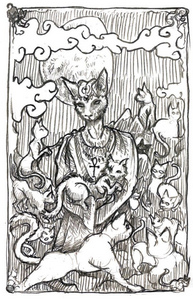
Celebrating H.P. Lovecraft’s interest in our fascinating felines.

The cover for The Black Cat magazine, October 1905. H.P. Lovecraft began to read this story-magazine in 1904, when he was aged about 14. The cover of each issue featured the distinctive cat configured within various graphic designs.

The idea of a big reward + a black cat may have been especially poignant to the 15 year-old Lovecraft when he picked this off the news-stands or opened a subscription copy in the morning mail. Because this edition was issued on the first year anniversary of the loss of his own beloved black cat, Trigger-ban, who had run away and been lost during the house-move of fall/autumn 1904.

New book: Providence After Dark and Other Writings

New from Hippocampus Press, the book Providence After Dark and Other Writings by T.E.D. Klein. Currently on their “New” page with a shipping date of “November 2019”.

Of Lovecraft interest…

I. On Lovecraft

Providence After Dark.

The United Amateur.

A Dreamer’s Tales [introduction to the 5th edition of Dagon and Other Macabre Tales, Arkham House, 1986].

Remembering Arkham House.

The Festival [recollections of the First World Fantasy Convention, Providence 1975].

The Old Gent.

T.E.D. Klein: Master of Ceremonies [1987 interview by Carl T. Ford].

II. On Other Authors

Frank Belknap Long.

etc…


Discovering the first place of publication for his First World Fantasy Convention report led me to a new booklet cover featuring Lovecraft, new in the sense that I hadn’t seen it before. The 52-page booklet had what appear to be three heavyweight convention reports all focused around musings on Lovecraft and Providence. I wouldn’t mind reading it but I see it’s become mildly collectable, so the price is now beyond me, and it’s not yet on Archive.org.

The John Brown house

We know that Lovecraft sketched a scene through the John Brown House doorway in Providence, imaginging the scene as it might once have been in the era of the clipper ships, and included this in a letter to Talman circa September 1927…

[From the archival record of a Lovecraft collection:] “Contains drawing [by Lovecraft] of a scene (featuring indications of a steeple and a ship’s rigged mast) as viewed through the doorway from inside of the John Brown House.”

Also…

“At the very end of his life Lovecraft saw the opening of the John Brown house (1786) as a museum, and it is now the home of the Rhode Island Historical Society.” (Joshi, I Am Providence)

Here is the exterior…

I should add that this fine example of penmanship showing the John Brown House is not Lovecraft’s drawing. This is by “Laswell”, George Laswell, who was the creator of the book Corners and Characters of Rhode Island (1924). My thanks to Ken Faig Jr. for pointing out that Sonia recalled that Lovecraft knew and admired these pen sketches — they had first appeared weekly in the local newspaper on which Laswell was a Staff Artist. Oh, for the days when a local newspaper had a Staff Artist…

I imagine the book will have more such quality drawings of Providence in Lovecraft’s time, or near enough. Let’s hope that, as a 1924 book, it’s being lined up for release into the public domain at the start of 2020.


Update: a photograph from 1914…