New book: Of Mud & Flame: A Penda’s Fen Sourcebook

Of Mud & Flame: A Penda’s Fen Sourcebook… “insightful essays by scholars across a range of disciplines including television history, literature, theatre, and medieval studies. … also includes the full revised screenplay of Penda’s Fen, its first time in print since 1975″. To be published 31st October 2019. Penda’s Fen is a classic ‘earth mysteries’ film, originally shown on British TV. A weird coming-of-age tale set in the West Midlands countryside around Worcester, and now very much a cult film.

Blood ‘n’ Thunder returns

The Blood ‘n’ Thunder journal has re-started, with a new second series. Billed as… “the premier journal for devotees of adventure, mystery and melodrama in American popular culture of the late 19th and early 20th centuries”. Illustrated essays by leading scholars of the field, and the focus appears to be summed up by the cover strapline: “adventure, mystery and melodrama” in the pulps, rather than weird and science-fiction.

September at Tentaclii

I’m pleased to say that a lovely Indian Summer suffused this corner of the West Midlands of England, if only for the first three weeks of September. Rich mellowness and fruitfulness abounds, even in the unlikely setting of inner-city Stoke-on-Trent and under the now rainy skies. In terms of new primary material on Lovecraft, September was also a rich and fruitful month here at Tentaclii, with much new primary material posted and many new discoveries made. Sadly this work didn’t translate into fruitful abundance on my Patreon, and the monthly total actually fell by $3. I have a feeling I may have to cease daily posting at the end of October, since at the end of its first full year the Patreon has obviously not been the success I had hoped for.

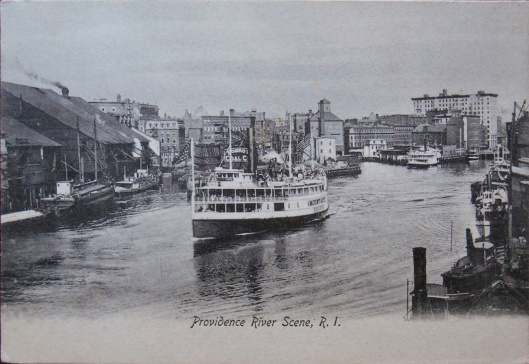
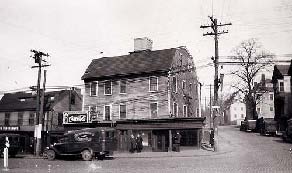
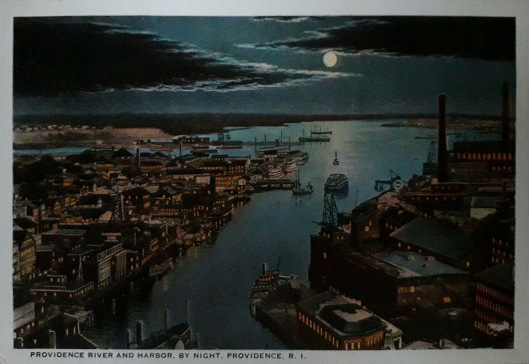
Still, my failed final effort to bring in Patreon patrons was at least a success in terms of new knowledge of Lovecraft, leading to a cavalcade of newly found and mostly visual items related to his final home of 66 College Street and also its views and environs. Along the way I also found good new pictures of Lovecraft’s “Prof. Upton of Brown”; found ‘Cthulhu’ outside the John Carter Brown Library; dug up new pictures of Winfield Townley Scott in his prime; of the “stacks” at Lovecraft’s local Library; and located and shared several useful c. 1928-40 street maps of Providence.

Patreon-only items this month were:

* College Hill from above: bonus pictures.

* Friday ‘Picture Postals’ from Lovecraft: College Street bonus pictures.

* Westward Ho! – Lovecraft’s view. (Many new pictures and my new panoramic Photoshop composite of what his study and rooftop view might have looked like).

* … and a chance to bag a scarce print book on eBay at a tenth of the usual price.

New discoveries are still being made elsewhere, too, and I noted that a new R.E. Howard letter had been found. As for myself, I was pleased to find several more unknown memoirs of Lovecraft dating from the 1940s. My ‘Picture Postals’ post “Misty lanes at the end of summer” also spiralled off into the topic of cosmic-rays and thus ended up making a fascinating discovery — Lovecraft appears to have been the first to link ‘space weather’ with ‘earth weather’ and to write about it.

In my own musings I delved into who was the first to use the term “Lovecraft mythos”. I looked over the horror and historical-epic movies Lovecraft could have seen when he stayed in New York 1932-33. In “A little more on used bookshops in Providence” I updated my long August 2019 post on my newly discovered memoir of Lovecraft.

Scholarly journals blogged about included the latest New Ray Bradbury Review, a horror special; the latest Jack Kirby Collector journal, a “Monsters and Bugs” special; and Monster Maniacs #1, a new fannish magazine on the history of horror comics.

In academia I noted the First Postgraduate Forum on Research in the Fantastic, a useful addition to the scholarly landscape in Germany; a more fannish Spanish event with Lovecraft papers being read in Madrid; and that the USA’s Steampunk Symposium 2020 will have the theme of “The Weird West”. A clutch of new additions were added to my ‘Open Lovecraft’ page for free online scholarship. I noted a call-out for the edited academic collection Not Dead, But Dreaming: Reading Lovecraft in the 21st Century.

I wrote a long review of the Lovecraft Annual journal for 2015, having bagged a copy at a low price. In this I’m glad I didn’t skip Bobby Derie’s short “Six Degrees of Lovecraft: Henry Miller” as it usefully vectored me onto The Black Cat story magazine. Reminding me that Lovecraft had read it in his boyhood, and along the way I also worked out that its demise in 1922 must have opened the way for Weird Tales to appear later the same year.

I’m pleased to say that I’ve also been able to get a bargain $10 inc. shipping copy of A Weird Writer in Our Midst, so expect a review of that at some point. For a bargain £5 each inc. shipping I also picked up the Lovecraft Annual for 2016 and 2017, and these should arrive shortly. My thanks again to my Patreons for helping to fund these, and the ginger beer with which to enjoy them. It’s quite possible these will also get reviews.

A range of relevant art was found and blogged here, and two new artist-published artbooks of Lovecraft were noted. Several major Moebius exhibitions were noted over in Europe. The Lovecraft Film Festival later in 2019 was noted, but I still can’t find any report from NecronomiCon 2019 that’s actually about Lovecraft and which says something worth linking to.

New non-fiction books were light on the ground this month, but I noted T.E.D. Klein’s book of collected essays / interviews / reviews as being due to ship in November; and of course the publication of the second and final volume of the New Annotated H.P. Lovecraft. Surprisingly Klinger hasn’t done “Hypnos”, but I have an “annotated Hypnos” 70% done that I need to get back to and finish sometime and which will fill the gap in due course.

In terms of online freebies, I was pleased to see that (at long last) Machen’s autobiography is online in full, all three volumes of it. I linked it up, and added one more for good measure. The Vita Privata di H.P. Lovecraft turned up on Archive.org — effectively Lovecraft Remembered in Italian translation. Nice for the Italian readers of Tentaclii, as it appears to be firmly out-of-print.

Audio was not such a rich seam this month, and I was only able to note S.T. Joshi’s 8,000 word ‘A Short Biography’ of Lovecraft. This spinning sepulchral sonification has been issued on an LP vinyl disc.

Other creative writers making guest appearances in posts here were Poul Anderson (leading to my discovery of an acclaimed and award-winning 1975 West Midlands fantasy novel); and the Simak-like Ardath Mayhar. Both were conservative science-fiction and fantasy writers I had not encountered back in the 1980s.

That’s it for September. Oh, there was also the Comics themed issue of the free Digital Art Live magazine, which you’ll find is something of a crypto-Lovecraft issue if you squint hard at it in an eldritch light.

Steampunk Symposium 2020: Weird West

The Steampunk Symposium 2020 (27th-29th March) is going “Weird West” as its theme in spring 2020. As in ‘the old west’ or ‘the wild west’ of America meets the weird, via steampunk. The event plans “…over 200 hours of programming with a grand schedule of presentations, exhibitors, vendors, entertainers”.

I’m unfamiliar with the sub-genre, but interested to learn that there’s obviously enough of it to hang a symposium on. I assume that the sub-genre must have stepped beyond a simple transplanting of mundane zombies and stock vampires into the Old West, with a few airships thrown in alongside the steam-trains? Do any readers know of really imaginative works in this sub-genre, which also work within an R.E. Howard / Lovecraft framework e.g. “Valley of the Lost”, “The Horror from the Mound”, “Transition of Juan Romero”, “The Mound”, etc.

Meanwhile, over in comics-land, this week Por Por takes a look at the 1977 survey book Comics of the American West. Never reprinted and now collectable, it seems. It’s not yet on Archive.org.

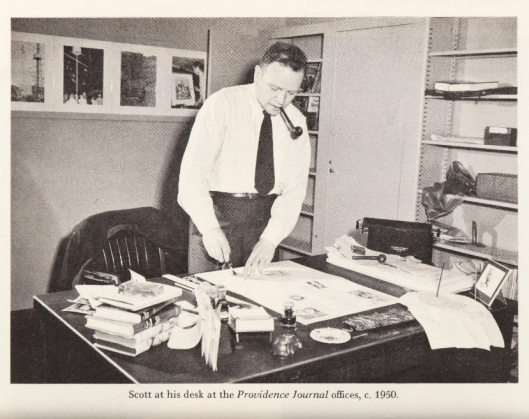
Photo of Winfield Townley Scott

I’ve found a photo of the first Lovecraft biographer, Winfield Townley Scott (1910-1968) in his prime. Likely to have been made in 1947 or 1948, at the time he was nearing the completion of around five years of writing about Lovecraft for the local newspaper and Books at Brown. The current online photos of him show an older and rather beaten-down-by-booze man.

Scott worked at the Providence Journal after his graduation from Brown, writing the “Bookman’s Galley” column in the 1930s. He later became the Literary Editor of the Providence Sunday Journal from 1944-51, before ceding the post to George F. Troy Jr.

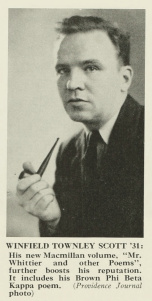
The “’31” here indicates that he graduated from Brown University in 1931.

What follows is partly a summary review of the facts given in Scott’s biography, with my additional research and commentary.


Scott Donaldson, Poet in America: Winfield Townley Scott (University of Texas, 1972).

Winfield Townley Scott graduated well from Brown University, but the year was 1931. He stepped out of the gilded gates into the teeth of the Great Depression. As such he was glad of $15 a week offer to run and edit the book section of the Providence Journal. By the mid 1930s he was supplementing his book reviewing with income from movie reviews. He also worked as a broadcaster on the radio station then owned by the Journal. His radio work introduced him to the city as a known personality and voice.

Only in 1944 was his Journal salary raised substantially and at that point he formally took the title of Literary Editor, with his weekly column being re-titled “Bookends and Odds” to reflect the change. This major career event provides some professional context for his 1943-49 work on discovering Lovecraft. Both his radio work and his new standing as Literary Editor may partly help explain his ability to get ‘memoir letters’ (and from those relatively high up in Providence society), access to childhood friends, as well as access to medical records and the confidence of a doctor.

Scott also rather bravely used his newspaper to berate New England’s literary censors, as the local Watch & Ward committees escalated their scares into further legislative force via an alliance with activist district attorneys. Again, this provides yet more context for his interest in Lovecraft’s fiction. At that time literary censorship by the police and courts was alive and well, and would only start to fade away circa the late 1960s (though the Canadian customs officers maintained heavy seize-and-destroy censorship of print, such as underground comix, well into the 1990s).

Scott first knew of Lovecraft as a horror writer in 1943, though a Scott letter to The Acolyte (Fall 1944) shows that the newspaper had dealings with him as a poet while alive. I had read somewhere that Scott once had some “correspondence” with Lovecraft, but perhaps this was only an occasional factual exchange relating to some niggling point in a book review? Anyway, 1943 is a key date in his public interest, evidenced by a remark in his 1949 Books at Brown issue and his review of the second Arkham volume of Lovecraft’s fiction for the Providence Sunday Journal

Curiously, this review does not appear in A Weird Writer in Our Midst: Early Criticism of H. P. Lovecraft. Perhaps S.T. Joshi didn’t want to stymie a possible book collection on Scott at some future date? (See below for my outline on the possible contents of such a book).

It’s well known in Lovecraftian circles that Scott wrote and published the important early Lovecraft articles “His Own Most Fantastic Creation: Howard Phillips Lovecraft” (1944) and “Lovecraft as a Poet” (1945), both published with revisions in his own Exiles and Fabrications and also to be found in the book-length collection Lovecraft Remembered and now the new collection of memoirs.

Less well known is that Scott also edited and heavily abridged a memoir of Lovecraft by his wife Sonia, published in the Providence Sunday Journal for 22nd August 1948. This later appeared, with a Scott introduction and still abridged, in the February 1949 ‘Lovecraft special’ double-issue of Books at Brown. In this Scott noted that its newspaper publication “brought forth letters of rebuttal as well as of corroboration”. Where are these letters now, from those who knew Lovecraft? Were they published? Has Brown University’s Scott Collection, with his huge archive of letters to “900 correspondents”, been checked for the original letters?

In 1951 a snippet in the Brown Alumni Monthly revealed him to be retiring from his post as Literary Editor to complete… “a book-length narrative poem on the Viking discoverers of America”. Posterity might have preferred to have a newspaperman-poet’s full-length biography of Lovecraft, made especially insightful by Scott’s own antiquarian bent, city pavement-pounding and regionalist sentiment. But as it is we have neither item, and it appears the Viking saga was either never written or was lost. By the early 1950s the general reading public anyway seemed to have less and less taste for fantasy and science-fiction, and I’d suspect that the poetic old ‘Vikings in New England’ notion of the 1920s and 30s — which had given birth to such fakes as the supposed ‘Vinland Map’ — had a fading allure for publishers in such an atmosphere.

Yet we should be grateful that Scott spent a number of years accessing rather difficult areas of Lovecraft’s life. Such as the medical records of Lovecraft’s mother, speaking to her doctor, and also getting letters from friends of the family along with newspaper-publication permission ➻. Then leaving us the first substantial and well-researched biographical text on Lovecraft. Without his boots-on-the-ground local work, several important aspects of Lovecraft’s life would be unknown today.

Some have idly insinuated that Scott might not have been a trustworthy observer of Lovecraft’s life. Well, his biography offers a partial answer. He was at that time a mature man of standing and deeply embedded in the city’s print news culture. Also in networks of literary scholarship and facticity. Here was a man who for the last 12 years had been called upon to scrutinise the detailed claims of others, as a weekly book reviewer, evaluating both scholarly and locally-known facts alongside their emotional tone and shadings. He was also a news man for the newspaper’s radio station. As such, we are entitled to assume that he took a local 1940s newspaperman’s pride in ‘reporting the facts’ and not embellishing them. It’s my feeling that if he had he been ‘making up’ claims, such as having seen the medical records of Lovecraft’s mother, then the informal ‘old boy’ and ‘old girl’ networks of the city would quickly have ‘called him out’ on the matter. As an active bisexual, newly engaged for marriage to a young heiress, he had a certain amount of standing to lose and little to gain from his curious interest in the then strange and mysterious Lovecraft. His anti-censorship stand and his published Diaries and memoirs also suggest a man scrupulously and personally dedicated to telling the truth, warts and all.

Yet he was foremost a poet and in the 1950s he was able to achieve his time-for-poetry due to his marriage to the lively young heiress Eleanor Metcalf, ten years his junior. He lived with her in Connecticut for a few years, until they went west in 1954 to join a colony of mostly visual artists in sunny Santa Fe. Part of the impetus seems to have been to give their young children an unsullied intellectual and physical landscape. They look the sullying of the landscape so seriously that they would sometimes go out at night and cut down the advertising billboards, then starting to mar the wide-open views. The Scotts also tried to en-noble their new home in more practical ways, lobbying for a college to move there and supporting the Santa Fe Opera — for which they started the youth programme. Again, we see a certain kinship here with Lovecraft — who had worked with the Irish youth to form an amateur journalism circle in Providence, who was mentor to so many young talents by correspondence, and who at the end of his life took the Jewish schoolboy Kenneth Sterling under his wing in Providence.

By now Scott was increasingly fighting the booze, but he kept his hand in with book reviews and wrote for The Santa Fe New Mexican. That title may be worth a quick check for overlooked 1954-64 reviews of Arkham books, perhaps, if someone has access to the relevant run of digitized issues. Those interested in his landscape sensibilities may be interested to know that Scott wrote a long essay on New Mexico, “A Calendar of Santa Fe”, detailing all its varieties and delights season-by-season. Looking at snippets of it, it sounds like the sort of item a local illustrator or graphic-novelist might usefully work into a new book today while interspersing it with a half-dozen local poems by Scott.


There is some potential for a Lovecraft-oriented Scott book, though I lack the finances to put it together. Here is my suggested outline:

* Memories of Newport in the 1920s, as an August 1951 memoir in the “Rhode Islander” section of the Providence Sunday Journal in which he penned “a love letter to Newport”. This was reprinted in his collection Exiles and Fabrications. Newport was where he had grown up as a child, before moving back to Haverhill for his teenage years (incidentally he mentioned elsewhere that Newburyport was considered ‘the seaside’ for Haverhill, presumably Plum Island). The dates here would approximately fit his Newport memories with the town’s ‘Lovecraft years’, circa 1920 — if Scott was recalling his town as seen through 10-year-old eyes.

* The Newport memoir was later followed by the full childhood memoir The Owl in the Hall. This was penned 1956 but only published in 1971 when its frank truthfulness meant it had small deletions made to accommodate family sensibilities. Some sources say it’s a full memoir, others a long poem, and I’ve been unable to see it.

* Any topographical poetry of Newport and Providence, relevant to Lovecraft.

* Relevant extracts from his biography (University of Texas, 1972) and his essay collection (Exiles and Fabrications).

* Memories of Haverhill and Newburyport in the 1920s (also Lovecraft places at the same time period).

* Any extracts from his well-regarded Diaries (published as a book in the 1950s), if he there describes the Providence that Lovecraft knew.

* “New England’s Newspaper World” (1943 essay).

* His 1943 Arkham Lovecraft book review.

* “His Own Most Fantastic Creation”, his essay on Lovecraft. With notes on what was revised for later re-publication.

* “Lovecraft as a Poet”. With notes on what was revised for later re-publication.

* Facsimiles of the above Lovecraft newspaper material, along with the twelve or so newspaper columns on Lovecraft, which Joshi’s Bibliography records as published 1944-49. It would be good to be able to read these in sequence.

* The Books at Brown journal had Lovecraft issues in 1944 and 1949. The 1944 issue is not scanned and online. The issues are:

   March 1944, Books At Brown, Volume 1, No. 3. “The Haunter of the Dark: Some Notes On Howard Phillips Lovecraft”.

   February 1949, Books at Brown, Scott’s foreword to his heavily abridged version of Sonia’s memories of Lovecraft. A 16 page double-issue.

* Any supernatural or R.E. Howard-like ‘Viking’ poetry (see above) he wrote.

* “The Tower at Newport” (essay, possible poetic musings on Vikings and New England?).

* Any other newly-discovered Lovecraft reviews (e.g. in The Santa Fe New Mexican, and he also wrote for the New York Herald Tribute in the 1940s).

* Suitable extracts from his letters (Brown University’s Scott Collection apparently has his archive of letters to “900 correspondents” and his 1944 handwritten journal), re: Providence and Lovecraft. “900 correspondent” suggests he had a further kinship with Lovecraft as an avid letter writer. Yet perhaps the bulk of the letters relate to his extensive book reviewing work?

* Scott also had a short letter to the ‘zine The Acolyte (Fall 1944), which shows he was in contact with the Lovecraft scene as it existed at that point.

* As an appendix, any of his reviews of 1930s horror movies that survive.


➻ Clara L. Hess, letter to The Providence Journal newspaper, 19th September 1948, later reprinted by Derleth (with some additions gleaned from an interview with her, probably conducted in late 1948) in the book Something about Cats and other Pieces, Arkham House, 1949, appearing there under the title “Addenda to H.P.L.”

Friday ‘Picture Postals’ from Lovecraft: In the Stacks

H.P. Lovecraft once had a ticket allowing him to freely access the lower “stacks” or “stack house” of the Providence Public Library, to browse among shelves inaccessible to the general public. If the public ever overheard librarians talking of “the stacks”, they probably vaguely imagined tottering towers of books stacked up in some mouldering basement. But by the time of Lovecraft’s youth the nation’s libraries employed more modern methods of bulk storage for their little-consulted items. The picture above shows what the Providence “stacks” looked like when first installed, before being filled with books and journals. They appear to have been of the usual tall sliding-case type, where the shelves are on sliders and can be compressed together to save space. The usual situation for access is that one then turns a knobbed and wheeled device at the end of certain cases, which then cracks open a walkway sufficiently large to allow entry for book or journal retrieval. One doesn’t linger, as one feels there could be another browser cranking a wheel elsewhere that could close the cases. Many such “stacks” must still exist behind the scenes, though I suspect that not many students encounter them today on the open library floors.

The young Lovecraft may well have had “behind the scenes access” to the public library, and a “stacks” card. He certainly became very fond of a Cataloguing Room Messenger & Stacks boy of about his own age, Arthur J. Fredlund. Arthur was a young and slight Swedish boy, the newly arrived Swedes then forming the largest immigrant group in Providence. Such a flood of blond beauty into the city, at such a formative time for Lovecraft, no doubt permanently influenced his conception of ‘the nordic’ in physical form. According to the Library Report Fredlund was a Messenger Boy in 1905, but Lovecraft talks of him working in the ‘stacks’ in 1906…

I came across a superficially bright Swedish boy in the Public Library. He worked in the ‘stack’ where the books were kept and I invited him to the house to broaden his mentality (I was fifteen and he was about the same, though he was smaller and seemed younger.) I thought I had uncovered a mute inglorious Milton (he professed a great interest in my work), and despite maternal protest entertained him frequently in my library. … But ere long he uncovered qualities which did not appeal to me … I never saw him more…” (21st August 1918, letter to Alfred Galpin)

Other data points for Lovecraft’s life show that their friendship lasted only from Spring to Autumn 1906, and had followed Lovecraft’s… “nervous breakdown (winter ’05-’06)” (Lord of a Visible World, page 32).


By the mid 1920s we know that Lovecraft definitely carried not only a regular Public Library borrowing card, but also a further card that would allow him to access the ‘stacks’. This was probably due to the goodwill of the head librarian, “good old William E. Foster”.

The stacks, and perhaps others like them in New York, probably contributed to Lovecraft’s idea of the library in “The Shadow Out of Time”…

These cases were stored in tiers of rectangular vault — like closed, locked shelves — wrought of the same rustless metal and fastened by knobs with intricate turnings.

I thought of the locked metal shelves, and of the curious knob-twistings needed to open each one. My own came vividly into my consciousness. How often had I gone through that intricate routine of varied turns and pressures in the terrestrial vertebrate section on the lowest level! Every detail was fresh and familiar. If there were such a vault as I had dreamed of, I could open it in a moment.

My feelings toward these shelves cannot be described — so utter and insistent was the sense of old acquaintance. … My [human] fingers, half-numb from climbing, were very clumsy at first; but I soon saw that they were anatomically adequate. And the memory-rhythm was strong in them. Out of unknown gulfs of time the intricate secret motions had somehow reached my brain correctly in every detail — for after less than five minutes of trying there came a click whose familiarity was all the more startling because I had not consciously anticipated it. In another instant the metal door was slowly swinging open with only the faintest grating sound. Dazedly I looked over the row of greyish case-ends thus exposed, and felt a tremendous surge of some wholly inexplicable emotion. Just within reach of my right hand was a case whose curving hieroglyphs made me shake with a pang infinitely more complex than one of mere fright. Still shaking, I managed to dislodge it amidst a shower of gritty flakes, and ease it over toward myself…

The insistent need for silence in opening the cases in “Shadow” may reflect something of the need to prevent creaking and rumbling when using the stack cases of the Providence Public Library. Incorrect or fumbling openings and slamming closings might have caused annoying sounds to be heard by the patrons of the silent Library above. In those days public libraries were real libraries, not children’s centres with a computer circle and a few books in one corner. A hushed silence was strictly enforced.

Another point of comparison suggests itself. Look again at the picture above an notice these items…

The lower cone-like section appears to me to bear comparison with the cone body-shape of the alien Great Race of Yith, the librarians in “Shadow”. Literary critics seeking sources always make the mistake of assuming that inspiration can only come from other literature, and the more prestigious the better. Writers know that inspiration can come from anywhere, and the more obscure it is the better they like it.

Richard Stanley’s big sword-and-sorcery movie

Richard Stanley gave a short interview to a local Austin newspaper. One of those annoying local newspapers in the USA which spams the world with its headlines and links… and then brutally blocks all visitors from outside America, displaying a message that make the said visitors feel like a criminal hacker.

But anyway… there’s a free VPN in my Opera browser, so here for all the world to read are some of the article’s Lovecraft and Howard-relevant quotes from Stanley.


His successful new Colour Out of Space movie is “designed for late nights where most of the audience would have to be slightly drunk or on some kind of substance or another.”

“He was my mother’s favorite author,” Stanley says. “She read me Lovecraft when I was a child. … I would have read ‘Color’ myself by the time I was 12.”

“Before I die, I would very much love to do a proper, fully blown sword-and-sorcery movie. I’ve mostly made science fiction, but I’m a big fantasy guy. There’s plenty of unfinished business out there.”