Zeitschrift fur Fantastikforschung – now Open Access

Zeitschrift fur Fantastikforschung is a twice-yearly German journal on the fantastic and science-fiction, from the German Association for Research in the Fantastic.

They have just taken the journal open access and Creative Commons, although this doesn’t seem to cover the many volumes of back-issues which are available to purchase in paper. The first open access issue is now online.

They have a standing call for submissions, and appear willing to review published books in English. They’re also open to transcribed and translated interviews with major figures, such as one with Tad Williams.

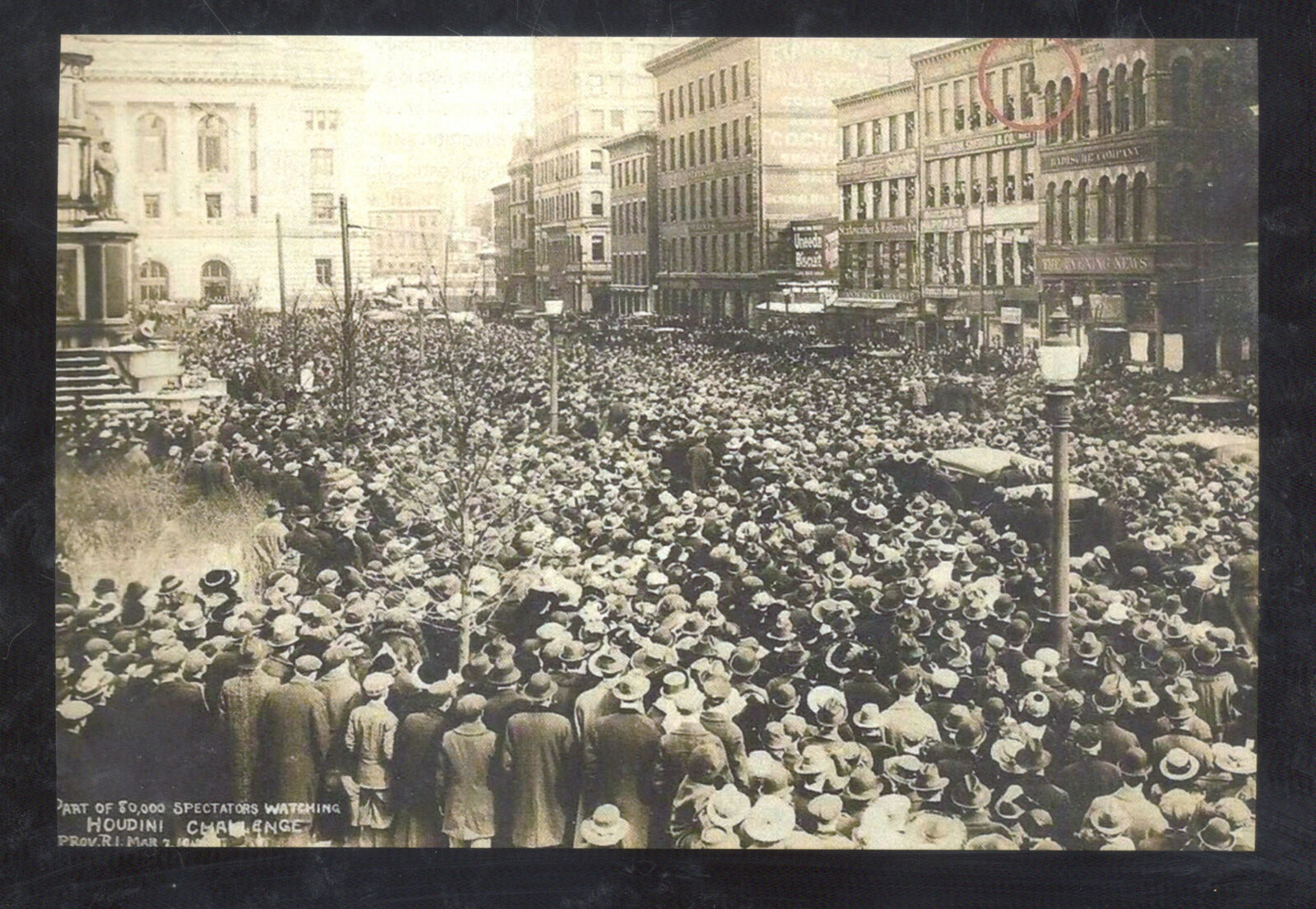
Houdini in Providence

Sold on eBay last week, a ‘Houdini in Providence’ photo-postcard. He is seen here in Exchange Place hanging in a straightjacket from the Evening News building, before a vast crowd. He is identified by the faint red circle on the card. An unreadable date, March 7th 19??, but Houdini scholars who read this blog may be able to supply the year.

In one 1920s letter to his aunts Lovecraft remarks that he never saw a “whole” show by Houdini, so perhaps this outdoor show was what he had seen at this point? Or perhaps he refers to the time of the “Pyramids” story, when he might have been talking with Houdini in his dressing-room while the warm-up acts of the show were happening on stage? Than he would presumably have gone out front into the audience to see the finale?

Update: Thanks to The Joey Zone for supplying the date. 1917, H.P. Lovecraft being then about age 26.

Update: Got a better, larger version, October 2021.

Cryptobotany Books

Three anthologies of tales of strange plants and fearsome fungi, which appear to have been mostly culled from the public domain. Available in paperback as Flora Curiosa, Botanica Deleria and Arboris Mysterius. There appears to be no ebook or audiobook editions.

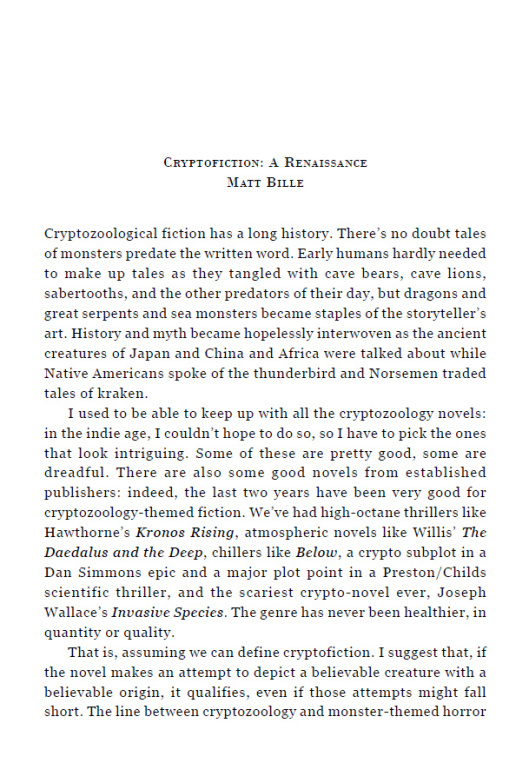
Amazon also reveals the anthologist to be the editor of a journal titled Biofortean Notes. Volume 4 (2015) of this had a survey of “Cryptofiction: A Renaissance”. Only eight pages, but it may interest fiction writers who want to learn what’s been done up to circa 2014, and those seeking adaptable work. “Crypto” here meaning cryptozoology rather than Bitcoin.

But before you go cashing in your $8k Bitcoin to buy copies of the journal at Amazon’s often rather silly prices, note that BioFortean Notes is currently free in PDF, and there are free issues up to 2018.

Perhaps S.T. Joshi would also welcome a survey of cryptobotany in fiction and graphic novels, from 2000-2020, for his new journal Penumbra?


Loosely connected to the theme is this curious twisted pear, in Lovecraft’s time located at the old Dyer residence near Providence. Lovecraft had the Dyer name in his family tree, so may well have visited and seen it. One thinks of Lovecraft stories such as “The Tree”.

Memoirs of pulpster

New on Archive.org, “A Penny A Word”, being the detailed and lively memoir of an anonymous pulp writer who entered the field circa 1924-26 and spent a decade in it. The memoir appeared in The American Mercury, March 1936.

Who knew Submarine Stories was ever a real title? It appeared early 1929, but six months later ran into the teeth of the Great Depression and is said to have folded after 13 shaky issues. As such, it can’t have appealed to H.P. Lovecraft as a market, even though he had tried his hand at submarine tales in “The Temple”.

Milan Machinima Festival 2020: “The Weird, the Eerie, and the Unreal”

The 2020 theme of the Milan Machinima Festival is to be “The Weird, the Eerie, and the Unreal”. This is the third Italian festival on machinima, celebrating animations and films made with real-time rendering engines (videogame engines, mostly) and bringing the best of such work to the big screen in Milan as part of its Digital Week. The dates are 9th-13th March 2020 in Milan, Italy.

The Secret Adventures of Jules Verne

I’m pleased to discover The Secret Adventures of Jules Verne, a 22-hour series which was the flagship series for HD TV, back in 1998-2000 when HD was a new thing. They cast well, spent $2m an episode, had lots of VFX, and superb and inventive scripts. Judging by the first few episodes it seems it paid off, and is a welcome reminder of the days when TV stories were stories, not an excuse for a string of political lectures.

But who knew there was such a thing, in steampunk? I’d never heard of the show before, despite it being loved by a hardcore of (rather quiet) fans. Part of the reason for that is that the show has never been released on DVD. Comments in old Starlog magazines suggest there was a very poorly promoted HD showing, and one gets the impression that most sci-fi fans had no clue it was even running. Then it was badly converted to film (too dark and muddy), for showing on the American TV channels. At that point the channels could not handle HD, and the result looked disappointing to many. Thus it appears that the old VHS TV captures are all the fans have in 2020. Not ideal, with the sumptuous costumes being an especially regrettable loss — they get smudged into down into a dark haze. But appears to be quite watchable. A very fractious set of investors apparently prevent any new HD release in the 2020s, with the HD masters presumably crumbling away in a vault somewhere.

Starlog #287 (2001) has the best extended magazine article on the series and what it was trying to do.

New book: Flame and Crimson: A History of Sword-and-Sorcery

A new article on “Why I Wrote Flame and Crimson: A History of Sword-and-Sorcery”, by the author. The article opens with some useful signposting to previous worthy attempts at such.

I definitely don’t care for book’s front cover, with a skeleton-warrior seen sporting a curious pose. He looks likes he’s been caught by a flash-photograph at the moment of passing a chalk-turd. But Flame and Crimson is a welcome 290-page book, and it’s published today. The author states that…

Flame and Crimson is an academic study of the genre, principally on its literary antecedents and key contributors. It’s heavily referenced with a lengthy ‘works cited’. I wanted to publish something authoritative and not (solely) opinion-based, that readers could use as a springboard for further research or pleasant Saturday afternoon of Internet searches. [Yet] I didn’t want to write something dry and pedantic. One of my goals was to try and tell an exciting tale of non-fiction. Sword-and-sorcery has a story of its own to tell, of a confluence of pulp talent, a mercurial renaissance, a staggering commercial fall, and a second life in the popular culture. I wanted to write the kind of academic study that I’d want to read — informative, but also entertaining.

Currently only in paperback, and let’s hope the eventual ebook will have a front cover that’s more mighty-thewed and appealing to the masses. As for the contents, here’s the TOC…

The Xothic Cycle in ebook

Amazon lists a new £3.99 ebook edition of The Xothic Cycle by Lin Carter, for publication 26th March 2020. It’s from Gateway, ebook re-publishers of the Gollancz yellow-covers of yesteryear. It’s possibly not completist, though, as the blurb calls it the first such book…

This is the first collection of Lin Carter’s Mythos tales; it includes his intended novel, The Terror Out of Time.

“First” of two or three? As such I suspect this is not to be confused with the Chaosium title The Xothic Legend Cycle: The Complete Mythos Fiction of Lin Carter, edited by Robert M. Price. If you can’t wait for the 2020 ebook, then the Price collection can currently be picked up in paperback for £10 inc. shipping, and has an introduction by Price to each story. According to a Table of Contents kindly posted by the late W.H. Pugmire it doesn’t, however, include the “intended novel, The Terror Out of Time” — which the ebook apparently does.

Was Carter any good as a Mythos writer? It’s not all that easy to quickly find out. He was a pro, and yet S.T. Joshi has little to say about Lin Carter as a fiction writer (rather than a scholar and critic) in the book The Rise and Fall. One has to snuffle around in the sparse online comments to get a sense that Carter was post-Derlethian in his free-wheeling and name-spawning approach to the Mythos. I don’t get the sense he was going reverently back to the master and trying to fill in the gaps, in manner that was both relatively seamless and stylistically congruent.

W.H. Pugmire was rather more helpful in giving an opinion, remarking in an Amazon review of the Price book that…

The writing in this book may not be first class, but dang if this isn’t an amazingly FUN book to read.”

He also implied there was no attempt to mimic Lovecraft, with Carter’s…

style being that of a story-teller, plain and simple. I find the writing style in this book extremely pleasant, and the narratives flow easily.

Thus it sounds like a fun book for completists. But don’t expect to encounter Lovecraft’s style, or a Mythos with the Derlethian accretions chiselled off.

Also from Carter, A Look Behind the Lovecraft Mythos seen here in the Panther paperback edition…