The Carrington House

Some pictures of the Carrington House in Providence, which Lovecraft visited in 1936.

The frontage…

And what appears to have been effectively the back…

In the early life of the city the gardens were regarded as among the finest made in Providence…

I can’t get more than a snippet but he mentions the house, and visiting it, to Derleth in both volumes of the Lovecraft-Derleth letters…

… thrown open as public museums … The Carrington house (built 1809[-11]) is less classical in its symmetry, but is remarkably homelike. With its stables, courtyard, coach-houses, & extensive grounds, it forms one of the finest domestic units of the Early-Republic now on exhibition. The estate has been given to the R.I. School of Design …

A repository record of a late letter from Lovecraft to Elizabeth Toldridge, reveals that in 1936 he… “Gives his impressions of the Brown and Carrington mansions which have opened as public museums”. The House opened as a public museum in 1936.

The Office…

On the walls he would have peered into some faded mythic scenes…

This modern use of the same wallpaper shows the scenes…

The back gate on the street, circa the 1940s, where Lovecraft may have emerged after his tour…

February on Tentaclii

Weary winter winds wizzle their way around Tentaclii Towers, offering spitterings of sleet. Lines of geese honk through the grey skies, newly back from the warm south and eager to shiver and hiss on perilous nests along the inner-city canals. Tentaclii’s own nest has been well-feathered in February, as daily or even twice-daily posting has continued. Although the fabled ‘golden egg’ has yet to be laid, as my Patreon total remains at $57, having lost $4 + $1 and gained a new $5 patron. If you are a potential patron and can afford even $1 a month, then it would be very encouraging. Being able to purchase a few more ginger beers might even help me ward off a virus or three. Apparently the virus has just arrived yesterday in the Tentaclii Towers hinterlands, via holiday-makers returning from the Canary Islands and Italy.

Two quality journals new to me were discovered this month: Fantasy Art and Studies; and Gramarye: The Journal of the Chichester Centre for Fairy Tales, Fantasy and Speculative Fiction. A new issue of the German Lovecrafter No.6, December 2019, was also noted. There were a number of calls and opportunities posted here, such as The Miskatonic Scholarship, and calls for The Pulpster and others. I noted that The Dark Man appears to need a publicist, and perhaps also a cover-artist, for each issue.

The month was light on new books but one was noted, Clark Ashton Smith: A Comprehensive Bibliography; and I was pleased to hear of a recent Spanish volume translating Lovecraft’s best poetry. I was also pleased to find The House of the Worm in ebook, and the comments on that post usefully got some of the publication history straightened out with the help of the author himself. A few more scholarly items were added to the Open Lovecraft page.

Various new pictures of Lovecraft’s Providence were found, including an aspect of the art of the Brown campus that I’d not previously known about. I also took a quick pictorial dive into what Lovecraft’s Quebec might have looked like. Various bits of Lovecraftian art were posted, and some tangentially related art / science exhibitions noted. Some passing attention was also paid to Lovecraftian videogames, and for film-makers there was a call for the H.P. Lovecraft Film Festival 2020. Here in the UK interest in Lovecraftian theatre continues to build — there’s a substantial theatre tour of Lovecraft’s work in 2020, from a noted performer.

Leaping Lovecraft

For Leap Day, what better than a small selection of Lovecraft on the topics of “leaping” and “leaps”…

* “Leaping, floating, flying down those endless stairs…” — “Erich Zann”.

* “Occasionally the things were shewn leaping through open windows at night…” — said of creatures depicted in paintings, in “Pickman’s Model”.

* “The urge to walk was gradually changing to an urge to leap mystically into space, and suddenly he realised just where the source of the pull lay. It was in the sky. A definite point among the stars had a claim on him and was calling him.” — “Dreams in the Witch House”.

* “… little specks of light leaping out one by one till the expanded sea of roofs is one titanic constellation” — Lovecraft describing watching a vista of Providence, slowly sliding from sunset into night.

* “The leap of the cats through space was very swift” — the Cats of Ulthar return from the Moon to the Dreamlands, in “Dream Quest”.

* “And on summer evenings in the twilight he [a kitten] would prove his kinship to the elfin things of shadow by racing across the lawn on nameless errands, darting into the blackness of the shrubbery now & then, & occasionally leaping at me from ambush & then bounding away again into invisibility before I could catch him.” — Lovecraft recalling his beloved childhood cat.

* “art has no parallel for the bewitching grace of the cat’s slightest motion. … whilst the unerring accuracy of his leaping and springing, running and hunting, has an art-value just as high in a more spirited way” — “Cats and Dogs”.

It’s 1955, and L. Sprague de Camp is reviewing The Lord of the Rings…

In August 1955 L. Sprague de Camp reviewed new Conan books and The Fellowship of the Ring, in Science Fiction Quarterly, August 1955.

Worth reading right across the spread, as it’s ‘all of a piece’. For those who have somehow not yet enjoyed The Lord of the Rings, note that his review has plot spoilers for the first volume. At that time the second of the three volumes was not yet published.

Camp must surely have here been the first to draw the comparison between the modus operandi of the ring in the Conan novelette “The Phoenix on the Sword” (1932) and The Lord of the Rings. Had he had the other two volumes, he might also have compared other aspects of LoTR with the Conan novel The Hour of the Dragon. But at that time de Camp was set for a tantalising wait to read the third volume, The Return of the King, which appeared in 1956.

Another interesting bit of historical trivia is that de Camp remarks that “Conan the Conquerer has been published by Boardman” in the UK in 1954, and of course the first volume of The Lord of the Rings appeared in July 1954. I can’t discover exactly when in 1954 the British Conan book was published, but it was obviously a good year to be a young British fantasy reader — if one was savvy enough to avoid the juvenile disaster of confusing 1954’s The Lord of the Flies with The Lord of the Rings.

Less than a year later de Camp went on to note the second volume of The Lord of the Rings, The Two Towers, in the Science Fiction Quarterly for May 1956. Complete with what must have been a very annoying salvo of massive plot-spoilers for the unwary reader…

It appears that de Camp never similarly reviewed The Return of the King, and thus the entire epic. Which is curious. I can’t find even a brief mention of it from him, which one might have expected after all the build-up he’d given it. But according to The Lord of the Rings, 1954-2004: Scholarship in Honor of Richard E. Blackwelder (2006)…

L. Sprague de Camp, in Science Fiction Quarterly, reviewed only the first two volumes.

A dastardly plot by the commies of the time, to suppress the book? Something like that happened to some extent and informally over the following decade, but no… it’s more likely that de Camp just quit reviewing for the magazine circa 1957. Because the magazine’s distributor went bust in 1957, and less copies on the news-stands meant that the magazine was only able to struggle on until February 1958. There were no more issues after that.

L. Sprague de Camp does, however, mention the final volume of LoTR in his book Literary Swordsmen and Sorcerers: the Makers of Heroic Fantasy (1976), where he has a chapter on Tolkien. By then the mood of the times had changed very radically, and 1976 was certainly not 1956. A version of the book’s chapter appeared in Fantastic: Sword & Sorcery and Fantasy Stories for November 1976 (Vol. 25, No. 5), under the title “White Wizard in Tweeds”. This wastes about half the article, first in a tedious defence against the ever-tedious Edmund Wilson (he hated Tolkien, as well as Lovecraft — for him The Lord of the Rings was “juvenile trash”). Then in explaining hobbits to the Fantastic reader who had somehow not heard of them by that time, and giving creaky plot-summaries of each volume. After some potted biography and a too-short account of his one-off meeting with Tolkien, he picks like an antsy fanboy at apparent logic-holes in LoTR. We don’t get any real sense of the “lascivious” passion that de Camp had evidently felt 20 years earlier, on first reading most of LoTR. Perhaps his 1976 article’s comment that “one can find flaws on re-reading” explains his lack of personal sentiment, in all but his obligatory-laudatory final line of the essay (“Few have equalled…” etc). Personally I find that The Lord of the Rings improves and deepens like a coastal shelf on re-reading, if one is paying close attention, but I get the feeling that in his old age de Camp kept getting hung up on what he perceived as niggling surface “flaws”.

Call: 2020 Pulpster

The 2020 issue of the PulpFest’s annual journal The Pulpster is seeking articles. The lead theme for 2020 is “Ray Bradbury”, but the editors state they already have enough articles in-hand about his life and work.

If you have a proposal for an article, please contact editor Bill Lampkin. Articles and artwork must be submitted by the end of April. Bill can be reached at bill@thepulpster.com.

For advertising, please contact PulpFest marketing and programming director and THE PULPSTER publisher Mike Chomko at mike@pulpfest.com.

Added to Open Lovecraft

Added to the Open Lovecraft page on this blog…

* J. E. Stephens, “The Expert as Character in the Work of Le Fanu and Lovecraft: Spirituality, Empiricism, and Rationality”, B.A. degree dissertation for the University of Arizona, December 2019.

* G. Harman, “Horror of Phenomenology: Lovecraft and Husserl”, Philosophy, Ethics, Religious Studies, #5, 2019. (In Russian. Drawing on and presenting in Russian some of the Lovecraftian ideas of Graham Harman, relating to Lovecraft, the object and its ‘objectivity’. Appears to be a translation of a text by Harman?)

And not yet on the page, but set for release to open access in December 2020, “The Geography of Horror: Lovecraft’s (Re)construction of New England”.

The Miskatonic Scholarship

George R.R. Martin (A Game of Thrones) has announced he is offering The Miskatonic Scholarship… “for a promising writer of Lovecraftian cosmic horror”. The winner gets an intensive six-week workshop retreat for “aspiring writers of science fiction, fantasy, and horror” in New Hampshire. Entrants will need to complete a Financial Need Statement which is due to be available 1st April 2020.

Scroll down the page to also find details another fund for the same New Hampshire retreat…

Applicants from the New York Metropolitan Area (including New Jersey) who are accepted into Odyssey [the New Hampshire writing retreat) are eligible to apply for a scholarship from the Donald A. and Elsie B. Wollheim Memorial Scholarship Fund.

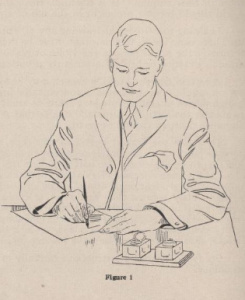
“the process of handwriting is no effort at all”

Learning Everyday Penmanship in the 1920s. Quite a craft, it appears, requiring a 90-page how-to manual with lessons!

According to Lovecraft…

“the process of handwriting is no effort at all unless one aims for great legibility & ornamentation. The reason moderns think handwriting is hard, is that they have never practiced it enough to get used to it.” — H.P. Lovecraft, Selected Letters III.

Tour the Brown campus

New on Archive.org, “A Sense of Place: David Macaulay surveys the Brown University campus”. A campus production dated 2010, newly uploaded…

Our guide for this look at the Brown campus is David Macaulay … view one of America’s historic campus landscapes through the lens of a camera and the eyes of one of America’s best-known illustrators.

Or not. It seems that Brown has managed to lock the actual media file on archive.org, and only its generic graphic can be downloaded. However, one can still grab the 340Mb audio podcast as a public download from here. It turns out to be a 26-minute VHS quality video. It’s also on YouTube, with what appears to be even higher compression.

Call: Papers on the Fantastic

The Northeast Alliance for Scholarship on the Fantastic and the Allied Fantastic Areas (NAS-FAFA?) is calling for papers for a conference at Southern New Hampshire University, in October 2020. Deadline: 1st June 2020. The venue is said to be “two hours from Providence”, by American reckoning of such things.

1) Specifically they want new papers that highlight ‘Wonder and the Marvellous’…

the more positive aspects of the fantastic genre … texts that bring about a sense of wonder in their receivers through their representation of the marvellous

Which seems to fit Lovecraft’s Dreamlands tales, and opens the door for a rare appreciation of tales such as “Iranon”, “The Cats of Ulthar”, and even “Hypnos”, or a survey of the quite extensive influence of his Dreamlands in rock music and comics from circa 1966-1986. “Hypnos”, especially, has been curiously neglected by critics. For instance, neither Joshi or Klinger have annotated it despite its rich vein of references and allusions. But I have an annotated version about 70% done, which will fill that gap, and which may perhaps be released for Lovecraft’s 2020 birthday.

2) The other part of the call is for ‘Monsters & the Monstrous’. But specifically papers on the scariness of such things, and how in devising such scariness an artist can draw on other traditions…

the things, whether mundane or marvelous, that scare us [discussed in papers which offer] fresh explorations into [how creatives have drawn on and transformed] texts from various countries, time periods, and media.

Which may offer some possibilities for paper on Lovecraft’s uses of the Classical tradition, and Lovecraft’s creative transformation of his fear of seeing the tradition’s dissolution in the face of modernity.