April on Tentaclii

The verdant greenwood once again embowers Tentaclii Towers, and an eerie hush covers the rolling acres. The new springtime heat imparts heat-shimmers to the air, their undulations disturbed only by the faint pulse of ambulance sirens. Stoke-on-Trent, for all its rumbustious reputation, seems to be taking the ‘bat flu’ (as I’ve heard it called here) well. And surprisingly quietly, given the usual levels of noise-pollution. Most adults are treating the lockdown as paid gardening-leave and the surprisingly chilled kids see it as school-holidays. This attitude is aided by the chance occurrence of a glorious run of weather — which has been both not-too-hot and relatively insect-free. One suspects the city won’t be so quiet once the UK lockdown is effectively and officially over, which at my guess will perhaps be Week Nine (Friday 22nd May). At which point Stokies will roar out of their homes seeking a Bank Holiday weekend of beer and beats, bonking and biffing, shopping and re-stocking.

The arboreal stillness has been a suitable atmosphere for my final stretch of reading into the Barlow-Lovecraft letters, O Fortunate Floridian. The letters inspired a post on The Haunted Castle, a 1927 study of the weird, in which I pin down its dates in relation to Lovecraft’s own survey in the same year. Another mention in the Barlow letters also inspired me to peep inside the Annmary Brown Memorial at Brown, a curious mausoleum-museum-library which Lovecraft showed to Barlow on a Providence visit. The Annmary Brown Memorial is yet another example of the Brown-Lovecraft overlap, something which existed despite Lovecraft having no formal connection with the university other than tangentially via his aunts and their circle. I suspect we may learn even more about such small points of informal Brunonian connection when ‘the aunts letters’ are released this summer.

A few weeks ago ‘Sci-Fi-Bookworm’ kindly posted a 1949 Arkham Sampler on Archive.org. This led to a chain of events which culminated in my making a major discovery. The Sampler had lauded S. Fowler Wright as the author of one of the key pre-1948 science fiction classics, and tantalisingly noted a similarity with Wells’s The Time Machine. That alone was enough to interest me, but I was also pleased to learn that Wright was from my own Birmingham / Staffordshire / West Midlands, which led to a long biographical post on Tentaclii.

Talking of aeon-lost scrolls wot the olde master writ himself, this month my bookshelves have been slightly re-organised to accommodate my growing number of Lovecraft items. I’m now a proud ‘one-and-a-half shelf’ Lovecraftian, with the remainder of the ‘new’ shelf accommodating my former pile of recent Tolkien print books. Hopefully by the end of the summer I’ll be a ‘two-shelf Lovecraftian’. My thanks to my Patreon patrons who’ve helped me acquire several chunky new volumes of letters and a handful of Lovecraft Annual issues. I’m currently reading through the latest Lovecraft Annual, with a view to a review-post in May.

Rather less momentously than my “Shadow” discovery, this blog’s Kittee Tuesday post-series made a return after its paws for thought, showing a fabulous rooftop ‘court of the cats’ from among the etchings in Chats et Autres Betes (1933). Again, this post was inspired by a brief mention in the Barlow-Lovecraft letters, and my online research dug up the marvellous picture at a good size.

Another excavation of a lost gem included my discovering the seemingly forgotten author Christoper Anvil and his fun 1960s Interstellar Patrol series, this time found due to my needing to find ‘sci-fi jungle’ paperback art for a Digital Art Live magazine feature. Like many of those Cold War guys from the U.S. Air Force, Anvil could could certainly write compelling fiction. Did they have some Top Secret Psy-ops training in hypnotic writing, during the Cold War? It seems so, and as such the forthcoming Tantor audiobook of his Interstellar Patrol should be a corker. Incidentally the ‘sci-fi jungle’ paperback art feature is to be found in Digital Art Live #48. At the back of the same issue there’s also a new ‘composite’ interview with movie director and FX pioneer George Pal, illustrated with newly colourised old press pictures. He made one of my all-time favourite movies, The Time Machine (1960), so I was pleased to do quite a bit of work digging the interview out of hard-coded subtitles and other deeply buried and utterly forgotten sources. As with S. Fowler Wright, George Pal is a 20th century science-fiction pioneer who is in dire need of a good book-length biography.

Various freebies were noted here, though not so many as of late. These included Conversations with Ray Bradbury, and Archive.org’s lockdown easing of its “Borrow” library arrangements. I also released a handy bundle of early H.G. Wells ebooks for your possible lockdown perusal, plus a book cover for possible POD use by my Patreon patrons.

In the arts, I made another survey of the best new Lovecraftian art on DeviantArt, with the charcoal art of ‘NikolaUzelac’ being a major find. I spotted that Gou Tanabe’s graphic novel of “Innsmouth” begins publishing in Japanese in May 2020, and found that his “The Shadow Out of Time” adaptation has still only had a French edition. I enlarged and coloured a reasonably good yearbook picture of Anna Helen Crofts, collaborator with Lovecraft on “Poetry and the Gods” (1920). There was a Patreon-only post here on the almost-movie The Cry of Cthulhu.

This month was light on links to podcasts, but I noted a strong episode of The Lovecraft Geek podcast (#4, new series), and Perfect Bound had a podcast survey of Lovecraftian horror in comics.

Several strong scholarly items were found and added to my Open Lovecraft page, and I’m pleased to see the major Tolkien scholar Thomas Honegger is turning his attention to Lovecraft.

Newly published books noted here included: a new edition of Bookery’s Guide to Pulps & Related Magazines; the Algis Budrys collection Beyond the Outposts: Essays on SF and Fantasy, 1955-1996; the free Fandom in the UK, 1939-1945; and the expensive academic book Weird Fiction and Science at the Fin de Siecle. New ‘forthcoming’ academic books noted included Aliens, Robots & Virtual Reality Idols in the Science Fiction of H.P. Lovecraft, Isaac Asimov and William Gibson; and another on some of the gothic influences to be detected in the apparently rationalist Sherlock Holmes tales.

Well, that’s it for this month’s round-up. If you can help boost my Patreon by a dollar or two, please, it would be much appreciated. If the virus doesn’t carry me off, then it’s quite possible that later in 2020 my Patreon patrons may get ‘early access’ to a chapter or two from my big Tolkien book.

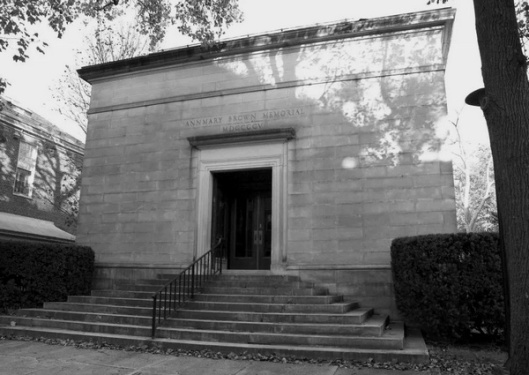
Picture postals: Brown, the “Annmary Brown Memorial”

The Barlow letters reveal that H.P. Lovecraft knew the Annmary Brown Memorial, located on a quiet part of the Brown campus.

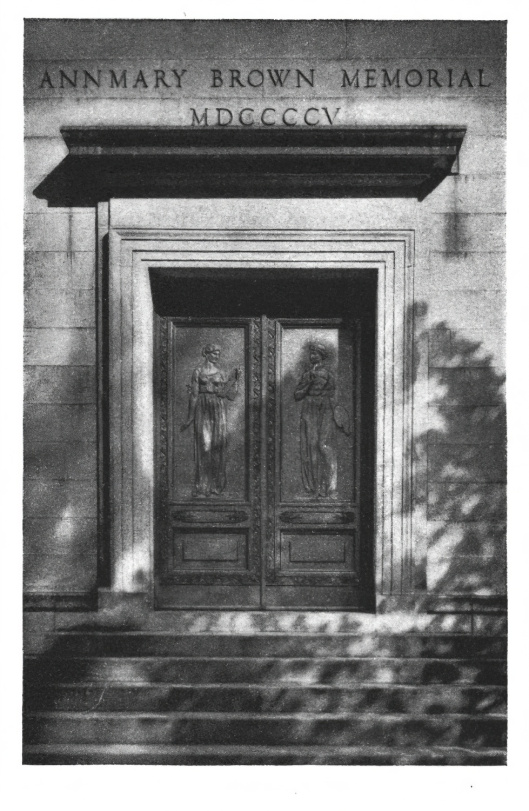
Picture: ‘Literature’ and ‘Art’ on the entrance doors.

The 1907 Memorial is at once a tomb, a 530-volume library of the rarest books from the presses of the first printers (circa 1450-1500, aka ‘incunabula’), and a substantial fine art gallery. Many early woodcuts were apparently also on display, showing their early use in book illustration. A catalogue for the Gallery was issued in 1913, and a descriptive essay book on the Memorial appeared in 1925. The latter evokes the scene as Lovecraft would have enjoyed it, after entering through the doors depicting personifications of ‘Literature’ and ‘Art’…

On a midwinter when a blanket of snow darkens the skylights overhead, the fire burns the brighter on the hearth. A sidelight from the glass doors of the vestibule catches on the burnished goldleaf of the initial letters and illuminated borders in the gallery of early printed books. Some ray will touch the lattice-work and tracery of the gold-bronze door which at the far end of the building leads into the mausoleum where General and Mrs. Hawkins lie entombed. … Like its exterior, the building itself is without embellishment save for the books and pictures with which its walls are lined. The entrance hail, its walls a neutral green, is hung with water-colours and etchings … At the left is the curator’s study with its reference books and cheery fire … an open doorway leads into the galleries, the first of which contains the early printed books. … In the tall glassed-in cases which line the walls of the first gallery, the shelves are made to slant like book rests. On them are laid these “first books”, opened such that their individual characteristics may be studied with ease; and an impressive display they make, their texts as clear and the linen paper almost as immaculate as the day they came from the press. … Venerable as they are, they show few marks of age as they rest content in the light and pure air of their final home. … A surprising number of these early printed books are still in their original bindings, oak boards covered with tooled pigskin or with vellum now taut with age, and in some instances with bosses and clasps still intact.

Picture: The book galleries as Lovecraft would have known them, and almost the same as in a 1908 picture of the same view. Note the Lovecraft-alike man in the next room, viewing the pictures.

Given the 1907 opening date and the original bindings of the books, there is the interesting possibility that such ancient books helped to form the young Lovecraft’s eventual idea of the Necronomicon, at least in terms of what the hoary tome might have looked like.

Offsetting the books was a huge vivid painting by veteran traveller and artist Edwin Lord Weeks. “The Golden Temple” formed a centrepiece of the Gallery section, and depicted the holy temple of the Sikhs. Lovecraft would have seen this work in its prime, as in later decades it was long used as a ‘test canvas’ for teaching student conservators how to clean a painting. The sunlit scene thus became very ‘patchy’, but has recently been painstakingly restored as much as possible.

This picture was accompanied by another large work from Weeks, “Caravan Crossing the Desert”. “Caravan” is not online, but was described in 1916 as being “beautifully executed in high academic style” … “buff sand and the dark blue of the African sky, with vigorous figures of Arabs and camels in the foreground.” One imagines that Lovecraft would have recalled his story “The Nameless City” on seeing such a work, or perhaps Abdul Alhazred.

His ancestral interests in England meant he would also have paused long before Lamorna Birch’s “Cornwall”, in which great windswept clouds are said to race over the Cornish downs. A picture by Adriaen van Ostade of an aged wandering fiddler might have recalled to mind his “Erich Zann”.

That Lovecraft knew the interior of the Memorial is evidenced by his planning to take young Barlow there on a visit to Providence. Barlow was, of course, a fine printer and developing a connoisseur’s taste for papers, bindings and inks. One imagines that the Memorial had also been on the itinerary for some of Lovecraft’s other visitors, at least those who would not feel bored and would benefit from closely observing the bite of type into laid paper, the sheen of oak-gall ink, and the hand-tooling of animal skins. In his time the Memorial was quietly open to the discerning for four days a week, and it was free to enter — an important point for the impoverished Lovecraft.

Ol’ Abe

Currently going through AbeBooks, a whole lot of editions carrying early Lovecraft material, such as the Tryout, National Amateur, Wolverine etc.

Sample titles:

* The National Amateur, May 1926, with “Polaris” by H. P. Lovecraft.
* The Vagrant, July 1918, with “The Poe-et’s Nightmare: A Fable” by H. P. Lovecraft.
* The National Amateur, January 1922, with “The Street” by H. P. Lovecraft.

Also items such as In Memoriam Howard Philips Lovecraft. Recollections, Appreciations, Estimates by Paul Cook, The Driftwood Press, Vermont, 1941.

All at ‘rich collector prices’, unfortunately, but some may be interested.

The Lovecraft Geek Podcast #4 (new series)

I’m pleased to find The Lovecraft Geek Podcast – New Series #4 (February 2020). I missed this, earlier in the spring, but here’s the link. It’s an excellent set of questions for Robert M. Price, this time around, and he rises to the challenge.

At the end of the The Lovecraft Geek podcast Price reveals he has a new book of short stories available, Horrors and Heresies, in which horror meets various aspects of religion. Price is, of course, an expert on the Bible as well as on Lovecraft and sword-and-sorcery, so a joining of the three should be especially succulent. If you want to know more of the anthology, the podcast The Free Thought Prophet #195 recently brought him onto the show to discuss the new collection.

I can also add a couple of small pointers to the questions and answers in this latest Lovecraft Geek.

i) On the ‘Poe’ question, there’s what appears to be a strong new book The Lovecraftian Poe which would be useful for the enquirer.

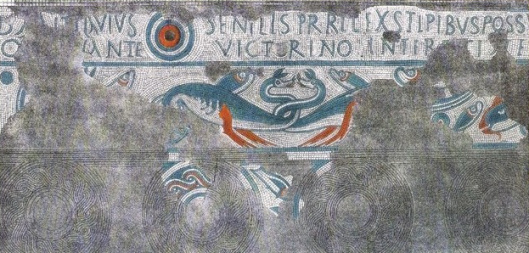
ii) On the ‘Nodens’ question, I can add that Nodens was once a god in ancient Britain, and this fact had been known among antiquarians after excavations at Lydney in the 1770s and became briefly known again when an additional find was written up for publication in the 1880s. This material and the name must surely have been known to Machen. Machen’s fictional use greatly impressed Lovecraft, who wrote in a letter…

I’ll never forget that pillar raised by Flavius Senilis to Nodens, Lord of the Great Abyss

Machen having the inscription read: “To the great god Nodens (the god of the Great Deep or Abyss) Flavius Senilis has erected this pillar on account of the marriage which he saw beneath the shade.”

Lovecraft had first discovered and read Machen’s work in the summer of 1923, and Nodens then appeared in Lovecraft’s “The Strange High House in the Mist” (1926) and Dream-Quest (1926-27). It seems quite plausible to assume, as Joshi and others have, that Lovecraft had been unfamiliar with Nodens prior to 1923. My quick search of Google Books for the 19th century and for 1900-1924 confirms this strong likelihood. You couldn’t look him up in an encyclopedia, it seems.

Nodens appears to have been only a brief dalliance by Lovecraft, as there seems to be nothing lurking in the poetry. But his lack of any pursuit of the god into Dunsanian realms was perhaps timely. Since there was a flurry of publicity by 1929 around the Nodens name, which would have constrained any continued use of the name in fantastic fiction. The name and site at Lydney became closely associated with the discovery of a lost golden ring, known as ‘The Vyne Ring’, and a curse. The discovers put a call through to one Professor Tolkien, who kindly wrote a learned philological essay on the name Nodens in the light of the new finds. His essay is to be found in good form in the back of the Report on the Excavation of the Prehistoric, Roman, and Post-Roman Site in Lydney Park, Gloucestershire (1932) and reprinted in Tolkien Studies #4 (2007).

Fourth-century inscription dedicated to Nodens, at Lydney, with sea-dragons. Note the Sauron-like staring ‘eye’.

Tolkien’s linguistic pursuit of the name led him to find a cognate across the Irish Sea in Nuada Argat-lam, he of the lost hand. There is thus a possible origin here for Tolkien’s idea of Sauron and the ring of power. Since Sauron lost a severed finger and with it his ring, and thus most of his power was lost. This key idea is not so far, at least in its basics, from a quick imaginative combination of the lost and cursed golden ‘Vyne Ring’ + the lost hand of Nuada.

New book: Fandom in the UK, 1939-1945

Rob Hansen’s new and free ebook HOMEFRONT: Fandom in the UK, 1939-1945 may interest those exploring the years immediately after the death of Lovecraft. 163,000 words of primary and memoir material from and about British fandom during the Second World War…

There was a scheme afoot to materialize Lovecraft [among the spiritualist mediums of wartime London]

Well, there’s a cue for a new Mythos and Lovecraft-as-character story. Just add some rival Blackshirt occultists, and a guest appearance by Churchill accompanied by his (apparently) wartime industrial-production consultant S. Fowler Wright.

The Joy of Information

This call-for-papers may tickle the fancy of lovers of deep and dusty research, and those who enter a library with a pocket digicam and a piratical grin. The Joy of Information: A Library Trends Special Issue

This special issue of Library Trends features writings that explore the relationship between information and joy [in an issue that] brings together bright and uplifting views of information to contrast with critical or problem-oriented perspectives that color our literature in grayscale.

They appear not to want to see proposals, but rather full-papers submitted by 1st August 2020.

Kittee Tuesday: I Don’t Want Moths

I Don’t Want Moths by Jade Armstrong, a fine little free cat (and moths) comic on Itch.io. I’ve been on Itch.io for a while, only for the 3D software Flowscape, and had no idea they also had a comics section. Looks like it’s large and thriving, and the presence of Atomic Robo on it inspires confidence. Checkout and downloading is very easy, and this particular comic comes as a .PDF file.

Grand Comics Database

The Grand Comics Database. It’s more or less the ‘IMDb for comic-books’. Back in 2016 Mike Monaco of The University of Akron gave it an assessment for librarians. As of 2020 they have 850,000 cover scans, so it’s also a resource for historic illustrations. The service is probably something that makers of Lovecraftian and related comics want to be sure they’re listed on, and listed correctly with a cover picture.

New book: Beyond the Outposts: Essays on SF and Fantasy, 1955-1996

Algis Budrys, Beyond the Outposts: Essays on SF and Fantasy, 1955-1996, newly published in the UK by Ansible. There’s a lot in the book’s 211,000 words. But of possible special interest to readers of Tentaclii are…

* “Non-Literary Influences on Science Fiction”, “exploring in disquieting depth how magazine stories were routinely cut, padded or rearranged for production reasons beyond the control of author or editor”.

* Science Fiction in the Marketplace.

* Pulp!

* Writing Science Fiction and Fantasy.