Joshi’s new ‘Advance of the Weird Tale’ and ‘Varieties of Crime Fiction’

S.T. Joshi’s blog has updated and he has news of another new book, his The Advance of the Weird Tale. This being his “miscellaneous essays on weird fiction”, and available now in Kindle. It anticipates another collection, as yet unpublished, to be titled The Progression of the Weird Tale.

He also notes another new survey book, his Varieties of Crime Fiction (April 2020), which his blog states he spent “a good three years writing”. It’s also available now on Kindle via Amazon.

Kthulhu Reich (2019)

This week Bobby Derie notes Kthulhu Reich (2019) by Asamatsu Ken. It’s a translated Cthulhu Mythos novel from Japan, fixed up from seven short-stories….

Asamatsu Ken was a bit ahead of the curve when he first published these stories in Japan in 1994-1999. Some of the stories are eerily prescient as far as capturing the essential dynamic of the post-2000 Mythos WWII craze.

Which is something I’ve thankfully missed out on, and was only very marginally aware of. Give me a good Commando comic, any day, with my ginger beer. But I have of course noticed many other ‘Nazi occult’ instances over the last few decades, in more mainstream movies and graphic novels from Indiana Jones onward. In his article Derie also touches on how… “World War II has become fertile ground writers of weird and fantasy fiction” and gives a few examples. I’d imagine that McFarland’s vast Popular Culture book-list already has a couple of surveys of the relevant movies and games.

Derie’s comment on Lovecraft “approving as he did of Nazi Germany’s ultranationalism” could be be misunderstood, though. Firstly one has to know that “ultranationalism” has a specific political-historical meaning: ‘the arrogant belief in the complete superiority of one’s nation over others, and the placing of its interests above all other nations at all times’. In the cases of Imperial Japan, Nazi Germany, Soviet Russia etc this was accompanied by variations on the ‘cult-of-the-Emperor’. Ultranationalism has also spawned an equally perverse leftist flipside, which despises any pride in the nation and seeks to constantly denigrate it at every opportunity.

One can then make the distinction between ultranationalism as expressed in foreign-policy and as expressed in the nation’s internal culture, and Lovecraft did so in regard to Germany in early 1934. He mildly approved of one, but derided the other. The evidence is in Lovecraft’s letters to Robert Bloch, which I’m currently reading. For about six pages and over several letters, Lovecraft tried to think through such distinctions. He coruscated the new Hitlerlism as it then stood, but as he understood it… i) the ailing Germany’s only choice was between fascism and communism, and… ii) the nation had some legitimate grievances about how harshly it had been subjugated after the First World War. Like many commentators of the time, he grasped these key wider imperatives of the new German ultranationalism: the Versailles treaty and communism. Lovecraft did however differ from many observers. He was painfully illiterate on even basic economics, as he himself admitted, and his grasp of fascist economics was simplistic — effectively nationalise key industries by constraining them with socialistic controls and price-fixing/profit-sharing regimes, and pay a small stipend to indigent writers such as himself. Probably he had not noticed that the programmes of job-creation for civilians had been quietly dropped from the ‘priority list’ of Germany’s key policies in December 1933.

Such Versailles→communism understandings of Germany were very common in early 1934, and Lovecraft’s epistolary “approval” of the new leader also followed the sentiment of the herd. In that he had an abstract and slightly grudging admiration of Hitler for ‘standing up’ to other nations, some two years before Germany actually marched into the Rhineland, while also stating that he was a “clown” given to buffoonish strutting. Lovecraft did not go on to express a concrete approval of an itemised tick-list of Nazi doctrines, so far as I’m aware. Beyond what he read in the English press (he had no German, having been put off it for life at school), the ambivalence of the “approval” of Germany’s new leader may have been underpinned by two factors: i) his ongoing correspondence with his friend Galpin, who sympathised with Mussolini’s nationalism in Italy and was thus highly critical of the German variety of fascism and its bizarre focus on anti-Semitism; and ii) by Lovecraft’s deep understanding of the Ancient Roman roots of the fascist worldview. In other words, Lovecraft knew something about how ersatz and crude Nazism was. It would be some years before his downstairs neighbour, a German teacher newly back from Germany, would also tearfully tell him of what Nazism was like on the streets and in the classrooms.

So, to return to the claim of “approving as he did of Nazi Germany’s ultranationalism”. In the Bloch letters of early 1934 Lovecraft appears to distinguish between: i) Germany’s outward-facing ultranationalist stance; and ii) the internal imposition of a new national socialist culture, which had then been underway for about a year following the infamous Reichstag fire (which allowed the Nazis to break with coalition government and take total power). Even before the ‘Night of the Long Knives’ purges (Hitler takes total control of the Party) in late June 1934, Lovecraft could see that national socialist culture was not going to be a sensible and timely adaptation of an old conservative culture to the new forces of modernity. Instead it was a rupture, a censorious book-burning flight into an ersatz and juvenile culture warped by ideology…

He has borrowed the Soviets’ [Russian communists] idea of a narrowly artificial culture or ‘ideology’ separate from Western Europe — & if this concept (with its foundation in definitely false science and rather infantile emotion) lasts long enough to colour a whole new generation, the ultimate result will be highly unfortunate.” — Lovecraft, Letters to Robert Bloch, page 98.

As de Camp wrote in the first substantial Lovecraft biography… “From the end of 1933 on, Lovecraft’s criticism of Hitler and fascism grew ever more severe.” (Lovecraft: A Biography). What is missing here is perhaps a “his”, as in “criticism of Hitler and his fascism”, i.e. Nazism. Lovecraft remained more ambivalent about the other forms of fascism.

Mythcon 51

Mythcon 51: The Mythopoeic Society conference will be in Albuquerque, New Mexico. Re-scheduled dates have been announced as 30th July – 2nd August 2021. The theme is very wide, but with a bit of a swerve toward ‘Area 51’-type UFO lore… “The Mythic, the Fantastic, and the Alien”. The call for papers was being pushed in a 19th May blog post, even though the call currently still carries a date of 15th May. Which implies there might be a chance the call is still effectively open, given the transfer to the new date in 2021.

May on Tentaclii

The virus abates, for now, as I had expected it to at the end of May. I’m glad to say that I haven’t yet keeled over and been wheeled away. I was almost blown away by a terrific three-day wind-storm, but the mighty-walled Tentaclii Towers withstood the buffeting. As I type only a faint breeze riffles the tops of the verdant May-time greenwood that is inner-city Stoke-on-Trent, and the merest grunting can be heard from within the curiously conical burrows that cluster beneath the boughs.

I’m pleased to see that no Lovecraftians have yet trimmed me from their Patreon list, in the face of a lockdown downturn in their finances. In fact, My Patreon has edged up a bit and now stands at an encouraging $64 a month. Anything you can do to nudge it closer to the magic ‘$100’ will be most welcome, please.

Here at Tentaclii I found various items relating to Lovecraft the man and his environs. I posted a link to the amusing 1940s memoir-cum-horoscope “Lovecraft and the Stars”. I similarly located a substantial and previously unconsidered cat book that influenced the boy Lovecraft, The Fireside Sphinx: A Cultural History of Cats (1901). The book Corners and characters of Rhode Island (1924) is also now at Archive.org, and it seems another key Lovecraft book but for a different reason — it’s now a handy visual reference book for the various Providence houses mentioned in Lovecraft’s stories and letters. Various new pictures from Lovecraft’s era and city were found, as seen in my regular ‘Picture Postals’ series of posts. The ‘Kittee Tuesday’ feature also continued this month, though future kittee posts depend on the availability of items. I’ve made a start on reading the volume of letters to Bloch and others, and hopefully this will help me locate many suitable posts over the summer.

As for Lovecraft scholarship, about another eight items were added to my Open Lovecraft page. I also posted a long review of the Lovecraft Annual 2019, and along the way made a few new discoveries about Red Hook and the Red Hook poem “The Cats”. The seminal long essay “New England Decadent” has also turned up for free at the French open-access journals service Persee, and it was linked here. My Patreon patrons now have access to my new 10,000-word near-final draft PDF discussing three possible newly-recognised sources for Lovecraft’s “The Shadow out of Time”…

… and yes, I took account of the letter to Clark Ashton Smith, which appears to prefigure the idea of the ‘captive minds from across time’.

Here at Tentaclii I comprehensively surveyed the weird and wonderful goodies entering the public domain at the start of 2021 in nations which follow “the 70 year rule”, the author having died in 1950. A slightly less rich vein of plot-sources can now be found in my “Consult Mr. Lovecraft” page, which has returned to operation after a hiatus of several years.

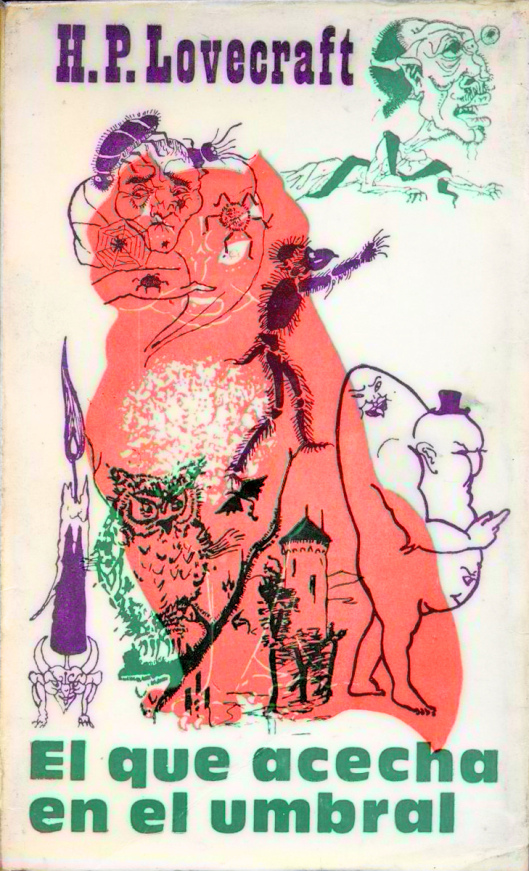
In media, the excellent Lovecraftian 1940s fantasy-detective movie Cast a Deadly Spell (1991) is said to have fairly recently landed on Amazon Prime, and I had a signposting post on it and its past incarnations and sequel. I discovered the existence of Jason Eckhardt’s “Map of Lovecraft’s Providence” posted (sold out), which I had not been aware of before. My post “Fragments from the Dreamlands” surveyed 1970s Lovecraft book cover illustrator Gervasio Gallardo. I also undertook another of my monthly surveys of new items on DeviantArt. I noted a call for the world to take curated VR tours of Lovecraft’s Providence.

This month I elsewhere produced Digital Art Live #49, a substantial issue of the magazine. The suitably lockdown-subdued theme is “Mono” (silhouette art, b&w, lineart), and it includes an in-depth interview with occasional Lovecraftian comics maker and adapter Matt Timson. Also, I hope that the next issue of sister title VisNews, a monthly publication for comics makers, will feature a long interview with Mockman (the Dream Quest graphic novel, wall-map of the Dreamlands, and more).

And lastly, I didn’t forget Robert E. Howard this month. I undertook what appears to be the first online survey of the various Conan encyclopaedias and gazetteers, even digging some of them out of The Wayback Machine. Also noted here were facsimile reprints of the Weird Tales sister title Oriental Stories / Magic Carpet, now available for purchase.

That’s it for May, onward into the summertime!

Cast a Deadly Spell (1991)

Looking for a Saturday-night movie, tonight? The movie Cast a Deadly Spell (1991) has reportedly arrived on Amazon Prime in the USA, and this week Film School Rejects has a short appreciation (warning: plot spoilers!) of this ambitious and successful attempt to create a fun mix of H.P. Lovecraft and 1940s gumshoe film noir

Cast a Deadly Spell is pure fun, first and foremost. That said, the movie is also a prime example of how great storytelling and imagination are two of the most magical ingredients in any film. This movie has those qualities in abundance, and it deserves to be appreciated by a wider audience.

When it first appeared, Darrell Schweitzer noted in a fanzine that the original title was to have been H.P. Lovecraft: Private Eye. The central character is indeed named Lovecraft, and the actor has a mild facial resemblance, but otherwise he’s a typical 1940s Private Investigator. Schweitzer also compared the movie to Disney’s equally retro The Rocketeer (1991), but with more overt humour and (I would add) the budget put into FX and hand-made monster-puppets rather than big shiny stunt-planes and jet-packs.

It even has the coveted Stamp Of Approval from S.T. Joshi, who knows his gumshoe detectives as well as his Lovecraft…

it ingeniously combines the Mythos with hard-boiled detection in its portrayal of a tough private eye, H. Phil Lovecraft … While not directly based on a specific Lovecraft story, it captures the essence of the Cthulhu Mythos surprisingly well.

In I Am Providence Joshi singled it out as a “striking performance” … “highly effective”. Although he calls it a “two hour” film, so it’s possible he saw a naughty convention screening of a print made before the editor trimmed it back for cable TV running times? Just my guess. The stated running-time is actually one hour and 36 minutes. I don’t seen any mention of some 14 minutes or so of out-takes being available elsewhere, on YouTube or the laser-disc version.

It appears that Cast a Deadly Spell was a cable-only U.S.-only show for many decades, with an old VHS tape being just-about obtainable and a laser-disc being almost unobtainable… but no DVD was allowed lest it interfere with cable showings. However, my UK version of Amazon now offers a £10 Spanish import DVD with multi-language including English. In terms of current streaming, nothing is visible on the UK Prime — at least to a UK Amazon user who shuns Prime. Such are the stupidities of the region-system. The UK is a big profitable market, with buyers who would spring instantly for a £3.99 streaming version. Yet instead we have to risk an import DVD, or dodge among the dodgy torrents, or peer at a 480px VHS-rip on YouTube.

Fangoria magazine #106 (1991) had a long article on the movie and many spoiler-pictures of the various monsters, as part of their ‘Lovecraft special’ issue. This same issue also has a long article from Will Murray in which he surveys Lovecraft adaptations to 1990…

Note that an early 1990s scan of Fangoria magazine is probably not ‘safe for work’ in 2020.

Beware also that there was a Cast a Deadly Spell sequel in 1994 with a different star and different cast, less charm and humour, and the Lovecraftian lore was cut. But those were the years of the virulent ‘satanic panic’ hysteria, so we’re probably lucky that either movie was made and then reached a mass mainstream American audience.

Picture postals: Providence Express

A Providence ‘trolley-car’. When Lovecraft refers in letters or a story to a ‘trolley’ or a ‘car’ this is the sort of public passenger vehicle he means. According to local transport buffs, they were green-and-cream in Providence until 1928, so I’ve colourised accordingly.

A Lovecraft dream of November 1927 involved a ‘trolley’…

“… under a grey autumn sky … lit up by a faint moonlight which had replac’d the expiring orb of day. Casting my eyes about, I beheld no living object; but was sensible of a very peculiar stirring far below me, amongst the whispering rushes of the pestilential swamp I had lately quitted. After walking for some distance, I encoun­ter’d the rusty tracks of a street-railway, & the worm-eaten poles which still held the limp & sagging trolley wire. Following this line, I soon came upon a yellow, vestibuled car numbered 1852 … It was untenanted, but evidently ready to start; the trolley being on the wire & the air-brake pump now & then throbbing beneath the floor. I boarded it & looked vainly about for the light switch — noting as I did so the absence of controller handle which implied the brief absence of the motorman. Then I sat down in one of the cross seats toward the middle, awaiting the ar­rival of the crew & the starting of the vehicle.

Presently I heard a swishing in the sparse grass toward the left, & saw the dark forms of two men looming up in the moonlight. They had the regulation caps of a railway company, & I could not doubt but that they were the conductor & motorman. Then one of them sniffed with singular sharpness, & raised his face to howl to the moon. The other dropped on all fours to run toward the car. I leaped up at once & raced madly out of that car & away across endless leagues of plateau till exhaustion waked me — doing this not because the conductor had dropped on all fours, but because the face of the motorman was a mere white cone tapering to one blood-red tentacle….”

Sexing up Lovecraft

Here’s the cover for The Colour Out of Space edition (Penguin Science Fiction) due in August 2020, ready for what would have been the ‘I got my student-grant!’ season. At first glance it seems a prime example of how marketeers think that slow cerebral science-fiction can’t be sold to the masses — except by misleadingly implying ‘there’s steamy sex inside!’ Eager readers hoping for ‘hot romps in the hay-loft’ may be disappointed.

Penguin may claim it’s actually a mutant seed-grain, if you sort-of squint hard at it. But that’s obviously not how potential readers are intended to see it on the shelves of the bookstore. Still, I suppose we and the designer should be grateful — at least there’s no Stephen King quote spoiling the cover. And the penguin trademark is actually kind of Lovecraftian, if you recall the giant-penguins in At The Mountains of Madness.

Lovecraft and the Stars

“Lovecraft and the Stars” by E. Hoffmann Price, in The Arkham Sampler #6, Spring 1949. In which Price indulges in some humorous astrological flummery and boondoggling as he makes up notes for Lovecraft’s astrological birth-chart. But he also slides in quite a few biographical angles, from one who had known Lovecraft in person and by correspondence.

According to Joshi’s Bibliography, it was never reprinted, though there is the later “Astrological Analysis” by Price in the 1970s HPL zine.

Amateur Correspondent, May-June 1937 has E. Hoffmann Price’s “The Sage of College Street”, not reprinted in Lovecraft Remembered but now collected in the new Ave atque Vale.