2021 Peter Lang Competition in Science Fiction Studies

Publisher Peter Lang is running a 2021 Peter Lang Young Scholars Competition in Science Fiction Studies

Proposals are invited from early career scholars in Science Fiction Studies [planning to write] academic monographs [and to qualify you must] have been awarded a PhD between 2015 and 2020 or expect to be awarded a PhD in 2021.

The deadline is 30th November 2020.

Also of interest is the $500 John A. Lent Scholarship in Comics Studies, which should open summer 2020 and which will then be seeking…

a current student who has authored, or is in the process of authoring, a substantial research-based writing project about comics.

Refreshingly, you don’t have to have a thesis in hand, as… “all students of comics are encouraged to apply.”

The Weird angle

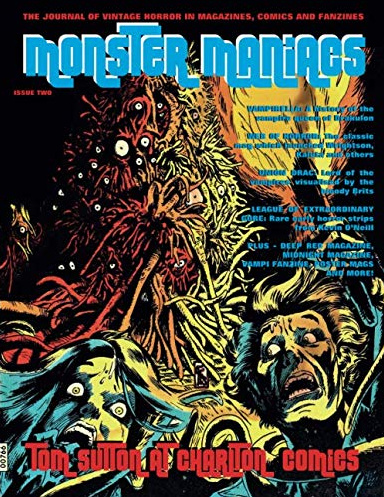
An unusual angle on Weird Tales. When Lovecraft mentions, in his letters of the mid 1930s, that the latest edition of Weird Tales is on his desk or shelf ‘hot from the news-stand’ this is what he saw, ready to lift and peruse.

Peruse somewhat reluctantly, as he is often heard bemoaning the unevenness of the magazine in its mid 1930s form. I get the impression from the Barlow / Bloch / Sterling letters that Lovecraft didn’t obtain his copy by subscription via the mail at this time, but preferred to walk down into town and patronise a local news-stand or store. Presumably he used the opportunity to browse the racks and shelves, casting a professional eye over the competition and near-rivals, while forming a rough idea of the state of ‘the slicks’. Incidentally, in his mid-1930s letters he refers several times to the ‘book-stalls’ of Providence, at which bargains could evidently be had by determined browsers such as Barlow, Loveman, Kenneth Sterling and himself. One imagines that, as the Great Depression set in, the four main bookstores of Providence saw competition from used book-stalls popping up in indoor markets and at regular fundraisers.

Talking of unusual angles, Black Gate has a short but perceptive review of the new academic book Weird Tales of Modernity (2019). The book’s author was also interviewed at length recently, on episode #140 of The Sectarian Review podcast.

‘Picture Postals’ from Lovecraft: a cool ice-cream in a hot Red Hook

‘Picture Postals’ from H.P. Lovecraft, part of an ongoing series.

Sabrett’s horse-drawn ice-cream cart in Red Hook, Brooklyn, New York City. Also selling coffee, candy etc. On the corner of Bush and Clinton Street, about a mile south of Lovecraft’s room in the notorious Red Hook.

“On December 31, 1924, I established myself in a large room … at 169 Clinton St.”

“Sometimes I get a dime’s worth of ice-cream for breakfast” (said of 1934, but just as likely after his walks in Brooklyn).

“It takes no effort at all [to imagine] that I am still 12 years old, and that when I go home it will be through the quieter, more village-like streets of those days — with horses and wagons, and little varicoloured street cars with open platforms…”

An interview with Brian Murphy

A new podcast, Literary Wonder & Adventure Show #15: The History of Sword and Sorcery: A conversation with author Brian Murphy. [Link removed – dead]

I see Murphy’s book now has a handy £5 Kindle ebook edition.

And… what better excuse to post here the three classic Chris Achilleos covers for Panther UK’s three-part Skull-face paperback re-issue, which introduced many to Robert E. Howard.

I’m fairly sure I also had these, also from Panther…

NLP with Lovecraft

Lovecraft with NLP. No, not the dodgy cultic ‘neuro linguistic programming’. NLP as in proper hardcore computer programming, in the form of ‘Natural Language Processing’ for digital humanities work. Towards Data Science currently has long articles showing exactly how to have a computer crunch the Lovecraft fiction corpus and thus help to answer questions such as…

Are the stories as negative as we thought? What are the most used adjectives, are they “horrible” and “unknown” and “ancient”?

Ideally the corpus would first be carefully chunked, split into distinct sections relating to his phases and places. Each would be probed separately. It’s probably big enough to chunk. Otherwise you’d get a bit of a smushy answer to such questions. “The Quest of Iranon” (1921) is not the same beastie as “The Shadow out of Time” (1935) etc.

Lovecraft with NLP: Part 1: Rule-Based Sentiment Analysis

Lovecraft with NLP: Part 2: Tokenisation and Word Counts

It looks like more parts are planned.

Update: Lovecraft with NLP: Part 3: TF-IDF and K-Means Clustering. At which point, having seen two articles, you hit the paywall.

Update: Lovecraft with NLP: Part 4: Latent Semantic Analysis.

Kittee Tuesday: Bloch’s “Bubastis”

A series of blog posts celebrating H.P. Lovecraft’s keen interest in our fascinating felines.

In his final letter to Robert Bloch, Lovecraft notes the lad’s new story in the March 1937 Weird Tales, “The Brood of Bubastis”. The cat theme and the Cornwall setting were both an obvious nod to Lovecraft. Cornwall being the more American-recognisable stand-in for neighbouring Devonshire, to which Lovecraft traced many ancestors. Though the general idea of a Cornwall-Egypt link was not at all new by 1937.

I was hardly aware of the early Bloch beyond the story that inspired Lovecraft’s “The Haunter of the Dark”, but I know a bit more now. The Egyptian theme was obviously one that Bloch pursued in his early Lovecraftian stories in 1936-38. An entry for Bloch in Horror Literature through History: An Encyclopedia usefully lists the short cycle of Bloch’s ‘Lovecraftian Egypt’ stories, and from 1936-38 points to…

“The Faceless God”
“The Secret of Sebek”
“The Brood of Bubastis”
“Fane of the Black Pharoah”
“The Opener of the Way”
“The Eyes of the Mummy”
“Beetles”

… with a warning that some lack Lovecraft lore, though all are generally said to be in the style and manner of Lovecraft. So far as I know these have not yet all been collected in a single “Robert Bloch’s Lovecraftian Egypt” volume. Such a collection might make for a good audiobook.

Looking into these I found a long survey essay on the early Bloch at Dark Worlds Quarterly, that I had missed in January 2020. I thus inadvertently discovered yet another early appearance of Lovecraft as a character…

The Dark Demon” (Weird Tales, November 1936) is another love letter to Lovecraft. Like “Shambler”, Bloch creates a character that is obviously HPL in Edgar Henquist Gordon. The man is tall and pale, writes horror stories for small magazines and is a bit of a recluse, though he has hundreds of correspondents.

wt-nov-1936-hpl.pdf

Lovecraft had sent editor Farnsworth Wright a signed note saying that Bloch was permitted to portray and ‘murder’ Lovecraft in published fiction, and this must have permitted the story a slot in Weird Tales that it might not otherwise have had. Curiously enough, this issue of the magazine managed to get a cute kitten on the cover of Weird Tales

More new instances of ‘Lovecraft as character’

Toward the close of the Bloch section of the Letters to Robert Bloch book, a mention of two early ‘Lovecraft as character’ stories…

Not long ago Kuttner showed me a new story — “Hydra” — in which all three of us figure … & are disposed of” … Shea has also slain me in a recent tale.

I’d not known about these before now. I was initially not quite sure what the Shea item is. The endnote for the mention is “RB 66”, this refers not to page 66 of the Bloch letters, but to letter #66. At first I thought it might refer to Shea’s “The Snouted Thing”, to be found his In Search of Lovecraft (1991), which appears to be its first publication. But a little further digging revealed that Lovecraft must have been referring to Shea’s tale “The Necronomicon”.

Kuttner’s “Hydra” eventually appeared, perhaps revised since Lovecraft had seen it, in the April 1939 issue of Weird Tales, later collected in The Watcher at the Door: The Early Kuttner, Volume Two.

 
At 2,500 words in clean text, I was interested in using the Shea tale as an AI audio test-text, and went looking to see if there’s any ‘sounds like a real human’ AI-shaped text-to-speech services or desktop software. Nope, it seems not — it’s still ‘if you have to ask the price, you can’t afford it’ offers of chatbot-focused API services which claim to do deep learning. Who uses chatbots enough that people want to invest in them?

Anyway, it seems we might have ‘just about good enough’ story-reading AI voices in the European languages by 2025. But for now ordinary mortals are still stuck with the TTS robo-voices, albeit with a few of them being vastly improved since the 2000s and with a new range of local accents. But I guess I should just stop being cheap, lugubriate the voice-box and do it myself.

Update: easy2reading.com Free online Text To Speech TTS and freetts.com Text to Speech Converter were found to be the best in April 2021, with either using Google’s excellent male GB-Standard-D, though lacking in emotional colouring. The latter costs $6 per 1m characters, but has the advantage of using TTS markup for pauses and emphasis.


I’ve started a new Lovecraft as character tag on this blog, and gone back and retrospectively tagged. It’s limited to just the early appearances or recognisable versions of him. I’ve also found another new one, but that will appear here tomorrow in the Kittee Tuesday feature.

Documentary: The Rise and Fall of Penn Station

Back in summer 2011, I blogged here about the architecture of H.P. Lovecraft’s entrance into New York City. This being the Pennsylvania Station…

When Mr. H.P. Lovecraft stepped down onto the platform of the Pennsylvania Station, on his first ever visit to New York in April 1922, he was surrounded by the neo-gothic imagination in the very architecture of the place.

I now see that a 60-minute PBS documentary film appeared a few years later, American Experience: The Rise and Fall of Penn Station, being added to what appears to have become a cottage-industry of books about the station. The documentary seems very well reviewed by critics and buyers alike, and is now on Amazon Prime at $3. Though only in America. In the UK we have to get Prime and then buy a monthly subscription to PBS.