Changes at Archive.org

Archive.org has now ended their ‘extended borrow’ feature for books. For the duration of the emergency, they had made borrowing a book possible to all members, regardless of how many others had also chosen to borrow the book at the same time. The Internet Archive ‘borrow’ service is now back to the old ‘one book, one borrow’ feature, akin to a normal public membership library that only has paper books. The mega-publishers would like you to think that the ending of it was due to Archive.org being ‘frightened off’ by their new law-suit. But this return to a ‘normal library’ approach was always planned, once the emergency period was over.

Archive.org has even added a useful new feature to ‘Borrow’. One that brings them more into line with the practice of Google Books, and with public libraries where one might take a book off the shelf and flip through it. On many books the potential borrower now gets a full-page preview of the page on which your search-hit occurs. This is potentially very useful for researchers who find the book is in high demand from borrowers. Hopefully someone will code a UserScript to place a ‘see this same page on Google Books’ link adjacent to the page preview. Thus potentially giving the researcher more free pages either side.

Book: Underground Rivers

Underground Rivers by Richard Heggen. A 1,500 page PDF book kindly placed online for free by the author in its latest summer 2018 draft, under Creative Commons Attribution NC. Effectively it’s a chronological and thematic encyclopedia with comprehensive coverage of British and American popular culture, and abundant illustrations. It also has many rich dips into ancient mythology on the topic. It’s evidently a years-long side-project and the author, Professor Emeritus of Civil Engineering at The University of New Mexico, asks to be informed of anything he may have missed over the decades.

While many of the illustration are in the public domain, some are likely not. It would probably be safer to assume that the Creative Commons Attribution NC licence applies to the text only.

‘Picture Postals’ from Lovecraft: Mammoth Cave

In early April 1905 a 15 year old H.P. Lovecraft walked down the old hill into town, buffeted and chilled by the unusually windy and snowy season. There he snuggled down in the warmth and silence of the Public Library and spent “days of boning at the library”, as he later said. The word ‘boning’ here being schoolboy shorthand for the elbows-on-the-table hardness of steady study — and perhaps also the dog-at-a-bone tenacity needed to do it.

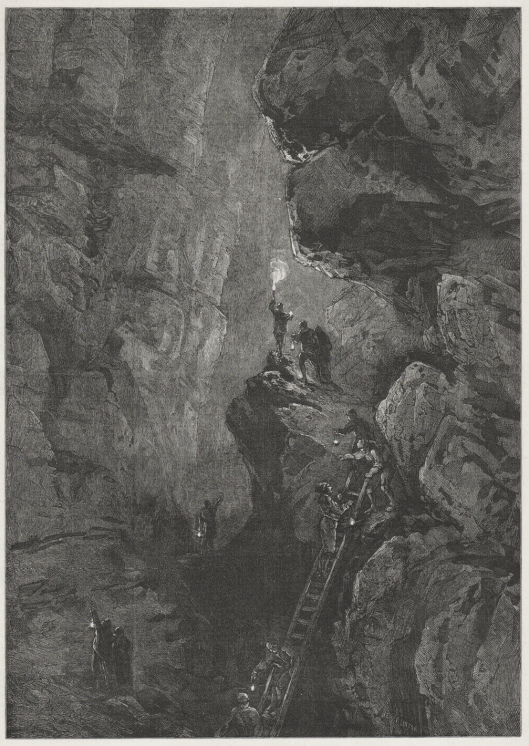
His research subject was the Mammoth Cave in distant Kentucky, a vast and reputedly endless cave system that had already been well-mined by juvenile writers. It was to form the setting of his juvenile tale “The Beast in the Cave”, of which S.T. Joshi states “the finished version dates to April 21, 1905”. While the photographic postcards of the 1920s and 30s were at that point still decades distant, Lovecraft would almost certainly have dug up evocative engravings made in the 1880s and 90s by Edwin Hopper and others…

The Descent

The River Cliffs

On Echo River, with the hint of a lost doorway being discovered.

Cyclopean formations

So far as I know he never visited Mammoth Cave, but he did take a long trip to see the Endless Caverns, which I’ve documented in another post.

New features at WordPress.com

WordPress.com upgrades have just become more interesting. WordPress.com hosts this blog, and a half dozen others I run. Even £3-a-month blogging at WordPress can now include ‘Premium Content Blocks’ — available only to Followers who pay a monthly or annual subscription. This has been newly introduced, and at last makes WordPress the obvious alternative to Patreon. The future of Patreon seems increasingly uncertain, judging by their recent behaviour and reports on their balance-sheet and staff-cuts.

It would cost me £36 (about $45) a year, to step from Free to the paid ‘Personal Plan’ at WordPress. This would give me 6Gb of storage rather than 3Gb, and… the ‘paid subscribers’ features.

That would need to be done for two of my current free sites, Tentaclii and a local-history gallery site which is nearly full of local images (and thus will need another 3Gb by the Autumn/Fall). £72 a year is not impossible.

Ads would also be removed from a £3-per-month blog, but I’m not bothered about those — since I assume 99% of visitors run an ad-blocker in their browser.

I’m not saying I’m immediately going to switch Tentaclii from Patreon, having struggled thus far to get $65 a month there. But it’s an option I’ll be keeping in mind, as the weather cools and the ‘self-employed virus hardship’ payment comes in.

Dracula in Sweden

S.T. Joshi’s blog has updated. He has a book-sale on now and, among other new book news, has details of: two late novels by Frank Belknap Long set to be reprinted by Centipede; his abridged Lovecraft biography A Dreamer and a Visionary: H.P. Lovecraft in His Time, now available in translation in Brazil; a forthcoming 300,000-word English translation of the Swedish version of Bram Stoker’s Dracula — possibly… “from an early version of the novel that found its way to Sweden in the 1890s. This version does not survive in English”. The Dracula translation has been edited by Joshi.

2021 Peter Lang Competition in Science Fiction Studies

Publisher Peter Lang is running a 2021 Peter Lang Young Scholars Competition in Science Fiction Studies

Proposals are invited from early career scholars in Science Fiction Studies [planning to write] academic monographs [and to qualify you must] have been awarded a PhD between 2015 and 2020 or expect to be awarded a PhD in 2021.

The deadline is 30th November 2020.

Also of interest is the $500 John A. Lent Scholarship in Comics Studies, which should open summer 2020 and which will then be seeking…

a current student who has authored, or is in the process of authoring, a substantial research-based writing project about comics.

Refreshingly, you don’t have to have a thesis in hand, as… “all students of comics are encouraged to apply.”

The Weird angle

An unusual angle on Weird Tales. When Lovecraft mentions, in his letters of the mid 1930s, that the latest edition of Weird Tales is on his desk or shelf ‘hot from the news-stand’ this is what he saw, ready to lift and peruse.

Peruse somewhat reluctantly, as he is often heard bemoaning the unevenness of the magazine in its mid 1930s form. I get the impression from the Barlow / Bloch / Sterling letters that Lovecraft didn’t obtain his copy by subscription via the mail at this time, but preferred to walk down into town and patronise a local news-stand or store. Presumably he used the opportunity to browse the racks and shelves, casting a professional eye over the competition and near-rivals, while forming a rough idea of the state of ‘the slicks’. Incidentally, in his mid-1930s letters he refers several times to the ‘book-stalls’ of Providence, at which bargains could evidently be had by determined browsers such as Barlow, Loveman, Kenneth Sterling and himself. One imagines that, as the Great Depression set in, the four main bookstores of Providence saw competition from used book-stalls popping up in indoor markets and at regular fundraisers.

Talking of unusual angles, Black Gate has a short but perceptive review of the new academic book Weird Tales of Modernity (2019). The book’s author was also interviewed at length recently, on episode #140 of The Sectarian Review podcast.