New book: The Fortean Influence on Science Fiction

The McFarland book list for Fall 2020 is now available. I got as far as spotting The Fortean Influence on Science Fiction, and had to give up on trying to use their painfully slow interactive-flipbook catalogue. It appears that there’s no alternative list. Lesson: if you want to reach media editors, make it fast, and also make it available in a portable/offline format such as PDF.

July on Tentaclii

Around Tentaclii Towers the verdant summer sward swoons and wilts, and certain leaf-edges begin to hint of a wistful Autumn. But first, most likely, the Towers will be enveloped in a typical English August of brooding thunderstorms and heavy rains. The dark cloudscapes may perhaps be made all the more eerie to behold, by the fact that everyone is now masked up like so many Lovecraftian cultists. The Tentaclii choice of face-mask is suitably cosmic, in dark dusk-blue cotton scattered with small white stars.

This month, in considering Lovecraft’s life and inspirations I purled through Lovecraft’s Dictionary; noted the Hope Street Reservoir as a possible inspiration for his “The Colour of of Space”; spotted various clues to the whereabouts of some of Lovecraft’s older books shortly before and after his death; considered the possible link between elephants and the Lovecraftian tentacular; looked into the fate of the lost Providence drawings of Henry J. Peck, once so admired by Lovecraft; and in an answer to a $6 Patreon patron’s question I wrote the post “On Lovecraft and Hemingway” (now newly updated a bit at the end, to note that Hemingway actually had his start as a writer in very pulpy circumstances).

In new books, I noted the new expanded H. P. Lovecraft: Letters to Alfred Galpin and Others; and that Dawnward Spire, Lonely Hill has finally gone into paperback in two volumes. The latter has the Lovecraft-CAS correspondence. In other languages I noted the new book Il linguaggio di Cthulhu: Filosofia e Dizionario di H.P.Lovecraft (‘On the Language of Cthulhu: A Philosophical Dictionary for H.P. Lovecraft’).

In older books newly-discovered, The pageant of Benefit Street down through the years (1945) has appeared at long last on Archive.org; the erudite A Letter Book was a nice discovery on Archive.org, offering a history of letter-writing to 1922 in 100 pages; I was pleased to learn of Brian Stableford’s three-volume scholarly history The Scientific Romance in Britain, 1890-1950 (1985). His first volume, The Origins of Scientific Romance, sounds especially interesting. But sadly I find I can’t get the UK’s self-employed cash bailout, so from now on it’s back to cat-food dinners and few book purchases.

In new scholarly/fan journals: I noted the June 2020 edition of The Dark Man: Journal of Robert E. Howard and Pulp Studies; that Monster Maniacs #2 has appeared, along with No. 27 of the review Dead Reckonings; and I also looked into recent relevant material the Vastarien journal. In academic journals, I was pleased to find Zanzala: Revista Brasileira de Estudos de Ficcao Cientifica (trans. ‘Zanzala: Brazilian journal for the study of science-fiction’); the new Journal of Gods and Monsters from Texas; and also an outstanding free French journal of comics and juvenile books which will be linked here in a few days. The worthy historical Providence blog Architecture Here and There was also noted and linked here.

Elsewhere in journals the new issue of The Gay & Lesbian Review surveyed “H. P. Lovecraft’s Odd Couples”. Incidentally, that reminds me that in my reading of the Moe letters I’ve spotted a rare comment — in which Lovecraft revealed his awareness of how his own string of “grandsons” might be misconstrued by others. A correspondent had remarked on a priest suddenly acquiring a “son” after returning from a long holiday in Europe. Lovecraft remarked wryly to Moe that… “Possibly he was being modernistically candid about what most priests call their “nephews”” (page 385).

In the arts, I spotted two excellent bronze cast busts of Lovecraft by the Joyner Studio; Heavy Metal magazine kindly placed the the missing pages for Druillet’s Necronomicon online; The Ring of the Nibelung was found in a fine comics adaptation, this being a handy way to discover the stories without spending 18 hours listening to German opera. This latter led me to discover that Archive.org has a new “one-hour borrow” feature available. A call for a forthcoming Mythos anthology, Shadows Over Avalon, was noted here due to its unusual British and historical theme. The major fact-and-fiction exhibition “Monsters of the Deep” was noted at the National Maritime Museum in Cornwall, UK.

A couple of nice RPG items were prised from the Archives, these being an envelope from Brown and a curious bookmark from a naturalist’s notebook. Also relevant to the RPG world, a couple of apparently forthcoming ‘Lovecraft Country’ books were noted, Tour de Lovecraft: The Destinations, and Miskatonic Country.

In scholarly software, I noted that the fine PDF Index Generator 2.9 had appeared, and that it now handles footnotes nicely and no longer requires a Java install.

A bit of blog housekeeping was done at Tentaclii and my blog’s ‘Lovecraft on the Web’ Directory was updated and repaired by hand.

As for other authors, I was pleased to see that Christopher Anvil’s 1960s Interstellar Patrol series of stories is now available as a new 17-hour audiobook, with the promise of the rest of the stories in audio by September 2020. The start of a new series of podcast interviews on Ray Bradbury was noted. Marvel’s Savage Sword of Conan mega-reprint #3 is shipping, and #4 is dated. There’s also a handy new Who’s Who In New Pulp guide to writers, and I noted Doc Vandal as being an especially interesting-sounding series. The new Who’s Who is probably also of interest to indie comics artists seeking suitably enthusiastic writers.

That’s it for this month. This blog’s weekly ‘Kitty Tuesday’ feature may have to ‘paws for thought’ in August, due to paucity of material. Expect such posts when you see them.

Exhibition: Monsters of the Deep

Here in the UK, our National Maritime Museum has taken the lockdown wraps off the major show “Monsters of the Deep” and opened it to the public. The show surveys the fact and fiction of sea-monsters, and includes hundreds of pickled mini-monster specimens shipped over from the U.S. National Oceanography Collection. It runs until January 2022, though note that this is not the London branch of the Museum — you will have to trek down to Falmouth, in relatively remote Cornwall, to see the show. It appears to be paired for its duration with “Viktor Wynd’s UnNatural History Museum” in which Viktor uses taxidermy to devise curious and never-seen creatures.

‘Winds of Kitty Hawk’ and ‘Ah! Wilderness’

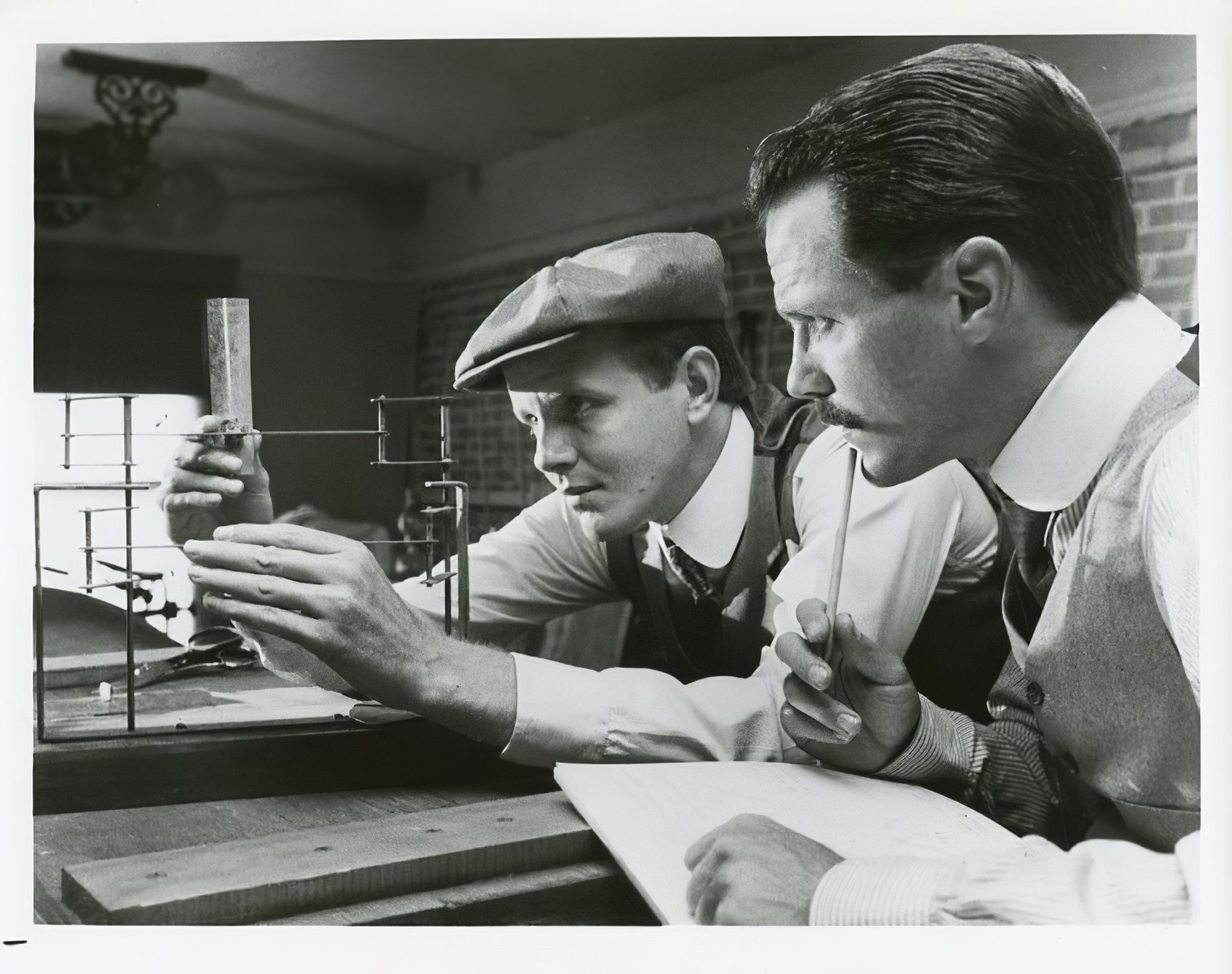
Here’s a bonus post in my regular “Picture Postals” slot, and also a movie suggestion for your weekend enjoyment and edification. This vintage NBC publicity press-picture was for the major TV movie Winds of Kitty Hawk (1978, colour). To my mind it very nicely evokes the entrepreneurial ‘back-shed science’ of the era in which Lovecraft grew up. After three years, and with no backers, the brothers succeeded. They had their first manned flight at Kitty Hawk just before Christmas 1903, at which point Lovecraft was then aged 13¼.

Surprisingly I find the movie to be the only serious feature-length drama of the Wright Brothers and their marvellous flying machine. In 2014 Tom Hanks was reported to be tinkering with the idea of a heading up a TV mini-series on the brothers, but evidently it never flew. You might have thought there would a half-dozen big-budget cinema movies by now, and several lesser bio-pics from the 1940s and 50s… but no. It’s another one of those great achievements in innovation history that big-budget cinema movie producers have been curiously uninterested in. There was another TV movie Orville and Wilbur (1972), part funded by the BBC, but it appears to have been lost (as with so much else the BBC made).

But we do have the one decent surviving movie for the Wright Brothers. Made for TV, but a pretty good movie due to locations, costumes, a deftly-handled low-key script, and recreation flying machines that fly. It’s pre-PC, almost free of the usual time-waster love-story sub-plot, doesn’t distort the facts too much, and was nominated for several Emmy awards (Outstanding Film Editing, Outstanding Sound, Outstanding Cinematography). It’s now streaming in the USA on Amazon, though here in the UK you have to hang around on eBay or Amazon waiting for low-priced DVD to be offered. I’ve now seen it, and I thoroughly enjoyed it.

The other big movie which evokes the same period, and indeed one that Lovecraft saw and adored for its vivid recreation of the era and settings of his boyhood, was the curiously titled Ah, Wilderness! (1935). Despite the misleading title this is not a ‘city dog lost in wild Alaska’ Jack London tale, but rather a Eugene O’Neill bittersweet comedy…

Pitting Lionel Barrymore against a young up-and-comer named Mickey Rooney gives Eugene O’Neill’s only comedy the loving luster it deserves. Horseless carriages, straw boaters, nickle beer: Ah, Wilderness! is a portrait of an America long gone — but forever remembered.

Lovecraft told Bloch that he had seen Ah, Wilderness sometime in early January 1936, and had…

revelled in it. Yuggoth, but it made me homesick for 1906! [it] gives all sorts of typical 1906 glimpses, including an old street-car, a primitive steam automobile, &c. It was photographed in Grafton, Mass. … where the passing years have left little visible toll.

He wrote to Moe that the movie recalled certain sensibilities and values that had since been lost to the world. While watching it…

At times I could well believe that the past had come back, & that the last 3 decades were a bad dream. [the world it depicted] having many a value which might well have been preserved had social evolution been less violently accelerated by the war.

Ah, Wilderness! is set on the 4th of July 1906, and in setting is meant to be a shore-town about 40 miles SW of Providence. This warm and human comedy is very well regarded, and is also now streaming in the USA. Together the two movies would probably make a pretty good double-bill, for those interested in the sensibilities of the ‘Young America’ of 1903-06 that helped form the young Lovecraft.

‘Picture Postals’ from Lovecraft: the elephant at the Park

Continuing the vague ‘zoo’ theme (we had zebras two weeks ago), this week’s ‘picture postal’ from Lovecraft is of an elephant.

Lovecraft would often jokingly refer to the size of his own nose in letters, and compare it to that of the resident pachyderm at Roger Williams Park in Providence…

Note the proboscidian effect,” [meaning his own large nose, in his photograph of him made by Robert Barlow …] “my only local rival in that field being the elephant at Roger Williams Park.

The choice of word faintly indicates the tentacular, and it was used again as such in the story “Out of the Aeons”, said of the nameless creature glimpsed through the mummy’s eye…

Even now I cannot begin to suggest it with any words at my command. I might call it gigantic — tentacled — proboscidian — octopus-eyed …

For most of the city’s children the elephant inspired amazement and curiosity rather than horror. They had clubbed together to raise the funds to obtain and keep him for the city. His name was “Baby Roger”, and he appears to have arrived at the park as a baby elephant when Lovecraft was aged three. We can plausibly imagine that the infant Lovecraft was taken to see him several times, and the elephant’s trunk may well have been his first real encounter with the ‘living tentacular’.

Lovecraft’s barn

Back in May I briefly mused on Lovecraft’s barn, where in 1934 he stored crates of the old 18th century books that he had grown up with and inherited.

In the Moe letters I’ve now come across another mention of this barn. It was located “about a mile away” from Barnes Street in 1930, and it then contained Lovecraft’s carbons for his pre-“Dagon” period of writing. This places the location approximately under this marked area…

This at least narrows the field, for those with access to barn-level street maps from the period. The ‘mile’ might be a little further in, if Lovecraft factored ‘wiggle-room’ into his walking distances.

One possible clue is that his younger aunt lived “about a mile away” from Barnes Street, before the move to 66 College Street. Her pre-1933 vicinity might be the best place to start looking for a barn.

It may also help to know that “Old Providence Barns” were catalogued and photographed by John Hutchins Cady in 1948.

This barn is to be differentiated from the substantial 1881 horse-stable at Lovecraft’s boyhood home, which he told Moe was being demolished in August 1931 (Letters to Maurice W. Moe, page 311). Though it must have had a hay-loft to store the winter horse feed, and one letter states that this stable was later used to store the books of a friend-of-the-family. One imagines that dry book-storage, located within a mile of Brown University, might have been in demand during that period.

Fivver bans ebook conversion services

It appears that Fivver no longer permit offers to convert a complex scholarly book from Word .DOC to Kindle ebook. In this case, a perfectly legitimate technical offer was banned, and indeed robo-libelled as well in their rejection. The offer was a perfectly legitimate and considered one. To take someone’s finished academic book to the Kindle ebook format, round-trip footnotes and all, to the linked Kindle format for sale by the author on Amazon. I was wondering why no-one had ever responded to the offer. Now I know.

New book: Bottorff’s Price Guide

Bottorff’s new Price Guide & Checklist (in PDF) has been updated with a new edition.

It’s for those pocket-book comic books and spot-cartoon collections produced in a paperback books from the 1950s to the early 1980s, prior to the switch to the landscape format so as to better accommodate newspaper comic-strip reprints. The Guide appears to be free in PDF, though I could not get the download to trigger.

At the Sign of the Cat

The Lovecraftians of Hungary are seeking sponsors for their planned Spring 2021 national/regional meet-up event, and hope to launch a crowdfunding appeal in October 2020. As such they…

are open to ideas and suggestions, we welcome anyone who can share with us their experience of organizing and running such a campaign.

This also all for 2021, but they also note that…

However, all of the above [re: delay of the national event to 2021] does not apply to the graphics exhibition titled Supernatural Horror in Literature, organised jointly with the Memento Morri Association. Due to the nature of the exhibition and the venue, the opening of this exhibition will continue as planned on 8th September 2020.

The show will, appropriately enough, be at “the Cat (1084 Budapest, Berkocsis utca 23.)” and run for a month.

Entry deadline: 11th August 2020, and physical framed works need to be shipped to Hungary in good time.

The Cat, Budapest.

New book: Miskatonic Country

Coming soon, a new Call of Cthulhu RPG Keeper’s Guide book…

This book is a guide to every Miskatonic Country scenario for the Call of Cthulhu role-playing game published in a book by Chaosium or one of its licensees, and set in the 1920s.

Perhaps also useful for Lovecraft Mythos writers, if only to know what’s already been done in the region in terms of RPG storytelling in the classic Lovecraft period.