Fantastique et Evenement

New in public Open Access, the French academic book Fantastique et Evenement: Etude comparee des oeuvres de Jules Verne et Howard P. Lovecraft.

Evenement has a specific French academic overtone which isn’t conveyed by simply translating it to ‘event’ in English. But in translation it might be something like The Fantastic and its Events: A comparative study of the works of Jules Verne and H. P. Lovecraft. The book appears to offer a good deal of historical context, more for Poe than for Lovecraft. This was the author’s first book, and he later wrote more books on Verne, as well as one on vampires, another on images of Bohemianism, and three books of essays on the fantastic.

Regrettably the book’s chapter PDFs are now behind an ‘academic libraries only’ paywall. The so-called ‘Open Edition’ site also hides the licence terms, while using the Open Access symbol for the book. But, for now, the HTML version of the book remains free and public. As it’s in plain-text the pages can also be run through Google Translate.

August 2020 on Tentaclii

The chill breath of Autumn exhales softly over the moistening land, and the rolling acres of Tentaclii Towers settle into a yellowing mellowness. A long-dreaded ‘second wave’ of the virus seems to be producing no more than a sniffle here, and things are slowly returning to a less nervous state. Children once again traipse through fallen leaves on their way back to mundane schools, with Halloween and fireworks on their vague horizons.

Talking of fireworks, things were popping this month on Tentaclii for material related to Lovecraft’s life; a new mapped cache of photos of New York City in 1939/1940 appeared, including one of his rooming house on the edge of Red Hook, Brooklyn, and more pictures may be mined this source in the future; a good 1930s night-view from Prospect Terrace was found, as it would have been seen by Lovecraft; I finally lighted on a photo of the Twin Islands in Providence, these islands being a possible partial inspiration for “Dagon”; I took a close look at Lovecraft’s walk into the India Wharf rail yards in Providence and discovered there a plausible inspiration for one aspect of his “Under The Pyramids”; I looked at “Lovecraft in Harlem” in the mid 1920s, and found Morton’s address and a photo of the place. I also looked at The Brooklynite (Blue Pencil Club) and wondered why the run of the latter publication has not yet been digitised and put online; I dug out a fascinating mid-1920s report on crime and gangs in Red Hook, which also had precise details on the demographics of the area and some small points which illuminated Lovecraft’s “Red Hook”; I pondered which exact edition of Webster’s Lovecraft had, re: the visual inspirations he found at the back of it as a lad; I found and acquired a good bird’s eye view of the back of the John Hay Library, on which more next month; I noted a few more facts to fit into the life-story of Kalem member and Lovecraft friend Arthur Leeds; and a few more early instances of “Lovecraft as character” were found, one being penned by Robert E. Howard.

In scholarly work, the 2020 Lovecraft Annual shipped this month, with the lead article being what should be a major essay by Steven J. Mariconda; S.T. Joshi’s blog returned to life after a short disappearance; The Fossil for July 2020 was found to have items of Lovecraft interest; there was a call for a 2021 conference ‘Proliferations of Lovecraft’, in which it appears that academics will ponder why he’s so popular; France’s Association Miskatonic kindly sent details of their 2021 plans; H.P. Lovecraft: A Bibliography (1952) appeared free on Archive.org, and it was found to have a still-useful list of ‘Lovecraft in anthologies’ during his lifetime and beyond; Hathi at last returned to usable speed; a number of free scholarly papers and chapters on Lovecraft were linked here; and I released version 1.0 of my Annotated “Hypnos”.

In new books, the major H.P. Lovecraft: Letters to Family and Family Friends began shipping as a two-volume set; a new ‘Lovecraft illustrated’ letterpress book Dark Dreamlands II was announced as imminent; in Brazil a sumptuous illustrated widescreen edition of “The Haunter of the Dark” was successfully crowdfunded; also in Brazil, Lovecraft’s collected works appeared as Contos Reunidos do Mestre do Horror Cosmico; in Italian there was the new non-fiction book Chi ha paura di H.P. Lovecraft. Some of my own non-fiction books became available again, as I was able to fix three broken links to Lulu.com.

With the free Digital Art Live magazine I was able to produce an August 2020 issue on the somewhat Lovecraftian theme of “Beneath”, though it leans more toward “Journey to the Centre of the Earth”. The issue is out now and has a long lead interview with one of the world’s leading pre-vis story-artists, and he was very generous with his time and good advice for artists.

The month in Lovecraftian audio was a bit squeaky, though it did produce news of “The Dunwich Horror” which it appears is shipping on two twin vinyl LPs; and booking began for H.P. Lovecraft Walking Tours in late October 2020 — also a polished kind of audio performance.

And finally Tentaclii also rounded up Web links to various items for Lovecraft’s 130th Birthday. Though there may still be a few more Birthday items out there as yet un-noticed, from places like Sweden, Poland and Japan. Lovecraft is, of course, doubtless still alive and sailing somewhere out in the vastness on a White Ship. Or perhaps, like St. Brendan, living after death in a tiny observatory built on the back of a whale…

Sadly my Patreon lacks, as yet, a whale-like size. It remains in the shallows at $69 a month, and even a few extra $s a month from you will be most welcome please. The aim is still to reach $100 a month for Tentaclii.

“The Dunwich Horror” on vinyl

New to me, an unabridged recording of “The Dunwich Horror”. As a limited edition twin-LP vinyl album and wall-poster, from Psilowave Records. Listed as “2020”, and shipping now.

Not to be confused with the abridged full-cast vinyl LP recording of “The Dunwich Horror”, issued in summer 2018 by Cadabra Records. That featured veteran screen actor Robert Powell as Dr. Henry Armitage.

PDF Index Generator 3.0

I blogged here about PDF Index Generator 2.9, back in mid July 2020, noting its affordable price and that it could now index footnotes. PDF Index Generator version 3.0 has just been released, and a key change is that the interface is now available in French, German and Italian translations. This update may well interest independent scholars and indie publishers in those nations. Other changes are ease-of-use features and updates, but these will be welcomed by those who use the tool more than a couple of times a year.

New book: “The Haunter of the Dark”

There’s a crowdfunder to publish a sumptuous illustrated edition of Lovecraft’s “The Haunter of the Dark” for Brazil. Apparently as yet unpublished in this translation…

“Lovecraft’s scariest tale in an unpublished version in Brazil, with art by [experienced comics artist] Salvador Sanz.”

It’s already 281% funded, and set to be published in a “widescreen” print edition…

I’m guessing the wide format would allow for English on one side, and Portuguese on the other, and on the same page.

169

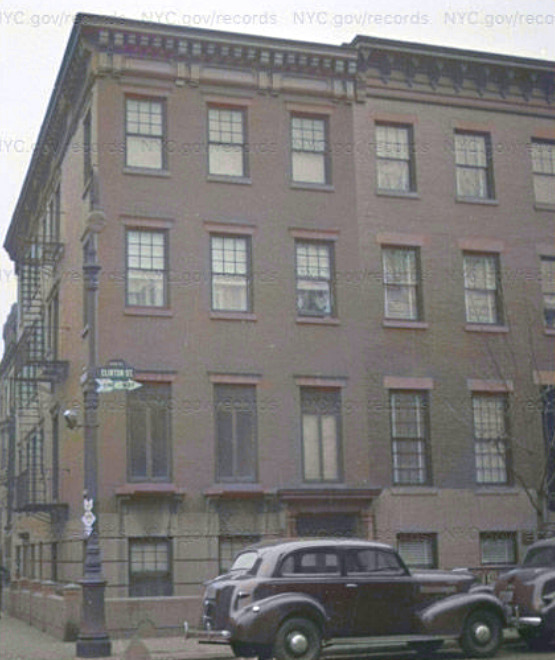
A new mapped cache of photos of New York City in 1939/1940, drawn from mundane tax-record photos of buildings.

It appears this is 169 Clinton Street. Though it’s difficult to be 110% sure as the buildings all look much the same. Also, both the site’s address-lookup and the 1939/40 in-photo numbering appear to be astray in terms of matching with house numbers. While the corner location, door, windows, roof-line and adjacent windows all suggest it’s almost certainly 169, modern pictures show a large front door on the building immediately to the left side — a door that isn’t present here.

Lovecraft seen in front of 169. Possibly late spring 1925, judging by the leafy tree behind him. Evidently the exterior fire-escapes were added to the building in the 1930s. A city report on the local juvenile gangs stated there was almost no easy roof-access in Red Hook at that time, in contrast to Hell’s Kitchen. If there had been a fire Lovecraft would presumably have had to fling himself from the window, Dagon-style.

Back to school… with Lovecraft

So, kiddies, it’s back to school on Tuesday 1st September. Here are a few suggestions for last-minute rush-orders for school stuff, to arrive Monday. All available now on eBay…


The H.P. Lovecraft shoulder bag for all your stuff, robust in black and blood red…

Gym-kit bag…

Stickers…

Cuddly ‘therapy Cthulhu’ doll…

Pencil and pens zip-case…

And matching cute sew-on-patch…

Rare tradez for schoolyard barter…

Sanity-check kit, for testing your xrazee new frendz…

Flag for your stand at the School Clubs recruitment fair…

Notepad for your Club rules and names…

Members’ pin-badge to entice potential Club members to become your minions…

A 3D printed Lovecraft bust, which your Club will diligently seek to smuggle into the School Trophy Cabinet…

A Hellish freebie…

This book chapter may well be the result of a time-limited public freebie from publisher Springer (they occasionaly do such things), so get it while you can if you’re interested. I can get both the full HTML and the PDF…

M. Ricciardi, “He Haunts One for Hours Afterwards”: Demonic Dissonance in Milton’s Satan and Lovecraft’s Nyarlathotep, chapter in the book The Hermeneutics of Hell, Palgrave Macmillan, 2017.

New New Pulp

The Pulp Super-Fan considers what should be in the next Who’s Who in New Pulp. I was surprised to read that Cirsova wasn’t listed under magazines. I thought that Cirsova Magazine #1 (Spring 2019) was a key recent moment and exemplar for New Pulp (of the sort that attempts to emulate the old magazines)? But perhaps the Who’s Who compiler considers the title to be a book series? I’ll take a look when I get around to fully reading the Kindle ebook version. I featured Who’s Who in the latest Digital Art Live magazine, but it probably needs a full review here at some point, paired with some of the other new and older books on pulp writing.

I’d add another suggestion for a future edition: writers who state they are interested in: i) licencing their plots and characters for production by comics publishers; and ii) writers interested in considering a ‘proposal for collaboration’ with indie comics artists; with a pointer to iii) an appendix outlining a brief standardised ‘approach package’ that artists should send to writers, to aid in easy evaluation of the proposal.