Call for papers: Religion and Horror Comics. Deadline for abstracts: 1st December 2020. For a volume of the Religion and Comics academic book series, published by Claremont Press. The planned book appears not to be open-access.


12 Monday Oct 2020
Posted in Lovecraftian arts, Scholarly works
Call for papers: Religion and Horror Comics. Deadline for abstracts: 1st December 2020. For a volume of the Religion and Comics academic book series, published by Claremont Press. The planned book appears not to be open-access.
11 Sunday Oct 2020
Posted in Historical context, Lovecraftian arts
An October question has arrived from one of my Patreon patrons.
What did HPL think of the artist Henry Fuseli?
There is not generally a lot to say about H.P. Lovecraft and art. A master he was, but not of practical visual art-making. He had aunts who were long-standing members of the local Art Club, and they could apparently produce a pleasing canvas of a seascape or similar Rhode Island scenes. But he could only produce fairly crude sketches, though these are not without some naive charm. Had he been trained from boyhood to draw, he might have produced passable pen-sketches of cherished scenes. He might even have later branched out into Mervyn Peake-like gothic ink drawings. But he both felt and knew that he had no talent for it, and at that point in time landscape and architectural photography was not a viable alternative picture-making option for him. He was an impoverished amateur, who made do with a box-camera and simple snaps developed at the local drug-store. This is not to say that he did not appreciate a silver-handed artistic talent in others, and indeed he encouraged it in his more hesitant young correspondents such as Dwyer and Barlow among others. Nor did his lack of ability mean that he was unable to appreciate fine art, though we can perhaps assume he lacked the very subtle eye of the practising visual artist.
What then of the painter Fuseli? He is referred to by name in Lovecraft’s “Pickman’s Model” (1926)…
I don’t have to tell you why a Fuseli really brings a shiver while a cheap ghost-story frontispiece merely makes us laugh.
This must refer to Fuseli’s masterwork “The Nightmare” (1781). The picture became so famous and well-reproduced, as both painting and its engraving by Thomas Burke (1783), that it was able to be very easily parodied and also alluded to in literature. There is a very vague claim that it may have inspired Shelley, and thus Shelley’s Frankenstein. This claim falls apart, as soon as one starts to dig into its footnotes. A much firmer example is found in two uses by Lovecraft’s idol Poe. There are a set of paintings in Poe’s “The Fall of the House of Usher” that are similarly compared to Fuseli…
If ever mortal painted an idea, that mortal was Roderick Usher. For me at least, in the circumstances then surrounding me, there arose out of the pure abstractions which the hypochondriac contrived to throw upon his canvas, an intensity of intolerable awe, no shadow of which felt I ever yet in the contemplation of the certainly glowing yet too concrete reveries of Fuseli.
Later in the tale there is a similar manifestation of a ‘dream terror’, as if from out of the paintings…
An irrepressible tremor gradually pervaded my frame; and, at length, there sat upon my very heart an incubus of utterly causeless alarm. Shaking this off with a gasp and a struggle, I uplifted myself upon the pillows, and, peering earnestly within the intense darkness of the chamber…
The allusion to the painting is subtle, but the setting is the same and would have promoted connoisseurs of the macabre to recall the famous “The Nightmare”. Lovecraft could also have recognised the more explicitly-named allusion to the painting in Poe’s “The Black Cat”…
I started, hourly, from dreams of unutterable fear, to find the hot breath of the thing upon my face, and its vast weight — an incarnate Night-Mare that I had no power to shake off — incumbent eternally upon my heart!”
These are likely the uses that Lovecraft sought to echo in his own “Pickman’s Model”, almost perhaps more in homage to Poe rather than for an avid fondness for the works of Fuseli. Since Lovecraft mentions Fuseli in no letters that I have access to, other than in a passing generic list given to Mrs Toldridge.

Yet, could Lovecraft have seen “The Nightmare” in its original? Let me quickly trace some of the history of the original picture. It seems that Fuseli, though of Swiss origin and name, had to all intents become an Englishman. This would have endeared him to Lovecraft even more, and it must then explain why the famous painting long remained in and around my own area, first at Ashbourne on the southern edge of the Derbyshire Peak, and later at the nearby county-town of Stafford. Local genius and future-visionary Erasmus Darwin saw it and wrote famous macabre poetry on the painting. This is a rather pleasing discovery for a localist like myself to make, and such data might one day find its way into a future story. But by 1950 the picture was gone. Post-war socialist death-duties and other punitive taxes were wracking and wrecking the stately homes, and it was sold and shipped to the USA. The original painting is apparently now in Detroit, USA, which seems a rather suitable resting place.
The above digital version is not ideal, but the quality of online reproductions is generally abysmal — and at least here one can see what’s going on in the picture. Including the dressing-table mirror and a trace of tell-tale blush on the cheek of the sleeping maiden. Note also the strong likeness to the squatting shape of Lovecraft’s Cthulhu idol.
There appears to have been no loan exhibition of any Fuseli to Boston or New York during Lovecraft’s lifetime. Thus it seems certain that Lovecraft knew the picture only as a good reproduction. However, there is a complicating factor. Fuseli also painted several other versions.
In a version destroyed in the infernos of the London Blitz during the Second World War, but whose likeness was captured in an engraving by William Raddon (1827), the demon-imp’s impact is lessened by having him look questioningly at the sheepish horse, and having the distinct shadow of a cat. The whole scene takes on a comedic self-parodic cast…

By 1810 Fuseli has his demon-imp escaping nightmare-woken women on the horse, by leaping out of the window astride the horse’s back. One suspects that Fuseli by this point had become rather fed-up of his famous painting, and was beyond even subtle self-parody. He was just playing it for laughs, to amuse friends. Possibly this picture also gives us a hint of the very large amount of items that his prudish widow heaped onto a bonfire shortly after his death.

One deep-diving art historian remarks that the famous demon-imp became a mere owl, in a version painted by Fuseli at age 80.
Thus my feeling is that what Lovecraft alludes to in “Pickman’s Model”, and what he assumes Poe also knew, was the version he would have seen in fine form in engravings — such as the one in Erasmus Darwin’s famous The Botanic Garden. We know that Lovecraft had an 1805 ‘sampler’ of the best of this long work, called Beauties of the Botanic Garden, and also an 1880 biography of Erasmus Darwin. In which case he would have been interested enough to peruse the complete poetic works, had he encountered the volumes in somewhere like Boston or perhaps even Providence. Had this been the 1799 edition, then on page 126 of Part Two (“The Loves of the Plants”) he would have seen a fine engraving of perhaps the best version of the famous work…

This plate faces and also illustrates the climax of a macabre section of the poem set at Wetton in the Manifold Valley in North Staffordshire, which was also (though Erasmus knew it not) the setting for the climax of the famous supernatural tale Sir Gawain and the Green Knight. Here is this version of the picture in paint, albeit in black and white…

Lovecraft may not have seen the connections with old European folklore, re: chest-squatting imps as folk explanations for sleep paralysis, or the water-horse (on which, to get past all the pagan parroting and modern mumbo-jumbo, see Stromback’s excellent “Some Notes on the Nix in the Older Nordic Tradition”, 1970, which is also comparative).
The paintings bear comparison with some other of Fuseli’s works. For instance in a study for “Prospero, Miranda, Caliban and Ariel”, the demon-imp and the dreaming girl are akin to Shakespeare’s Caliban and a swooning Miranda (Miranda here being just pencilled-in)…

In “Milton Dictating to His Daughter”, the blind Milton has a face akin to the original horse complete with blind eyes, and the long flowing drapery and Blake-like limbs of the girl is also similar…

There is another reference to Fuseli in Lovecraft’s fiction, in “The Colour out of Space”…
All the farm was shining with the hideous unknown blend of colour; trees, buildings, and even such grass and herbage as had not been wholly changed to lethal grey brittleness. The boughs were all straining skyward, tipped with tongues of foul flame, and lambent tricklings of the same monstrous fire were creeping about the ridgepoles of the house, barn and sheds. It was a scene from a vision of Fuseli…
This implies that by March 1927 Lovecraft had seen more of Fuseli than engravings or b&w reproductions of “The Nightmare”. Such works were most likely encountered in the public and personal libraries of New York City during his stay there, either as good reproductions or perhaps even as originals in the museums. What might the pictures have been? Well, it’s very difficult to see the full range of Fuseli’s work in the macabre and supernatural, and very easy to come away from any one old book unimpressed. But put them together and you start to glimpse how impressive he would be in this area if such works were collected together. I’d suggest what’s needed is a blockbuster 21st century exhibition of such works, in due course, hint hint…
So it’s currently difficult to say what Lovecraft saw in New York City. But perhaps this engraved faery picture might give a hint at the sort of ‘swirling’ painted work that Lovecraft had in mind in “The Colour out of Space”.

Or perhaps the background of Fuseli’s witch-sabbat “The Night Hag” also gives us a glimpse…

The other hints of influence are to be found in two entries in Lovecraft’s Commonplace Book of story-ideas…
Very late in 1923
#106. A thing that sat on a sleeper’s chest. Gone in morning, but something left behind.
Early 1924
#119. Art note — fantastick daemons of Salvator Rosa or Fuseli (trunk-proboscis).
From this, I suspect, eventually came Lovecraft’s Brown Jenkin in “Dreams in the Witch House” (1932)…

Further reading:
* Nicolas Powell, Fuseli: The Nightmare, Viking Press, 1973.
* Sleep Paralysis: Night-Mares, Nocebos, and the Mind-Body Connection, Studies in Medical Anthropology, 2011.
11 Sunday Oct 2020
Posted in New books, Scholarly works
S.T. Joshi’s Blog has updated again. He reveals the forthcoming…
new collection of Ken Faig’s writings on some of the more obscure corners of the Lovecraftian world. Some of these writings have been published in very limited editions by Ken himself as part of his “Moshassuck Monographs” series, but we intend to gather them and others together into a solid volume that will display the depth of Ken’s researches.
I’d known about this planned book via email, but now the good news is public.
10 Saturday Oct 2020
Posted in Historical context, Odd scratchings
A nice offer on back-issue sets, from the Pulpdom fanzine.
#1-75 in PDF with an index, for $25. Or all 98 issues in PDF for $30 (presumably also with the index for #1-75?)

09 Friday Oct 2020
Posted in New books
Revista Dossier reviews what appears to be a new re-publication of Confesiones de un Incredulo (Madrid, 1972), which presents Lovecraft’s essays, plus selected letters and articles, in a good translation. The title translates back to English as something like Confessions of Incredulity: and other selected essays.

09 Friday Oct 2020
Posted in Picture postals

Until he was aged about age 9 or 10 this would have been “the University library” (1878) that the boy Lovecraft knew of, as he mentally mapped the topography of College Hill and the wider city. The Library, being rather small for the growing university, was replaced by the current larger one in which Lovecraft’s letters are now housed.

The old Library then became simply “Robinson Hall”. The Economics Dept. relocated there in 1912 and, since Lovecraft was economically illiterate, it seems unlikely he knew it further other than by sight. The decorative exterior ironwork was lost due to decades of neglect, and when the ivy became unfashionable in the 1980s it was also removed. Like many desirable spaces in universities, by the early 1990s it was being used not by teachers and creatives but by the university admin staff. The building hung on until about 2017, when local press reports state it was demolished and replaced by an unremarkable modern admin block. One can’t help thinking what a wonderful ‘H.P. Lovecraft Museum and Archives’ it might have made, from the 1970s onward, serving as a significant tourist and visitor attraction for the city.
It was here that a strange final act of Lovecraft’s Providence life was staged. A large crowd gathered outside one Sunday in the fall/autumn of 1959, to see the surreal sight of H.P. Lovecraft’s entire house slowly moving through the streets of his city…
Truly, I never saw such fixed attention in a large crowd. I remember one elderly lady in tweeds who seated herself on a granite curb on the edge of the lawn at Robinson Hall to watch the show and enjoy a cigarette or two: she never once looked away from the slowly advancing house as she smoked.

08 Thursday Oct 2020
Posted in Historical context, Podcasts etc.
The Voluminous podcast starts in on a long Robert E. Howard letter, with “The Letters of H.P. Lovecraft: REH Part 1 – Rhode Island”…
In the first part of a long letter to Robert E. Howard, Lovecraft shares many thoughts including the fascinating and sometimes horrifying history of Rhode Island.
07 Wednesday Oct 2020
Posted in Podcasts etc.
Derek Coveart has a new Librivox reading of H. P. Lovecraft’s seminal poem “The City”.
I produced an annotated version of the poem last October.
06 Tuesday Oct 2020
Posted in Scholarly works
* B. Granic, Aesthetics of the Underworld, 2020. (Masters dissertation for the Department of English, University of Split. Includes the chapter “The concepts of aesthetics and the underworld in the work of H.P. Lovecraft”).
* M. Rosen (Ed.), Diseases of the Head: Essays on the Horrors of Speculative Philosophy, PunctumBooks, 2020. (Has the chapters: “Horror of the Real: H.P. Lovecraft’s Old Ones and Contemporary Speculative Philosophy”; “When the Monstrous Object Becomes a Tremendous Non-Event: Rudolf Otto’s Monster-Gods, H.P. Lovecraft’s Cthulhu, and Graham Harman’s Theory of Everything”; and “Encountering Weird Objects: Lovecraft, LARP, and Speculative Philosophy”).
05 Monday Oct 2020
Posted in New books
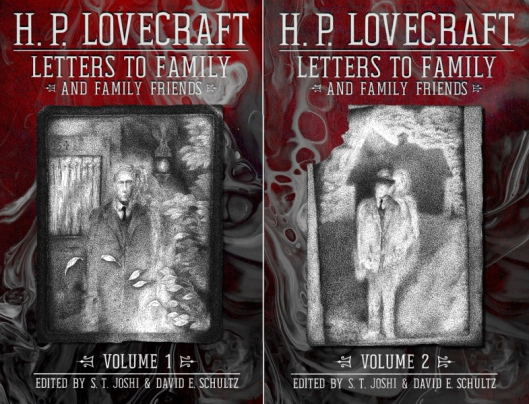
hplovecraft.com now has a page for H.P. Lovecraft: Letters to Family and Family Friends, giving the full table of contents for both volumes.
05 Monday Oct 2020
Posted in New books, Scholarly works
Donald Wandrei’s The Complete Ivy Frost is set to ship. 720 pages, in paper hardcover.

Also shipping soon, the Ray Bradbury edition of The Pulpster, Number 29.
04 Sunday Oct 2020
Posted in Historical context, Lovecraft as character
Dipping at random into my newly arrived book of Letters to Donald and Howard Wandrei has yielded up a new addition to my recent Harlem post at Tentaclii. In a 1927 letter Lovecraft talks of the sights the lad must see in New York, and one of these was Harlem…
sinister and fascinating — not a white face for blocks. Lenox Ave. subway to 125th St. — walk north.
This most likely indicates a route Lovecraft was familiar with. Possibly the one he took to visit Morton, who lived in a Harlem brownstone, or one that Morton took to give Lovecraft a taste of Harlem. We know from Lovecraft’s day-by-day 1925 Diary that he made a trip into Harlem at least once.
Update: There was at least one meeting of the Kalem Club in Harlem, at Morton’s place in the heat of August 1924, and this is attested by a Lovecraft letter in Letters to Family and a mention in Kirk’s Diary.
Also found was a new addition to the ‘Lovecraft as character’ list, albeit not extant. In a 1931 letter Lovecraft revealed that Frank Belknap Long was busy writing a novel with Lovecraft and his circle as lightly-veiled characters. This work has evidently not survived. Although Long’s “The Black Druid” (1930) has, in which Lovecraft is the lightly-veiled “Stephen Benefield”. Possibly the novel was an expansion of “The Black Druid”?