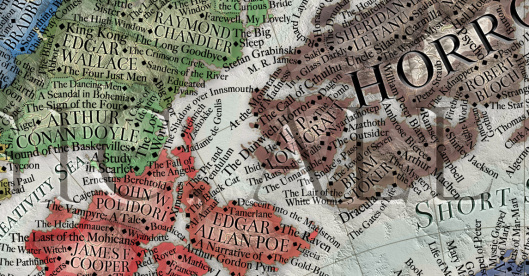
New to me, a peep at the cover of a 1980 German edition of The Dream-Quest of Unknown Kadath.

The over-sized Teutonic battle-horns and black-letter typography would no doubt have prompted a wry chuckle from Lovecraft, had he seen it.

18 Monday Jan 2021
Posted in Lovecraftian arts
New to me, a peep at the cover of a 1980 German edition of The Dream-Quest of Unknown Kadath.
The over-sized Teutonic battle-horns and black-letter typography would no doubt have prompted a wry chuckle from Lovecraft, had he seen it.
18 Monday Jan 2021
Posted in Historical context
The January 2021 question has arrived from John Miller, a Patreon patron…
What did HPL think of Prohibition? Was he a drinker? Did he have a favourite drink?
Lovecraft was not a ‘sot’ nor even a ‘tippler’, as he might have phrased it his best Georgian manner. He remained ‘dry’ until the end of his life. As for the wider society in which he lived, he was early in favour of the Prohibition Party and then welcomed the advent of the well-known ‘Prohibition era’ of 1920-33. His publication The Conservative championed prohibition. In letters and even an occasional private story (“Old Bugs”) he tried to guide his early proteges away from hard drink. Though, like many, he became increasingly sceptical about the practicalities of formal Prohibition.
His early stance on prohibition was forthright. It is in evidence in print from around 1915, though probably existed earlier. One vivid early example is his response to an encounter had on a night-walk in October 1916. He happened upon an open-air speech by a member of the Prohibition Party. The man had driven into what was obviously an insalubrious part of Providence at night, and was giving a public talk from an open car. Lovecraft, then aged 26, admired the seasoned and savvy fellow immensely. But was even more intrigued by the crowd listening…
… scarcely less interesting than the speaker were the dregs of humanity who clustered closest about him. I may say truly, that I have never before seen so many human derelicts all at once, gathered in one spot. I beheld modifications of human physiognomy which would have startled even a Hogarth, and abnormal types of gait and bodily carriage which proclaim with startling vividness man’s kinship to the jungle ape. And even in the open air the stench of whiskey was appalling. To this fiendish poison, I am certain, the greater part of the squalor I saw is due. … I reflected upon the power of wine, and marvelled how self-respecting persons can imbibe such stuff, or permit it be served upon their tables. It is the deadliest enemy with which humanity is faced. Not all the European wars could produce a tenth of the havock occasioned among men by the wretched fluid which responsible governments allow to be sold openly…. I am perhaps an extremist on the subject of prohibition, but I can see no justification whatsoever for the tolerance of such a degrading demon as drink.
Did Lovecraft ever get more than a sniff of booze? Perhaps. There is the vague and possibly made-up story that, at a party in New York (or perhaps Cleveland), someone once spiked his drink. It is said he became more talkative and voluble than usual, but that was apparently the only effect. Did he “know” afterward that he had experienced alcohol? That, as I recall, was left unstated. A more reliable account of a ‘brush with booze’ was an incident which occurred in the nighted alleys of New York City, when Lovecraft had to be rescued by friends from a well-hidden ‘speakeasy’ — a clandestine bar of the Prohibition period, run by gangsters. In pursuit of yet another shapely Georgian door-knocker, or perhaps an especially winsome stray kitty, he had innocently stumbled upon the concealed entrance.
In 1928 he felt much the same about the need for Prohibition, though by then he had come to doubt the practicalities of it when enforced by the state…
The existence of intoxicating drink is certainly an almost unrelieved evil from the point of view of an orderly and delicately cultivated civilisation; for I can’t see that it does
much save coarsen, animalise, and degrade. Any step to get rid of it is to be welcomed — just as any step to get rid of murder, robbery, and forgery is to be welcomed — and the only criticisms one can make of prohibitary legislation is that which pertains to its effectiveness and enforcement. … to a cynical soul [there comes] the question of whether or not the law is
worth the trouble of enforcing. … I am beginning to doubt. In 1919 I was a whole-hearted prohibitionist, but in 1928 I am more or less of a neutral [on the question of] legalised liquor versus futile and troublesome prohibition […] It is [now largely] an aesthetic matter with me. I think drink is ugly, and therefore I have nothing to do with it. This aesthetic position, by the way, may sound odd for one who professes to be a conservative; since of course all our respected forbears indulged [and] I think my own paternal great-great grandfather could have drunk any young modern cake-eater under the table without shaking a bit of powder from his Albemarle tie-wig; nor do I think any the less of him … [society has gradually lessened its need for alcohol, through temperance, led by the Victorians, and the habit seems to by dying out among the upper classes, but] my own aesthetic theory cannot help carrying it onward to the ideal of total extinction [where] the graces of wine live [only] in literature.
By 1929 he was indulging in a gargantuan correspondence with Woodburn Harris who, before his sudden conversion to doctrinaire communism, was a firebrand writer on the prohibition of liquor. Presumably Lovecraft learned much about the ways of the bootleggers and gangsters, in passing and over the years, from this and other correspondence. In “Old Bugs” he implied knowledge of the trade in Chicago, presumably gleaned from a correspondent, stating that… “Sheehan’s is the acknowledged centre to Chicago’s subterranean traffic in liquor and narcotics”. Later he even knew where it might be possible to obtain ‘hooch’ in Providence. He once joked with a friend that he might acquire a local case of bootleg whisky to ship to Weird Tales editor Farnsworth Wright (to help steady his physical jitters induced by Parkinson’s disease)…
I feel tempted to unearth a local bootlegger [and] Providence’s Italian quarter is a miniature Chicago of hootch, gang wars, and rackets!
This was indeed the state of affairs in Federal Hill, under the Morelli mafia gang which had been allowed to become established there from 1917. Prohibition was said to be very unpopular in Providence, and it seems likely that some blind eyes were turned. That was one of the problems of Prohibition: it tended to bring the interest of gangsters and politicians into an uneasy alignment.
Prohibition lightly enters a few of Lovecraft’s stories. In “Red Hook” Detective Malone makes… “well-timed offers of hip-pocket liquor” to get information from his street informants. In Dexter Ward we learn of the hijack of clandestine “liquor shipments”, and in “The Shadow over Innsmouth” the narrator procures some under-the-counter bootleg liquor to lugubriate the tongue of old Zadock Allen. “Beyond the Wall of Sleep” mentions “a whiskey debauch”. Alcohol features most centrally in “The Quest of Iranon”, with the pivotal tragedy being how… “Romnod who had been a small boy in granite Teloth grew coarser and redder with wine”. In “Dream-Quest” some of the exotic wines of the Dreamlands can appear unimaginably potent to a visitor, as when the hero Carter takes… “only the least sip [of wine, and], he felt the dizziness of space and the fever of unimagined jungles.”
Prohibition also enhanced the idea of ‘the swamp’ in the popular mind. Such places were partly drained but still vast and trackless, prior to the extensive heavy-logging and draining of the mid 1930s. As such they had become key criminal conduits for running quality liquor and narcotic drugs into the USA, and it appears that some swamp dwellers added baby-farming to the roster of crime. This fed into the imaginative popular culture of the 1920s and thus the background of prohibition is implicit in the vivid swamp scenes of “The Call of Cthulhu”. Readers of the time would have recognised this link.
In some revision tales “whiskey” briefly appears. In “The Curse of Yig”… “Charms were always ready in exchange for whiskey”, and “The Horror in the Museum” states that it was… “on a night when Jones had brought a bottle of good whiskey and plied his host somewhat freely, that the really demented talk first appeared.”
Thus, there is ample evidence that those who today brew a pungent craft-beer or a spice-seasoned gin should be wary of naming it after Lovecraft, his creations or places. He would have raised an eyebrow at least, and would certainly not have endorsed the fiendish brew.
A different question is, did Lovecraft have a favourite drink? Well, his habitual drink was coffee, but that does not necessarily make it ‘the favourite’. One does not tend to sup ‘the favourite’ every day, or it palls. And as all coffee drinkers know… there is ‘coffee’ and there is ‘coffee!’ As with all pleasures, the experience can come close to disgust in some aspects, if over time one becomes more refined and discriminating in one’s pursuit of the chosen pleasure. The Camp bottle-coffee, that once delighted a glugging youth, in middle-age may come to seem a strange and somewhat distasteful brew. The coffee connoisseur will have long since moved on to better brands, with whiter and purer sugar, and he undoubtedly expects the beverage served at a certain temperature and even in a certain type of tableware. Perhaps ‘the favourite’ then becomes a certain exquisite coffee variety served in the expected way, and with a topping of vanilla ice-cream.
Lovecraft was lucky enough to live for a time in Brooklyn at its height, in the mid 1920s, where ‘coffee’ was ‘coffee!’ He patronised the Double-R Coffee House, whose manager was a seasoned Brazilian and where the “nicotined atmosphere” and artistic “types” added an extra buzz. In New York coffee was also available by the bucket, if needed. Lovecraft often carried a ‘pail’ of fresh coffee back to the gang, to help fuel their all-night ‘talk and walk’ sessions in Hell’s Kitchen, and he even purchased his own galvanised steel bucket for the purpose. Doubtless he also sampled the coffee-flavoured inventions of the city’s many glittering ice-cream bars, and may well have found an occasional favourite or two there. But ‘Lovecraft and coffee’ is an essay that has yet to be written.
17 Sunday Jan 2021
Posted in Lovecraftian arts, Odd scratchings
On 1st January 2021 the copyright time-pinger ‘dinged’ and thus enabled hplovecraft.com to restore the text of “Deaf, Dumb, and Blind” by C. M. Eddy, Jr. and H. P. Lovecraft. The short tale is now presumably also available for YouTube audio recordings and adaptation into comics, animation etc.
Originally published in Weird Tales for April 1925, and there credited to Eddy.

Joshi’s considered option in I Am Providence was that Eddy likely wrote the first draft of the tale, and Lovecraft then revised this “around February 1924, just prior to his move to New York”. Then advised further on finessing the ending, in what Eddy later referred to as “several conferences” — an ambiguous phrase which I would suggest might even encompass telephone calls from New York.
17 Sunday Jan 2021
Posted in Podcasts etc.
Now on Librivox as a free audio reading, The Book of the Thousand Nights and a Night (aka The Arabian Nights), Volume 11.
There are apparently 10 volumes in the main Burton set, plus another six Supplemental Nights and other related material. Presumably this appearance on Librivox of the new Vol. 11 means the team has now started working through the Supplemental Nights volumes, and aims to get a completist reading finished for the whole set.
16 Saturday Jan 2021
Posted in New books, Scholarly works
More news from S.T. Joshi. His blog announces… “another collection of my miscellaneous essays, reviews, introductions, etc” and gives the table of contents. Said to be imminent, The Progression of the Weird Tale will include a substantial central section of items on Lovecraft and Barlow, plus a critical assessment of two novels by Frank Belknap Long. Also memoirs of several fellow Lovecraftians.
Not to be confused with his already available collection The Advance of the Weird Tale.
15 Friday Jan 2021
Posted in Picture postals
This week, a picture by Charles Wheeler Locke showing a typical ‘tramp steamer’ at the Brooklyn dockside, New York City, in 1925. It has the distinctive clusters of cargo cranes, which appear to be typical of its class.

Lovecraft’s “The Horror at Red Hook”, written in high summer 1925, features the Brooklyn dockside at Red Hook and just such a freight-carrying steamer…
[New York police detective Malone had discovered] “They had come in steamships, apparently tramp freighters, and had been unloaded by stealth on moonless nights in rowboats which stole under a certain wharf and followed a hidden canal to a secret subterranean pool beneath a house.”
“Then the tramp steamer claimed all attention. A boat put off, and a horde of swart, insolent ruffians in officers’ dress swarmed aboard the temporarily halted Cunarder. They wanted Suydam or his body — they had known of his trip, and for certain reasons were sure he would die.”
15 Friday Jan 2021
Posted in Historical context, New discoveries, Odd scratchings
Newly up for sale at Abe, what’s said to be The Works of Virgil from Lovecraft’s personal library, in an 1855 English translation with some comments and corrections seemingly from the man himself. It appears to show that he thought the translation of Eclogue VIII “very fine”, had noted an “Egyptus” name in the Aeneid, and had revised the translation for sense in at least one place. It also provides a specimen of the free handwriting of the young Lovecraft, then still at 598 Angell Street. The only thing that gives me pause is wondering if, at that point in time, he would not rather have used his full name than a simple “H.P.”? The dots on the H.P. are also rather ebulliently high, and the huge comma doubles-up as an exclamation mark. Are there comparable early inscriptions in books?


14 Thursday Jan 2021
Posted in Lovecraftian arts
Having finally got around to hearing Harlan Ellison’s fine reading of Clark Ashton Smith’s “The City of the Singing Flame”, I was impressed and left wondering what the other “Philip Hastane stories” are. “Singing Flame” is the first of these, but regrettably the others are said to be far more plainly written and darker in tone. It turns out all are free on the Eldritch Dark website and can be found in audio…
* “The City of the Singing Flame” (as original + sequel) (& audio);
* “The Devotee of Evil” (& audio);
* “Hunters from Beyond” (& audio);
* “The Music of Death” (posthumous, long fragment and ideas);
* “The Rebirth of the Flame” (posthumous, unwritten, brief outline and ideas).
These are more ‘Lovecraftian + sex’, on hearing.
What is actually similar to the more lyrical and mystical “Singing Flame”? It’s said that the “Captain Volmar tales” are actually the closest shelf-companions to “Singing Flame”. These being collected recently in the print book Red World of Polaris, and also mostly available free online in text form. In order…
* “Marooned in Andromeda”;
* “The Amazing Planet” (originally “Captivity in Serpens”);
* The Red World of Polaris (newly re-discovered);
* The Ocean-World of Alioth (unwritten, synopsis and fragment only).
Some other of Smith’s similar-sounding pulp science-fiction tales from around this time appear to be…
* “The Eternal World”;
* “The Dimension of Chance”;
* “The Immeasurable Horror”.
Of the above and the “Captain Volmar” tales, only “The Immeasurable Horror” is in audio, being free on YouTube here and here.
There are Audible listings for some paid Smith audiobooks, but these are all listed as “unavailable” even when using a USA VPN. Were they ever released? Theoretically an audiobook for the multi volume Collected Fantasies of Clark Ashton Smith should have:
Vol. 1: inc. “Marooned in Andromeda”.
Vol. 2. inc. “The Amazing Planet”.
14 Thursday Jan 2021
Posted in Scholarly works
I see Wildside now has an affordable $5 Kindle ebook edition of Clark Ashton Smith: A Critical Guide to the Man and His Work. This is the second edition of Summer 2013, said to have been lightly corrected by the author Steve Behrends for errors of fact. Though he was not in a position to take account of the wealth of new Smith scholarship, new critical editions and letters published after 1985.
It’s well thought-of and looks like it could use a review on the Wildside Press site, where at present it has none.
I’ve now heard the Harlan Ellison reading of Smith’s “The City of the Singing Flame” and sequel, and am duly impressed. Slightly over-written and with some of the early “cosmic” dabs rather forced, but a very enjoyable listen and… somewhat like an 80-minute audio version of one of the less convoluted graphic novels of Moebius.
14 Thursday Jan 2021
Posted in Lovecraftian arts
“The Other Lovecraft” by science-fiction author James Blish, written 1964 and seemingly still unpublished.

It appears to be mis-described in the sale listing. The later note appended by the editor says “would have appeared”, not “was” published, in “Epilogue magazine”, and the bundle appears to include an earlier announcement page for the article.
But Epilogue was actually George Zebrowski’s fanzine rather than a regular magazine and it appears to have lasted only three issues… and ended with #3 in summer 1964. I can find no trace of this Blish article on Lovecraft, which had been set to appear in the Halloween issue, and thus have to assume this item has never been published. There’s nothing of it in the Bibliography and no other trace of it.
Judging by what can be glimpsed of the first page, it appears not to be a personal memoir, but who know what lurks on the reverse of the sheet?
13 Wednesday Jan 2021
Posted in Lovecraftian arts
More production press-stills on eBay, from The Cry of Cthulhu movie. I had a previous post here on this $7m stop-motion Lovecraft movie from 1977 (set for a 1981 release that never happened). The Cthulhu picture adds a new name to the model makers on the failed project, Robert Skotack, who later worked with James Cameron.


12 Tuesday Jan 2021
Posted in Lovecraftian arts
Back in 2012 Tentaclii noted that Horacio Lalia was seeking English licensees and translators for his H.P. Lovecraft comics adaptations. At the time I could only find one book collection of his work, and that not in English.
New to me in 2021, I see that there are now four volumes of Lovecraft comics adaptations from this veteran b&w Argentine comics artist. Three were made for publisher Albin Michel and are now collectable at around £60-80 used, plus a later one for Glenat which is still available at a reasonable price. All were published in French in the French ‘BD’ format.
Lovecraft – La Couleur Tombee Du Ciel (1998)
Lovecraft – Le Grimoire Maudit (2000)
Lovecraft – Le Manuscrit Oublie (2003)
Lovecraft – Les Cauchemars de Lovecraft (2014)

Sadly it appears he never found a way to get an English edition, circa 2012. Possibly the b&w was a hard-sell, at a time when publishers assumed that young audiences needed garish re-colouring if they were to buy comics reprints. But British readers may fondly recall his name from 2000AD and StarLord in the late 1970s and early/mid 1980s. Here is an example from what appears to be his 1970s work, with superb layout and fine penmanship, and another showing the woodcut-like style later used in his Lovecraft adaptations.