A Patreon patron asks a question: “Did HPL visit sites associated with Poe and what did he think of them?”
Lovecraft revered Poe, and entire books could be written on the ramifying connections. Indeed, one such has been. The recent heavyweight The Lovecraftian Poe. Another book could likely be written by tracking down all the times Lovecraft visited a ‘Poe place’, and by gleaning all his sentiments and comments from the letters and poems. That would however be a large task, and must remain beyond the scope of this post.
Nevertheless, I can lay a bit of groundwork for others who may wish to tread further down this path. Firstly, Lovecraft has left us the usefully brisk essay “Homes and Shrines of Poe” (Collected Essays: Travel) which surveyed the homes and lodging houses as Lovecraft then knew them. I’m not in any way a Poe scholar and Poe scholarship may, of course, have finessed some of the dates or addresses or added new ones. But “Homes and Shrines” tells us what Lovecraft knew. His essay was published in The Californian for Winter 1934. Quotes below are from “Homes and Shrines” unless otherwise stated. Collected Essays footnotes “Homes and Shrines” with… “Poe’s residences in Philadelphia, Richmond, Charlottesville, Baltimore, New York, and Fordham, all of which HPL had personally visited.” The Encyclopaedia adds that he had visited “nearly all” the sites noted in the essay.
Here I limit the scope to the homes. There are, of course, a great many other places associated with Poe — including in Providence.
1. Poe was born in Boston at 62 Carver Street, but knew it not and grew up as a foster-son in Richmond. Lovecraft refers to this birthplace as… “the cheap boarding-house in Boston’s South End” and notes it “bears a bronze tablet” with some simple facts, and that the nearby district of his mother’s house was found by Lovecraft to be “very squalid”.
Lovecraft knew Boston well and especially explored the North End which features in “Pickman’s Model”. We have to assume he also took the time to visit the Poe birthplace, but I can find no evidence that he lingered. It appears to have been even more insalubrious and possibly dangerous than the decrepit North End.
2. Poe’s very young boyhood place was the “Allan home” on “Fourteenth Street between Franklin and Main in Richmond”, Virginia. Lovecraft calls this… “a three-story brick house at 14th Street and Tobacco Alley … still standing, though long ago converted into a shop and now deserted and unmarked.”
S.T. Joshi remarks in I Am Providence that Lovecraft include Virginia in his travels of Spring 1929, descending on the region like a whirlwind…
“… for only four days but [he] took in an astonishing number of sites — Richmond, Williamsburg, Jamestown, Yorktown, Fredericksburg, and Falmouth. All were delightful. Richmond [included the] Valentine Museum, which contained the then recently discovered letters by Poe to his guardian, John Allan … He also saw the farmhouse … that formed the Poe Shrine (now the Edgar Allan Poe Museum), which had also opened only recently. Aside from actual furniture owned by Poe, this place had a delightful model of the entire city of Richmond as it was around 1820; this made it much easier for Lovecraft to orient himself and to locate the surviving antiquities. “I never set eyes on the place till yesterday — yet today I know it like an old resident.”
Lovecraft sent Wandrei a May 1929 postcard of “The Edgar Allan Poe Shrine [Oldest House in Richmond]”. He noted however… “The oldest house — preserv’d as a Poe shrine though Poe never inhabited it — dates behind any of the others (estimates vary from 1685 to 1737!); it being a stone farmhouse preceding the urban settlement of the town.”
“In Richmond the chief object of interest for me is the Poe Shrine an old stone house with two adjoining houses connected as wings & used as a storehouse of Poe reliques. Here I have spent much time examining the objects associated with my supreme literary favourite.”
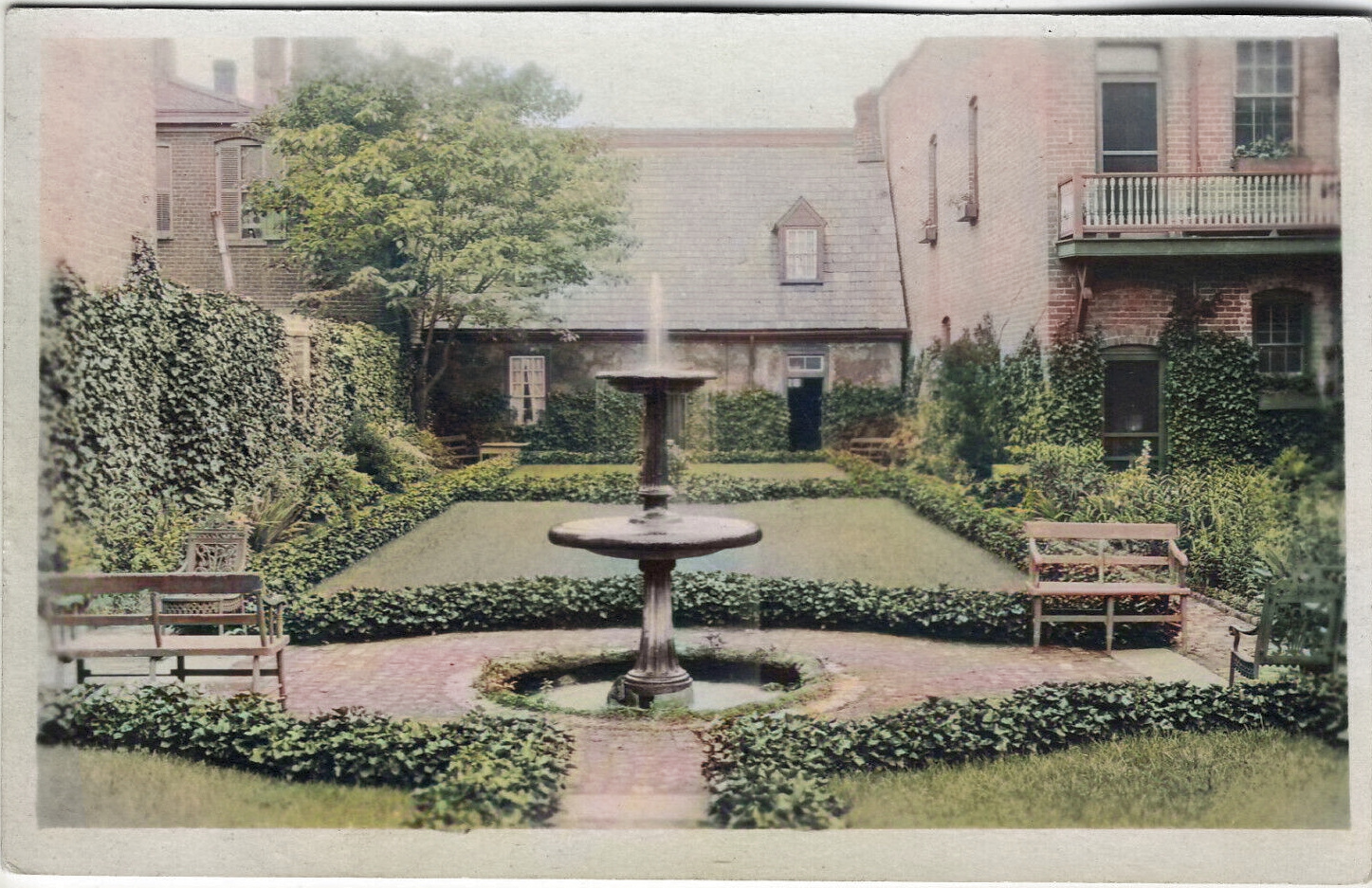
“… though Poe never inhabited it”
In his essay “Travels in the Provinces of America” Lovecraft elaborated on the artful deception…
“The ancient stone house and its adjuncts lying in the easterly slum reaches of Main Street and now serving as a “Poe Shrine”. This house, a farmhouse … remains in a sound state of preservation. The space near it has been purchas’d by Poe-lovers and developed with great taste and ingenuity; an exquisite garden … and the two adjacent houses on each side being annex’d as part of a three-building unit. Of these added houses that on the west is colonial, whilst that on the east is a fireproof museum in imitation of the Richmond residence of John Allan, Esq., where Poe was rear’d as an adopted son. I spent an hour in this fascinating place, and saw all manner of Poe reliques — far more than are stor’d in the Fordham cottage I know so well.”
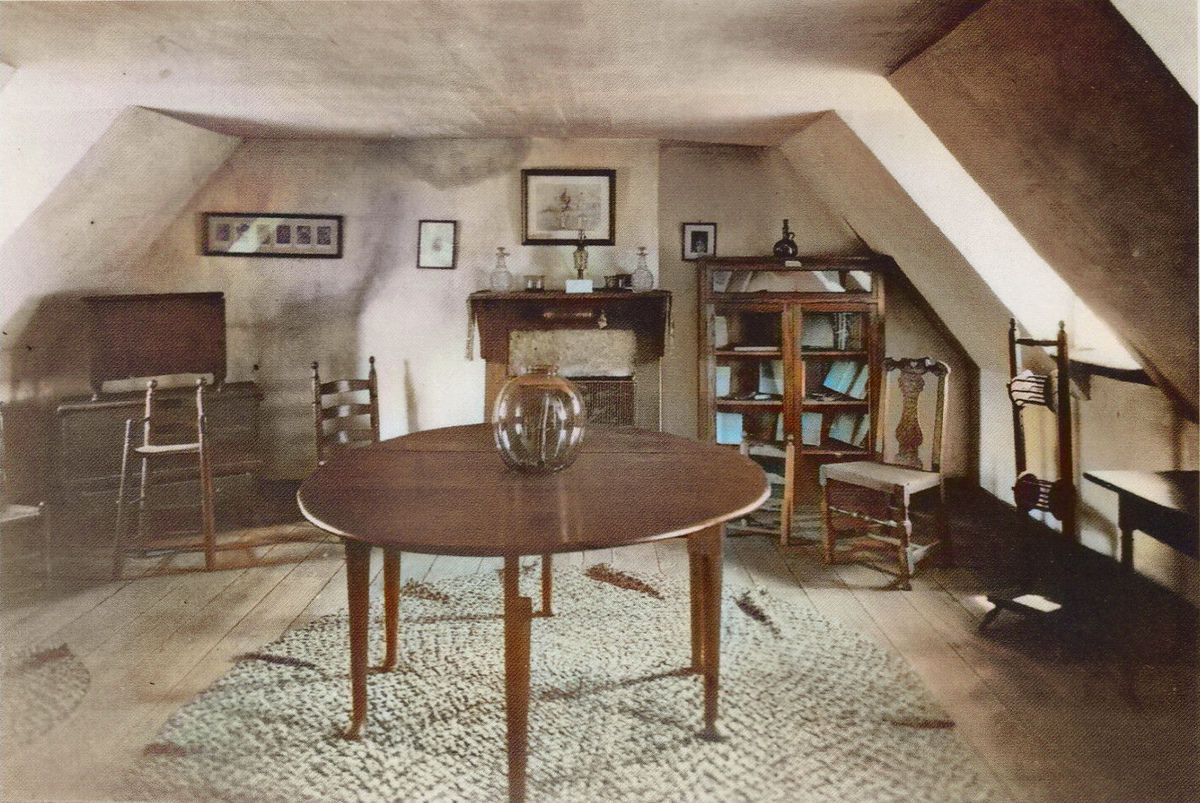
“Poe’s chair, desk, and various personal belongings are there, as well as many architectural details (mantels, a staircase, etc.) from the two Allan houses and the Southern Literary Messenger building [where Poe had been editor], all now demolish’d. One utterly magnificent feature is a gigantick model of the whole town of Richmond as it was during Poe’s boy-hood — about 1820 — in a glass case occupying the entire ground floor space of the colonial house attached to the shrine. This model, made in natural colours and on a scale permitting even the smallest houses to be about an inch square, was constructed a few years ago with the utmost antiquarian accuracy and artistick skill; and is so vivid that one can almost imagine himself in a balloon looking down over the outspread Georgian city. Never have I seen an antient town so miraculously conjured out of the past — I wish someone wou’d do the same for Old Providence!”
Lovecraft returned to Richmond in 1930, on which more later.
3. Poe was taken to live in Britain at a formative time of his life, from 1815-20, aged around 6 to 11. He was schooled in Richmond, then in Surrey and near but not in London.
Lovecraft remarks that the British sites… “are not marked or generally known”. Lovecraft is however known to have made a minute and sustained study of London’s historical topography and thus one wonders if, in part, this was an attempt at a tracing of the young Poe?
4. For a short while on his return to America, a house at Clay and Fifth Streets, Richmond.
Lovecraft states… “This house has vanished, and the site is unmarked.”
5. From 1825 then at the house ‘Moldavia’ at Main and Fifth Streets, Richmond.
Lovecraft notes this is an important site but “demolished without the marking of the site”. See above, for his remarks on the later attempt at recreating this home in Richmond.
6. Rooms at the University of Virginia in Charlottesville. Lovecraft notes this is “fortunately, well commemorated. His room at 13 West Range is fitted up as it was during his tenancy”.

Collected Essays notes that Lovecraft had visited Charlottesville, and presumably an account of the visit is somewhere in the Letters.
7. Various military sites associated with his time as a soldier. Lovecraft notes many of the key military sites “survive, though without Poe tablets” to mark them. Also that “no marker remains to record his sojourn in Room 28, South Barracks” at West Point.
Possibly Lovecraft recalled some of these regions via his boyhood travels with his grandfather.
8. Mechanics Row, Milk Street, Baltimore. This “has vanished without commemoration”.
9. Amity Street, Baltimore, with relatives. Lovecraft calls this “a dormer-windowed brick house at 3 Amity Street, which is still standing though unmarked.”
On visiting Lovecraft found Baltimore “hideously foreignised” but with some colonial survivals in the slums, and there “All the old houses have white marble steps, which are kept spotless by dint of constant labour.” “But to me the culminating thing in Baltimore was a dingy monument in a corner of Westminster Presbyterian Churchyard, which the slums have long overtaken. It is near a high wall, and a willow weeps over it. Melancholy broods around it, and black wings brush it in the night — for it is the grave of Edgar Allan Poe.” He tried to buy some postcards of the “dingy monument” for friends, but quickly had to abandon the quest as he had left himself so little time in the city.
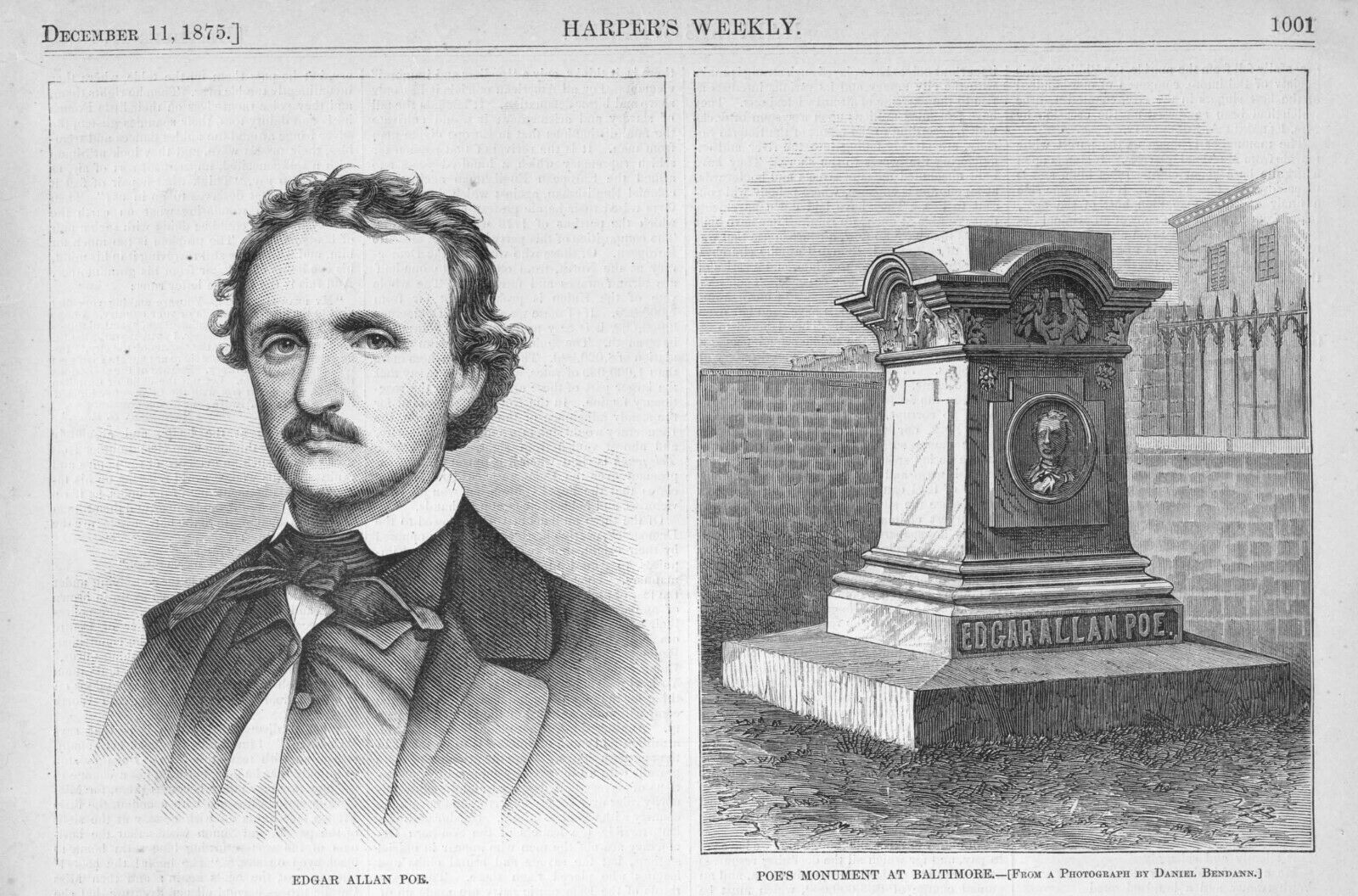
It’s uncertain if he found more than the grave in his very limited time there. He remarks in a February 1930 letter… “I have not looked up the Poe houses or localities in Baltimore, but mean to do so some time”.
10. Bank Street, Capitol Square, Richmond, to marry his thirteen year old bride Virginia. Lovecraft states this… “has disappeared and whose site is unmarked.”
In 1930 Lovecraft returned to Richmond in earnest, spending ten days there and with the benefit of two recent scholarly books on Poe’s life. One assumes that he then located and saw all there was to be seen.
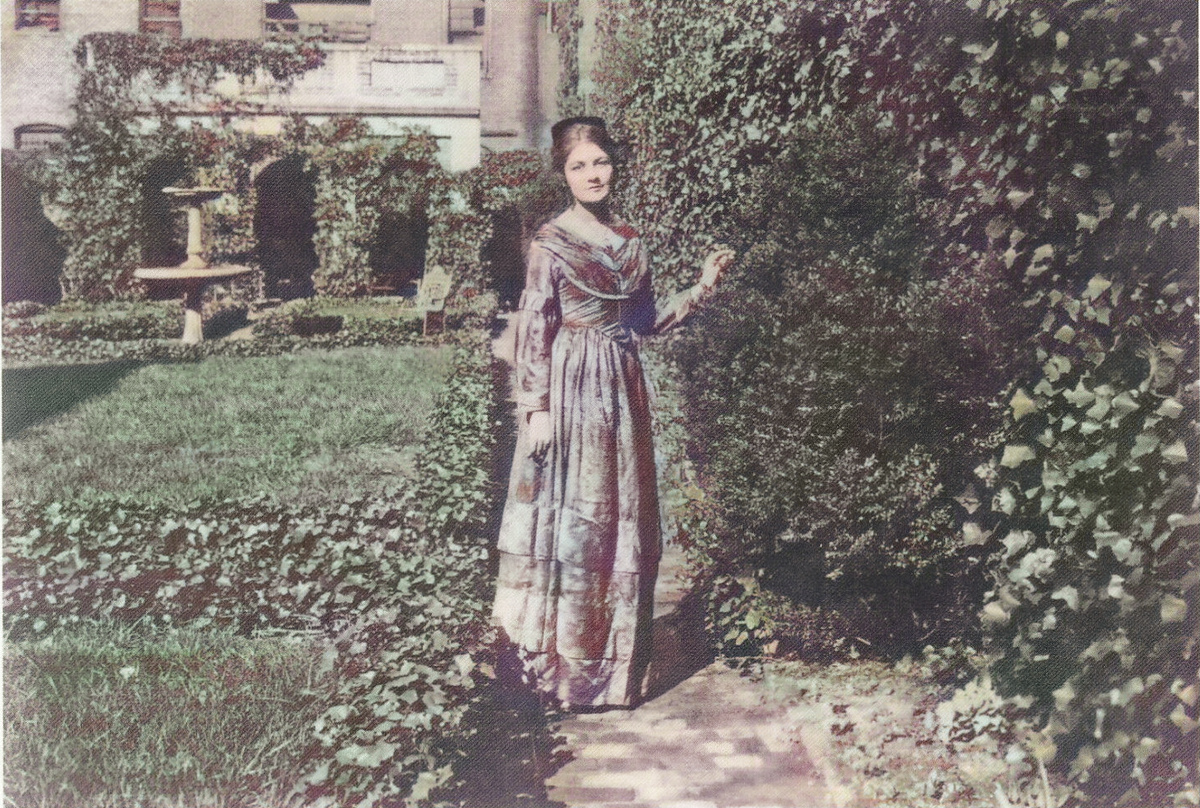
Recreation of Virginia as a teenager, in the garden of the ‘Poe Shrine’ in Richmond.
11. Poe then appears to have made an early try to establish his new family in Greenwich Village. On this Lovecraft refers to… “the corner of Sixth Avenue and Waverly Place in Greenwich Village, where no trace of his tenancy remains. In the spring he moved to 13½ Carmine Street, a site still commonly associated with him, though neither house nor marker exists”.
One imagines this was investigated on night walks during Lovecraft’s New York City years.
12. There were then six years in Philadelphia, where some of Poe’s most famous work was said to have been written. First at two boarding houses, then a small house at… “16th Street near Locust”, soon followed by a larger house “at the junction of Coates Street and Fairmount Drive, overlooking the Schuylkill [river]. Though without a marker, this building is still standing unless very recently destroyed.”
While visiting Philadelphia Lovecraft once… “rose before dawn in order to “observe the gold & rose dawn from the hills beyond the Schuylkill.” (I Am Providence). This sounds like it might have been at or near the Poe site, and his remark “this building is still standing” seems to show personal knowledge.
13. Then the Poe “shrine” cottage in Philadelphia… “the neat brick cottage at North Seventh and Spring Garden Streets, where from 1842 to 1844 lived Edgar Allan Poe”, writing some of his key works.
Lovecraft saw this in 1934 and wrote to Galpin that he had… “inspected the home of Poe (1842–44) at N. 7th & Spring Garden Sts., lately open’d as a publick museum. This small brick cottage is precisely as it was in Poe’s day, & hath been appropriately furnish’d. In a building adjacent is an ample collection of reliques, including copies of most of the magazines containing the first appearance of the various tales & poems. The effect of the place is extreamly lifelike, & it was not difficult to imagine the bard as present in person to welcome & guide the pilgrim.”
This appears to have brought him close to Poe, and perhaps more so than in other places.
14. Poe was then back to Greenwich Village in 1844, and Lovecraft would have thought that for a time he was living in the former Planters Hotel on… “the northwest corner of Greenwich and Albany Streets” which as Lovecraft says “still exists in good condition as a restaurant; though there is no tablet to indicate Poe’s connexion with it.” This may be because its claim to Poe now appears to be questionable. It’s now though likely that Poe never stayed there, and the belief was put about by the restaurant.
Again, one assumes that Lovecraft and his circle did a ‘Poe tour’ of Greenwich Village at night, at least once.
15. A summer house in the “Bloomingdale region” for 1844… “on a knoll near what is now the busy intersection of Broadway and 84th Street” … “The house has of course long vanished, nor does any marker amidst the babel of shops and apartments attest the fact that “The Raven” was completed on that spot”. There seem to be various competing sites for the writing of the famous “The Raven”, but this is obviously where Lovecraft thought it had been written.
Lovecraft was in Bloomingdale after Christmas 1933, for he haled Morton in a letter written from… “West 97th St., corner of the Bloomingdale Road, over-against Stryker’s Bay, Bloomingdale”. His comment that the Poe site there was among “the babel of shops and apartments” suggests he had actually tried to visit the spot.
16. In the direst poverty the Poe family then made a rapid series of complex moves around Greenwich, Broadway, Bloomingdale, and out to Turtle Bay… “15 Amity Street. Neither the house nor any marker exists at present. … 195 Broadway … in extreme poverty, sharing a single back room in a run-down tenement long ago destroyed and forgotten. By midsummer … a return to Amity Street, this time to No. 85, which like so many other Poe abodes has sunk without a trace. … the Bloomingdale farmhouse [and] later to another rural boarding-house at Turtle Bay, where the present 47th Street meets the East River. This was a large farmhouse, of which no vestige or memorial now survives.”
I’m not sure if Lovecraft ever visited the farmhouse/boarding-house site at Turtle Bay.
17. The famous Poe Cottage, at Fordham in the Bronx. Here Poe apparently wrote “Annabel Lee” and “The Bells”. This location was then rural, said to be about fourteen miles outside the current New York City. Lovecraft calls it… “a small but shapely farmhouse … in Poe’s time situated amidst a countryside of the greatest possible beauty. [In 1913 the city] moved it northward about 450 feet to the crossing of the Grand Concourse and Kingsbridge Road, in a small park named for Poe. By 1921 its restoration was complete, and the surrounding landscape was made to resemble its original setting as closely as possible. It is furnished just as it was in Poe’s time; three articles — a rocking-chair, a bedstead, and a mirror — being actually the ones he owned and used. Various relics of Poe are present.”
In 1930 Lovecraft recalled his memories of the first visit there in 1922… “rattle of the elevated [railway] through unknown labyrinths of accursed life … sweep of red-gold sun over a luring balustraded hill-crest — and the Home of Poe!” He later remarked on “the Fordham cottage I know so well”. Another comment was that… “In that shrine of America’s greatest literary artist, a brooding atmosphere lingers, and unseen wings seem to brush the cheek of the worshipper”.
In 1925 Lovecraft saw the eclipse of the sun from High Bridge, and likely knew that for Poe… “a walk to High Bridge was one of his favorite and habitual recreations” while at Fordham.

Frank Belknap Long wrote a prose-poem of the 1922 Lovecraft-Loveman-Morton-Long visit of April 1922, “At the Home of Poe”, published in the United Amateur for May 1922…
“The home of Poe! … The dead years circle slowly and solemnly around its low white walls, and clothe it in a mystic veil of unseen tears. And many marvellous stories could this quaint little old house tell, many weird and cryptic stories of him of the Raven hair, and high, pallid brow, and sad, sweet face, and melancholy mien; and of the beloved Virginia, that sweet child of a thousand magic visions, child of the lonesome, pale-gray latter years, child of the soft and happy South. And how the dreamer of the spheres must have loved this strange little house. Every night the hollow boards of its porch must have echoed to his footfall, and every morn the great rising sun must have sent its rays through the little window, and bathed the lovely tresses of the dream-child in mystical yellow. And perhaps there was laughter within the walls of that house, laughter and merriment and singing. But we know that the Evil One came at last, the grim humourless spectre who loves not beauty, and is not of this world. And we know that the house of youth and of love became a house of death … a thing seen darkly as in a looking-glass; but lovely beyond the dreams of mortals, and ineffably sad.”

On a later 1924 visit with his aunt, Lovecraft was less certain (at least architecturally) of what he had formerly regarded as the “shapely” farmhouse. Finding it now… “very squat and cramped”. But with enough charm in its removed re-creation for visitors, that he could still imagine himself actually living there (Letters to Family). In early 1930 he stated in a letter that preferred Richmond, even though by that time he had spent relatively little time there… “Fordham, (now absorbed in N.Y. City) where so much is made of his cottage. Richmond, however, is really the authentic ‘home town’, where all the formative influences of youth had their sway.” Lovecraft returned to Richmond for ten days in summer 1930, to immerse himself in the places of his idol.