May on Tentaclii

After a chilly May, a pleasant English summer is finally a’ coming in, and the verdant greenwood once again embraces Tentaclii Towers. Down in the moat, small fluffy goslings occasionally vanish into the savage jaws of a lurking pike. Curiously iridescent insects emerge from their wintering holes. Servants at the Towers become irritatingly frisky.

One especially frisky servant has been my PC. So frisky that the old fellow keeled over and died, sadly. But I’m pleased to say I lost no books or other recent work. I should probably now be mercenary and start a ‘new PC for Dave’ crowd-funder. But I doubt it would get anywhere near the £1,200 ($1,700) needed for a reasonably future-proof PC. So in the meantime I’ve fallen back on an old cupboard-hauled PC and have ordered a £70 SSD drive to give it a speed boost. That’s where your kind Patreon donations have gone this month, rather than on a book or two.

Volume two of Lovecraft’s Letters to Family and several other Letters books still await my reading, as (when not PC-wrangling) I’ve been immersed in reading and taking notes on Tolkien: maker of Middle-earth and The Worlds of J.R.R. Tolkien. These have been waiting for over a year to be properly read, and I’d now dug out the magnifying glass needed — the fonts are often infinitesimally small and especially on the vital footnotes for Worlds.

In June there may well be a long review of the last Lovecraft Annual here, as I now only have the long final ‘zombies’ essay to get past (I have no interest in zombies, the ‘monster for the unimaginative’) and then the reviews to read and make notes on.

New books discovered and noted on Tentaclii in May included: H.P. Lovecraft et le jeu video in Spanish and French; and The Werewolf In The Ancient World. Found via S.T. Joshi’s blog were the short books Lovecraft, l’Arabe, l’horreur and Lovecraft: sous le signe du chat, and I did a little more digging to discover what these were about. Also noted here were the journals St. Austin Review and Modern Age, re: their current willingness to carry articles about suitably interesting fantasy writers. In paid ‘Lovecraft & circle’ journals I noted the releases of the Italian Studi Lovecraftiani #19, and Zothique #6 & #7 — #7 being an R.E. Howard special issue. My “Fairytales” issue of the free Digital Art Live magazine also appeared this month.

My regular ‘Picture Postals’ posts looked at Lovecraft and: the appeal of Georgian doorways; the neo-gothic Radiator Co. building in New York City; and his favourite non-weird artist Nicholas Roerich. A long post for a Patreon patron surveyed “HPL at the movies”. Also posted was a newly enlarged and colourised picture of 169 Clinton St. in 1935.

In freebies at Archive.org, I spotted the worthy three-volume Dictionary Of Mythology, Folklore And Symbols (1962). This is newly available in downloadable PDF. Also free over at SFFaudio is a haul of tales determined to be newly ‘public domain’. I plucked the items of most interest from their list, and noted five from Frank Belknap Long. I added more links to free scholarly work at my Open Lovecraft page.

In bargain-spotting, I noted that the volume of Lovecraft-Barlow letters are available again in paperback and now at a very reasonable price. Presumably Florida University Press have wised up to print-on-demand, or else has produced a new print-run. The Barlow letters are now a good affordable ‘starter’ for those considering dipping a toe into the Lovecraft letters.

In comics and graphics novels I found several old ‘Lovecraft as character’ items, both new to me. These were Charles Cutting’s major graphic novel Kadath, or, The dream quest of Randolph Carter; and Alex CF’s one-off Lovers #1. In art I also noted that Armel Gaulme is selling off his “The Rats in the Walls” fine pencil illustrations.

In celeb news, Alan Moore announced his un-retirement, and del Toro won his legal case over supposed ‘plagiarism’.

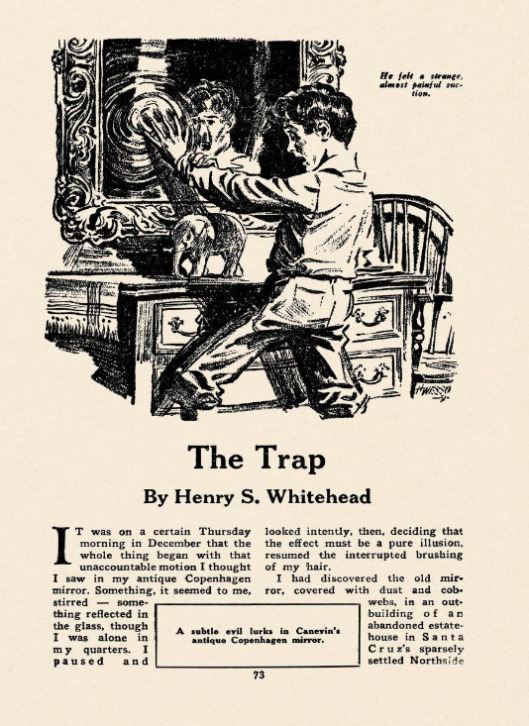
In audio, Horrorbabble provided worthy new free readings of the Whitehead-Lovecraft tale “The Trap” and the Lovecraftian story “Far Below”. Dark Adventure Radio Theatre announced their paid CD of The Horror in the Museum, but the release will not be until Lovecraft’s birthday in August.

That’s it for this month’s round-up. Please support me via my Patreon, it really helps me out. Especially when my PC blows up. Thanks.

Cuttings from Kadath

New to me, Kadath, or, The dream quest of Randolph Carter from Sloth Comics of London, 2014. Creator Charles Cutting is an illustrator from Oxford, in the UK. I like the style, and it’s probably even better on paper. There’s lots of it too, with over 100 pages of detailed art.

The first quarter of the adaptation was a webcomic originally on The Illustrated Ape website, then the first issue appeared in 2012 — but a crowd-funder for the rest of the issues is said to have failed. Congratulations to Cutting for getting the book finished and published regardless, especially in the context of the difficult UK scene. One review lamented that…

work of this calibre seems to slip ‘under the radar’ in the comics community

It certainly slipped under my radar, and yet Lovecraft + comics is on the radar for me. But then it’s always been a problem finding out about entertaining completed-story graphic novels for over-18 readers, unless they’re mass-market superhero fare or the sort of angsty politically-correct wrist-slashers that the reviewers flock to.

Anyway, get Kadath for £11.99 (about $17 U.S.) as a new paperback via Sloth (appears to be still in print, delivered by Amazon) and help support Charles with royalties. Or get it used on Amazon for (currently) a little less inc. postage.

‘Picture postals’ from Lovecraft: Nicholas Roerich

This week, H.P. Lovecraft’s favourite non-magazine artist, Nicholas Roerich (1874-1947). As seen in The New York Times Magazine, 1st September 1929, as the article “Gods and Men in Storied India” (the northern Punjab). This is the only version online and is just about readable if you squint, but the rest of the article is not available.

From the same year, free as a PDF on Archive.org, his own book Altai-Himalaya: a travel diary, by Nicholas Roerich; with twenty reproductions from paintings, evoking and recording horseback journeys from 1924 to 1928 through the immense spaces and places of Asia, with the Altai Mountains being visited in 1926. This is the high bio-region where four nations now meet, China, Russia, Kazakhstan and Mongolia. It seen just before modernity and collectivisation, and the start of deforestation and the environmental damage wrought by socialism.

One wonders if Lovecraft read the book. But there is no Roerich book listed in Lovecraft’s Library. It seems like the sort of book that the budding ethnographer Barlow would have valued and taken away. Of course, it could also have been read from the Public Library. Roerich was then very famous, and there was no reason the Providence Public Library would not have stocked it.

If Lovecraft had picked up Roerich’s 1929 book a little late, in the early 1930s, and read as far as the 1926 “Altai” chapter then he would have been reading history. Wikipedia’s page on the Altai curiously skips the 1930s, but according to the reliable The Former Soviet Union’s Diverse Peoples: A Reference Sourcebook and other sources, under communism the Altai people were sent to small reserves in the south of the region, and by 1930 vast numbers of Slavs had been shipped in as part of a deliberate population-replacement strategy. In 1933 the Altai alphabet was banned, and the Altai religion was deemed an anti-Soviet conspiracy. The Altai who still remained outside the reserves were forced to settle and collectivise. During the war Stalin’s paranoia deemed them “pro-Japanese”. The post-war Soviet ‘Virgin Lands campaign’ brought gigantic collectivised farms to the region — 50 million acres of it went under the plough to grow the wheat needed to buy revolution and terror around the world. The Altai people were reduced to barely 20% of the population. Just a few years after his death in 1947, here and elsewhere in the high places of Asia, Roerich’s mid-1920s Shangri-la was gone.

Roerich’s 1920s ‘travel for painting’ diary book is fronted with a fine portrait of the man Lovecraft may have briefly talked with or seen on some of his many visits to Roerich’s New York City gallery. He would have been in his mid 50s by that time, then deemed ‘old’ by the male life-expectancy of the time.

…good old Nick Roerich, whose joint at Riverside Drive and 103rd Street is one of my shrines in the pest zone [New York City]” — Lovecraft letter to James F. Morton, March 1937.

Note that Roerich’s long expedition to Asia appears to have left New York City in March 1925, so after that date during the ‘New York City period’ Lovecraft would not have met or glimpsed Roerich in his Gallery. It’s quite possible the departure was covered by the cinema newsreels, though, and Lovecraft may have seen him on the screen.

Also new on Archive.org. “Nicholas Roerich and Science”, an article extracted from Art and Archaeology, May 1930. This presents an overview of the explorations and papers by Roerich that Lovecraft might have known by 1929, if only through personal discussion or press reports.

Simple elegant select / translate at Google Books

Simple Translate for Chrome, Opera, and other Web browsers which support Chrome addons. Works on Google Books. Unlike other free addons, this one doesn’t make you jump through hoops or go to Google Translate. It also has a feature that ensures it doesn’t work in places such as search-engine input boxes. Made in Japan, and a mature and maintained bit of software development.

How it works:

Select your target text, a small button shows up.

Click the button to instantly show the translation. Language is auto-detected.

While the translation box is displayed, you can also select and Ctrl + C to copy text from it if you wish.

Clicking away from the translation removes the translation box and also deselects the page text.


To run on Google Books, as seen above, after install in Opera:

1. Access Options. Run on all sites. (This appears to be the default, but make sure it is).

2. Applications. Manage Extension. Turn on “Allow Access to Search Results”, to have it work on Google and Google Books and other search results. Opera requires this, and I assume others Web browsers do also.

3. In its own Settings page there are also switches to ensure it does not display its button in unwanted places such as search-engine input boxes, password input forms etc. This vital feature is missing in a couple of other similar addons.

In the Modern Age

The new Spring 2021 edition of the journal Modern Age: a Conservative Review offers two free and public articles…

* “The Dark Virtues of Robert E. Howard”.

Of the Howard article the editor states…

If all you know about Conan comes from Arnold Schwarzenegger, you should definitely read Birzer’s piece. You’ll see how Howard’s nihilistic philosophy and experiences in early 1900s Texas influenced his ideas about: religion; sexuality; modernity; masculinity; big business; decadence.

In the same issue…

* “The Western Canon”, reviewing the Library of America’s new The Western: Four Classic Novels of the 1940s and 50s.

Does it matter that such fiction is finely typeset on bible-paper with sewn-in satin bookmarks and clasped in firm leathery boards? Rather than in warm-smelling woodpulp paperbacks, with garish six-gun covers and gummy discount-store stickers? The latest Journal of American Culture (March 2021) might seem to have an answer that question with the essay “From Pulps to Paperbacks: The Role of Medium in the Development of Sword-and-Sorcery Fiction”. This is currently online for free.

Sadly this essay does not turn out to be an elegant Guy Davenport-like consideration of the subtle psychological impacts of the actual mediums involved. I mean in terms of the madeleine-like tactility, the olfactory qualities, the surrounding-matter, the ads, the font and its size, the memory of the point-of-purchase and suchlike. That essay remains to be written. But the fannish reader who can make it beyond the introduction (“the genre reached full maturity in the works of Michael Moorcock”) is treated to a usefully brisk historical overview covering the role of editors, fans and publishers from the 1930s to the 1980s.