‘Picture postals’ from Lovecraft: the almanacs

As we move into the New Year, it seems apt to take a look at the annual almanacs which H.P. Lovecraft cherished. Not quite postcards, of course, but still pictorial.

He inherited, and then further developed, a substantial collection of such old country almanacs. He writes in a letter that this family collection, when first passed down to him…

went back solidly only to 1877, with scattering copies back to 1815

Trying to complete this set eventually became a keen occasional hobby, though he had some luck there. He was allowed to root among the home storage attic of his sometime-friend Eddy’s book-selling uncle, and he descended the ladder with many a rare old copy. Which Uncle Eddy then sold him at a very affordable price. This haul appears to have spurred his ambitions, and he wrote…

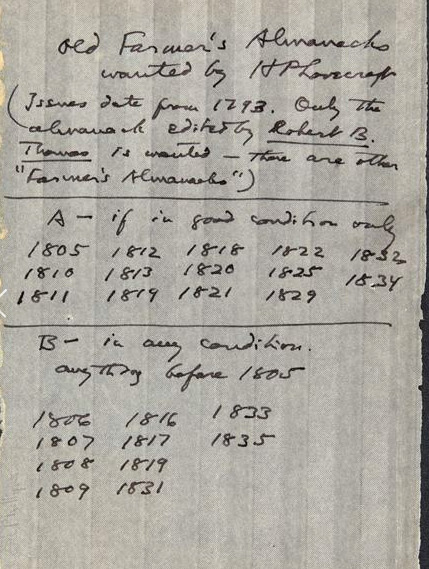
I am now trying to complete my family file of the Old Farmer’s Almanack

Here we see Lovecraft’s collecting ‘wants list’, as he tried to complete the set…

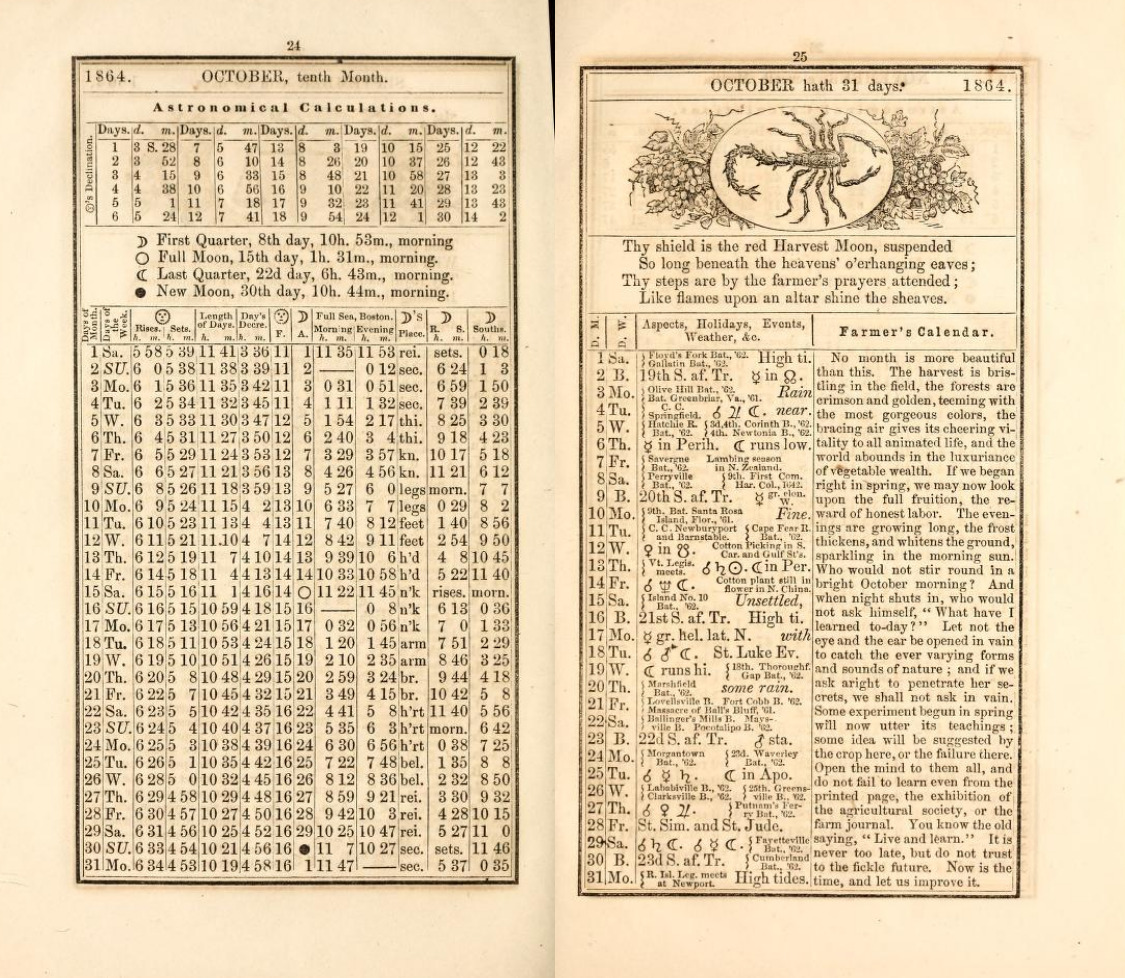
What, exactly, was this publication? Archive.org now has a small selection of scans of this Old Farmer’s Almanack, and thus we can get a better idea of what Lovecraft found between the pages. To be specific, he inherited and collected old copies of the Old Farmer’s Almanack edited by Robert B. Thomas. (It can’t be linked, as the URL is malformed, but if you paste this into the Archive.org search-box you should get it: creator:”Thomas, Robert Bailey, 1766-1846″ )

There were other publications of the same or similar title, but Old Farmer’s Almanack was Lovecraft’s mainstay. Which is not say he wasn’t delighted to discover that other similar almanacs were still publishing, out in the countryside…

It sure did give me a kick to find Dudley Leavitt’s Farmer’s Almanack [Leavitt’s Farmer’s Almanack, improved] still going after all these years. The last previous copy I had seen was of the Civil War period. But of course my main standby is Robt. B. Thomas’s [Almanack]

Thomas’s Old Farmer’s Almanack had begun publication in 1793. As we can see from the above list, Lovecraft was especially keen to get hold of anything before 1805 and in any condition. Many of these used the old long-S in the text…

I can dream a whole cycle of colonial life from merely gazing on a tattered old book or almanack with the long S.

This dream had first occurred very early in his life, and at age five the family Almanack had made a lasting impression…

my earliest memories — a picture, a library table, an 1895 Farmer’s Almanack, a small music-box

Evidently then this annual was taken and consulted in his home at that time. Also cherished and kept, since we know he was able to read the entire set…

[As a boy] I read them all through from 1815 to the present, & came early to think of every turn & season of the year in terms of the crops, the zodiac, the moon, the ploughing & [harvest] reaping, the face of the landscape, & all the other primeval guideposts which have been familiar to mankind since the first accidental discovery of agriculture in the Tigris-Euphrates Valley.

Nor did he overlook the rustic pictures…

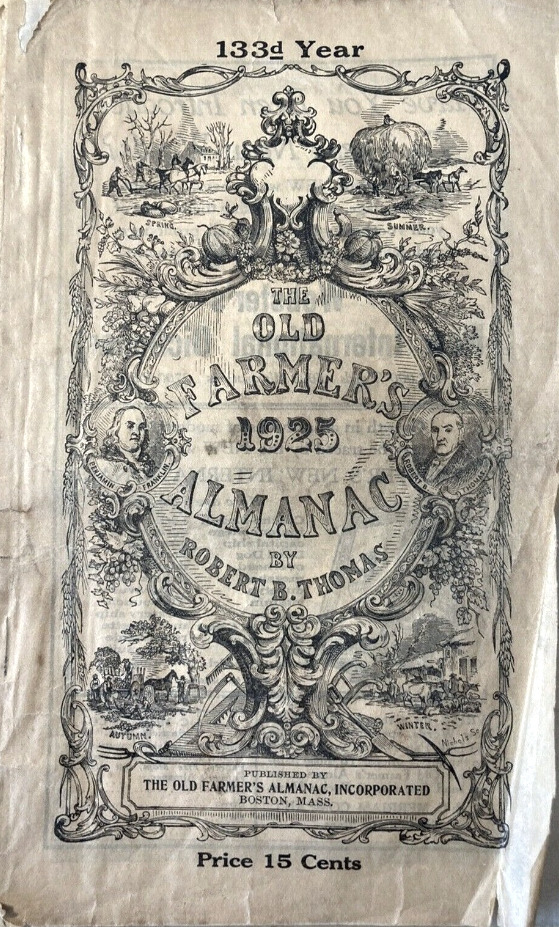
I am always fond of seasonal pictures, & dote on the little ovals on the cover of the ancient Farmer’s Almanack — spring , summer, autumn, & winter

On his travels he later found places where the homely traditions and moon and star-lore of the Farmer’s Almanack were still followed, such places as Vermont…

That Arcadian world which we see faintly reflected in the Farmer’s Almanack is here a vital & vivid actuality [in rural Vermont]

The publication was indeed a useful one. For instance it enabled Lovecraft to anticipate with ease the year’s lesser heavenly events…

Sun crosses the equinox next Wednesday at 7:24 p.m. according to the Old Farmer’s Almanack — which we have had in our family, I fancy, ever since its founding in 1793.

Having sent some introductory astronomy books, Lovecraft also sent young Rimel a copy of the latest Old Farmer’s Almanac for the coming year of 1935. In a later letter to Rimel of 28th January 1935, Lovecraft explicitly recommends the publication for astronomy use. The Almanac being…

capable of assisting the study of astronomy quite a bit.

The weather predictions found in its pages were perhaps of less use. Or at least, they had become so by the late 1970s. In 1981 Weatherwise magazine made a tally of sixty forecasts across five years. They found the month-by-month Almanack forecast to be little better than chance by then. How accurate the monthly weather forecasts might have been in the 1895-1935 period and in Providence remains to be determined. It might be quite interesting to tally that, with perhaps a leeway of two days. But to do so one would likely need to go back to the original journal / newspaper summaries of the month’s actual weather, rather than trust any recently ‘rectified’ computer-created data for those decades.

The Almanacks also contained a wealth of rather more reliable factual information. Such as the dates of the year’s key elections, court days, festival and saint’s days, tides, recurring natural events (usual time of lambing, bringing in cows for the winter etc), anniversary dates for sundry historical events, lists of Presidents, the standard weights and measures, distances, nutritional values of various crops and fodder, together with small amusements such as riddles and poetry. Short articles could also be present. Most importantly for Lovecraft’s huge flow of parcels and letters, the little booklets also appear to have given the latest postal regulations in a concise form.

In format they were rather like Lovecraft’s stories, then. A whole lot of sound facts garnished with a few slivers of delicious speculation (meaning the weather forecasts, rather than monsters and cults). Indeed, one might see something of the ‘carnivalesque’ at work in such publications. The use of a small inversion, that by its amusing ridiculousness serves to bolster the belief in the facticity of the rest of the structure.

The latest annual Almanack was also ever-present in Lovecraft’s own study, as he wrote to Galpin in 1933…

You may be assur’d, that my colonial study mantel has swinging from it the undying Farmer’s Almanack of Robert B. Thomas (now in its 141st year) which has swung beside the kindred mantels of all my New-England forbears for near a century & a half: that almanack without which my grandfather wou’d never permit himself to be, & of which a family file extending unbrokenly back to 1836 & scatteringly to 1805 still reposes in the lower drawer of my library table [evidently Lovecraft had by this time added 1876-1836 to the “family file”] … which was likewise my grandfather’s library table. A real civilisation, Sir, can never depart far from the state of a people’s rootedness in the soil, & their adherence to the landskip & phaenomena & methods which from a primitive antiquity shap’d them to their particular set of manners & institutions & perspectives.

This mantel-hanging had been a long-standing practice. For instance it was noted by his earliest visitor, when Lovecraft was emerging from his hermit phase. Rheinhart Kleiner recalled of his curious visit to the darkened room that…

An almanac hung against the wall directly over his desk, and I think he said it was the Farmers’ Almanac.

Lovecraft even kept up the tradition during the hectic New York years, writing in late 1924…

the Old Farmer’s Almanack … of which I am monstrous eager to get the 1925 issue

In that era the Almanacks were very often personalised and annotated quite heavily by their users, and a rural man’s personal collection grew to form a sort of natural diary and personal time-series for useful farm data. In 1900 40% of the American people still worked on the land, so such things were vital.

So far as I’m aware we have none of Lovecraft’s own copies today, so we don’t know if he also marked and noted them in various ways. Or if he had inherited copies that had been so marked by his relatives.

He also hints at being aware of and valuing another such publication. For instance, when he remarked on the discovery of the planet Pluto he wrote…

the discovery of the new trans-Neptunian planet …. I have always wished I could live to see such a thing come to light — & here it is! …. One wonders what it is like, & what dim-litten fungi may sprout coldly on its frozen surface! I think I shall suggest its being named Yuggoth! …. I shall await its ephemerides & elements with interest. Probably it will receive a symbol & be treated of in the Nautical Almanack — I wonder whether it will get into the popular almanacks as well?

In his early newspaper columns on astronomy he also appears to refer to this same publication…

The motions of these satellites, their eclipses, occultations, and transits, form a pleasing picture of celestial activity to the diligent astronomer; and are predicted with great accuracy in the National Almanack. [I assume here a mis-transcription by the newspaper editor of “National” for “Nautical”, or perhaps a correction to its shorthand name in the district].

Indeed, both Almanacks feature in Lovecraft’s “Principal Astronomical Work” list, among the vital accessories needed for a study of the night-sky…

Accessories:

Lunar Map by Wright.
Year Book — Farmer’s Almanack.
Planispheres — Whitaker & Barrett-Serviss.
Atlas by Upton — Library.
Opera glasses — Prism Binoculars.
Am. Exh. & Want Almanac. [meaning the American Ephemeris & Nautical Almanac, as “Exh.” is “Eph.” and “Want” should be “Naut”]

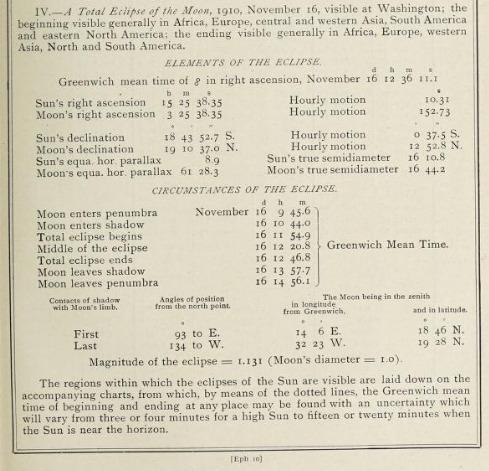
This Nautical Almanac is also on Archive.org, so we can peep inside a copy of that from 1910. Forthcoming eclipses were noted over several pages. Here, for instance we see all the details needed to observe a total eclipse of the Moon in November 1910, the beginning visible from “eastern North America”. I think we have a hint here about what Lovecraft was likely to have been doing in the late evening of 16th November 1910…

Archive.org also has The Old Farmer and his Almanack, a 1920 book which surveyed the topic with erudition. Lovecraft was heartily pleased to discover and read it shortly after publication.

Almanacks occur only once (and very trivially) in Lovecraft’s poetry. The one use in his fiction is more intriguing. In “The Picture in the House” (December 1920) a book is noted…

a Pilgrim’s Progress of like period, illustrated with grotesque woodcuts and printed by the almanack-maker Isaiah Thomas

The sharp-eyed will have spotted that Lovecraft might have meant to imply that this “Thomas” could have been the ancestor of the Robert B. Thomas of Old Farmer’s Almanack fame. That might be how some savvy bookmen took it at the time, but it is not so. For Lovecraft would have known that there was a real “almanack-maker Isaiah Thomas” and that he was no relation. Robert B. Thomas himself tells us this fact, in recalling his early years of trying to get a start in publishing almanacks…

I wanted practical knowledge of the calculations of an Almanack. In September, I journeyed into Vermont to see the then-famous Dr. S. Sternes, who for many years calculated Isaiah Thomas’s Almanack, but failed to see him. … In the fall, I called on Isaiah Thomas of Worcester (no relation) to purchase 100 of his Almanacks in sheets, but he refused to let me have them. I was mortified and came home with a determination to have an Almanack of my own.

Thus my feeling is that Lovecraft knew of these snubs and also, probably while reading his The Old Farmer and his Almanack (1920), had learned that Isaiah Thomas had sustained a sideline in publishing booklets containing the worst sorts of “astrology, palmistry, and physiognomy”. Thus, later that same year Lovecraft gave curmudgeonly old Isaiah Thomas a small poke in his fiction, by implying that Isaiah had marred a classic book with “grotesque” pictures — so “grotesque” that the resulting book ended up resting next to Pigafetta’s account of the Congo and its cannibals.


Update: The Nautical Almanac. Hathi now have the full run of the Nautical Almanac online.

All aboard the Trans-Europe Express…

Eldritch-con 2022: A Horror and Fantasy Game Writers’ Convention. In November 2022, including the possibility of…

a unique, luxury pre-convention travel package – a rail journey from Paris, France to Bucharest, Romania upon the Venice Simplon Orient Express [including] a live-action role-playing experience created by Sean Branney / the H.P. Lovecraft Historical Society

McNeil as photographer

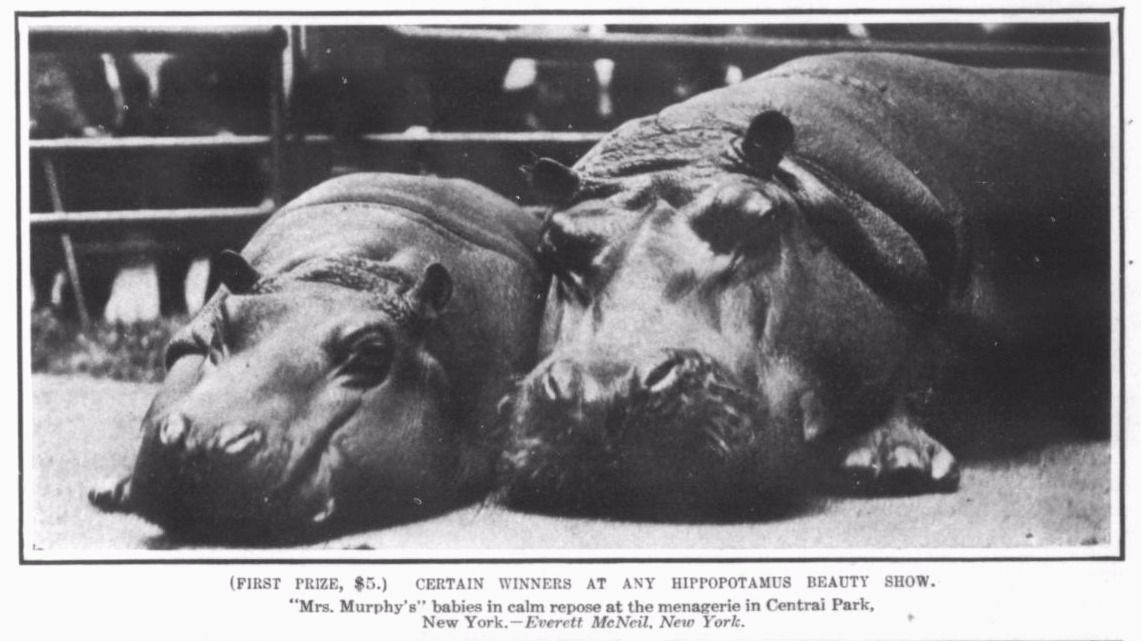
I’ve found a little more evidence that Lovecraft’s friend Everett McNeil was rather a good cameraman, at least with still subjects. I spotted that he won $5 in a Leslie’s Illustrated Weekly photography contest for August 1909. $5 was a healthy amount in 1909. This was about the time he was successfully entering the movie-making business, then located in New York City. He was a few years into having ‘made it’ in New York City, and to be able to make good pictures like this one imagines he might have then invested in a better camera and developing equipment. He appears to have often entered prize contests in writing, probably influenced by his farming father David McNeil who had been a regular winner of most of his district’s agricultural produce prizes. Now we know that his son also entered photographic contests.

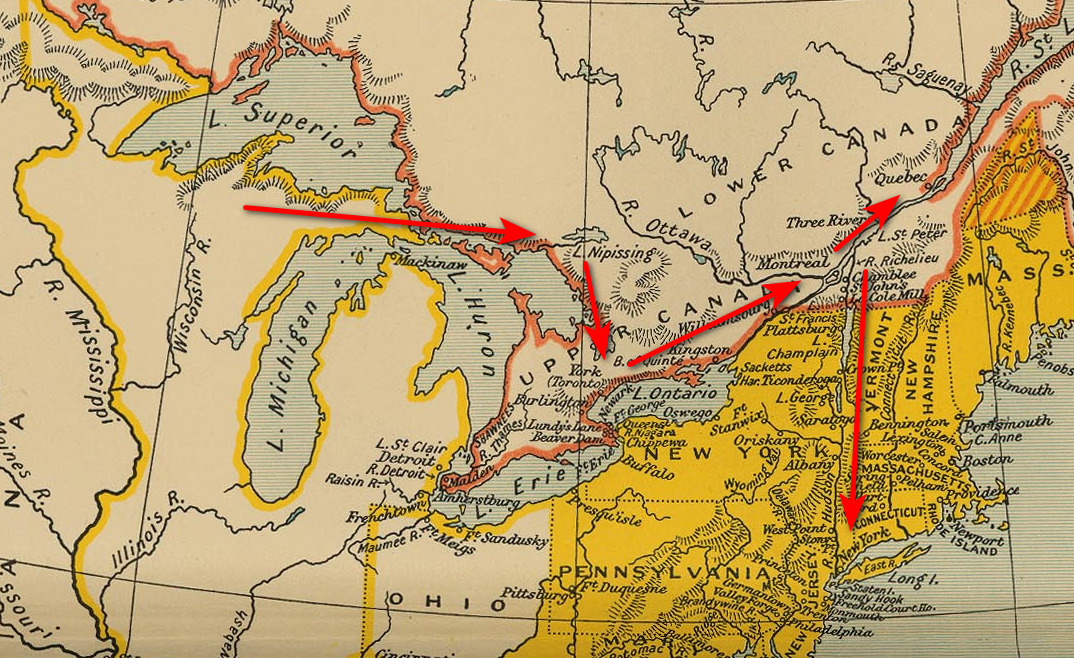
The Lovecraft circle knew that McNeil had ‘walked to New York’ circa 1894, and I rather suspect he earned his way as a travelling photographic portraitist. Possibly going from his home in Wisconsin to Quebec and then down the Hudson Valley to reach New York. In a letter Lovecraft indicates that McNeil had known the city of Quebec well at some point, and the life of a young itinerant photographer was realistically depicted in his story “The Photographing of Billy Oreamnos” (1909). In this a young man travels in rural Canada with his camera and gear…

… in search of Canadian dollars and dimes in exchange for more or less artistic photographs of the natives.

In 1912 a magazine published McNeil’s professional-quality architectural pictures of General Knox’s headquarters. McNeil’s later fine self-portrait with his New York City room as surrounding background (see my book on him) also shows a professional’s skill in composition and lighting.

I can’t be more certain than that about a possible early career in photography. But these fragments of evidence do seem to point that way. He was around age 32 when he left for his long walk to New York, and it was likely a ‘now or never’ try at reaching and ‘sticking’ in the big city. A photographic skill would be a natural method by which to pay one’s way, and the civilised English-speaking parts of what is now eastern Ontario might have offered good prospects — better than the stolid monotony of the Ohio farmlands and then the hillybilly backroads of the Pennsylvania mountains.

A likely route to New York

Encyclopaedia Britannica 1926

Newly liberated into the public domain, the Encyclopaedia Britannica 1926 supplement in three chunky volumes. They form “an entirely new survey of the march of events”, as the Preface has it.

These became the latest supplement to the 11th edition, and they provide a useful updating and snapshot of various emerging fields as they were understood in the ‘prime Lovecraft years’ of 1910-1926 (the dates given in the Preface). Lovecraft owned the 9th edition (1875-89), and its “A Guide to Systematic Reading In…”, the 9th edition being especially revered for its very high standards of scholarship. The dates of the 9th may seen antediluvian to us, but on most matters he was only about 20-25 years behind the current volumes… until 1926. Presumably for more modern topics he was able to consult the latest edition, and its most recent supplements, at the Public Library in Providence or New York City.

Sword-and-Sorcery Studies

At DMR Brian Murphy offers a useful new article “Things That Are Undone and Ought Not To Be: A Sword-and-Sorcery Studies Wish List”.

A good ‘Not Conan or R.E. Howard’ critical survey of the genre in pre-PC comics would certainly be welcome, ideally including British (Karl the Viking etc) and European titles (e.g. in editor Toutain’s Heavy-Metal-alike magazines). And a lavish coffee-table book of related pinball-table art, perhaps with a DVD slotted in the back with the playable pinball table ROMs on it.

To his list I’d add:

* a survey-study of vintage paperback cover-art (as published) and its artists, though if the permissions could be obtained is perhaps doubtful now and one would have to rely on ‘fair use’ for covers;

* a close study of the curiously tepid cultural receptions and contexts of The Lord of the Rings in its ‘fallow period’ between publication and mass take-up. Say 1952-72, to add two years of run-up and take-off at either end;

* perhaps a study of the uses / re-workings sword-and-sorcery authors made of traditional works which were (by their time) effectively in the public domain (folklore, semi-fictional history, Arthur, Norse tales, Arabian Nights, the Northern fairy-tales, Ovid and ancient myth etc). They too had a ‘public domain’, though it was different than ours.

New book: Miskatonic Country Scenarios

New from Sentinel Hill Press, Miskatonic Country Scenarios: A Keeper’s Guide. Meant for RPG game-masters, but also of likely interest to Mythos and graphic novel writers seeking references and inspiration…

An explanation of … the region … A short bibliography … a discussion of all the books from Chaosium’s “Lovecraft Country” series as well as Miskatonic Country-focused scenario collections … a detailed description of more than 60 published scenarios … Concordances for places, entities and tomes encountered.

December on Tentaclii

Here’s a quick round-up for December on Tentaclii, for what it’s worth now. In December my ‘Picture Postals’ posts took a look at Robie Alzada Place (1827–1896) and her home place to the west of Providence, this also having been the home place of Lovecraft’s mother; I followed Lovecraft’s travel trail far up into the White Mountains; and I mused on the Ladd Observatory and its relation to time and time-keeping in Providence.

I wrote a long summary here of the year’s more general Lovecraft-related activity by others, in “Lovecraft in 2021: a summary survey”.

Not much in new books in December, but I was pleased to spot S.T. Joshi’s Phantasmagoria: The Weird Fiction, Poetry, and Criticism of Sir Walter Scott and its fine cover. Also the Lovecraft astronomy book El Astronomicon Y Otros Textes En Defense De La Ciencia down in Spain. The French had shipping dates for the various volumes in the sumptuous Editions Mnemos set of Lovecraft’s work in a new translation.

Not much research by me in December, other than for the ‘Picture Postals’, though I am slowly reading through a new book of letters. I did look at who Chapman Miske was, what he published on Lovecraft, and where to find it. I took another look at Lovecraft’s knowledge of Harlem, after finding some new data.

I spotted that H.P. Lovecraft’s first publication (Scientific American, 25th August 1906) was for sale on eBay. Also on eBay I found a good watercolour of the “Longitude” lane in Charleston, which Lovecraft described and admired on his travels. Over on Abe, a set of “At the Mountains of Madness” in Astounding Stories appeared for sale. More significantly, at the end of the month Abe also landed a big bundle of Lovecraft’s earliest appearances in print.

Popping up on Archive.org for free in December was a comprehensive plot-annotated checklist of ‘Bibliomysteries’ (mystery novels across various genres which centre on rare books, book collectors, old bookshops and suchlike); and I was also pleased to see Clifford D. Simak: a primary and secondary bibliography.

Among the audio, the timely story “The Return of the Undead” by Arthur Leeds saw a welcome free release on YouTube. It’s also just gone into the public domain. A new Voluminous podcast looked at ‘H.P. Lovecraft, Detective’, doggedly solving a dastardly crime at the Haverhill Post Office. A books podcast interviewed the author of the intriguing new novel Providence Blue: A Fantasy Quest.

I was pleased to see that the Robert E. Howard Days in Texas announced their 2022 dates. I was also pleased to find a new lost story by Lovecraft’s friend Everett McNeil, “A Descendant of the Vikings” (1906/07).

In software I noted the new writing software CQuill Writer 1.x, an interesting style-prompting assistant which could be filled (in its full paid version) with the works of Lovecraft. I also see that Scrivener 3.x for Windows was released, at long last, something I had missed earlier in 2021. The latter seems hideously complex, but is said to be the best software for writers on Windows. In 3D software I noted free 3D writing accessories for the free DAZ Studio 3D figure rendering software, which could be used with the 3D Lovecraft figure.

Elsewhere I produced a bumper 108-page ‘Moebius tribute’ issue of Digital Art Live, and also interviewed Simon Ravenhill (Striker, in The Sun newspaper) for VisNews. I comprehensively updated my free “The Folk-lore of North Staffordshire” annotated bibliography, now available online in version 1.7. I released my short book Tolkien and the Lizard: J.R.R. Tolkien in Cornwall, 1914, this being a PDF extract from a much larger book on a far larger and more intellectual topic relating to the young Tolkien. Cornwall has sold only two copies, as a fundraiser for the larger book, but did at least help pay for the meagre Christmas food shopping.

All this while having Omicron. From which I’m now recovered — and I presumably now have the latest and greatest antibodies.

Coming soon on Tentaclii… Lovecraft’s almanacks, Tom Baker’s best, and taking the Trans-Europe Express to vampire-country. Not necessarily in that order.

Cats and Creativity in the 18th century

Found while updating my bibliography of North Staffordshire folklore, an item which seems relevant to two of Lovecraft’s abiding interests. In the newly published book of essays on Human-Animal Interactions in the Eighteenth Century ($ paywall), Chapter 12 is “‘For I Will Consider My Cat Jeoffry’: Cats and Creativity in Eighteenth-Century Britain”

Cats became very popular pets during the eighteenth century, especially in the cities, as Britain gradually moved from being a predominantly agrarian society to an increasingly urbanised world. Yet cats did not lose their magical powers, as many popular folklore tales bore witness. Cats, purring by the fireside, were familiar domestic friends, whilst retaining their relative feline aloofness and ‘strangeness’. Their alliance of opposing characteristics was a source of great literary and intellectual creativity. Thus cats conveyed ‘electric’ messages….

Giant Penguins

In 1948 a giant penguin, fifteen feet tall, was haunting the coast of Florida. There were strange tracks on the beach to prove it. Supposedly. Was it a Lovecraftian hoax, a la the giant penguins in At The Mountains of The Madness? The latest edition of Skeptic magazine goes in search of the truth, in a detailed 13 page investigation.

Meanwhile, over on DeviantArt, a delightfully stylised set of new posters for Lovecraft stories by Jared Boyer. With the “Mountains” one visualising the albino penguins.