Psychedelic Baby and Necronomicon

A curious bit of prog-rock Lovecraftian history and a new interview, new on the prog-tastic Psychedelic Baby magazine’s website

The legendary underground album ‘Tips zum Selbstmord’ by Lovecraftian prog rockers Necronomicon was originally released in a complex fold-out cover in 1972. The band formed in Aachen and was one of the few progressive groups that dared to perform songs in their native language. [English was then the default language for pop/rock in continental Europe] Lyrics and the band name were taken from the legendary H.P. Lovecraft.

Uninteresting cover artwork, from a Lovecraftian perspective. But possibly the music still has appeal for German Lovecraftians?

Collected Letters of Robert E. Howard, Volume 1 – paperback listing on Amazon

Amazon is now listing the Robert E. Howard Foundation’s The Collected Letters of Robert E. Howard, Volume 1 in the long-awaited paperback edition, with a publication date of 22nd January 2022.

Now seems to be shipping in both the UK and the USA. I recall that there was said to be a new cover for the paperback, different than the hardback’s cover. But that doesn’t now seem to be the case.

While you’re waiting for it to arrive you might peruse The World of Robert E. Howard. This website has scans of original letters to read online, and a call for “digital copies of any [original] letters” to show on the page.

A little more on the Almanacs

Added to my recent post on Lovecraft’s Almanac collection:

Having sent some introductory astronomy books, Lovecraft also sent young Rimel a copy of the latest Old Farmer’s Almanac for 1935. In a later letter to Rimel of 28th January 1935, Rimel has obviously been a little puzzled by the gift. Lovecraft has to explicitly explain that he recommends it for astronomy. The Almanac being…

capable of assisting the study of astronomy quite a bit.

Fourteen Weeks

In a 1934 letter to Rimel Lovecraft remarks…

I have the entire series of Steele’s old ’14 Weeks’ textbooks […] which were wildly popular half a century ago [circa 1885] and which I still think are almost unsurpassed in giving beginners a good introduction to the science they cover.

These included Joel Dorman Steele’s A Fourteen Weeks Course in Descriptive Astronomy (1873), found in his library after his death. Joshi remarks in I Am Providence that of the old astronomy books found there…

some at least must have come from [his grandmother] Robie’s [astronomy] library. Of course, Lovecraft, ever the ardent used-bookstore hunter, could have picked up some of these titles on various book-hunting expeditions throughout his life.

Archive.org has several of the “Fourteen Weeks” series as scans, including the one on Descriptive Astronomy, though an 1875 edition.

In his reading guide for Anne Tillery Renshaw he calls the one in Physics “antediluvian” and classes it among the “whiskered reliques”, but still rates the ones on Chemistry and Zoology

For a sound elementary introduction read Steele’s ancient Fourteen Weeks in Chemistry

Steele’s old Fourteen Weeks in Zoology is an easy start, and not at all misleading.

This might sound strange to us, but it’s no different than someone in 2022 recommending books from 1972 or thereabouts. Just as we might now still want to recommend a Carl Sagan or a Richard Feynman book to a beginner.

None of the mentions tell us when he acquired the set, though it must have been before 1934.

‘Picture postals’ from Lovecraft: Uncle Eddy

This was H.P. Lovecraft’s Providence bookseller, the uncle of his sometime-friend and fellow-writer Eddy. Here I’ve de-screened from newsprint and colorised as best I can. Until someone comes up with a magic ‘AI newsprint de-screener’ this is as good as it gets, even from a big 600dpi scan.
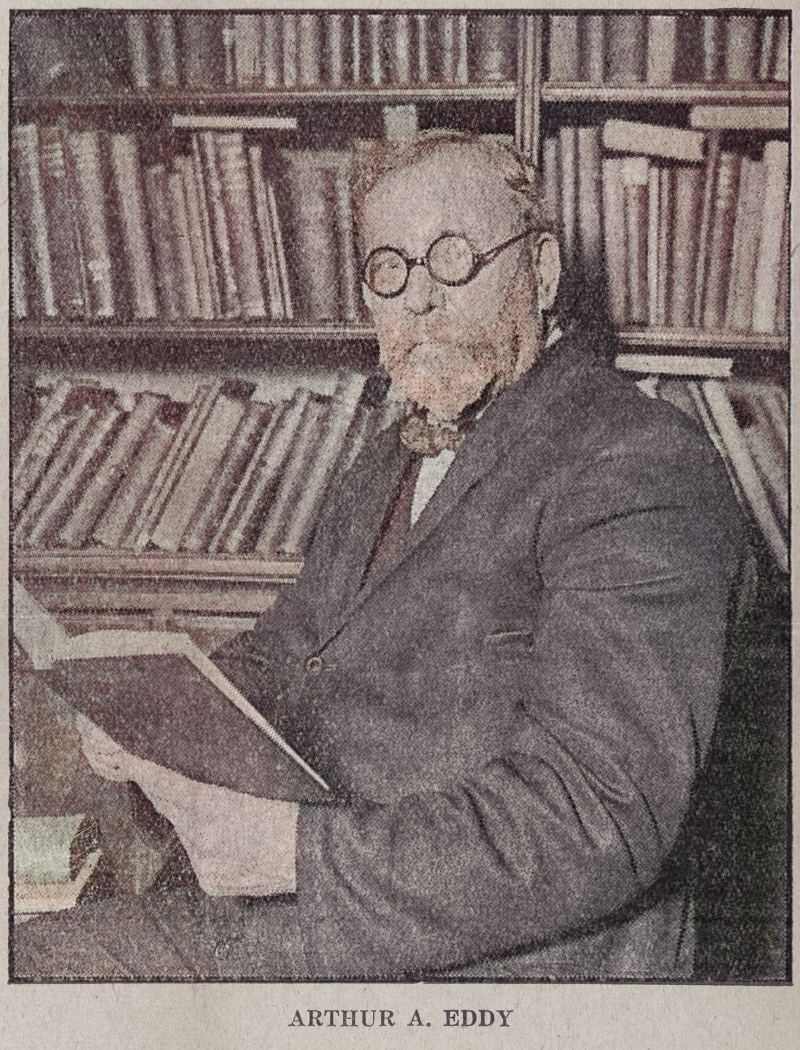
This comes from the now-found ‘Uncle Eddy’ cutting I referred to some posts back. Evidently the ‘RIAMCO listing’ is actually for the Brown University holdings of Lovecraft, which are now online as hi-res scans along with their enclosures and cuttings. Good to know. Thus we now have a very good picture of Lovecraft’s favourite Providence book-dealer, albeit in dotty newsprint.

It’s from the Providence News-Tribune, 22nd July 1931. Lovecraft and the visiting Morton happened to pop in to the Eddy bookshop shortly after it had been published, and thus were presumably able to rush around and find some local news-stores that had not sent back their ‘returns’ copies of the paper. Copies were duly purchased and the clippings sent to correspondents who knew and had patronised Eddy.

What appears to be a Frankenstein-like scar on the right of his face seems to be his glasses-chain.

What do we learn from the article?

1) His shop was “probably the largest of its kind in the city” at 1931. A massive 200,000 volumes (and, as we know from Lovecraft, more in his attic store at home). Thus Lovecraft’s joking in a letter to the effect that ‘Cook had cleaned Eddy out’ on a spending spree, must refer to the weird and supernatural items only.

2) He looks as though he might be in his early 60s in 1931, although several scratches suggest the press used a picture dated earlier. Possibly came of age circa 1887-90? He had not yet retired at the point of publication. Indeed, he had taken on and recently sold the Bargain Book Shop on Empire Street, which suggest he was still very much in business and had money to invest in new stock.

3) Modern poetry was then “much in demand”, which would be unthinkable today when contemporary poets can only sell to other poets. “Modern” here may not necessarily mean modernist poetry, as this is Providence in 1931.

4) The article hints at his willingness to sell the sort of “paperback” items that would bring fulminating religious ministers into the store to berate him. He would stand up to them. Possibly the books were the Haldeman-Julius ‘Blue Books’ line.

5) He started the business as a side-line, though to what is not stated.

The final part of the article covers the city’s Dana bookstore, and another shop run by Livsey and Knight. This section has other detail on the state of the book trade in Providence during the early years of the Great Depression.

Sea pods

New on LibriVox as part of a new Librivox story collection, recordings of Frank Belknap Long’s “The Sea-Thing” (1925) and “The Dog-Eared God” (1926). The SFFaudio podcast also has the discussion episode Reading, Short And Deep #267 – “The Sea Thing” by Frank Belknap Long, from a year ago. At about the same time PseudoPod 742 also had a reading of “The Sea Thing” by Andrew Leman on their podcast. But the new LibriVox recording is Public Domain, which makes it more useful for re-use.

For some reason Librivox decided to put the Lovecraft juvenile story “The Beast in the Cave” first in this overall collection of stories. It seems to be becoming a subtle leftist tactic to push newbies to Lovecraft’s earliest and lacklustre stories, such as “The Alchemist” or “Beast”, as their very first experience of Lovecraft. Presumably with the vague hope that readers will go “ugh, not very good” and avoid Lovecraft stories in future.

In other blogs

Deep Cuts has a useful post surveying the response of Lovecraft to the new talent of C. L. Moore, toward the end of his life.

M.C. Tuggle has a short review of S.T. Joshi’s new book The Recognition of H.P. Lovecraft.

And S.T. Joshi’s blog has updated, including further confirmation on the two Letters volumes planned for 2022…

this year we do hope to get out at least two other Lovecraft letters volumes: Letters to Woodburn Harris and Others (including letters to Zealia Bishop and others), and Miscellaneous Letters (a huge volume of letters to a wide array of individuals, as well as letters published in Lovecraft’s lifetime).

Also very tantalising is news of…

“Ellen Greenham’s fascinating book After Engulfment, a study of Lovecraft’s cosmicism and how it was adapted or amended” by later science-fiction writers.

However, this is still only at the copyediting stage. I assume the author is aware of the influence on Arthur C. Clarke, though Joshi doesn’t mention him in the list of influenced writers.

Lovecraft was right, part 473

I have seen the dark universe yawning,
Where the black planets roll without aim;
Where they roll in their horror unheeded,
without knowledge or lustre or name.

— from “Nemesis” by H.P. Lovecraft.

Astronomers have used new techniques to detect about 100 ‘dark’ planets moving madly through space rather than orbiting their home star, just as Lovecraft imagined. A rigorous examination of observation data has now given a new catalogue of 70-170 of these. The researchers conclude that there are so many of these in the observed area that… “planets formed around stars and then banished to the blackness must be an important contribution” to their number. It then follows, as they suggest, that billions of unknown sun-less ‘black planets’ must roll through the cold wastes between the stars.

Other research has discovered ‘untethered black holes’, which have no black disk of matter pulled in around them — but can still be detected by the bending of light.