A peek at a new 10,000-word essay, now available for my Patreon patrons in PDF, over at my posts on the Patreon site. It’ll also be posted here at Tentaclii, as a patron-only post, tomorrow…


29 Friday May 2020
Posted in Historical context, Scholarly works
A peek at a new 10,000-word essay, now available for my Patreon patrons in PDF, over at my posts on the Patreon site. It’ll also be posted here at Tentaclii, as a patron-only post, tomorrow…
26 Tuesday May 2020
Posted in Historical context, Kittee Tuesday, Scholarly works
In 1932 Lovecraft wrote to his friend Moe, recalling once again the lost-lost days of 1900 when he had been ten years old. One of the items recalled in his stream-of-consciousness flow was… “the new cat book by Agnes Rapplier”.
Rapplier was a conservative Catholic essayist and reviewer, who also wrote popular books. The “new cat book” must be her The Fireside Sphinx: A Cultural History of Cats which appeared in 1901. Thus Lovecraft mis-placed it a little amid the tumble of memories, as a book of 1900.

It is just the sort of erudite yet breezy book that would have delighted a precocious lad who doted on cats, with chapters on Egypt, Dark Ages hysteria, and cats in his beloved British Isles. It is full of little stories and brisk histories. The book is simply footnoted as The Fireside Sphinx (without its subtitle indicating its non-fiction nature) in the Moe letters, and does not appear in my edition of Joshi’s Lovecraft’s Library. But, as a formative childhood book, it should probably be listed in a future edition of the Library.
Being out-of-copyright it could also make the basis of various new media productions, trimmed down a bit, from dramatized audiobook to graphic novel. Although note that archaeology is starting to dramatically change the story of ancient domestic cats in Europe — that bit would need to be added/updated.
When did Lovecraft have it and read it? A quick search suggests The Fireside Sphinx was probably issued October 1901 with an eye to the Christmas market. Thus it was perhaps a family gift, possibly to his mother or more likely to the young Lovecraft himself at Christmas 1901 when he was aged 11. By my calculations Lovecraft would then have been a doting cat-owner for several years and the kitten Trigger-ban, that had been presented to him as a “tiny black handful” at about age seven, would have fully grown into an adult pet cat by Christmas 1901.
24 Sunday May 2020
Posted in Scholarly works
* J. Wierzbicki, “Silent Listening, The Aesthetics of Literary Sounds”, Resonance: The Journal of Sound and Culture, Vol. 1, Number 1, 2020. (Discussion of sounds in Poe and Lovecraft).
* P. Jarvinen, “The Social Outsider: Generating Horror Through External and Internal Alienation in “The Outsider” and “The Music of Erich Zann” by H.P. Lovecraft”. (April 2020 undergraduate dissertation for Tampere University, Finland).
* A. de Sena, “Frankenstein de Mary Shelley e “O Intruso” de H.P. Lovecraft: Simetrias”, in Figuracao de Personagens Monstruosas, DialogArts, University of Rio de Janeiro, 2020. (Sees parallels between Shelley’s Frankenstein and “The Outsider”. In Brazilian Portuguese. Book chapter, book title roughly translates as ‘The Figurations of Monstrous Characters’).
* J. Franca, “Fundamentos esteticos da literatura de horror: a influencia de Edmund Burke em H. P. Lovecraft”, Caderno Seminal Digital, Vol. 16, No. 14, June-December 2010. (In Brazilian Portuguese. Edmund Burke’s influence on Lovecraft’s Supernatural Horror. Graduate Journal of the University of Rio de Janeiro.)
21 Thursday May 2020
Posted in New books, Scholarly works
A free A-Z Encyclopedia Hyboria (2019) by ‘bittertreememory’. His book is relatively mighty-thewed at 24,000 words, if you also paste the well-hidden Preface into a Word .DOC file. The Preface reveals that Encyclopedia Hyboria only covers the Howard works. Dipping in randomly, it seems to me like excellent and precise work.
I’d assume ‘bittertreememory’ is American, given his American spelling of encyclopaedia. Someone should try to contact him and get permission for an expanded book, adding…
* an additional introduction by a big name such as Roy Thomas;
* an introduction that surveys similar reference works if they exist, and/or any in-world reference files Howard developed for his own use;
* a short in-world story chronology of Howard’s Conan tales;
* story titles added to each entry, where relevant – see ‘at a glance’ where each item or character was used;
* abundant use of small illustrations in a suitably loose Kaluta/Frazetta sort of pen-and-ink style;
* add maps and then add runes that colour-code the entries by region;
* add a short scholarly survey of the most notable and faithful new items added by later writers of Conan tales;
* then design and print it up as a book.
Another option for such a book would be Dale E. Rippke’s online A Gazetteer Hyboria which is a 1,000-item A-Z that includes the pastiche books and the better comics of the 1970s and 80s. Though, by including the larger post-Howard Conan works, this would cause all sorts of copyright tangles for a new expanded book version.
The author states that about a third of A Gazetteer Hyboria, presumably the purist Howard-only items, had long ago appeared in print in the Borgo Press guide titled A Gazeteer of the Hyborian World of Conan (1977). Some sources have this as Starmont House, not Borgo. Possibly there was a hardback from Starmont, and a paperback from Borgo?
A Gazetteer Hyboria seems to have vanished from all but Archive.org, presumably for fear of copyright trolls, but Dale E. Rippke also has a live Solomon Kane Gazetteer v.2.0 (2015) online for free.
For additional non-people/places items, the 128-page gamer book GURPS Conan has a section titled… “A gazetteer featuring the people, customs, laws, religion, and mysteries of 34 lands in the world of Conan.”
Also noted recently, and also useful for fan-writers as well as gamers, the new Conan the Adventurer (Modiphius, 2020). This is a 120-page illustrated PDF sourcebook, described as…
the definitive guide to the lands south of the Styx River, including serpent-haunted Stygia, Kush, Darfar, Keshan, Punt, Zembabwei, and that vast region known to the folk of the Dreaming West as ‘the Black Kingdoms’.

Apparently the new book was… “developed with leading Conan scholars”, so is presumably largely ‘Howardian’ — rather than bolting on later developments in movies, videogames, cash-in novels, comics etc.
Modiphius previously published Conan: Nameless Cults, a sumptuous book and…
guide to the cosmology, gods, cults, and otherworldly entities of Conan’s world and time.
20 Wednesday May 2020
Posted in Astronomy, Historical context, New books, Scholarly works
One can quite imagine S.T. Joshi as a 1920s stage magician. He must surely have at least some magical powers, in order to sustain his vast workload and output. Look, there he is now… appearing from behind a curiously carved panel on the darkened stage. An interlude of dancing cats exits stage-right. Joshi steps forward into the spotlight and deftly tips his bright red fez hat in greeting. Then he whisks back his thick satin cape, and with the merest raise of his eyebrows he invites a member of the audience to step up and inside yet another of his mysterious magical cabinets.
Up the cabinet rises through a stage trap-door. In this case the particular ‘mysterious cabinet’ is the 2019 edition of the annual scholarly journal titled The Lovecraft Annual. This usually appears like magic at the end of each summer. Joshi is here, as usual, the benign editor with the magic wand. Once inside his cabinet it’s a bit of a tight fit, since the page gutters could do with another eighth of an inch. But the audience member doesn’t mind, as he is whirled through 12 essays and several reviews.
The first essay is Fred S. Lubnow’s “The Lovecraftian Solar System”, which briskly alights on each planet in turn and surveys Lovecraft’s footprints on it. The solar tour includes a tantalising single mention of the “white fungi” on Neptune, among which Lovecraft’s indescribable Neptunians must move. Lubnow tracks down most solar items, but in one instance he states that “Lovecraft made no specific reference to Uranus in any of his tales”. I would point out that there is an inference, at least, in one story. “Pickman’s Model” has mention of… “the trans-Saturnian landscapes and lunar fungi that Clark Ashton Smith uses to freeze the blood”. Trans-Saturnian refers to, I believe, Uranus and Neptune. Admittedly, this is a reference not to the planets themselves but to their depiction in art. The planet Pluto (yes, it is a planet in my view) is understandably left until last by Lubnow, and as Yuggoth it sees the most discussion. It also understandable that Lubnow did not want to burden the survey with items from the letters or the poetry. But I hope that in due course we will see a Part Two, in which he does draw on and survey these. Perhaps even a Part Three on things like comets that enter the system, the aurora or ‘northern lights’, meteors, the “star winds”, and similar.
Duncan Norris’s essay “Hungry fer Victuals I Couldn’t Raise nor Buy”: Anthropophagy in Lovecraft” is an excellent survey of cannibalism in Lovecraft’s work, with abundant historical, anthropological and literary contexts. Once one starts looking, it seems, cannibalism is everywhere and Lovecraft was consumed by it. Usefully, Norris also looks for hidden or hinted-at cannibalism. He does not mention Bloch’s “A Visit with H. P. Lovecraft” and its toothsome ending, which would have been an amusing final nibble for the end of the essay.
Andrew Paul Wood’s “The Rings of Cthulhu: Lovecraft, Durer, Saturn, and Melancholy” is a fascinating speculative essay that draws first on Durer’s famous picture “Melancholy”. Then on the mythical Saturn. Saturn’s ‘ravening for delight’ aspect, and one aspect of his visual appearance in his defeat, is linked with the possible genesis of Cthulhu. Lovecraft’s fascination with Saturnalia (the Roman revels of 17th December) is noted along with his early knowledge of Virgil’s ‘golden age of Saturn’, and likely awareness of a lines from Keats’s “The Fall of Hyperion”…
And saw, what first I thought an image huge,
Like to the image pedestal’d so high
In Saturn’s temple. Then Moneta’s voice
Came brief upon mine ear ‘So Saturn sat
When he had lost his realms’ …
One can quite see the potential inspiration, as Wood suggests, for the famous sitting idol showing Cthulhu on his pedestal. Wood offers the reader a brilliant and fascinating essay. There is occasional over-reaching, but the informed reader can make up his own mind on such things. He misses a few elements that might have augmented his argument. He notes Lovecraft’s “Simplicity: A Poem” (1922), further evidence of Lovecraft’s awareness of Virgil’s ‘golden age of Saturn’…
Etherial spirits of celestial grace;
And he, unspoil’d, may childlike bask again
Beneath the beams of Saturn’s golden reign.
But he overlooks another poem which offers… “Hath held too long his Saturnalian feast”. These items again remind me how useful it would be for Lovecraft researchers to have a keyword-searchable ebook edition of The Ancient Track: The Complete Poetical Works of H. P. Lovecraft.
Also unmentioned by Wood is that Lovecraft’s friend Loveman had a literary interest in Saturn, evidenced by his naming his journal The Saturnian. But it’s only an incidental connection, and it’s quite possible that Loveman was using the word Saturnian as it arose from the French decadent milieu, from which it spilled over into use among poets as a code word for ‘homosexual’. A little earlier in time Uranian had a similar vogue among Edwardian poets as a code-word. Still, if Wood is right about a partial Saturn influence on the posture of the Cthulhu idol, then the all-male cultists cavorting around the idol in “The Call of Cthulhu” are also Saturnian orgiasts in the Loveman sense of the word. Because, as Lovecraft himself bemoaned…
You’ll recall that Rankin [the Weird Tales artist] made ample-bosomed wenches of my male orgiasts in the Louisiana swamp scene of “Cthulhu!”
Cecelia Hopkins-Drewer’s short “The Cats”: An Environmental Ditty” is thankfully not saddled with questionable eco-critical theory, and is a straightforward discussion of Lovecraft’s 1925 poem with some historical context. Her essay is a useful study of this powerful New York poem, delving into the sound-patterning and also discussing the relationship to the similar future-visions in the story “He”. Some phrases in the poem are seen to relate to what she claims to have been the state of the sanitation and water supply of New York City in 1925. Fair enough. But there is a rather unfortunate historical tangle on page 71, in which the reader expecting good evidence for the suggestion is expected to jump from 1925 to 1935, and then we get the quote “no system for disposing of sewage and garbage …” which — on my finding its source — actually relates to circa the 1690s. This date is not given by Hopkins-Drewer, and yet she immediately follows the quote with… “Certainly, if the pollution had been left unchecked…” in 1925, Lovecraft’s prediction of a future New York City in “The Cats” would have come true.
Such a damaging tangle on the historical evidence could have been avoided with just a little online research, and the argument strengthened. For instance I can quite easily find that in the 1920s the Brooklyn water-supply actually came from pumped ground-water in Queens, on Long Island, drawn from a catchment area of over 100 square miles. It was chlorinated by the time it reached the taps of Red Hook and does not appear to have done Lovecraft, or probably any of the street-kitties he encountered at their water-bowls, any harm. On sewage Hopkins-Drewer is correct, although the evidence presented for her point is confused and somewhat misleading. It should have quite easy to nail the claim quite precisely to the mid 1920s and Brooklyn, with just a little research — it’s easy enough to find that by the summer of 1926 raw sewage pollution of the harbour became so intolerably bad that all the New York City public beaches were closed, except those that directly faced the open ocean. When we think of Lovecraft living in Red Hook, we forget the likely summer smells — all the raw effluent of New York City, massing up day after day and week after week around the harbour, and the reek of it wafting in over the tenements. Knowing this, one then reads “Red Hook” somewhat differently — regarding the opening words such as “oily waves” and “filth”. In the searing killer heatwave of June 1925 the shores were presumably oily with more than just ship-bilge, and on a windy day the filthy smell of excrement must indeed have been noticeable even some miles from the shore. One wonders if some prevailing summer wind from such a shore partly explains why, until the public works of the mid to late 1930s, there were still shantytowns, open scrubby land and undrained marshland along the waterfront there and why the eastern parts of Red Hook were heavily dotted with “weedy undeveloped terrain” on 1924 aerial photography.
However “The Cats” was actually written in the winter. On 15th February 1925 to be precise, an important point that Hopkins-Drewer does not note. Lovecraft was then about a month into living in his “dismal hovel” at 169 Clinton Street, having luckily moved in just days before the worst snowstorm in living memory (1st-3rd January 1925). The date of the poem might suggest that an early thaw made him suddenly aware of the stench that might well waft up from the shoreline in the high summer. The New York Times for February 1925 does indeed suggest a thaw, with one of its articles titled “Thaw Releases Frozen Cars”. Also, the few letters Lovecraft sent from New York at this time suggest he was out and about and these make no mention of snow or ice. But if a February thaw and sun was quite enough of a thaw to send a new shoreline scent to Lovecraft’s sensitive nose is rather debatable.
Such points do not lessen a claim that “The Cats” is in part an “environmental ditty”, and it is anyway a poetical work that is only partly biographical (i.e. the Red Hook location, the implied black cats which relate to his own lost cat, the allusion to Poe’s Pluto, Lovecraft’s repeated nightmare of how the “thick tide retreats” leaving a shining river a mass of oozing mud). It can certainly be read as an environmental poem — “Streams of live foetor, that rots in the sun. … Jumbles of odour that stifle the brain.” — but such claims need more precise historical evidence on matters of water-supply, sewerage and weather, and close attention to dates.
Hopkins-Drewer does excavate one fascinating historical nugget that was wholly new to me. The Chicago gangster Johnny Torrio was “holed up” in Red Hook after a January 1925 mob shooting in Chicago, and he took over the rackets there. I can add that he appears to have arrived in Red Hook from Chicago in February or March, probably shortly after Lovecraft wrote “The Cats”. He went to Red Hook because he had grown up there and it was his old racketeering ground. It’s not impossible, as Hopkins-Drewer hints, that Red Hook was abuzz with the return of Torrio in summer 1925, when Lovecraft was about to write of the similarly ‘resurrection’-like return to social life of the gangster-consorting Robert Suydam in “The Horror at Red Hook”. We know that Lovecraft frequented cheap cafes where one could overhear hoodlums talking over the current state of things in Red Hook, and there may also have been local cafe-owner gossip and press coverage of the matter. It’s quite a plausible suggestion, and again a little more research would have let Hopkins-Drewer strengthen the suggestion.
What of a curious line in the poem “The Cats”, of their “Yelling the burden of Pluto’s red rune” at the city, almost as a form of curse? This is not addressed in the essay, but it offers another route to a concern with animals and thus the environment. “Pluto” is not a science-fiction reference to the cats arriving from that distant planet in a gigantic cosmic leap — akin to that of the Cats of Ulthar or perhaps the Cats of Saturn in Dream Quest. Since the planet Pluto was not discovered or named until 1930. Rather, it is a reference to the eye-less cat Pluto in Poe’s famous tale “The Black Cat” and thus to Pluto the god of the underworld. Lovecraft thus makes a poetic linkage of this cruel mistreatment of cats with the astrological rune for the planet Pluto, which resembles an eye socket with blood dripping from it. Presumably Poe had also seen this macabre likeness, and drew his tale from the observation. Though I can find no scholar of either Poe or Lovecraft noting a possible connection.
Is there any additional symbolism to the Pluto rune? Unfortunately it is impossible for a search-engine to cut through all the blather produced by neo-pagan parrots and occult mumbo-jumbo munchers. But it’s possible to find some 19th century scholarly sources that suggest a couple of options. To summarise, to one it was spirited living intellect circling above the inevitable river of the underworld (death). To another it simply arose as a confusion with a Nile goddess symbol, when Ptolemy took over Egypt and moved in his new statues. From there it became a sign for Pluto as a god of the underworld. There seems to be no clear route back in time, and the origin is probably lost. All we can really say is that it is a circle in an arc above a short cross. But we can say that Lovecraft’s cryptic literary-historical symbolism in “The Cats” is also a form of concealed environmental commentary for the learned and literary reader, since it evokes the cruelty of certain types of people to animals. One can also note that he cleverly accents the shape of this “rune” with the “oo”s seen in the following line’s “swoop low” — which offers a partial rhyme with “Pluto”. Two “oo”s (eyes) become one “o” (a missing eye), just as in Poe’s gory tale. The imagery of “swoop low” also evokes the gouging motion involved.
Lovecraft’s use of “rune” in the poem may seem incongruous since it offers a Nordic touch to the poem, evoking the one-eyed Odin of the North and Northern runes. If so, then this was not entirely his spurious confabulation. Lovecraft may have noted in the histories that Nordic and Teutonic warrior-cultures had long sent armies across the Danube, and had even occupied Sparta and Alexander the Great’s boyhood/maternal homeland. This would offer Lovecraft a possible cultural origin in the North for the later use of the Pluto symbol in the Egypt of Ptolemy — Ptolemy having raced to claim and hold Egypt as his own, after the death of Alexander. Ptolemy’s Hellenistic Egypt is of course a key place for early astrology and also where one finds the first direct evidence for the origin of alchemy, and it seems from some brief research that such origins were under active discussion in the psychological (Jung) and archaeological literature of the early 1920s.
Matthew Beach’s “Lovecraft’s Consolation” is a follow-up to his earlier “Lovecraft’s Optimism” in Lovecraftian Proceedings #2. He examines the possible consolations of ‘the cosmic’, something Lovecraft offered to some of his friends in letters. These consolations are basically that we need not despair at the ultimate ‘futility of it all’, because: ‘cosmic time’ is full of potential, even if rather impersonal from a human perspective; and the endlessness of ‘cosmic space’ offers infinite possibilities.
Such a sense of time and scale may then give us a certain sense of freedom from the earthly judgements of others. Hence the personal ‘indifferentist’ stance that Lovecraft tried to maintain toward others. This stance was bolstered somewhat by his more down-to-earth understanding of the glandular human body, and the (in his eyes) uncontrollable urges this produced. It follows that if some had “abnormal” urges, they couldn’t help it. Equally, a sense of the vastness of time and space may lead us to consider that beauty and significance may reside, or at least be thought to be found, outside what our age considers “normal”. Perhaps even in the non-human, somewhere else in the vastness of cosmic time and space. Such cosmic possibilities might even arouse in us the “sense of curiosity” (Selected Letters III), and the prospect of the pursuit and gratification of such curiosity would also be a cause for optimism. If not for oneself, then for future generations — to which one contributes useful knowledge today, knowledge on which future generations will build.
In some sense then, I would also suggest we can see Lovecraft as having anticipated the discovery and ‘cosmic unity’ later presented by the more advanced novels of galactic civilisation and alien encounter. In which the presence of a striving and expanding mankind in the galaxy at least supplements the formerly cold cosmic wastes with meaning, even if it doesn’t deeply infuse it with meaning. Of course, if Lovecraft’s work and letters actually influenced the genesis of this sub-genre is more debatable and it would take some hard sleuthing by Lovecraftian scholars to prove such a claim. But when Beach notes Lovecraft tell Sully in a consoling letter that one can “harbour great hopes” for the human future, albeit in a “light, indefinite way”, and extract from them a “bracing power” that should be harnessed to the human imagination — then he might seem to be laying the foundations for a future galactic empire or two.
That said, it’s obvious that if Lovecraft has an “optimism” to share then it’s not the blithe emotionalist’s happy-clappy variety of optimism. He says as much himself, and Beech deftly extracts the relevant quotes. Rather it is an optimism that “integrates rather than ignores the harsh realities within cosmic time and space” (Beech). A sort of Super-rational Optimism. But these “harsh realities” offer another clear form of consolation to the cosmicist — that harsh though the universe is, it has clear and un-breakable rules. There is no capricious hostile god or malign devil toying with human lives or expecting weekly sacrifices of burning babes. Similarly, priests have no power to call down retributions or to channel divine beneficence.
His other consoling advice is more homely and it must draw on the various writers of the classical world that he admired. Practice pragmatism in everyday life. Minimise pain and maximise pleasure, in moderation. Plan for a sensible future, one that will include “inevitable loss” — but with the understanding that ‘time heals all wounds’, and that both personal human memory and long-term recording allow us to cherish and recall the best of what has been. Lovecraft’s antiquarianism was part of this stance, I would suggest, and somewhat fits with his cosmic view. If there is no god, then ancestors can at least serve one as secular substitutes for the saints and angels. The risk comes in knowing too much about them. Spend too much time “correlating the contents” and one’s historical heroes may develop feet of clay, or one’s family tree may develop an unwanted fishy side. A new monograph by Ken Faig Jr. suggests that Lovecraft’s family tree did just that, and I suspect the discovery probably informed “The Shadow over Innsmouth”.
Dylan Henderson’s “The Inability of the Human Mind”: Lovecraft, Zunshine, and Theory of Mind” seeks to sift Lovecraft’s rich life for signs of autism — whatever that is these days, as the definitions are stretched and warped by non-autistics seeking a ‘get out of jail free’ pass for bad behaviour — then he tries to do the same at a few points in Dexter Ward. There may be a case to be made, but I was not convinced by this brief tour of some possibilities.
A brief Notes paragraph notes that no less than three new Lovecraft documentaries are underway.
“H. P. Lovecraft’s ‘Sunset’” is S.T. Joshi’s own musical choral setting for Lovecraft wistful autumn/fall poem of 1917, with pages of musical notation. I don’t read music, so can’t judge this item. Joshi’s blog reports that his choir has performed it several times, but it appears not to be online.
Ann McCarthy’s “The Pathos in the Mythos” is a short essay that points up some elements of emotional ‘colour’ in Lovecraft’s work: the joy he finds in certain places and evocative views; the delight in dogged research and scholarly detection; his sympathy for old and isolated men, both living and those literary ancestors isolated from him in time. One might have added his tenderness and concern for cats, although admittedly this is more in the poems and letters than the stories.
Jan B. W. Pedersen’s ““Now Will You Be Good?”: Lovecraft, Teetotalism, and Philosophy” is a survey of alcohol in the stories, and partly in the letters and in The Conservative. This is introduced with eight pages of general history on temperance and teetotalism, pages which might instead be given over to digging into the context of two fascinating Lovecraft quotes which Pedersen leaves un-examined. The first is the 1915 quote… “to transform himself to a beast, and in the end to degrade himself and his descendants permanently in the scale of evolution”. The second is from 1932, talking with R.E. Howard about “the hard-pressed classes” and their drinking… “The more drink-sodden they get, the worse their biological stock becomes”. Evidently in 1932 Lovecraft was still holding to the “three generations is enough” argument of the 1910s, a slogan which implied the outright danger of allowing the breeding of a “fourth generation”. Circa 1910 the commonly understood sequence of degeneration ran: nervous temperament and moral laxness in the first generation; then their children, who have severe neurotic behaviour leading to addictions and drink; leading in the third generation to insanity and suicide; then at the last a sterile fourth generation with outright cretinism and often malformed bodies and heads. There was also an increasing understanding that recessive genes could be carried by seemingly healthy people, and passed to offspring who would then exhibit the defect. Peterson misses a prime opportunity to explore or at least summarise the anti-liquor movement’s theory of generational degeneration and recessive traits. To ask if Lovecraft understood this correctly, if it was modified by research or was supported by other currents in society and/or developed and added to by Lovecraft himself. Then to tease out what uses might have been made of it in the stories.
I had anticipated that Michael D. Miller “Lovecraft’s Open Boat” might be about the young Lovecraft’s row-boat on the Seekonk river, finding connections to “Dagon” via Lovecraft’s recurring dream of the Seekonk drained to oozing mud, and his landing by row-boat on the muddy washed-over Twin Islands in the Seekonk. But it is not. Miller finds some parallels between Lovecraft’s indifferentist and cosmic stances and Stephen Crane’s “The Boat” (1897), a story inspired by his shipwreck while travelling to pre-communist Cuba.
Horace A. Smith’s “Lovecraft Seeks the Garden of Eratosthenes” details the young Lovecraft’s astronomical observations of the Moon in 1903-06, in particular certain areas of the Moon, and offers some fascinating historical context about the lunar life theories and the observations of William Henry Pickering. Pickering imagined the life he ‘saw’ on the Moon as being a low vegetation. Could the young Lovecraft’s vivid imagination have mused on these Selenites as vegetable animals, a possible precursor to some of his later creatures? Possibly, but Smith sagely calls that idea “a stretch”. Yet Smith also notes something from early in Joshi’s I Am Providence: that the young Lovecraft once had a “now lost tale set on the dark side of a Moon”, although at an unknown date. Smith doesn’t speculate on what the story might have had in it. But I’ve looked into the story’s scientific spur and it seems informative. In 1854 the eminent German astronomer Hansen had proposed that our Moon was not a perfect sphere, but was deformed by a huge elevation of about 35 miles in height. This ‘bump’ was directed toward Earth, presumably due to gravity, and its presence would mean that a shallow atmosphere could just about persist on the dark side, most likely with some icy crater-lakes and thus the potential for primitive life. However, by 1903-06 most scientists assumed that any water and ice would long ago have been lost to space. But not all scientists, as the Germans were still proposing an 1890s ‘water ice’ theory for many cosmic bodies, and this was championed and bolstered by the substantial book Glacial-Kosmogonie in 1912. The theory apparently persisted into 1930s Germany. In the 2010s abundant water ice was indeed found by probes on the surface of the Moon, and presumably it exists in even more abundance on the dark sides of the poles. One assumes Lovecraft’s lost juvenile story would have encountered life of some kind (he recalls it as a “thriller” in a letter to Kleiner) and one wonders if Lovecraft’s 1919… “insect-philosophers that crawl proudly over the fourth moon of Jupiter” (“Beyond the Wall of Sleep”) preserves a hint of the subject matter. Likely written at around age 14, the science of 1904 suggests he would have imagined shallow ice lakes and their sub-surface primitive entities. In this he would have been following the recent German elaborations of Hansen’s initial 1854 proposal. One assumes that the astronomical journals were keeping readers abreast of such developments from Germany, even though the growing consensus elsewhere appears to have been that any Moon water had long since drifted away into space. Such a juvenile tale would thus, eventually, have been proved partly right by science. No ice-lakes, no vegetable-insect life musing on their slow alien philosophies, but… around 6% water-ice per NASA probe-scoop, and possibly much more ice banked up in the crater-shadows. Quite how his tale’s presumed protagonists and their acetylene lamps would have reached the dark side of the Moon from Providence is another question. One imagines that Lovecraft’s beloved black cat, leaping and darting all around his telescope in the garden dusk, might have given him the idea of simply leaping to the Moon as if in a dream. Lovecraft would muse more solidly on such matters a few years later, in his “Can The Moon Be Reached By Man?” (1906).
Scott Meyer’s “Diabolists and Decadents: H. P. Lovecraft as Purveyor, Indulger, and Appraiser of Puritan Horror Fiction Psychohistory” attempts to detect alignments between Lovecraft and the Puritan worldview, and this seems most useful in a short section in which he examines the letters.
Steven J. Mariconda’s “How to Read Lovecraft” column muses on Lovecraft’s playfulness, although the essay sticks within the confines of the 1930s/1970s psychological ideas of the puer aeternus (aka ‘Peter Pan Syndrome’) and Jungian archetypes. We also learn that Lovecraft’s mother was “apparently progressing toward schizophrenia”. She was undoubtedly mad before her botched gall-bladder operation and death, but “toward schizophrenia” seemed to me a rather bold armchair diagnosis. Does one really “progress” toward such a thing? I’d never heard that said, and on investigation it appears not to be the case — on which point see the 2013 paper “The Myth of Schizophrenia as a Progressive Brain Disease” in a leading Oxford University Press journal. Another point of error in the column is the claim that… “Lovecraft was thirty-three and Barlow was sixteen when the former went to Florida”. Actually, when Lovecraft stepped off the bus, he was forty-three and Barlow was fifteen.
Finishing up the 240 page issue is a lengthy book review by veteran Lovecraft scholar Ken Faig Jr., reviewing the new Ave atque Vale, here rather amusing titled Ave atque Value — perhaps in an unconscious pun on its mere $30 price in paperback. This is the fine new book of reminiscences of Lovecraft, effectively replacing the previous Lovecraft Remembered. Faig’s review is entertaining and erudite, and doesn’t forget to give the juicy details of the book — that it has notes and an index, biographies of contributors, and 400 footnotes. One data point has already been superseded — my recent discovery of more Eddy memoirs adds to our knowledge of the bookshops, and Faig’s observation that “Lovecraft knew each of the big three of Providence bookselling” must now be expanded to four — including ‘Uncle’ Eddy.
Well, that’s it for 2019. Onward to the 2020 issue — which I imagine will be going to pre-order relatively soon.
18 Monday May 2020
Posted in New books, Odd scratchings, Scholarly works
S. T. Joshi’s Blog has updated. The two volume German translation of I Am Providence is complete, as Joshi now has the second volume in his hands. The next Lovecraft Annual will have a review of a new volume of Arthur Meursault-translated Lovecraft pastiches, by one ‘Oobmab’ who lives somewhere in China.
18 Monday May 2020
Posted in New books, Scholarly works
Hippocampus has some nice prices at the moment…


Also, now open for pre-order, for a June delivery, is the new H. P. Lovecraft: Letters to Alfred Galpin and Others (Updated and Enlarged). Nearly 500 pages with “over 200 new pages of material … a substantial amount of Galpin’s own writings – some never-before published – are included”.
13 Wednesday May 2020
Posted in Scholarly works
Call for papers…
‘Ill met by moonlight’: Gothic Encounters with Enchantment and the Fairy Realm in Literature and Culture, in the UK and set for 8th-10th April, 2021 (assuming no third-wave of the virus and lockdown).

10 Sunday May 2020
Posted in Scholarly works
* L. Arriagada, “Realismo estructural ontico en H.P. Lovecraft, Laboratorio, No. 21, 2019. (In Spanish. “Ontic Structural Realism in H.P. Lovecraft”).
* The Fantastic Universe of H.P. Lovecraft, a special issue of Brumal, Vol. 7, No. 1, 2019:
– “Rhetorics and Cosmicism in H.P. Lovecraft.”
– “Multiplied Horror: An isotopy in three stories by Lovecraft.”
– “H.P. Lovecraft on Screen: A challenge for filmmakers.”
– “Hidden Rituals, Secret Powers And Everlasting Horrors: The presence of the Lovecraftian imaginary in recent Spanish extreme metal.”
– “The Forms of The Unspeakable: some representations of Lovecraftian horror in the adaptations of Alberto Breccia.”
– “The Influence Of H.P. Lovecraft in the work of Junji Ito”.
07 Thursday May 2020
Posted in Scholarly works
Barton Levi St-Armand’s “H. P. Lovecraft : New England Decadent” (1975) is now online for free at Persee, as part of their digitisation of the literary journal Caliban. No. 12, 1975 was a special issue on American science-fiction, and its long article on Lovecraft as a “New England Decadent” was an important item of early Lovecraft scholarship.
“New England Decadent” had been issued as an ebook fundraiser for the WaterFire Providence festival, in connection with NecronomiCon 2013…
WaterFire Providence is re-publishing, H.P. Lovecraft: New England Decadent by Professor Emeritus Barton Levi St. Armand. First published in 1979, the book, which examines the history of Lovecraft scholarship and his roots in the decadent movement of 19th Century Britain and Europe, has been corrected and re-released for NecronomiCon Providence 2013.
… but this edition later vanished from Amazon sometime in late summer 2018. Presumably the permission for an ebook only lasted five years.
02 Saturday May 2020
Posted in Kipling, New books, Scholarly works
S. T. Joshi’s blog has updated. He’s rescued sixteen of the best weird stories by the first William Waldorf Astor (1848-1919), the post-1892 owner of The Pall Mall Gazette in London. These are now published in a new 358-page volume titled The Ghosts of Austerlitz and Others. It has a Kindle edition nicely priced at a mere $4, and has a Joshi-penned biography of Astor.
The Pall Mall Gazette is a familiar name to anyone who has looked into the early life of H.G. Wells. Under Astor’s new ownership, and the conservative editorship of his new editor Henry Crust, the Gazette provided a congenial home for paid essays and humour pieces by the impoverished H.G. Wells at an absolutely crucial time in his pre-fame career. If Wells had not had a bare living from the post-1892 Gazette under William Waldorf Astor, we might not have had The Time Machine in 1894-95 — and the history of science-fiction could have looked very different.
I seem to recall the Gazette also published Kipling, and that there was an anthology a year ago of various strange stories gleaned from the Gazette. Presumably Astor’s liking for the weird made it a congenial home for the likes of Wells, Kipling and others. More on such matters will no doubt be found in Joshi’s biographical essay.
The Wikipedia portrait of Astor at the end of his life is not at all flattering. So here is my repaired, enlarged and colourised picture of him in his prime. Here he might be aged around age 42-ish — about the time when he purchased the Gazette.

Joshi’s new blog post also has new news on the ongoing series of annotated Lovecraft letters…
Later this year we should be publishing Letters to Rheinhart Kleiner and Others (including letters to Arthur Harris, James Larkin Pearson, Winifred V. Jackson, Arthur Leeds, and Paul J. Campbell).
29 Wednesday Apr 2020
Posted in Historical context, Podcasts etc., Scholarly works
I’m pleased to find The Lovecraft Geek Podcast – New Series #4 (February 2020). I missed this, earlier in the spring, but here’s the link. It’s an excellent set of questions for Robert M. Price, this time around, and he rises to the challenge.
At the end of the The Lovecraft Geek podcast Price reveals he has a new book of short stories available, Horrors and Heresies, in which horror meets various aspects of religion. Price is, of course, an expert on the Bible as well as on Lovecraft and sword-and-sorcery, so a joining of the three should be especially succulent. If you want to know more of the anthology, the podcast The Free Thought Prophet #195 recently brought him onto the show to discuss the new collection.
I can also add a couple of small pointers to the questions and answers in this latest Lovecraft Geek.
i) On the ‘Poe’ question, there’s what appears to be a strong new book The Lovecraftian Poe which would be useful for the enquirer.
ii) On the ‘Nodens’ question, I can add that Nodens was once a god in ancient Britain, and this fact had been known among antiquarians after excavations at Lydney in the 1770s and became briefly known again when an additional find was written up for publication in the 1880s. This material and the name must surely have been known to Machen. Machen’s fictional use greatly impressed Lovecraft, who wrote in a letter…
I’ll never forget that pillar raised by Flavius Senilis to Nodens, Lord of the Great Abyss
Machen having the inscription read: “To the great god Nodens (the god of the Great Deep or Abyss) Flavius Senilis has erected this pillar on account of the marriage which he saw beneath the shade.”
Lovecraft had first discovered and read Machen’s work in the summer of 1923, and Nodens then appeared in Lovecraft’s “The Strange High House in the Mist” (1926) and Dream-Quest (1926-27). It seems quite plausible to assume, as Joshi and others have, that Lovecraft had been unfamiliar with Nodens prior to 1923. My quick search of Google Books for the 19th century and for 1900-1924 confirms this strong likelihood. You couldn’t look him up in an encyclopedia, it seems.
Nodens appears to have been only a brief dalliance by Lovecraft, as there seems to be nothing lurking in the poetry. But his lack of any pursuit of the god into Dunsanian realms was perhaps timely. Since there was a flurry of publicity by 1929 around the Nodens name, which would have constrained any continued use of the name in fantastic fiction. The name and site at Lydney became closely associated with the discovery of a lost golden ring, known as ‘The Vyne Ring’, and a curse. The discovers put a call through to one Professor Tolkien, who kindly wrote a learned philological essay on the name Nodens in the light of the new finds. His essay is to be found in good form in the back of the Report on the Excavation of the Prehistoric, Roman, and Post-Roman Site in Lydney Park, Gloucestershire (1932) and reprinted in Tolkien Studies #4 (2007).
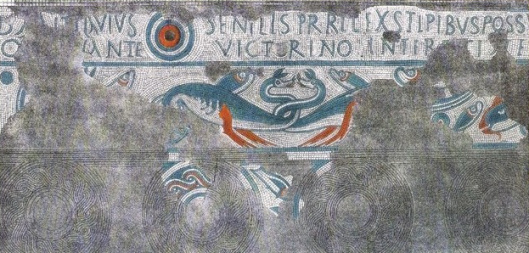 Fourth-century inscription dedicated to Nodens, at Lydney, with sea-dragons. Note the Sauron-like staring ‘eye’.
Tolkien’s linguistic pursuit of the name led him to find a cognate across the Irish Sea in Nuada Argat-lam, he of the lost hand. There is thus a possible origin here for Tolkien’s idea of Sauron and the ring of power. Since Sauron lost a severed finger and with it his ring, and thus most of his power was lost. This key idea is not so far, at least in its basics, from a quick imaginative combination of the lost and cursed golden ‘Vyne Ring’ + the lost hand of Nuada.
