• About
  • Directory
  • Free stuff
  • Lovecraft for beginners
  • My Books
  • Open Lovecraft
  • Reviews
  • Travel Posters
  • SALTES

Tentaclii

~ News & scholarship on H.P. Lovecraft

Tentaclii

Category Archives: Scholarly works

Lovecraft’s Dictionary

14 Tuesday Jul 2020

Posted by asdjfdlkf in Historical context, Kittee Tuesday, Scholarly works

≈ Leave a comment

Lovecraft’s well-used dictionary was a red-bound one-volume edition of Stormonth or Stormonth’s Dictionary of the English Language (Harpers, New York, 1885 revised). Given its status as one of the most famous dictionaries, it’s regrettable that Lovecraft’s edition is only to be found scanned and online at Hathi — regrettable because Hathi is now so slow as to be effectively unusable, and because they don’t allow whole volumes to be downloaded. The best that Archive.org can offer is an 1874 British edition via the University of Oxford.

Spine of the $6 Harpers edition of 1885, as sold recently at auction.

Lovecraft used the Rev. James Stormonth’s venerable dictionary to help him write early letters to Moe on the permissible rhyming of rrr words, circa 1914-1916. It appears that, at that point in time, he had been using the single-volume work since he had first needed a good dictionary. It was one of two dictionaries he asked his aunts to send to New York, when he married Sonia, the other being Webster’s Unabridged (Webster’s International, 1890). Evidently it was not bagged by burgling youths in Red Hook, and if they saw it then they likely baulked at its hefty 1,200+ pages and well-thumbed state. A later letter shows Lovecraft was still consulting and recommending Stormonth in 1929. As late as December 1936 he tells Fritz Leiber that the use of the word constrictious in Adept’s Gambit is doubtful because…

I can’t find it in either of the two dictionaries — a Stormonth & an 1890 Webster’s International — which I possess.

He remarks to Moe that he valued Stormonth because it was thoroughly British and his British father had used the same edition, partly to prevent him “becoming nasally Yankeeised” in America. Lovecraft also valued it because its “conservative authority” eschewed what Lovecraft called “Oxfordisms” (slangy ‘tricks of phrase, syntax, and metaphor’, emanating from the University of Oxford) and gave the proper London pronunciation of the mid Victorian period. The first edition was in 1871, so the well-bred speech of the 1860s might be assumed…

Amidst the sea of conflicting usage, the man of sense will pronounce as his father and grandfather pronounced before him. I use a Stormonth’s Dictionary which was my father’s — recommended to him by his father. And I shall use it till I die, Sir! A fig for your momentary fashions!

He was largely averse to the Victorians, especially their mawkish Dickensian sentiment and their larger forms of architecture. Yet admired the era’s spirit of idealism, and also its personal manners and refined pronunciation. In 1927 he wrote…

If I could create an ideal world, it would be an England with the fire of the Elizabethans, the correct taste of the Georgians, and the refinement and pure ideals of the Victorians.

Given his vast collection of old books, it seems a little curious to me that Lovecraft only ever had two dictionaries, even if they were thick enough to stun a rat and thus presumably very comprehensive. The Rev. Stormonth wrote several other useful dictionaries which Lovecraft might have used and enjoyed. For instance, one wonders if Lovecraft knew of his A manual of scientific terms, pronouncing, etymological, and explanatory, chiefly comprising terms in botany, natural history, anatomy, medicine, and veterinary science, with an appendix of specific names (1885), which appears to be a shelf-companion for the scientific reader to Stormonth’s Dictionary edition of the same year. This is now on Archive.org and one can see from the first few pages that it is not an ordinary dictionary, as the startled dipper encounters curiosities such as abrachia (‘absence of the arms’), acanthocephala (‘parasitic worms armed with spines’), achroma (deficiency in colour), actea (‘the elder tree, full of clusters, clustering … black snake root’), aduncate (‘bent in the form of a hook’), amadou (from the German, ‘dry leathery fungus found on old trees’). Even in the first few pages there are inspirations for weird horror stories a-plenty. But perhaps he didn’t need the additional volume, because its 300 pages were already included in the much larger 1885 edition? Until we get a workable online copy of the larger work, we can’t know.


Stormonth’s dictionaries included ‘phonetic pronunciation’, meaning that the word is also given in a special phonetic alphabet meant to indicate ‘how you say it’. You can see an example above, drawn from A manual of scientific terms. Lovecraft appears to have been as conversant with the ‘phonetic pronunciation’ system as he was with poetic meter. But this system is not easily graspable by the tongue of the layman. Is there a simpler method to ‘hear’ the form, involving computers? Of course, you won’t find the ‘phonetic symbols’ on a standard keyboard. But what about a virtual keyboard? Yes, there’s one of those at ipa.typeit.org, so you can at least painstakingly get the complete ‘word’ from the page of a book to your Windows clipboard. But how then to have the computer ‘speak’ it? The indications are that such things are still in the realm of academic papers, surprisingly, but there is one basic option — for free at the 2017 tech-demo phoneme synthesis. Which, apart from the mechanical robo-voice in which the words are spoken, is a cool demo because it’s happening in your browser in javascript. As the maker of the site states, “It was odd that this tool did not exist”. I concur. Who, looking at a dictionary like Stormonth, would not want a digital version of it to embed one-click ‘click to pronounce’ speech-to-audio synthesis?

But possibly a more portable solution might be best — a free browser add-on that knows how to OCR (copy) the notation symbols from the screen, then offers options for correcting the inevitable copying errors from small complex text, and then knows how to pronounce the resulting ‘word’ using your chosen TTS audio voice. There is a browser tool that does this for the phonetic instances given on Wikipedia entries, but in that case they’re already neatly typed out. Such an addon might be extended to OCR not only the International Phonetic Alphabet (est. 1888), but also pre-1888 phonetic systems, and allow a choice of speaking voice. In which case, someone should please synthesise Terry Thomas, so that we can get an authentic sounding male British voice for the Victorian dictionaries.

Or erm… (oh, it’s Kittee Tuesday!) just for fun you could have it read by a cat. Now there’s an idea, a TTS voice that can read any text in a voice that sounds sort-of like it should be a cat ‘speaking’. Just add small purr-lings, and micro-meows, and some touches of LOLcat-ese…

PDF Index Generator 2.9 – indexes footnotes

13 Monday Jul 2020

Posted by asdjfdlkf in Odd scratchings, Scholarly works

≈ Leave a comment

Writers of non-fiction may be interested in the software PDF Index Generator 2.9 (February 2020) which is automated back-of-the-book indexing software for books. This latest release very usefully adds…

Ability to index footnotes automatically & list the footnote numbers of the indexed terms in the output index.

The software ‘knows’ it’s indexing a footnote, because it detects footnotes as being in a different font/size from the body text. Prior to this release you could add footnote numbers, but you had to do it manually. Not much fun, if you have 1,000 footnotes. But now the software can do it automatically.

The cost is $70, and I’ve never seen it go to a 50% discount even on Black Friday. It’s the best of about three choices, I’d say, and it’s the one I use. It’s now supported with a new 17 minute YouTube step-by-step tutorial, and there’s also a video demo of how to set the footnote indexing.

Basic usage for me is: first include footnotes and then filter by “Capitalised Phrases”; then add a filter to get “surnames; forenames” switched over; go through the resulting long list and un-tick the irrelevancies and mis-fires; then output the formatted index to Word; then (while proof-reading) manually slot in various un-capitalised concepts of interest to the likely reader. The result will not get you an invitation to the annual ball of the Society of Indexers, but is useful and should be good enough for a self-published book.

All of this is for a static index, not a dynamic index. By which I mean, if you then go tinkering with pages and shifting the text around, your index is kaput in terms of page-numbers. You thus have to be absolutely sure the book is finished bar some very minor typo-fixes, and the index is then the very last feature you add to the body of the book before the final-final proofreading.

Note that this is Java-based software and as such it used to require that you install Java and keep it updated (otherwise it’s a huge security risk). But with 2.9…

The Windows edition of the program now comes with Java embedded inside it, so you don’t have to worry about installing the right Java edition to run the program.

Anything Java is still a potential security risk, though, so you may still want to run it offline on an old laptop.

A current blog on Providence architecture

13 Monday Jul 2020

Posted by asdjfdlkf in New books, Scholarly works

≈ Leave a comment

Architecture Here and There is a fine architectural appreciation blog for Providence, from the author of the book Lost Providence (2017). The RSS feed is not linked but is here.

“All life might well be a trifling pimple or disease”

13 Monday Jul 2020

Posted by asdjfdlkf in Historical context, Scholarly works

≈ Leave a comment

The Voluminous podcast dips into Lovecraft’s letters to his aunts, to find one on “Laundry and Influenza”…

Written during his time in New York, this letter to HPL’s Aunt Lillian discusses … the Spanish Flu pandemic of 1918.

I haven’t yet listened to the podcast yet, and perhaps the presenters verbally state where the letter is from. But I have the Letters from New York volume, and there’s no entry for ‘Influenza’ in the index. A Google Books search hints (without a snippet) it might be in Selected Letters 1, but Joshi’s index booklet (2nd ed.) for the Selected Letters has no entry at all for ‘Influenza’, and my quick flick-through of Vol. 1 in paper fails to identify a letter that appears to mention the topic.

Presumably all will be revealed when we get the indexed and annotated ‘aunts letters’, due later this summer in two volumes from Hippocampus. Update: I’ve now listened to the show, and yes, it’s from this forthcoming book.

In the meanwhile, I see that Hippocampus is now newly listing No. 27 of Dead Reckonings: A Review of Horror and the Weird in the Arts.

The Scientific Romance in Britain

12 Sunday Jul 2020

Posted by asdjfdlkf in Historical context, New books, Scholarly works

≈ Leave a comment

MarzAat reviews Brian Stableford’s scholarly history The Scientific Romance in Britain, 1890-1950 (1985). His review also reveals a book unknown to me and not previously noted on Tentaclii…

I would recommend this book to others interested in the history of science fiction, but, I suspect, it’s been superseded by Stableford’s four volume New Atlantis. Published in 2017, it pushes his survey back in time to some works of proto-scientific romance starting with Francis Bacon.

New Atlantis: A Narrative History of Scientific Romance appears to be from Wildside Press though some booksellers have it as Borgo Press, and the cost of extracting a set of paperbacks from Wildside is currently $64 plus shipping. In the UK they can also be had via eBay, with free shipping. There appears to be no ebook version yet.

Vol. I: The Origins of Scientific Romance sounds rather interesting in its own right. A weary reviewer castigated the book for its compendious nature…

Its aim seems to be to enumerate in the most exhaustive fashion how virtually every form of storytelling and every instance of scientific or pseudoscientific speculation, from the ancient world to the end of the nineteenth century, contributed to the gestation of the six-decade life of the scientific romance.

… but that sounds fine to me. One may not want to actually read through 300 pages in that form. But it sounds like a good ‘dip in at random’ book, for idle moments with tea and toast. I’d be interested to see if Stableford noticed my local lad Erasmus Darwin as being a precursor of science-fiction.

A Letter Book

11 Saturday Jul 2020

Posted by asdjfdlkf in Historical context, Scholarly works

≈ Leave a comment

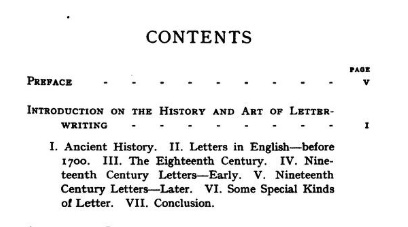
In 1922, George Saintsbury published A Letter Book, Selected with an Introduction on the History and Art of Letter-Writing, with the Introduction running to a fulsome 100 pages. The rest of his 300-page book draws on classic letters, almost all English, to provide examples of points made in the Introduction.

Did the most formidable letter writer of the 20th century read this? I can find no evidence that Lovecraft read this particular book, but we do know that he knew of George Saintsbury’s large and judicious anthology Tales of Mystery (1891). In I Am Providence, S.T. Joshi informs us that…

Lovecraft had obtained [this book] in one of his New York trips of 1922. He drew very heavily upon this latter compilation [for Supernatural Literature]

Tales of Mystery was a gift from Long, presumably picked up from one of the bookstores and used book-stalls he knew so well. Thus Lovecraft was strongly aware of the author in 1922/23, and would have been alert to his name in the various book reviews of that year. It is then probable that he, and his growing circle, were at least aware of the existence of a worthy new introductory book on the history of letters. It does seem the sort of book that Lovecraft might have corresponded with Loveman on, though we can’t know unless the perhaps-lost letters to Loveman re-surface. The book also seems one that a good public library might have wanted on their shelves. However, is is not a book listed in the edition of Joshi’s Lovecraft’s Library I have access to.

Nevertheless Saintsbury’s Introduction offers an interesting and accessible introduction to the epistolary traditions of which Lovecraft was aware of in other ways, and which he sought to perpetuate into the new Machine Age with his ever-dashing pen.

Aunties and Elizabeths

09 Thursday Jul 2020

Posted by asdjfdlkf in Films & trailers, New books, Odd scratchings, Scholarly works

≈ Leave a comment

S. T. Joshi’s blog has updated, and includes news that…

Hippocampus is preparing to release a number of additional titles very soon, including a huge two-volume edition of Lovecraft’s Letters to Family and Family Friends.

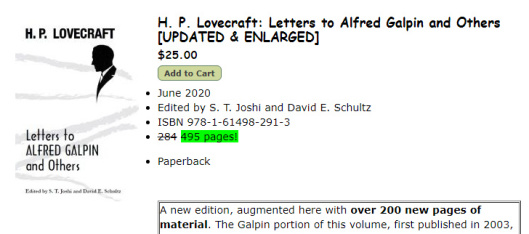
These will contain the long-awaited complete set of letters from Lovecraft to his aunts. Looking at the Hippocampus website, I see that the new H. P. Lovecraft: Letters to Alfred Galpin and Others [UPDATED & ENLARGED] is now available for order.

I’m also pleased to read on Joshi’s blog that he has rekindled an old, and apparently ardent, interest in British history. He has started reading the Oxford History of England (the original set, 1934-86) and has become interested in the reigns of the two Elizabeths (our current Queen Elizabeth, long may she reign, and Elizabeth the First from the time of Shakespeare). I recall that about twenty or more years ago I picked up a nearly complete set of History of England, swiftly gathered up by the armful and sold to me for a few pounds by a dozy Boy Scout at a jumble sale (USA equivalent: a large garage sale held in a church hall). I then filleted them for notes on West Midlands history, and then sold them for a handsome profit on eBay. That was before ebooks. I recall they’re surprisingly readable, though of course much has changed since. A number of the Marxist distortions introduced in the 1950s-70s have since been shown to be fudge and bunk (e.g. the claim that the slave trade funded the Industrial Revolution). Archaeology, genetics and other more obscure sciences have since illuminated seemingly impenetrable mysteries. But I’d imagine the 1934-86 set is still a good sound introduction, perhaps alongside Churchill’s abridged History of the English-Speaking Peoples, and its fine sequel by Andrew Roberts which covers the period from 1900 onward.

I’d send Joshi a cheap eBay DVD of the excellent movies Elizabeth / its sequel Elizabeth: The Golden Age, which it sounds like he’d enjoy — only I don’t know if his DVD player is multi-region or is locked to USA-only discs. The combo Elizabeth/Golden Age DVD appears to be three or four times more expensive on the USA eBay, presumably because it’s pitched as being an exotic imported art-house thing, but they’re dirt cheap here in the UK. Does anyone happen to know if Joshi can play DVDs sent in from anywhere in the world?

Anyway, talking of DVDs and Hippocampus, I see that Clark Ashton Smith: The Emperor of Dreams DVD is currently on a discount at a mere $10 plus shipping.

New book: Il linguaggio di Cthulhu

08 Wednesday Jul 2020

Posted by asdjfdlkf in New books, Scholarly works

≈ Leave a comment

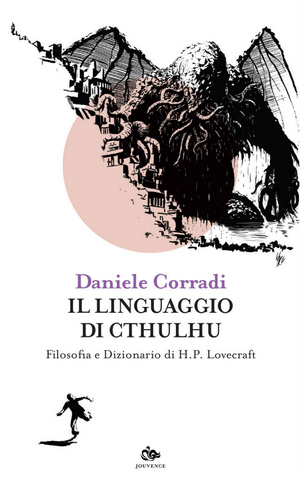
New in Italian, Daniele Corradi’s Il linguaggio di Cthulhu: Filosofia e Dizionario di H.P.Lovecraft (Jouvence series No.31, September 2019).

The title doesn’t quite make sense in English translation. Something like “On the Language of Cthulhu: A Philosophical Dictionary for H.P. Lovecraft” would be elegant but imprecise. From the Italian, some of the blurb…

A lengthy critical essay on the language, narrative techniques and philosophies of the greatest horror author of all time … suggests a philosophy of horror that re-establishes reality and psychology … In closing, [we have] the Lovecraftian Dictionary: a lively philological survey of recurring terms in Lovecraft’s work.

Monster Maniacs #2

05 Sunday Jul 2020

Posted by asdjfdlkf in New books, Scholarly works

≈ Leave a comment

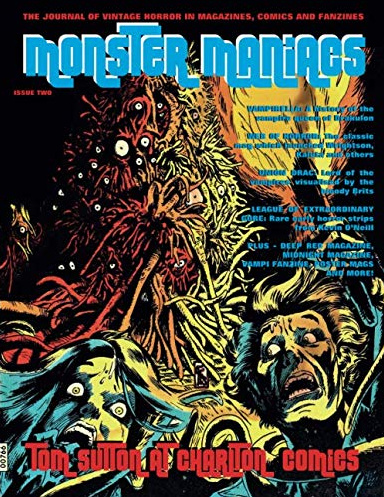
Monster Maniacs #2, now available in paper, being “the journal of vintage horror in magazines, comics and fanzines.”

Vastarien to date

04 Saturday Jul 2020

Posted by asdjfdlkf in Lovecraftian arts, New books, Scholarly works

≈ Leave a comment

Last noted here just before Christmas 2018, Grimscribe Press’s Vastarien journal has since produced six more issues.

Assuming you already have (or have previously noted the contents of) issue one, then the following is the scholarly non-fiction you’d have missed in the later issues…

Objects of Desire and Dreams of Objectification in Thomas Ligotti’s Short Stories.

Thomas Lovell Beddoes: Marginalia in a Cadaveric Atlas.

H. P. Lovecraft and H. R. Giger: The Maestros and Their Muses.

Expansion, Psychogeography, and the Living City in Andrei Bely’s Petersburg.

Interview with T. E. D. Klein.

The Atmospheric Machines of Poe and Ligotti.

Polanski’s Apartment Trilogy: Perceptual Crisis, Identity, and the Rented Flat.

Visions of the Gothic Body in Thomas Ligotti’s Short Stories.

The Dark Passions of Mark Samuels.

The Power of Individuality in the Work of Charlotte Perkins Gilman.

Richard Gavin: The Nature of Horror.

The Ghosts of Their Guns: Magical Realism in the Fiction of Nadia Bulkin.

Bequeathing the World to Insects [possible survey of post-human beetle-races etc, in fiction??]

Lacan on Lynch: Viewing Twin Peaks through a Psychoanalytic Lens.

Occult Detective Magazine / Hellebore

30 Tuesday Jun 2020

Posted by asdjfdlkf in Kittee Tuesday, New books, Scholarly works

≈ Leave a comment

New to me, there’s now an Occult Detective Magazine which has just reached #7. The title includes articles and reviews as well as fiction. For instance, the new Spring 2020 edition features Bobby Derie’s “Conan and Carnacki: Robert E. Howard and William Hope Hodgson”.

It appears to be an offshoot from and continuation of the late Sam Gafford’s Occult Detective Quarterly.

Also new and carrying non-fiction articles, the stylish British magazine Hellebore, devoted to the British ‘folk horror’ subgenre and nice typography.

Changes at Archive.org

27 Saturday Jun 2020

Posted by asdjfdlkf in Odd scratchings, Scholarly works

≈ Leave a comment

Archive.org has now ended their ‘extended borrow’ feature for books. For the duration of the emergency, they had made borrowing a book possible to all members, regardless of how many others had also chosen to borrow the book at the same time. The Internet Archive ‘borrow’ service is now back to the old ‘one book, one borrow’ feature, akin to a normal public membership library that only has paper books. The mega-publishers would like you to think that the ending of it was due to Archive.org being ‘frightened off’ by their new law-suit. But this return to a ‘normal library’ approach was always planned, once the emergency period was over.

Archive.org has even added a useful new feature to ‘Borrow’. One that brings them more into line with the practice of Google Books, and with public libraries where one might take a book off the shelf and flip through it. On many books the potential borrower now gets a full-page preview of the page on which your search-hit occurs. This is potentially very useful for researchers who find the book is in high demand from borrowers. Hopefully someone will code a UserScript to place a ‘see this same page on Google Books’ link adjacent to the page preview. Thus potentially giving the researcher more free pages either side.

← Older posts
Newer posts →


Please become my patron at www.patreon.com/davehaden to help this blog survive and thrive.

Or donate via PayPal — any amount is welcome! Donations total at Easter 2025, since 2015: $390.

Archives

  • February 2026
  • January 2026
  • December 2025
  • November 2025
  • October 2025
  • September 2025
  • August 2025
  • July 2025
  • June 2025
  • May 2025
  • April 2025
  • March 2025
  • February 2025
  • January 2025
  • December 2024
  • November 2024
  • October 2024
  • September 2024
  • August 2024
  • July 2024
  • June 2024
  • May 2024
  • April 2024
  • March 2024
  • February 2024
  • January 2024
  • December 2023
  • November 2023
  • October 2023
  • September 2023
  • August 2023
  • July 2023
  • June 2023
  • May 2023
  • April 2023
  • March 2023
  • February 2023
  • January 2023
  • December 2022
  • November 2022
  • October 2022
  • September 2022
  • August 2022
  • July 2022
  • June 2022
  • May 2022
  • April 2022
  • March 2022
  • February 2022
  • January 2022
  • December 2021
  • November 2021
  • October 2021
  • September 2021
  • August 2021
  • July 2021
  • June 2021
  • May 2021
  • April 2021
  • March 2021
  • February 2021
  • January 2021
  • December 2020
  • November 2020
  • October 2020
  • September 2020
  • August 2020
  • July 2020
  • June 2020
  • May 2020
  • April 2020
  • March 2020
  • February 2020
  • January 2020
  • December 2019
  • November 2019
  • October 2019
  • September 2019
  • August 2019
  • July 2019
  • June 2019
  • May 2019
  • April 2019
  • March 2019
  • February 2019
  • January 2019
  • December 2018
  • November 2018
  • October 2018
  • September 2018
  • August 2018
  • August 2015
  • July 2015
  • April 2015
  • March 2015
  • February 2015
  • January 2015
  • December 2014
  • November 2014
  • October 2014
  • September 2014
  • August 2014
  • July 2014
  • June 2014
  • May 2014
  • March 2014
  • February 2014
  • January 2014
  • December 2013
  • November 2013
  • October 2013
  • September 2013
  • August 2013
  • July 2013
  • June 2013
  • May 2013
  • April 2013
  • March 2013
  • February 2013
  • January 2013
  • December 2012
  • November 2012
  • October 2012
  • September 2012
  • August 2012
  • July 2012
  • June 2012
  • May 2012
  • April 2012
  • March 2012
  • February 2012
  • January 2012
  • December 2011
  • November 2011
  • October 2011
  • September 2011
  • August 2011
  • July 2011
  • June 2011
  • May 2011
  • April 2011
  • March 2011
  • February 2011
  • January 2011
  • December 2010
  • November 2010
  • October 2010
  • September 2010
  • August 2010
  • July 2010

Categories

  • 3D (14)
  • AI (70)
  • Astronomy (70)
  • Censorship (14)
  • de Camp (7)
  • Doyle (7)
  • Films & trailers (101)
  • Fonts (9)
  • Guest posts (2)
  • Historical context (1,095)
  • Housekeeping (91)
  • HPLinks (74)
  • Kipling (11)
  • Kittee Tuesday (92)
  • Lovecraft as character (58)
  • Lovecraftian arts (1,626)
  • Lovecraftian places (19)
  • Maps (70)
  • NecronomiCon 2013 (40)
  • NecronomiCon 2015 (22)
  • New books (966)
  • New discoveries (165)
  • Night in Providence (17)
  • Odd scratchings (984)
  • Picture postals (276)
  • Podcasts etc. (431)
  • REH (184)
  • Scholarly works (1,469)
  • Summer School (31)
  • Unnamable (87)

Get this blog in your newsreader:
 
RSS Feed — Posts
RSS Feed — Comments

H.P. Lovecraft's Poster Collection - 17 retro travel posters for $18. Print ready, and available to buy — the proceeds help to support the work of Tentaclii.

Proudly powered by WordPress Theme: Chateau by Ignacio Ricci.