• About
  • Directory
  • Free stuff
  • Lovecraft for beginners
  • My Books
  • Open Lovecraft
  • Reviews
  • Travel Posters
  • SALTES

Tentaclii

~ News & scholarship on H.P. Lovecraft

Tentaclii

Category Archives: Scholarly works

Henry Darger and H.P. Lovecraft

10 Thursday Aug 2023

Posted by asdjfdlkf in Scholarly works

≈ Leave a comment

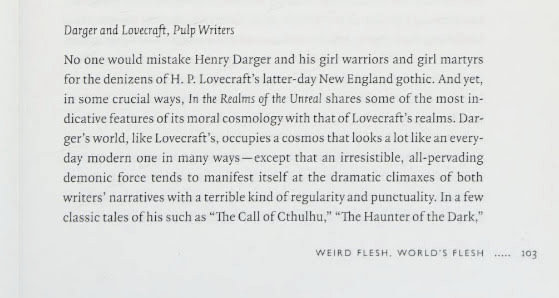
Henry Darger and H.P. Lovecraft. What a combination. New on Archive.org to borrow, the book Darger’s Resources (2012). With the chapter “Weird flesh, world’s flesh: Darger and the pulps”.

Review of the Lovecraft Annual 2022

07 Monday Aug 2023

Posted by asdjfdlkf in Scholarly works

≈ Leave a comment

Review of the Lovecraft Annual 2022.

Last year’s ‘curry coloured’ Lovecraft Annual 2022 is about to be edged aside by the new ‘brilliant blue’ 2023 issue of the S.T. Joshi edited journal. Thus I thought I should hurry up and post my review. Here it is.

The issue opens with “A Tale of Two Providences: Topographical Realism in “The Haunter of the Dark”, a close study of Lovecraft’s depictions of his own College Hill and the more distant Federal Hill in the city of Providence. The author asks why candles were not lit inside the College Hill study, to try to keep the Haunter at bay by giving at least some light? A valid query, but one perhaps open to objections. There had recently been strong storms and power-cuts, making it likely all the local stores had sold out of candles. But the main objection would be that the protagonist Blake clearly states that he needs to see out into the dark, meaning that his curtains must be open and the interior of the room totally dark. How else can he know if the power has been cut on Federal Hill? Though it’s later made very evident that the Haunter is ‘taking him over’ in some strange way, and perhaps restraining certain of his actions — such as lighting candles. The essay goes on to note that Blake tries to define himself at the end by giving his address, as if standing before a desk in a police station. This leads the author to many interesting points relating to Lovecraft’s own close identification with the fabric and layout of the city of Providence, including that if ‘he was Providence’ as it was circa 1900, then thereafter “every change that affected Providence also affected Lovecraft”.

My own research on “‘Uncle Eddy’: H.P. Lovecraft’s Used Bookseller” follows. I present several newly-found 1940s memoirs of Lovecraft, and test their veracity. Along the way I add to our understanding of the role of the Eddy family in Lovecraft’s life in Providence. This essay is the first investigation of ‘Uncle Eddy’, despite his being mentioned several times in passing in the letters. It shows, I think, what can be done when one ranges across the wealth of new 1920s and 30s resources now becoming freely available via Archive.org, Hathi Trust, Google Books, eBay and in the newly online large collections of the American museums and map collectors. Not to mention the Brown repository, which provided several useful items for my essay.

I wasn’t expecting much from “The Ripple Effect: Star Trek and the Lovecraft Mythos” but I found the essay engrossing, at least in its first sections which offer fascinating information about the impact of Lovecraft on some episodes of the original TV show (1966-69), via Robert Bloch and Samuel Peeples. It may help if the reader is aware of the classic Shatner/Nimoy first Star Trek, rather than all the later versions. But if not, it’s easy enough to view the episodes under discussion. The final section of the essay becomes a re-telling of the plot of Lovecraft’s “Whisperer in Darkness”, whereas I would have preferred deeper considerations of the philosophies involved in the context of the cultural dialogue between the 1930s and the mid 1960s.

“Solitary Conversation: A Bakhtinian Exploration of H.P. Lovecraft’s “Dagon”” is next. The author reads the story “Dagon” through the lens of the worthy theorist Mikhail Bakhtin. Who is best known in academia for ideas about ‘the carnivalesque’. But here his useful ideas are those about ‘polyphony’ (multiple voices) and the multiple layers of meanings that arise from this — even when we appear to have a single narrator.

““The Essence of Cosmic Mystery”: The Appeal of John Martin’s Paradise Lost Pictures to H.P. Lovecraft” is both well-written and fun, a rare combination for anything concerning Milton. In the first half we learn more about Martin than about Lovecraft, but I still found it an interesting read. Martin comes across as a Lovecraft precursor in the visual arts, dedicated to scenes of a proto-cosmic sweep and in which man is a puny and insignificant figure. Lovecraft felt that this partly arose because Martin, like himself, was technically weak on depicting the human figure but excellent in sweeping vistas and monstrous architecture. An interesting point, technical inability pushing an artist toward certain avenues of expression rather than others. There are no pictures here, all of which should by now be public domain, but one wonders if an illustrated free ebook edition might be possible at some point.

“Lovecraft and the Folklore of Glocester’s Dark Swamp” examines the accounts of the Lovecraft-Eddy trip in search of the swamp. Then, across twenty pages, exhaustively examines a range of previously undetected local lore and history relating to it or to thereabouts. The conclusion is that it’s ultimately impossible to know if Lovecraft or Eddy ever knew of such local lore. But again we see the wealth of unknown material that opens up once independent scholars have free access to online archives.

“A Note on Nodens in Lovecraft’s Mythos” looks at the sparse and transient use of Nodens in Lovecraft’s own work. Sources are pointed out in Machen and elsewhere, though the author doesn’t suggest the Neptune garden on a headland near Magnolia, on a shoreline that Lovecraft and Sonia knew well. One wonders if it was open to the public at certain times in the summer in the 1920s.

The estate (1904-1958) was at the end of Magnolia Beach… “Most summers, we lived in cottages on Magnolia Beach […] The famed Coolidge Estate was built high atop the rocky end of the horseshoe-shaped beach.” (Meredith d’Ambrosio). Demolished due to property taxes in 1958, and the land given to be maintained as a natural park in perpetuity. The red dot indicates the location…

The British archaeological and philological findings on the pagan deity Nodens are recounted (the River Severn, the Vyne ring, Nuada of the Silver Hand, etc) all of which will be familiar ground to many Tolkien scholars. The author also usefully looks at the Noden related idea of the “Great Abyss” of Lovecraft’s Dreamlands and how this and other voids might have related to the crucial early scientific idea of ‘the vacuum’ and the discovery of void spaces in which there seemed (at that time) to be nothingness. The subtle relations of Lovecraft’s work to the hard sciences is under-discussed, and I found this to be a welcome and unexpected turn in the essay.

The essay “Lovecraft’s Garden: Heart’s Blood at the Root” follows, with a long preamble that establishes for the reader the key themes in the uses of gardens and gardening by the Romantics (i.e. the Wordsworth era in English literature). There follows a two or three page survey of gardens in Lovecraft, with a few extracts from letters. Though the author was not able to unearth some very pertinent letters such as…

In childhood I used to haunt such places [florists’ shops] about February, when the strain of hated winter became unbearable. I liked to walk through the long greenhouses & imbibe the atmosphere of warm earth & plant-life, & see the vivid masses of green & floral colour. One of my early doggerel attempts was a description of an hypothetical glass-covered, furnace-heated world of groves & gardens …” (Selected Letters Vol. III, page 138).

A deeper and comprehensive survey of Lovecraft and gardens is needed from someone, I’d suggest. This essay is not it. But it makes a good start. The essay then concludes with a very long examination of Lovecraft’s long poem “The Garden” (1917), written when he was about 26/27. This poem is found to deploy themes and categories that would have been recognisable to the Romantics. The author contends that this early poetic Lovecraft can be understood to be what he terms a “Romantic ‘on the darkside’”. I would be interested in a sequel which might look at the Wildean and continental Decadents and gardens, in relation to Lovecraft.

We then have “The Authorship of The Cancer of Superstition and Lovecraft’s Late Readings on Folklore”, which shows that the Arkham House published text of CoS was hardly written by Eddy. Nor by Lovecraft, at least in the usual way. Rather it was Lovecraft’s short telegraphic synopsis, woven and patched together with a number of extracts that Eddy lifted from books which had been supplied to him for his research. The contribution of Eddy to CoS is thus judged to be about 15% of the total, as printed by Arkham House. On this matter, here are the key Collected Essays notes of Lovecraft’s outline synopsis…

HPL’s synopsis for a book combating superstition, commissioned by Harry Houdini; the work was halted by Houdini’s sudden death on 31st October 1926. His colleague in the Houdini work, C. M. Eddy, Jr., then attempted to write out the synopsis.

Joshi’s I Am Providence has it that this attempt at expansion was…

clearly by Eddy; I see little of Lovecraft’s actual prose in it, although no doubt many of the facts cited in it were supplied by him.

The author has established the book sources used to construct Eddy’s patchwork of post-Houdini expansion. The examination of these titles and authors leads to the suggestion that preparatory ‘Houdini reading’ for this joint project might have influenced the story “The Call of Cthulhu”. In terms of ideas about cultic idolatory, sunken temples, earthquakes as ’caused by the gods’, and astrology (“the stars were right”). Possibly, but Lovecraft was playing with such ideas long before that. So were many in Weird Tales, not to mention the Theosophists. Recall also the countless real ancient idols and primal carvings Lovecraft would have seen when visiting the New York museums, immediately prior to “Cthulhu”. Reading was not his only source of inspiration.

I wondered how many of the ‘book paragraphs’, the ones Eddy evidently had access to and largely plagiarised, might have actually come to him via Houdini’s notes (made from Houdini’s extensive book collection)? But I don’t recall this point being addressed.

Next is “Painting in Word Shadows: The Role of the Hidden and Unknown to the Reader in Lovecraft”. This surveys the main stories for examples of ‘unseen but seen’. For instance, when we see Cthulhu…

We are seeing the narrator’s highly condensed version of Johansen’s diary, which in turn is his censored version of something he did not truly understand written long after the events occurred, in a language other than the writer’s.

The artful obsurement of his monsters, while simultaneously depicting them in a manner in which the readers can paradoxically see them clearly for themselves, remains a cornerstone in the power of his work.

We then head into the book reviews. Steven J. Mariconda offers the reader a long and initially discursive chapter-sized look at Joshi’s The Recognition of H.P. Lovecraft (2021, though here “2012”) along with Joshi’s Journals 1974-1987 (2021-22, three volumes). Mariconda eventually comes to the judgement that Lovecraft’s enduring appeal is partly because…

he found the instruments for probing and documenting his own consciousness using the language of symbolism. […] he developed an art divorced from didacticism and ethical significance. He was devoted entirely to his vision, striving to embody it with perfection of form and complexity of technique. Over time he succeeded: his tales became progressively more intricate and layered. […] His concerns are not transitory [and mundane, but] speak to two fundamental issues — the unknown of the external world, and the isolation of existing inside a human mind.

And he did this when there was a growing need for a “new basis in art”, an art enhanced by the new sciences and their many interlocking revelations about humanity and the cosmos.

At a more workaday level Mariconda picks out a few entertaining ‘digs’ from Joshi’s new books. But overall observes that…

a few may be surprised at the mild tone Joshi adopts for the bulk of the Recognition. […] He even refrains from blasting certain academic Lovecraft criticism — vague, jargon-filled and detached from pertinent sources — which is manifestly inferior to many prior contributions.

There is also a useful outline of what is to be found in Joshi’s three-volume personal Journals, and a deep appreciation of Joshi’s decades of initially thankless and unrewarded labour on Lovecraft’s behalf. The Journals can be easily found as affordable Kindle ebooks.

The shorter reviews follow. The new publication of Arthur S. Koki’s 1962 Lovecraft biography is ably evaluated by Ken Faig Jr. Faig nods in approval at this early attempt, noting the extensive access that Koki had to many of Lovecraft’s still living friends and neighbours. He also notes and approves Koki’s still-unrealised hopes for a superb and highly illustrated edition of the Dream-Quest. I was interested to learn that Koki had owned a ‘How to Read and Write Spanish’ book seemingly purchased by Lovecraft in 1911 (age 21), who had written his name in it. Faig points out that this book is not in Lovecraft’s Library. But I would be cautious here, since we know that Koki was interviewing Loveman at that time. And Loveman was well known in the rare book trade for that kind of fake…

Nearly every catalogue that [the older] Loveman issued was tilled with fabulous ‘bargains’ — books signed by Melville, Mark Twain or Hawthorne — a whole galaxy of great authors. All priced at ten to twenty-five dollars each” (Joe Nickell, Real or Fake: Studies in Authentication, University Press of Kentucky, 2009).

As senility set in, Loveman got more and more careless about signing books, using ball-point pens for signatures of authors who had died before the ball-point pen was invented. His catalogs were an endless source of amusement to those familiar with his wares”. (Robert A. Wilson, Modern Book Collecting: A Basic Guide to All Aspects of Book Collecting, 1980).

So far as I’m aware Loveman never sold Lovecraft fakes. But I’m guessing that he might have made one as a quick present for Koki. Lovecraft had no sustained facility with Spanish that I know of. Nor would he have needed it. Since at that time the bulk of the immigrants to Providence were Swedish, Irish and Italian.

Bobby Derie then has a short review of Faig Jr.’s Lovecraftian People and Places, and finally Martin Andersson rounds out the issue with a short joint review of the new Miscellaneous Letters and Letters to Woodburn Harris and others. It’s stated that the Lovecraft letters are nearing the end, with only a few more volumes to go. But my hope is that funds can then be raised to go beyond these print volumes, by establishing a search tool for searching inside and across the full texts all of Lovecraft’s works, essays, poems and letters. Only snippets would be provided in results, in much the same way that Google Books works. This is not the sort of technical job that S.T. Joshi will want to take on, but with his support a major crowd-funder campaign could surely raise the funds needed to pay the professional coders and server-wranglers.


The Lovecraft Annual 2022 can be had from Hippocampus Press, and some might want to order it with the 2023 edition — which is set to appear very soon.

H.P. Lovecraft and Astronomy / Lovecraft Annual 2023

06 Sunday Aug 2023

Posted by asdjfdlkf in New books, Scholarly works

≈ Leave a comment

New on the Hippocampus Press site, the forthcoming book When the Stars Are Right: H.P. Lovecraft and Astronomy. A chunky 412 pages.

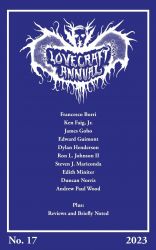
Also the new Lovecraft Annual for 2023 (No. 17) with nearly 250 pages and in a rather pleasing shade of blue…

Already on Amazon UK which has it shipping on 1st August, though also anticipating delivery by the 26th August at the earliest. Basically, still a pre-order then. A bit cheaper this year, at £12.

Futures Past: A Visual History of SF

29 Saturday Jul 2023

Posted by asdjfdlkf in Scholarly works

≈ Leave a comment

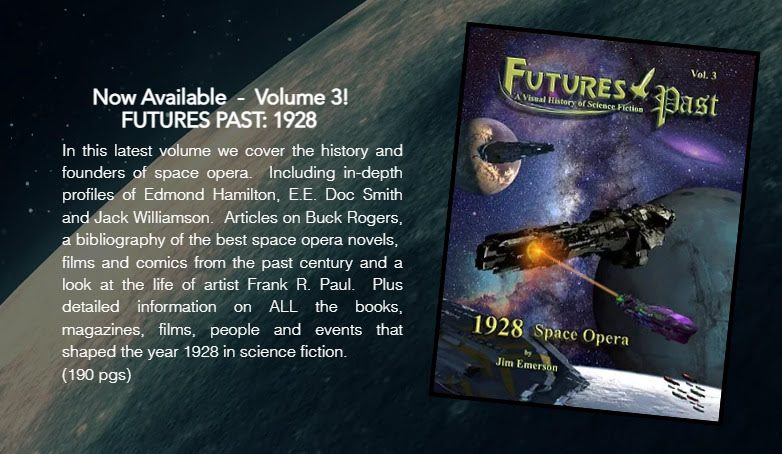
Jim Emerson is creating a complete Futures Past: A Visual History of SF set, year by year. Vol. 3 is now available. And you can get Vol. 1 (1926) free from the website, as a PDF download.

It’s apparently set to be a complete survey of the output, people and occurrences (i.e. new words, sub-genres etc) for each and every year, with nothing left unmentioned.

Letters to Wilfred B. Talman – the third set of notes

27 Thursday Jul 2023

Posted by asdjfdlkf in Scholarly works

≈ Leave a comment

Here’s my third set of notes on Lovecraft’s Letters to Wilfred B. Talman and Helen V. and Genevieve Sully. These notes cover letters from November 1929 to May 1931.


Page 124. We get the last address of ‘Good Old Mac’, the boys’ adventure novelist and sometimes juvenile fantasist Everett McNeil, which may be of use to those still seeking the lost letters and manuscripts of McNeil. He was with his sister at “Collins, 6227 Warner St., South Tacoma, Wash.” He died there shortly after arriving.

Page 127. It’s mid April 1930, and Lovecraft’s summer travels are in the offing. He implies he is to meet Belknap Long in Atlantic City, “thereafter continuing southwards alone”. Thus it seems he visited Atlantic City.

Page 130. “Strange musick around Red Hook [Brooklyn] seems quite a usual thing. I always noticed gangs of sinister-looking youths marching about with ukuleles and harmonicas, & wondered what dark & furtive gods of the nether-world they were hymning in their cryptic rituals.”

Page 131. Said of his new story “The Whisperer in Darkness”, in mid late July 1930… “When I get a chance to rewrite it … It won’t do in its present form.” If I remember correctly it was relatively rare story in terms of being written away from home and during the summer.

Page 134. The New Zealand amateur Robert G. Barr published Lovecraft’s “Harbour Whistles” (part of Fungi from Yuggoth) in his Silver Fern. Today the National Library of New Zealand has Robert G. Barr Collection of Amateur Journalism. “This collection is catalogued online”.

Page 135. On seeing the initials “FOFA”, Lovecraft imagined some possible meanings. “Fiends of Forest Abbey” and “Fifty Ogres from Acheron”. These may be of interest to RPG gamers and Mythos writers.

Page 135. September 1930. Arthur Leeds was then touring with a theatrical company, and had recently “passed through” New York City in the late summer.

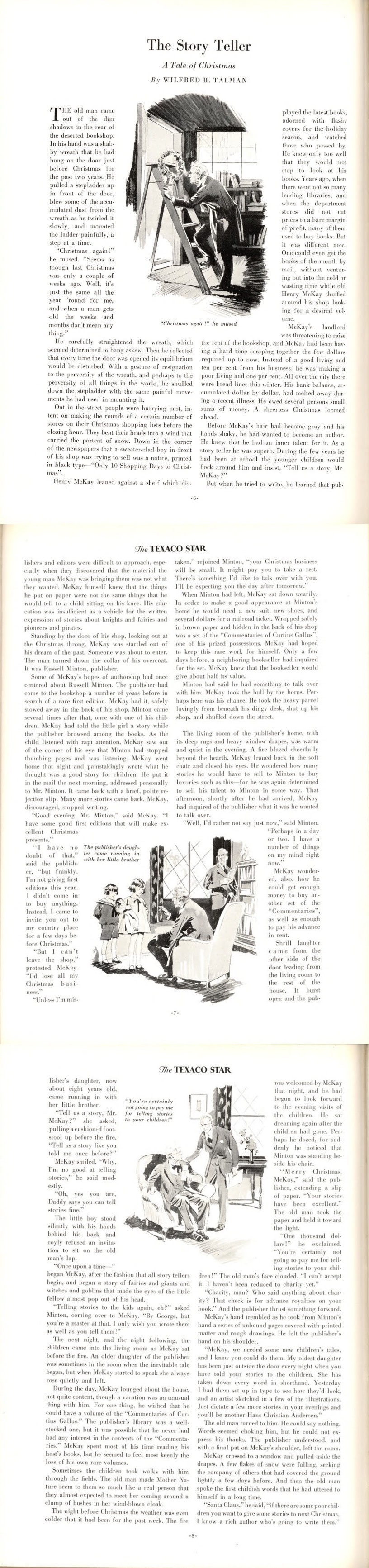
Page 137. Talman wrote a “tale based on our good old friend Honest Mac” (Everett McNeil). Lovecraft notes “His real charm as a perpetual boy telling stories to other boys”. Talman’s story was mangled by an editor. The man being “a sterotyped commercial robot” and “a big-winded office-hound” in Lovecraft’s view. The editor had demanded that a stenographer be added, “as if it were illogical for a writer not to be able to hire a typist”. The tale was “The Story Teller: A Tale of Christmas”, which survives in its editor-warped “mangled” form.

Thus McNeil features as a character in another story, albeit not a weird one. I have a survey of ‘McNeil as character’ in my biography of him. Talman’s tale ran in the Christmas number of The Texaco Star (Vol. 17, No. 11, December 1930), and is interesting as a romantic pen-picture of a key Kalem member by one who knew him. Lovecraft objected to the frock-coat in the illustrations, but thought the pictures “looked a bit like him”.

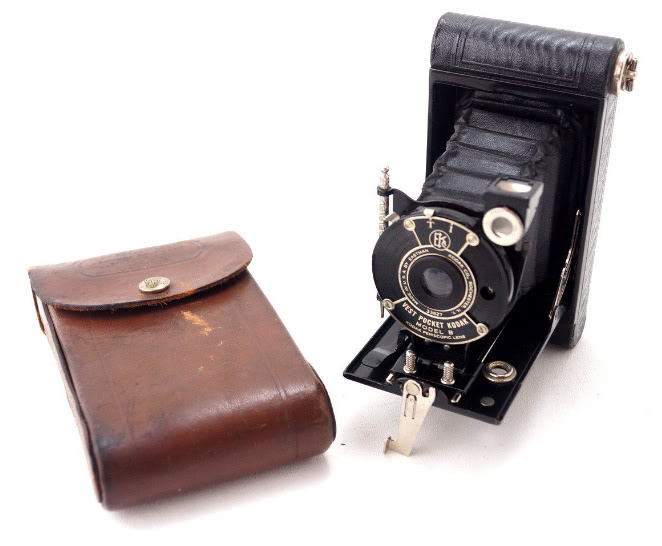
Page 138. Lovecraft’s camera was, by October 1930, a portable “vest-pocket Kodak” though it made what he called “microscopic views”. This was then his only camera “in working order”. He doesn’t give its model or date, so the model can’t be guessed. A 1918 early “vest-pocket Kodak” model looked like this…

Several years later he tells Talman that he has photographed his new home at No. 66 with his old “1907 #2 Brownie” (a Kodak ‘box-brownie’), so he must have had it mended since 1930 or perhaps just bought film for it and given it a clean.

Page 149. “Bedford is one of my favourite villages”. The latest Texaco Star has arrived, and the “New London article interested me greatly”, and he was further captivated by “the whaling article” along with “the Jamaica article”. He eagerly awaits “the Providence article” in a later issue, to which by the sound of it he has contributed something. At this time Talman is working on the magazine. Not noted by Lovecraft, the latest Texaco Star’ Contents page briefly notes that dinosaur eggs have been discovered in the USA for the first time.

Page 153. Lovecraft reads the reviews in the Sunday Times, presumably the Sunday edition of the New York Times and not the Times of London.

Page 160. Of his press cuttings collection he notes that “most of them are printed on such rotten paper that they perish in the course of a very few years”. Thus his cuttings file(s), which I had previously wondered about re: their present location, might only have been a relatively ephemeral thing. By Christmas 1930 it was possible to copy a document by hunting up what he calls “a photostatic reproducer” who would change “50 cents” to copy the proofreading booklet that Talman had then sent. But obviously the costs would have been prohibitive for preserving newspaper cuttings.

Page 162. “Prose must be created with just the same exactness, delicacy of ear, imaginative fertility etc, as verse.”

Page 164. On Blackwood… “His prose is so accursedly bad and journalese”.

Page 169. He reveals what he was doing in 1904-05, at age 14-15. Intensively studying the histories of the ancient world. On the details of the capture of Babylon in 312 B.C…. “in 1905 or so I knew all this just as well as I know my own name”. In 1932 he had to refresh his memory of some of the details.

Page 175. “My postcard collection is classified”, ordered by place presumably, and it “hath now overflowed the trunk and includes two cardboard boxes as an annexe”. Today, the Brown repository only 557 cards, some of those not from Lovecraft (e.g. Cook to Cole) or if from Lovecraft are not picture-postcards.

Page 175. “I’ll have to cook up some adventures of Ward Phillips, the occult deteckatiff” (i.e. himself). In April 1931 he was evidently perusing the “scientifiction” magazines, if only on the news-stands, since he remarks that he has not yet seen any Belknap Long science-fiction stories in these.

Page 177-178. He gives detailed advice on “The Curse Wheel” for Talman, re: re-writing this ‘Jersey Devil’ tale. Getting carried away, he gives his own substantial rewriting in five long paragraphs. New fiction from Lovecraft! Well, new to me anyway.

New journal: Insolita

26 Wednesday Jul 2023

Posted by asdjfdlkf in Lovecraftian arts, Scholarly works

≈ Leave a comment

I was pleased to find another new journal of the fantastic, Insolita: Revista Brasileira de Estudos Interdisciplinares do Insolito, da Fantasia e do Imaginario (‘Brazilian Journal of Interdisciplinary Studies of the Unusual, Fantasy and Imaginary’). Which is of course not in English (mostly, there is some English in the latest issue). But there are auto-translators these days.

Five issues, so far, in open-access as nearly all South American journals are. Seems to have a definite tilt toward horror. The new and latest issue is themed “The Philosophy of Horror; the horror of philosophy”, and leads with an article which translates as “Cyclopean Games: the Lovecraftian heritage in games”.

Lost Continents

24 Monday Jul 2023

Posted by asdjfdlkf in Scholarly works

≈ Leave a comment

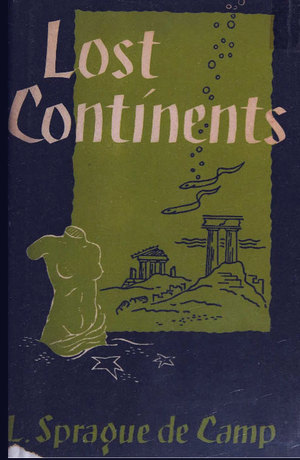
New on Archive.org to borrow, a good scan of L. Sprague de Camp’s Lost Continents: The Atlantis Theme in History, Science, and Literature (1954). The original Gnome Press edition, not later popular re-issues. It looks like maps and illustrations are un-stolen.

After Engulfment reviewed

17 Monday Jul 2023

Posted by asdjfdlkf in New books, Scholarly works

≈ Leave a comment

A substantial chunk of a July 2023 review in Science Fiction Studies for the book After Engulfment: Cosmicism and Neocosmicism in H.P. Lovecraft, Philip K. Dick, Robert A. Heinlein, and Frank Herbert (2022). The rest of the review is behind the Project MUSE paywall. Amazon UK has no reviews, and this is the first I’ve seen or can find. But note there’s now a Kindle ebook edition, which means you can get the first 10% of the book on a Kindle as a free sample.

Also looking at Lovecraft from a theoretical angle, a short article on “H.P. Lovecraft and Hubert Fichte” with some interesting things to say about bodies and flows.

The Fossil for April 2023

16 Sunday Jul 2023

Posted by asdjfdlkf in Historical context, Scholarly works

≈ Leave a comment

A new edition of The Fossil, journal for the history of amateur journalism. This April 2023 issue has some Lovecraft interest for items relating to Lovecraft’s friend Maurice W. Moe. There’s a reprint of Moe’s “Amateur Journalism and the English Teacher”, a newly discovered item. This was his address to the National Council of Teachers of English in 1914. Ken Faig, Jr. follows with a short biography of Moe, with a focus on his amateur journalism work.

Miscellaneous Writings

15 Saturday Jul 2023

Posted by asdjfdlkf in Lovecraft as character, Scholarly works

≈ Leave a comment

New on Archive.org to borrow, Miscellaneous Writings. Most will have access to this material elsewhere. But some may want to look up old ‘page-number references’, found in scholarly writing on Lovecraft, that they have been unable to check due to lack of access.

Talking of once-obscure items, S.T. Joshi brings news of a “major auction of books and other matter devoted to the field of weird fiction”, set for Halloween 2023 at Bonhams in Boston. Sounds like the plot of a Mythos story, already. What may interest readers of Tentaclii is that Bonhams are still seeking consignments of quality/rare eldritch items for the auction. In that regard, don’t forget there’s also PulpFest 2023 in August.

Joshi’s latest blog post also spots a late ‘Lovecraft as character’ appearance, at the end of the movie Incident in a Ghostland (2018), and he useful identifies the actor.

The Illustrated History of Warren Magazines

10 Monday Jul 2023

Posted by asdjfdlkf in New books, Scholarly works

≈ Leave a comment

The Illustrated History of Warren Magazines is now available in a new “revised and expanded” edition, with the original being Illustrators Special No. 14, which lists on Amazon UK as “The Illustrated History of Warren Comics”.

Still fairly short, at 152 illustrated pages. Also covers 1984, which took material from the European Toutian edited titles which were Metal Hurlant competitors.

This June 2023 version is said to have a new chapter at the back, as well as a few tweaks for the former layout and text. Publisher’s page at The Book Palace.

Elsewhere, for free, Dark Worlds is surveying Sword and Sorcery at Warren and has so far reached the mid 1970s.

LIJ Ibero

08 Saturday Jul 2023

Posted by asdjfdlkf in Scholarly works

≈ Leave a comment

Of possible interest to some Tentaclii readers, LIJ Ibero: Revista de Literatura Infantil y Juvenil Contemporanea, an open-access journal I’ve only just discovered. The title translates as ‘Journal of Contemporary Literature for Children and Youths’. 16 issues, so far. Under Creative Commons Non-Commercial, so a translation could be used in a non-profit English language magazine etc.

← Older posts
Newer posts →


Please become my patron at www.patreon.com/davehaden to help this blog survive and thrive.

Or donate via PayPal — any amount is welcome! Donations total at Easter 2025, since 2015: $390.

Archives

  • February 2026
  • January 2026
  • December 2025
  • November 2025
  • October 2025
  • September 2025
  • August 2025
  • July 2025
  • June 2025
  • May 2025
  • April 2025
  • March 2025
  • February 2025
  • January 2025
  • December 2024
  • November 2024
  • October 2024
  • September 2024
  • August 2024
  • July 2024
  • June 2024
  • May 2024
  • April 2024
  • March 2024
  • February 2024
  • January 2024
  • December 2023
  • November 2023
  • October 2023
  • September 2023
  • August 2023
  • July 2023
  • June 2023
  • May 2023
  • April 2023
  • March 2023
  • February 2023
  • January 2023
  • December 2022
  • November 2022
  • October 2022
  • September 2022
  • August 2022
  • July 2022
  • June 2022
  • May 2022
  • April 2022
  • March 2022
  • February 2022
  • January 2022
  • December 2021
  • November 2021
  • October 2021
  • September 2021
  • August 2021
  • July 2021
  • June 2021
  • May 2021
  • April 2021
  • March 2021
  • February 2021
  • January 2021
  • December 2020
  • November 2020
  • October 2020
  • September 2020
  • August 2020
  • July 2020
  • June 2020
  • May 2020
  • April 2020
  • March 2020
  • February 2020
  • January 2020
  • December 2019
  • November 2019
  • October 2019
  • September 2019
  • August 2019
  • July 2019
  • June 2019
  • May 2019
  • April 2019
  • March 2019
  • February 2019
  • January 2019
  • December 2018
  • November 2018
  • October 2018
  • September 2018
  • August 2018
  • August 2015
  • July 2015
  • April 2015
  • March 2015
  • February 2015
  • January 2015
  • December 2014
  • November 2014
  • October 2014
  • September 2014
  • August 2014
  • July 2014
  • June 2014
  • May 2014
  • March 2014
  • February 2014
  • January 2014
  • December 2013
  • November 2013
  • October 2013
  • September 2013
  • August 2013
  • July 2013
  • June 2013
  • May 2013
  • April 2013
  • March 2013
  • February 2013
  • January 2013
  • December 2012
  • November 2012
  • October 2012
  • September 2012
  • August 2012
  • July 2012
  • June 2012
  • May 2012
  • April 2012
  • March 2012
  • February 2012
  • January 2012
  • December 2011
  • November 2011
  • October 2011
  • September 2011
  • August 2011
  • July 2011
  • June 2011
  • May 2011
  • April 2011
  • March 2011
  • February 2011
  • January 2011
  • December 2010
  • November 2010
  • October 2010
  • September 2010
  • August 2010
  • July 2010

Categories

  • 3D (14)
  • AI (70)
  • Astronomy (70)
  • Censorship (14)
  • de Camp (7)
  • Doyle (7)
  • Films & trailers (101)
  • Fonts (9)
  • Guest posts (2)
  • Historical context (1,095)
  • Housekeeping (91)
  • HPLinks (74)
  • Kipling (11)
  • Kittee Tuesday (92)
  • Lovecraft as character (58)
  • Lovecraftian arts (1,626)
  • Lovecraftian places (19)
  • Maps (70)
  • NecronomiCon 2013 (40)
  • NecronomiCon 2015 (22)
  • New books (966)
  • New discoveries (165)
  • Night in Providence (17)
  • Odd scratchings (984)
  • Picture postals (276)
  • Podcasts etc. (431)
  • REH (184)
  • Scholarly works (1,469)
  • Summer School (31)
  • Unnamable (87)

Get this blog in your newsreader:
 
RSS Feed — Posts
RSS Feed — Comments

H.P. Lovecraft's Poster Collection - 17 retro travel posters for $18. Print ready, and available to buy — the proceeds help to support the work of Tentaclii.

Proudly powered by WordPress Theme: Chateau by Ignacio Ricci.