• About
  • Directory
  • Free stuff
  • Lovecraft for beginners
  • My Books
  • Open Lovecraft
  • Reviews
  • Travel Posters
  • SALTES

Tentaclii

~ News & scholarship on H.P. Lovecraft

Tentaclii

Category Archives: REH

Some interesting authors entering the public domain at the start of 2021

17 Sunday May 2020

Posted by asdjfdlkf in Odd scratchings, REH

≈ Leave a comment

Here’s my survey of interesting texts and authors set to enter the public domain in early 2021 in nations which follow “the 70 year rule”, the author having died in 1950. Some of their works may already be in the public domain, but soon all of them will be. Then I follow this section by briefly noting the names in the “50-year rule” nations.


Nations following the 70 year rule:

* Edgar Rice Burroughs, for Tarzan, Barsoom, old Venus and more.

* George Orwell, for the anti-authoritarian political classics, Animal Farm and 1984. His essays might also be selected from to make a new themed book.

* Olaf Stapledon, ground-breaking British science-fiction author. His seminal ‘future history’ Last and First Men (1930) and Star Maker (1937) are his best known books. His post-war Worlds of Wonder: Three Tales of Fantasy (1949) was only issued in a limited edition of 500. Basil Davenport collected his best in To the End of Time: the Best of Olaf Stapledon (1953) and Sam Moskowitz gathered up the rest in Far Future Calling: Uncollected Science Fiction and Fantasies of Olaf Stapledon (1979).

* Ernest Haycox, an extremely prolific and popular author of what appear to be romping quality westerns and revolutionary war adventures, featuring tough and robust characters who live by their own rules. Had stories in the pulps of the 1920s, and he later graduated to the ‘slicks’ where he was admired by the likes of Ernest Hemingway. I would imagine he was being noticed by the likes of Robert E. Howard. One story was filmed as Stagecoach (1939), another as Union Pacific (1939). He had a vast output, and looks likely to be an excellent mine of brisk adventure plots that could be morphed into newly-told science-fiction works.

* Rafael Sabatini, a prolific English-Italian writer of historical adventure and mystery novels. His sea adventures The Sea Hawk (1915) and Captain Blood (1922) became best-sellers and were filmed. Blood became over time, effectively, a four-book set. Along with the works of Everett McNeil, the Blood books were among the very few books that librarians found it impossible to keep on the juvenile library shelves in the 1920s and 30s — as soon as they came back, another boy would take them out. He also published a three-book series The Historical Nights’ Entertainment, containing vivid re-tellings of real-life royal murders and intrigues, impersonations and similar bizarre doings in the upper echelons of society. His mystery stories were collected in The Evidence of the Sword and Other Mysteries (2006). At a guess, he’s now possibly of most interest today to makers of media productions looking for the next Game of Thrones with a pirate-y twist.

* Max Pemberton, a London dandy who had an early career as a boys’ magazine editor. Knowing what boys want, his The Iron Pirate was a best-seller of the 1890s — a tale of a giant new type of gas-powered ironclad ship which dominates the Atlantic. He went on to write many historical adventure novels and mystery-crime stories. His Wheels of Anarchy (1908) is an “adventure tale about anarchists and assassins that is set across Europe”.

* William Hovgaard, a naval historian. His early book The Voyages of the Norsemen in America (1914) has probably been superseded, but perhaps suitably updated with his 1925 article “The Norsemen in Greenland” and later scholarship, it might make the basis of an unusual non-fiction graphic novel?

* Erle Cox, an Australian science-fiction writer with a modest output. His novel Out of the Silence (1919 as a serial, 1925 as a book, 1928 in New York) was very popular in Australia and saw 13 reprints. This became a long-running comic strip and also a radio series in Australia. His Fools Harvest (1939) was a prophetic future-war tale. Short story collections available include Major Mendax: Tales of a Mad Scientist, and The Gift of Venus and Other Stories. He was perfectly timed, and with the right politics, to have been an occasional H.P. Lovecraft correspondent — but he doesn’t appear to have been.

* George Bernard Shaw, the once incredibly famous playwright and thinker. He had a vast output, but almost all of his work addressed ‘topical issues’ of his time and thus is not usually to modern tastes. Some of it has had a lasting popularity, such as his Pygmalion (famously filmed as My Fair Lady) which might be newly adapted into science-fiction, perhaps with themes of AI and robots. His Back to Methuselah (A Metabiological Pentateuch) is a series of linked plays leading into the far-future in an Olaf Stapledon-like manner, and it is his only serious attempt at science-fiction. It was ambitiously presented as an unabridged full-cast broadcast for BBC radio in 1952, but no recording or reading-script appears to have survived. By the 1950s Back to Methuselah had become a running joke in the dressing-rooms of British theatre-land, for its difficult staging and long running-time. Like most of the British left at that time, he was avidly in favour of eugenic breeding — which may freak out today’s enfeebled left and cause further problems with any revival.

* R. R. Ryan. (Evelyn Bradley). Tense and ghoulish psychological horror novels of the 1930s, usually involving girls being menaced. From the descriptions, he seems to be an acquired taste for hardened connoisseurs of obscure British horror.

* Ralph Straus, a science-fiction and fantasy author with some novels that still sound interesting and are probably already in the public domain in most places. His The Dust which is God (1907) takes the Edwardian reader on a Dante-esque guided tour of several utopian planets, and it may be of interest to those who enjoy early ideas-led Edwardian cosmic science-fiction and attempts to imagine utopias. Apparently rather a good book, according to several reviewers in the 1970s, though he doesn’t appear in Science Fiction: The Early Years. In his later Pengard Awake (1920) he departed from his usual style, and has “An English book collector travel to Chicago where he meets an antiquarian bookseller in his shop in Chicago and tries to help him cope with a dark mystery.” The review in Punch said that the author “tells his queer story so plausibly and with so light a touch that even though you may affect to scoff at his dashing improbabilities you cannot escape their attraction.” The New York Tribune made it sound a little darker… “an amazing but plausible novel of dual personality. Not since Robert Louis Stevenson’s Dr. Jekyll and Mr. Hyde have we had a more powerful delineation of the forces of good and evil at war in a man’s soul.” Possibly there are other interesting stories by Straus to be found and collected.

* Irving Bacheller was a successful American newspaperman who introduced American readers to the likes of Arthur Conan Doyle and Rudyard Kipling, and who sponsored The Red Badge of Courage. He turned to writing his own enormously popular semi-autobiographical novels of early America, farm-life and war. He also wrote what appear to be vivid historical novels such as Vergilius: A Tale of the Coming of Christ, and his favourite A Man for the Ages: A Story of the Builders of Democracy (being the story of Abraham Lincoln).

* William Rose Benet the American encyclopedia-maker, reviewer, anthologist and poet. His more intriguing titles include The Flying King of Kurio: A Story of Children (1926) and the poetry pamphlet Mad Blake: A Poem (1937). The latter seemingly sunk without trace, but presumably being about the visionary William Blake. His dark poem “The Skater of Ghost Lake” is taught in American schools. His Pulitzer Prize winning poetry book The Dust which is God is not to be confused with the novel of the same name by Ralph Straus (see above).

* Frank Parker Day, whose novel Rockbound (1928) evokes the terrible powers of the Atlantic ocean, as it tells the story of bitterly feuding families on an isolated island off Nova Scotia. Not a novel to take away on your cheerful island holiday, by the sound of it, though it appears to have a cult following among modern gloomsters.

* Warwick Deeping, a once very popular British story and novel writer, who saw reprints in the Saturday Evening Post and Adventure. His early works were described as… “misty colour-shot, ultra-fantastic romances of pre-Arthurian days”, and he is is said to have gleefully re-worked Arthurian characters in a Marion Zimmer Bradley manner. But he was stung by vicious utilitarian critics for the crime of being both fantastical and middle-brow, and he appears to have tried to please the critics by turning to modern tales addressing worthy ‘social issues’. He apparently sometimes succeeded quite well at this, despite the continuing disdain of the critics — who made his name a by-word for popular mediocrity. But one wonders what he might have produced, if his lighter historical fantasies had been allowed to develop and deepen through the 1920s and 30s. But what we do have of the earlier historical and Arthurian novels are: Uther and Igraine; Love Among the Ruins; The Seven Streams; Bertrand of Brittany; The Red Saint; Joan of the Tower; The House of Spies (Napoleonic period); Martin Valliant, and also the posthumous The Sword and the Cross (1957). His time-travel story The Man Who Went Back popped up as the lead novel in Famous Fantastic Mysteries magazine for Christmas 1947, and is essentially a historical work. Probably there are others like it…

* E.C. Bentley, a British poet who published a much-praised modern detective novel, Trent’s Last Case (1913) which was filmed three times. Later Trent short stories were collected in his Trent Intervenes (1938). A science-fiction story, “Flying Visit” (Evening Standard, 1953) has recently been re-discovered.

* Lawrence Donovan, a writer of nine Doc Savage novels, he may have died in 1948 or 1950 (Wikipedia has 1948, Gutenberg Australia has 1950). In the 1920s he landed stories in titles ranging from Argosy to Zeppelin Stories, and then continued publishing in the pulps and mystery magazines into the 1930s.

* Dorothy Kathleen Broster is now best known for a trilogy of historical Scottish novels set at the time of the Jacobites, but she also wrote some British ghost stories. These are said to be almost all collected in the wartime book Couching at the Door: Strange and Macabre Tales (1942).

* Percy K. Fitzhugh was an enormously popular writer of Boy Scout books in 1920s America, often humorous and most of them officially approved by the Boy Scouts of America. They sound vaguely like a sort of Scouting version of the British Just William tales, only with less grubby boys.

* Johannes Vilhelm Jensen, the Nobel Prize winner and a leading Danish author of the 20th century. His The Long Journey trilogy (in English 1923–24) “attempted to create a Darwinian alternative to the Biblical Genesis myth” by following “the development of mankind from the Ice Age to the times of Columbus”. Most of his work is in Danish, and some of it appears to be on ancient myths.

* Alfred Korzybski, a charlatan whose book General Semantics somewhat influenced early science fiction writers, with van Vogt using the ideas to fuel at least one imaginative work. General Semantics allegedly offered a way to “improve mental health through linguistic discipline”, and as such may have inspired Hubbard and perhaps even modern ‘political correctness’.


50-year rule nations:

E. M. Forster.

Erle Stanley Gardner (the Perry Mason books)

Rube Goldberg.

Yukio Mishima.

Lone Star Fictioneer #1 and 4

16 Thursday Apr 2020

Posted by asdjfdlkf in Odd scratchings, REH

≈ Leave a comment

Here’s a good look at a fine Solomon Kane cover by Steve Fabian, for the launch of Lone Star Fictioneer #1. This is the apparently-rare 1975 first-issue of the R.E. Howard fanzine produced by Byron L. Roak. Contents list.

Search suggests that the ‘zine is not on Archive.org or the usual fanzine archives, but issue #4 is online at Georgia Tech as a student digitisation and Omeka familiarisation project.

R.E. Howard and Amir Timur

15 Wednesday Apr 2020

Posted by asdjfdlkf in REH, Scholarly works

≈ Leave a comment

New on Cyberlenika, the main Russian open scholarly repository, a short paper which examines…

the image of [Amir] Timur the Great [aka Tamerlane] and description of his epoch in the story Lord of Samarcand by well-known American writer Robert E. Howard.

The paper is in reasonable English and is under Creative Commons Attribution, and thus an English-language journal might be interested in publishing a re-formatted and expanded version. One imagines that public-domain maps and illustrations could be found to illustrate it, along with relevant sections from the letters and the Weird Tales sister title Magic Carpet.

Solomon Kane: The Original Marvel Years Omnibus

06 Monday Apr 2020

Posted by asdjfdlkf in Censorship, New books, REH

≈ Leave a comment

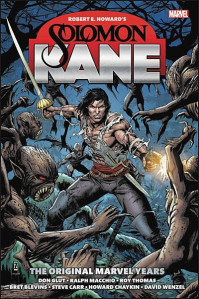
Due in July 2020, the 624-page collection Solomon Kane: The Original Marvel Years Omnibus, collecting all the Marvel comics featuring R.E. Howard’s Puritan adventurer.

I’m not keen on the cover. I guess it helps sales, though, since it makes him look vaguely like Conan or a generic pirate. But personally I’d walk straight past it and not recognise Solomon Kane the Puritan.

Also it seems you can no longer trust Marvel’s new reprints, as they’ve started censoring and pasting out things like Wolverine’s cigar. And probably other things now deemed ‘politically incorrect’. It’s a slippery slope. How long before tight shiny spandex, on slightly-too-curvy “boobs ‘n bums”, gets covered up under stick-on shrouds?

Anyway, I just took another look for the 2010 movie of Kane, hoping that by now there might be a longer Director’s Cut. A flop at the time, I seem to remember it was hardly released. I found it good entertainment but very choppy in the first half, as though large chunks had been hastily cut out. But no… it seems the 2010 theatrical release of the movie is all we have in 2020.

Literary Influences of Robert E. Howard

30 Monday Mar 2020

Posted by asdjfdlkf in Historical context, Odd scratchings, REH

≈ Leave a comment

Todd B. Vick has just launched a new blog series, “The Literary Influences of Robert E. Howard”, with the increasingly forgotten James Branch Cabell as the opener.

In his review, Howard calls Cabell the ablest writer of the present age. Along with many other readers back then, Howard was seized by Cabell’s command of the English language.

Carl van Vechten’s portrait of Cabell, 1935. B&W from the Library of Congress, but here newly up-rezzed, tweaked and colourised by me. View on a dark background and good monitor, to see the wooden cane in the lower half. Feel free to use for worthy projects.

DMR also recently had a short post Forefathers of Sword and Sorcery: James Branch Cabell which noted others influenced by Cabell…

Neil Gaiman counts JBC as his favorite author.

The Lovecraft-Barlow letters also reveal that Cabell was a key idol for Barlow. The Lovecraft-Bloch letters also indicate Bloch was an admirer, though perhaps less ardently that Barlow.

What of Lovecraft? He was more tepid. In 1920 he called Cabell a “real thinker”. But while judging most of Cabell’s fiction “sound and admirable”, and often with an enjoyable “light, witty, & sophisticated manner” and a fine ear for “prose rhythm”, for fantasy Lovecraft very much preferred Dunsany for his “genuine magic & freshness”.

He was distinctly sniffy about the politics, though, by 1935. To Bloch he wrote… “Cabell strikes me as a pale-pink Anatole France — with a lot less to say than his prototype had”. Pale-pink here seems to refer to Cabell’s politics. If one was ‘pink’ in the mid 1930s, one was a dupe or a fellow-traveller of the ‘reds’ (the Communist Party). Such people failed to know or recall that when ‘the revolution’ is in its early stages the intellectual comrade — the bookish guy with intellectual theories and a taste for poetry — is the one put up against the wall and shot by the thuggish element among his comrades. Still, even in a letter to Bloch of November 1935 Lovecraft can still be found lauding Cabell and overlooking his political foolishness. In this letter Lovecraft remarked that Cabell had… “one of the finest and maturest styles yet found in American prose”.

New book: Rattle of Bones

23 Monday Mar 2020

Posted by asdjfdlkf in New books, REH

≈ Leave a comment

I don’t normally feature Kickstarters, but I’ll make an exception for a sumptuous one-volume collection of Robert E. Howard’s horror stories. Rattle of Bones is “already fully funded” at $17k and is now adding the fancy trimmings.

“Traumas et conflits symboliques dans l’oeuvre de Robert E. Howard”

07 Saturday Mar 2020

Posted by asdjfdlkf in REH, Scholarly works

≈ Leave a comment

Patrice Louinet, Traumas et conflits symboliques dans l’oeuvre de Robert E. Howard (“Traumas and Symbolic Conflicts in the Work of Robert E. Howard”), a PhD thesis in French for the Sorbonne. Successfully defended 22nd November 2019, and now with a new record page online with English abstract…

“This study explores the fiction of Robert E. Howard [and] calls into question what is seen as the purely escapist nature of his tales and challenge the notion that his fiction is representative of the sub-genre he is considered to have initiated. [The thesis presents] the theory that Howard’s fiction is escapist only in the sense that it avoids writing about a traumatic episode dating from the author’s childhood. Focusing at first on apparently inconsequential details such as the characters’ names or the colour of their eyes, the present work identifies the literary traces and manifestations of the trauma we postulate, to reveal an elaborate, if hidden, architecture that informs the entire body of his fiction. This, in turn, offers new perspectives on Howard’s contribution to American fantasy and leads us to conclude that the very form of the genre proceeds from trauma.”

An Invitation to Cross Plains

06 Thursday Feb 2020

Posted by asdjfdlkf in Podcasts etc., REH

≈ Leave a comment

The Cromcast: An Invitation to Cross Plains. Departing from the usual story format, the podcast…

talks with Robert E. Howard super-fan, ‘Indy’ Bill Cavalier!

In the dark about The Dark Man

06 Thursday Feb 2020

Posted by asdjfdlkf in New books, REH, Scholarly works

≈ 2 Comments

Curious… Amazon UK and USA each have a listing for a paperback of The Dark Man: Journal of Robert E. Howard and Pulp Studies, issue 10.2, dated 15th December 2019. It appears to be live (not a pre-order) and available to purchase in paperback, but offers no table-of-contents and nothing else has appeared online about it.

Howard Days 2020

07 Tuesday Jan 2020

Posted by asdjfdlkf in Odd scratchings, REH

≈ Leave a comment

A new post from Robert E. Howard Days gives an early outline of the structure of Howard Days 2020. Sadly there’s no British delegation set to fly a classic 1930s airship across the Atlantic and land it in a field next to REH’s house, but apart from that it looks excellent.

The Black Stone

07 Tuesday Jan 2020

Posted by asdjfdlkf in Kittee Tuesday, Odd scratchings, REH

≈ Leave a comment

The Library of America selected a prime “R.E. Howard writes Lovecraft” story as their Free Story of the Week: “The Black Stone”. At the end of 2019 it proved to be at #5 in their end-of-year tally of their most popular stories.

Here it is in Weird Tales for November 1931.

The cover of this issue is also interesting. C.C. Senf provides a bristling black kittee that must have delighted the cat-loving Lovecraft when he saw the picture.

Issue Zero: “The Case for Conan The Barbarian”

20 Friday Dec 2019

Posted by asdjfdlkf in Podcasts etc., REH

≈ Leave a comment

In the new Issue Zero podcast, comics writer Fred Kennedy (The Fourth Planet, due Jan 2020) makes “The Case for Conan The Barbarian” in comics. He gives a potted history of Conan and makes the case that he’s a…

tragically underrated and misrepresented hero” in comics … “just like his creator” Robert E. Howard.

In related news, comics veteran Roy Thomas will be the guest of honour at the Robert E. Howard Days in Texas in 2020. While the covers of the latest Marvel Conan book looks iffy (Conan is apparently now running around in the far-future, with a high-tech cyber-sword…) you can’t fault the old Savage Sword of Conan runs from Marvel.

← Older posts
Newer posts →


Please become my patron at www.patreon.com/davehaden to help this blog survive and thrive.

Or donate via PayPal — any amount is welcome! Donations total at Easter 2025, since 2015: $390.

Archives

  • July 2026
  • June 2026
  • May 2026
  • April 2026
  • March 2026
  • February 2026
  • January 2026
  • December 2025
  • November 2025
  • October 2025
  • September 2025
  • August 2025
  • July 2025
  • June 2025
  • May 2025
  • April 2025
  • March 2025
  • February 2025
  • January 2025
  • December 2024
  • November 2024
  • October 2024
  • September 2024
  • August 2024
  • July 2024
  • June 2024
  • May 2024
  • April 2024
  • March 2024
  • February 2024
  • January 2024
  • December 2023
  • November 2023
  • October 2023
  • September 2023
  • August 2023
  • July 2023
  • June 2023
  • May 2023
  • April 2023
  • March 2023
  • February 2023
  • January 2023
  • December 2022
  • November 2022
  • October 2022
  • September 2022
  • August 2022
  • July 2022
  • June 2022
  • May 2022
  • April 2022
  • March 2022
  • February 2022
  • January 2022
  • December 2021
  • November 2021
  • October 2021
  • September 2021
  • August 2021
  • July 2021
  • June 2021
  • May 2021
  • April 2021
  • March 2021
  • February 2021
  • January 2021
  • December 2020
  • November 2020
  • October 2020
  • September 2020
  • August 2020
  • July 2020
  • June 2020
  • May 2020
  • April 2020
  • March 2020
  • February 2020
  • January 2020
  • December 2019
  • November 2019
  • October 2019
  • September 2019
  • August 2019
  • July 2019
  • June 2019
  • May 2019
  • April 2019
  • March 2019
  • February 2019
  • January 2019
  • December 2018
  • November 2018
  • October 2018
  • September 2018
  • August 2018
  • August 2015
  • July 2015
  • March 2015
  • February 2015
  • January 2015
  • December 2014
  • November 2014
  • October 2014
  • September 2014
  • August 2014
  • July 2014
  • June 2014
  • May 2014
  • March 2014
  • February 2014
  • January 2014
  • December 2013
  • November 2013
  • October 2013
  • September 2013
  • August 2013
  • July 2013
  • June 2013
  • May 2013
  • April 2013
  • March 2013
  • February 2013
  • January 2013
  • December 2012
  • November 2012
  • October 2012
  • September 2012
  • August 2012
  • July 2012
  • June 2012
  • May 2012
  • April 2012
  • March 2012
  • February 2012
  • January 2012
  • December 2011
  • November 2011
  • October 2011
  • September 2011
  • August 2011
  • July 2011
  • June 2011
  • May 2011
  • April 2011
  • March 2011
  • February 2011
  • January 2011
  • December 2010
  • November 2010
  • October 2010
  • September 2010
  • August 2010
  • July 2010

Categories

  • 3D (14)
  • AI (74)
  • Astronomy (70)
  • Censorship (14)
  • de Camp (7)
  • Doyle (7)
  • Films & trailers (101)
  • Fonts (9)
  • Guest posts (2)
  • Historical context (1,096)
  • Housekeeping (91)
  • HPLinks (91)
  • Kipling (11)
  • Kittee Tuesday (92)
  • Lovecraft as character (58)
  • Lovecraftian arts (1,637)
  • Lovecraftian places (19)
  • Maps (71)
  • NecronomiCon 2013 (40)
  • NecronomiCon 2015 (21)
  • New books (972)
  • New discoveries (165)
  • Night in Providence (17)
  • Odd scratchings (984)
  • Picture postals (277)
  • Podcasts etc. (431)
  • REH (188)
  • Scholarly works (1,476)
  • Summer School (31)
  • Unnamable (87)

Get this blog in your newsreader:
 
RSS Feed — Posts
RSS Feed — Comments

H.P. Lovecraft's Poster Collection - 17 retro travel posters for $18. Print ready, and available to buy — the proceeds help to support the work of Tentaclii.

Proudly powered by WordPress Theme: Chateau by Ignacio Ricci.