• About
  • Directory
  • Free stuff
  • Lovecraft for beginners
  • My Books
  • Open Lovecraft
  • Reviews
  • Travel Posters
  • SALTES

Tentaclii

~ News & scholarship on H.P. Lovecraft

Tentaclii

Category Archives: Picture postals

Friday picture postals from Lovecraft: the New York Public Library

05 Friday Apr 2019

Posted by asdjfdlkf in Historical context, Picture postals

≈ Leave a comment

This is the third in what is becoming a short series of postings on Lovecraft and the bookstores and libraries of New York City. I’m developing another chapter for a future new expanded edition of my Walking With Cthulhu book, it seems.

“… bidding the Longs farewell at the 96th St. station I proceeded forthwith to the Public Library in 42nd St. — where [as you will remember, on previous occasion] we saw the manuscripts — to read a new Arthur Machen tale, The Shining Pyramid, obtainable there but not removable from the building.” — H.P. Lovecraft, May 1925.

Here is the Library exterior seen in a rare postcard from approximately street view, whereas most postcards show a bird’s-eye view…

I think the background tower here is The Empire State Building, completed 1931, so it wouldn’t have been towering over the scene as Lovecraft approached the Library in 1925.

Let’s accompany Lovecraft into the building and up to the Reading Room. Lovecraft approaches the entrance frontage from approx. street level…

He knows the entrance well. Here’s the entrance as it was in winter, 1927…

And here’s a view on the entrance that Lovecraft would likely have been familiar with, on ascending the steps…

I’m uncertain if he borrowed books from here, as apparently the Circulation shelves / issuing desks tended to become very crowded…

The 1916 Handbook notes of the postcard picture (above) of the Circulation room…

“Central Circulation Branch (sign over door reads, “Circulating Library”). This is one of the forty-four Branches of The New York Public Library, intended for the circulation of books for home use. In this instance alone the Branch is situated in the Central Building and is supported by the funds of the Library and not by the City. The room is interesting because of its activity. The view of it reproduced in this book had to be taken when but few people were there, but during afternoons and evenings, especially in the autumn, winter, and spring months, the room is frequently over-crowded with readers and borrowers of books.” (my emphasis)

Thus he may have been relatively unfamiliar with the lending library, and passed it by. But possibly he often stopped off at the Exhibition Hall for temporary shows, the Exhibition Hall apparently being on the First Floor. The entrance to it is seen here during wartime…

I don’t know of any conveniently dated listing of exhibitions held here in the 1920s and 30s, by which we might see if any would have especially appealed to Lovecraft and his circle.

But let us assume that, on this day, Lovecraft merely looked over the notices and posters for forthcoming exhibitions and then continued walking up to the third floor and the Reading Rooms…

Given its contents such as American History, Genealogy, Maps, Manuscripts, and small Art and Exhibitions rooms, this is likely to have been a frequent haunt of Lovecraft.

This was the Third Floor Hall, onto which the stairs from the lower floors (seen in the picture) emerged…

Given his constitution he may have rested after climbing all those stairs. Either on the rather chilly stone benches seen above, or on the more warm looking benches in the Picture Gallery…

And then, in one of the wings of the Reading Room Lovecraft, most likely read “The Shining Pyramid” by Machen…

Of course, in May 1925 and later the building would have been far more crowded than shown above.

Having left the building, he might have walked away through the park at the side of the Library…

Though the library closed late, and in May it may have been dark by the time he departed.


Here he is on the “Publick Library” in September 1925, having discovered and closely perused a book there on Providence history, again on the Third Floor of the library…

“Belknap now took an omnibus home, whilst the Old Gentleman kept on walking toward the Publick Library. Having reached that haven, I proceeded to the lair of the Kimball book [he read this… “At the northern end of the Main Reading Room i[n] the room devoted to Local History and Genealogy (No. 328).”] The closing bell drove me forth from Providence to the garish terraces of Babylon at 10 p.m.”

Without actually looking up the details, I’d fairly sure he also drew on the New York libraries for the book The Cancer of Superstition for Houdini. He did the same for his own Supernatural Horror in Literature. While that intensive library-work is beyond the scope of this short blog post, we can assume he delved quite deeply into the Public Library’s arcana. Lovecraft was not then familiar with the ways and devices of heraldry, and he was only later introduced to the details of the art by a friend in the genealogy section of the Providence Public Library.

Today the main “Publick Library” in New York City has strong collections on esoteric magic, spiritualism and witchcraft, divination and Theosophy, as well as a nationally important archive of Lovecraft letters.

Friday picture postals from Lovecraft: Schulte’s Book Store

29 Friday Mar 2019

Posted by asdjfdlkf in Historical context, Picture postals

≈ Leave a comment

Schulte’s Book Store was at 80 – 82 Fourth Avenue on ‘Booksellers’ Row’ in New York City. Here is Lovecraft writing home, about being unable to resist bagging a 10 cent collection from the store, despite his growing poverty…

“[…] Here I’ll have to admit a fall from grace so far as non-purchasing is concern’d, for a great volume of Bulwer-Lytton, with most of the weird novels complete — Zanoni, A Strange Story, and The House and the Brain — for only ten cents, proved a fatal bait; and I departed from the Schulte Emporium with less in my pocket and more in my hand. But only a dime, remember!” — from a Lovecraft letter of 20th May 1925.

The store was on a ‘Booksellers’ Row’ in the city. That name was first applied to the old Bookseller’s Row, near “St. Clement’s Dane Church in the Strand”, reportedly pulled down in 1903 at which time the New York Observer report it… “is now a mass of fallen and misshapen walls in process of removal, the lime-laden dust pervading the historic atmosphere.” Fourth Avenue then appears to have become the new ‘Booksellers’ Row’ perhaps circa 1911 and was a New York fixture until the 1960s, with a few stores hanging on into the 1970s. Ephemeral New York has a good short article on “Fourth Avenue’s Book Row”.

Schulte’s is seen at the lower end of the above map and was run by Theo Schulte, and from 1925 also by his new business partner Philip Pesky. They had a crowd of bookish boy assistants, and shipping packers in the packing room, all eager to learn the trade. It was the sort of place where Binkin, later to buy a huge Lovecraft collection and hence recall that Lovecraft had once patronised his book store, might have started off in the trade — and thus seen Lovecraft’s face on a regular basis in the 1920s.

By 1938 the store’s magazine adverts had it that the store… “invites you to browse among their interesting stock of over 500,000 used books.” (Saturday Review of Literature). A 1939 Harper’s Bazaar profile had it that the store was located “in about the most Victorian section of New York”. It was also well known that Schulte was always willing to buy good books that one had finished with.

There’s no interior photography that I can find online, but there are two evocative passages that describe the interior experience of the store as it would have been had by Lovecraft and his circle…

“Schulte was the eminence grise of the book trade … His shop at 80 [and 82] Fourth Avenue was legendary. Like the other bookstores, it had a large sidewalk stock out front, where you can choose for your pennies, tomes in old—fashioned binding and printing. But inside, behind front windows that proclaimed it LARGEST SECOND HAND BOOKSTORE IN NY, it was uniquely impressive with a huge main floor, tall balconies, and a cavernous basement. It was also well stocked. “Inside,” according to Guido Bruno’s Adventures, “are shelves laden with books in delightful disorder left by the book-hunter who looked through them before you. So large was the place that the staff could not keep up with all the action: shoppers were responsible for switching on and off the bare bulbs that lighted the alcoves and labyrinthine paths of the store.” (from Thieves of Book Row: New York’s Most Notorious Rare Book Ring).

By the 1960s it had less books than the 500,000 of its heyday, and Mr. Schulte had passed on in 1950…

“Surveying its barn-like main floor, its basement and three-sided balcony, an awestruck customer called Schulte’s “a great amphitheater” in which there seemed to sit “arranged all the books that were ever penned.” When I visited it, every stair step and nearly every floor board in the place creaked with nearly every footfall, but there were 140,000 books on its shelves, and, if a person could not find what he wanted, there were these lines to reassure him: “The Mounties always get their crook! And Schulte’s always get their book,” in proud, if flawed, poesy. If there wasn’t enough on the main floor, it was upstairs to Asia, Africa and Religion, two land masses leading on to infinity — up there amid pipes and low-hanging bare light bulbs, which customers turned on and off as they moved from section to section. Tables were heaped with books in stacks running thirty high and, if you saw a title that looked tempting near the base of a stack, it was quite a trick to slip it out without spilling a tower of books.” (from McCandlish Phillips, City Notebook).

Incidentally, amazingly it was Lovecraft who in 1922 had introduced the New York native Frank Belknap Long to the second-hand bookshops of New York. Not the other way around.

Friday picture postals from Lovecraft: Roger Williams Park, Providence

22 Friday Mar 2019

Posted by asdjfdlkf in Historical context, Picture postals

≈ 2 Comments

Two postcard plans of Roger Williams Park, Providence. Here’s the first. This card is from about 1907, and thus indicative of the park which Lovecraft would have known as a boy…

I can just about read the words, and can spot things like a “Dutch Garden”. Which is a distinctive garden form also appears in “The Lurking Fear”, forming the setting for the “deserted mansion”. The distinctive garden form is, as I wrote in a footnote to my annotated “Lurking Fear”…

“A rectangular formal garden laid out with angular geometric sunken paths, creating a densely packed atmosphere. Often planted with Dutch tulips and other vivid and erect flowers, and with a rectangular sunken pool in the centre.”

One also has to wonder if the riding of the zebra in Lovecraft’s Dream Quest might not be some distant reflection of his boyhood desire to ride the zebra on the Park’s merry-go-round…

There was also a bandstand. S.T. Joshi notes that… “There is a curious letter to the editor of the Providence Sunday Journal for August 3, 1913, complaining of the inadequate seating for band concerts at Roger Williams Park (the letter suggests that Lovecraft was a frequent attendant of these concerts)” — I Am Providence.

A later letter reveals that he went there with family, in his grandfather’s time…

“I had just as good a time as I ever used to have in youth listening to the concerts of Reeves’ American Band at Roger Williams Park with my grandfather. Old days …. old days……”

“Reeves’ American Band from Providence”, 1902.

These would have been the faces an eleven or twelve year old Lovecraft would have seen playing their instruments in the Park. His own group of friends occasionally formed their own amateur Band, with penny whistles and zithers and the like, presumably in juvenile emulation of the Park band.

At about this time he was also a keen bicyclist, and evidently bicycling was permitted in the Park…

This was posted 1906, so might have been photographed a few years earlier, making the boys in the picture about Lovecraft’s age.

He also wrote that he had visited a ‘cosmic’ exhibition at the Museum there, c. 1916…

“There is now on exhibition at the museum of Roger Williams Park a remarkable collection of astronomical photographs, taken by the celebrated Prof. Percival Lowell of Flagstaff, Arizona, whose theories concerning [‘canals’ on] the planet Mars are so widely known. The pictures are in the form of glass transparencies, exhibited in a darkened room, and illuminated from behind, so that they stand out with vivid clearness”.

Evidently Lovecraft later had some correspondence with the Museum Director, on his return to Providence from New York. The “History of the Necronomicon” is partly written on the back of a 27th April 1927 letter to Lovecraft from William L. Bryant, the Director.

Here are some pictures of the animals in the interior of the Museum. Note the lobster and sea-things in jars and bottles…

He was also amused by the various exotic animals to be seen alive in the grounds of the Park. For instance, he once commented on a photo of himself…

“Note the proboscidian effect,” [meaning his large nose, in his photograph of him made by Robert Barlow] he said, “my only local rival in that field being the elephant at Roger Williams Park. Keep this curio if it’s of any use — I ordered six prints from Barlow.”

He also investigated the new Benedict Monument to Music in the Park, dedicated in September 1924, which had been built while he was away in New York City…

“I took the [trolley] car for Roger Williams Park to search out that new classick marble temple which I had never seen…”

He writes that he was moved to ecstasy by the austere classical style and quiet setting of this acoustic stage for musical performances…

“All visible objects [were] the hushed and tenantless greensward, the piercing blue of sky and water, the gleaming and half-erubescent whiteness of the towering temple itself combin’d with the background of translacustrine forest and the warmth and magick of mid-spring to create an atmosphere of induplicable fascination, and even of a kind of pagan holiness.” — quoted by L. Sprague de Camp in Lovecraft: A Biography.

Here is the second map of the Park, a two-tone postcard probably from the 1930s. Note the dragon in the top-right, next to a male peacock. Was there a dedicated lizard-house, or does this simply indicate the Menagerie house?

Lovecraft still visited and strolled the Park at this point, in summer, as one of his letters for 30th July 1933 is headed from “Bench in Roger Williams Park”.

Friday picture postals from Lovecraft: un-tarred Brattleboro back-road to the mountain

15 Friday Mar 2019

Posted by asdjfdlkf in Historical context, Picture postals

≈ Leave a comment

“The kinship and hospitality of the Main Street [of Brattleboro] spread over us, and encourage us to climb higher into the charmed sea of westerly greenness to which these atavistic bricks form pylon and peristyle. The wild hills are before us […] Narrow, half-hidden roads bore their way through solid, luxuriant masses of forest, among whose primal trees whole armies of elemental spirits lurk.” — H.P. Lovecraft, “Vermont: A First Impression” (September 1927).

Lovecraft’s friend and fellow amateur pressman Arthur H. Goodenough lived near Brattleboro, hence Lovecraft came to know the place quite well on several visits. He also visited with Vrest Orton, also near Brattleboro.

The local history Brattleboro Words project also has…

“I’ve never seen no country niftier than the wild hills west of Brattleboro,” Lovecraft wrote to a friend. “The nearness and intimacy of the little domed hills become almost breathtaking. Their steepness and abruptness hold nothing in common with the hum-drum standardized world we know, and we cannot help feeling that our outlines have some strange and almost forgotten meaning.”

The full quote, uncensored by political correctness, is as follows. Lovecraft starts off in contemporary slang…

“I never seen no country niftier than the wild hills west of Brattleboro, where this guy hangs out. Brat itself is the diploduccus’ gold molar, with its works of pristine Yankee survival, but once you climb the slopes toward the setting sun you’re in another and an elder world. All allegiance to modern and decadent things is cast off — all memory of such degenerate excrescences as steel and steam, tar and concrete roads, and the vulgar civilization that bred them —”

The nearness and intimacy of the little domed hills become almost breath-taking — their steepness and abruptness hold nothing in common with the humdrum, standardized world we know, and we cannot help feeling that their outlines have some strange and almost-forgotten meaning, like vast hieroglyphs left by a rumoured titan race whose glories live on in rare, deep dreams.”

Friday ‘picture postals’ from Lovecraft: The Endless Caverns

08 Friday Mar 2019

Posted by asdjfdlkf in Historical context, Picture postals

≈ 1 Comment

In his “Observations on Several Parts of America” (written summer 1928) Lovecraft gives a vivid account of his summer excursion… “westward to the Endless Caverns.” He ventured out to these famous caves on a very long train journey of around four hours…

“But the climax of the whole Odyssey was my excursion, by train, to the Endless Caverns in the exquisite Shenandoah Valley. Despite all the fantasy I have written concerning the nether world, I had never beheld a real cave before in all my life…”

S.T. Joshi states in I Am Providence that this was a bus excursion, but Lovecraft clearly states “train” in the above quote. A further Lovecraft quote reveals that a motor coach was used for only a short part(s) of the journey…

New Market was reacht after a four-hour [scenic train] ride, and a coach took the sightseers to the mouth of the actual caverns, some six miles away.

Lovecraft had been lured out there by the rather cheap $2.50 fare, the prospect of a scenic ride during lovely summer weather, and most probably also by the travel brochure leaflets he picked up in Washington. The following samples were obtained in 1931, and have a number of pages that detail the tour Lovecraft must have experienced. His account is to be found in the Travels volume of Collected Essays, where it forms part of “Observations”. Also a slightly different 1929 article form, which is printed at the back of the Travels volume and titled ‘Descent…’.

One can see how such a grand guignol brochure design might have immediately appealed to his sense of the macabre. Nor was not disappointed in what he later called this “subterrene world of wonder!”, stating that the advance publicity contained not the slightest lie.

Possibly these free brochures, or ones very like them, were what he called “the booklets to which I have given such wide circulation” to his friends in the mail, which are mentioned in the essay. One imagines they were freely given out in bundles at the caves, for visitors to distribute to friends and family and thus draw in more tourists (the cave owners conveniently also owned the Eastern Printing Corporation). Lovecraft thus appears to have used these in place of sending postcards of the caverns to his friends. At that time there was no Post Office at the caves, and presumably the tour did not delay at the railway halt, so it seems unlikely he was able to send any postcards from the caves or their visitor centre.

Though Lovecraft did not visit the other nearby attractions pictured in the paper brochure seen above…

I wished that I might visit the Luray and Shenandoah Caverns, not far from New Market; but the schedule of the excursion did not permit of it.

He had been fascinated by caves since childhood and one of his earliest boyhood attempts at a story, “The Beast of the cave”, was set in the real Mammoth Cave, Kentucky. On which he had presumably ‘read up’ and seen pictures.

In 1928 his first ever underground tour of an actual deep cave lasted “over an hour”. While it’s true that Lovecraft had previously and rather trepidaciously entered a cave-like cleft, for a few yards only, in the Bear’s Den in July 1927, that hardly counted as a cave compared to what he now encountered. Lovecraft hung back from his Endless Caverns tour-party as much as the rear guide would let him, which is understandable on such tours. Since one uniquely sensitive to sublime vistas and eerie shadows would naturally wish to be somewhat away from from the bright lighting, the lecturing voice of the tour guide, and the inane comments and chatter of his fellow visitors.

The best photography of the caves from the period looks like it might be found in this 1925 history/geology booklet, though the title is not on Archive.org…

Art folio of the Shenandoah Valley (1924) does however give two good pictures, among a general survey…

He might have been rather scared. It is difficult to imagine Lovecraft, master of fear, feeling it for real. Yet he admitted that…

Of the celebrated “phobias” of the modern psychologists (or of things like them) I have only one; & that, amusingly enough, is one I have never seen cited or named. Probably it has a name & record, but my very superficial knowledge of psychology (a subject which fails to fascinate me greatly, despite its grotesque fictional possibilities) does not include any glimpse of it. I know about claustrophobia & agoraphobia, but I have neither. I have, however, a cross betwixt the two — in the form of a distinct fear of very large enclosed spaces. The dark carriage-room of a stable — the shadowy interior of a deserted gas-house — an empty assembly-room or theatre-auditorium — a large cave — you can probably get the idea. Not that such things throw me into visible & uncontrollable jittery spasms, but that they give me a profound & crawling sense of the sinister — even at my age. I’m not sure of the source of this fear, but I believe it must link up somehow with the black abysses of my infant nightmares.

I would imagine that something of Lovecraft’s experience later emerged in a filtered fictional form, in the exploration depicted by Lovecraft in “At the Mountains of Madness”. The caves also appear to the reader in more recognisable form in “The Shadow Out of Time”…

I was given charge of my funds, and spent them slowly and on the whole wisely, in travel and in study at various centres of learning. My travels, however, were singular in the extreme, involving long visits to remote and desolate places.

In 1909 I spent a month in the Himalayas, and in 1911 roused much attention through a camel trip into the unknown deserts of Arabia. What happened on those journeys I have never been able to learn.

During the summer of 1912 I chartered a ship and sailed in the Arctic, north of Spitzbergen, afterward showing signs of disappointment.

Later in that year I spent weeks — alone beyond the limits of previous or subsequent exploration in the vast limestone cavern systems of western Virginia — black labyrinths so complex that no retracing of my steps could even be considered.

It was only in 1922 that part of the Endless Caverns had been equipped for safety, with miles of electric cables and bright lighting, and opened to public tours. Thus in 1913, as Lovecraft has it, they would indeed have been “black labyrinths”. Lovecraft’s “no retracing of my steps could even be considered” implies that these labyrinthine caves were escaped, and thus that an ‘end’ had been found in some far and secret exit to the outside world.

Yet in reality this vast cave complex has apparently still not been fully mapped even today, and at present is known to extend for five and a half miles. While the Endless Caverns cannot geologically be quite endless, nevertheless their labyrinthine nature means that they are in effect an endless experience for those who descend and foolishly seek to explore off the tourist trails.

Friday ‘picture postals’ from Lovecraft: The Biltmore

01 Friday Mar 2019

Posted by asdjfdlkf in Picture postals

≈ Leave a comment

I imagine that people are making their hotel bookings about now for NecronomiCon. So here are two evocative postcards showing the main hotel which will host the NecronomiCon 2019 Lovecraft convention. One could almost imagine that the fellow in the drawing might be the Old Gent himself, perhaps taking a close look at the pigeons to check for signs of Yuggothian tendencies.

The hotel opened in 1922. While it may seem unlikely that Lovecraft or his friends ever lounged in the lobby here, one can imagine Frank Belknap Long’s affluent family staying there overnight. Though I know of no evidence that they did. A Spanish text I have suggests that when Barlow was travelling with his family they stayed in this level of hotel. But again, I know of no evidence they ever came with Barlow to Providence.

Possibly Lovecraft was more familiar with the park adjacent. It looks like the sort of place where one might have a pleasant wait away from the crowds, if a train was heavily delayed. Or could have served as a place to sit out with friends, while they recovered from their train journey enough to walk up the hill.

The hotel is briefly mentioned by Lovecraft in “Dexter Ward”, when Lovecraft evokes in fiction his own homecoming to Providence from New York…

“his head swam curiously as the vehicle rolled down to the terminal behind the Biltmore … It was twilight, and Charles Dexter Ward had come home.”

Friday ‘picture postals’ from Lovecraft: Prospect Terrace

22 Friday Feb 2019

Posted by asdjfdlkf in Picture postals

≈ Leave a comment

“the mystic sunset flaming beyond the antient Baptist steeple, the narrow colonial hill streets with their fanlights & double rows of steps, & the great outspread sea of roofs & domes & spires leading off to the purple western hills as glimpsed from old Prospect Terrace? Zeus! the charm & mystery of the violet early evening, when the lights of the ancient city below began to twinkle forth one by one! […] Why, Sir, modernity cannot exist for one who has really gazed upon the elder world!”

“the sunset, seen beyond the mystical spires and domes of the lower town from Prospect Terrace, always fill[s] me with a curious sensation of opening gates and about-to-be-revealed wonders”

“What I want [is] a seclusion amidst ancient scenes wherein I may cast off the actual modern world in a quiet round of reading, writing, & pilgrimages to quaint & historick places. I want to dream in an atmosphere of my childhood — to sit on Prospect Terrace with an old book or a pad & pencil in my hands.”

Friday ‘picture postals’ from Lovecraft: Sheepshead Bay, NYC

15 Friday Feb 2019

Posted by asdjfdlkf in Historical context, Picture postals

≈ 1 Comment

The dyke and spillway at Sheepshead Bay, New York City. Presumably the open sea is on one side, hence the spray of the waves hitting the breakwater, and a low semi-tidal salt-marsh bay is on the other side.

This appears to be the southernmost extremity of a watery landscape that H. P. Lovecraft discovered rather early in his encounter with New York City, because Dench had his home there…

Dench’s [home on Emmons Ave. was a regular amateur press meeting-place, and was located] by the old, curious wharves of Sheepshead Bay [near the old Dutch marsh country, that being] “the vast, low-lying flat lands and salt marshes of Southern Brooklyn; where old Dutch cottages reared their curved gables, and old Dutch winds stirred the sedges along sluggish inlets brooding gray and shadowy and out of reach of the long red rays of hazy setting suns.

Emmons Ave., Sheepshead Bay, in 1931, showing how it fronted the wharves and jetties. John Milton Heins’s “Face to Face with Amateur Journalists” (1920 reprinted in The Fossil #333 from The American Amateur) reveals a few more details of the Dench house, confirming that it was directly on the shoreline… “Sheepshead Bay in a bungalow, on the water front”. In Lovecraft’s time this waterfront was a busy working place, and in the season boats were eagerly hired by sports fishermen and hunters. The following two maps show the Sheepshead Bay shoreline frontage in broad relation to Fulton St. and Prospect Park, and the flatlands to the north. The detailed topographical maps shows the exact location of the Sheepshead Bay shoreline frontage on which Dench’s house was located, and the proxity to the named “Flatlands” settlement and its wide marshland surroundings. One can see why the area provided New York City with such excellent fishing and duck-hunting.

Almost the entire Long Island shoreline was once salt-marsh flatland and swamps. By Lovecraft’s time most of this was long gone, but the New York City Guide of 1939 reported a settlement called the ‘Flatlands’ remained and that… “Much of the southern section [of this] is unreclaimed marshland” with a population of rough squatters and fishermen. Lovecraft’s “vast, low-lying flat lands and salt marshes” of the 1920s thus appear to have run south of the settlement of Flatlands toward Sheepshead Bay, with “Bergen Beach” being mentioned by the Guide as an especially bleak place: “At Bergen Beach, the brooding silence of the dour marshland hangs over old houses and shanties”.

This watery landscape had originally drawn Dutch settlers because it reminded them of the very similar fenland country in Holland, and they knew how to work it and what could be got from it. By Lovecraft’s time it seems that the Dutch had mostly moved on and up in New York society, but their relics remained and continued to fascinate him. For instance Lovecraft’s self-parodying story “The Hound” arose in September 1922 after… “I had been exploring an old Dutch cemetery in Flatbush, where the ancient gravestones are in the Dutch language”. He had chipped a small piece off a Dutch gravestone…

I must place it beneath my pillow as I sleep… who can say what thing might not come out of the centuried earth to exact vengeance for his desecrated tomb? And should it come, who can say what it might not resemble?

It is likely that Lovecraft first knew the marshland area through walks there in the company of his fellow writer Everett McNeil. Seemingly in Autumn 1922, when they likely used Dench’s nearby house in Sheepshead Bay as a base. Possibly this large marshland area was not fully explored by Lovecraft in 1922. Nor during his later New York residency, unless perhaps you count as evidence the briefest vision of a pre-New York landscape in the story “He”… “in the distance ahead I saw the unhealthy shimmer of a vast salt marsh constellated with nervous fireflies.”

But the area and its Dutch heritage certainly fascinated Lovecraft. He continued to visits Flatbush for walks (for instance in August 1925), and drew heavily on his historical knowledge of the New York Dutch in “The Horror at Red Hook”. In 1928, when he briefly returned to New York, he spent much time intensively researching the Flatbush area, to seek out the most ‘antient’ buildings in the flatlands and other rare survivals from colonial times that might still lurk there. This project included venturing out (seemingly for the first time?) to the old tidal-mill called Gerritsen Mill…

Being oblig’d by circumstances to spend above a month and a half, last spring [Spring 1928], in the town of Flatbush, near New-York, in the province of that name, I resolv’d to make my sojourn pleasant by means of such observations of good scenery and historick monuments as the nature of the region permitted. […] My stay in Flatbush was chiefly notable for my discovery, thro’ diligent searching of many books, of several objects of much antiquity which I had never discover’d before. The western end of Long-Island, in which the village [of Flatbush] is situate, was settled by Hollanders at a very early date; and so widely scatter’d were their architectural constructions, that a surprising number have surviv’d to the present time amidst surroundings more and more incongruous. […]

But most of my late explorations dealt with those parts of the country south of the village; once very open and sparsely settled, but now fast spoilt by cheap streets and the cottages of an hybrid foreign rabble. On the 19th of May I made a trip to that part of Jamaica Bay call’d the Mill Basin, there seeing for the first time the Jan Schenck house, built in 1656 from the timbers of a privateer [ship], and reputed to be the oldest house in the entire province of New-York. This house, an old Dutch cottage with steep peaked roof, is situate on a flat tidal marsh near the shoar […]

On still another occasion I visited the old Gerritsen Tide Mill on a creek south of Flatbush. This was built in 1688, and a dam made at the same time still confines the rising waters of the sea. The wheel is in a good state, though the building itself hath suffer’d considerably since its abandonment near forty years ago. […]

Further explorations in Flatbush, Flatlands, New Utrecht, and related regions yielded many highly picturesque glimpses of old farmhouses, churches, churchyards, and other reliques of better days.

The Mill in 1922, as Lovecraft would have known it.

The newspaper cutting above is from 1934, after Lovecraft’s time as a resident in New York. A grand 1930s mega-scheme was afoot and intended to drain the marshes for a vast new leisure-park. The Gerritsen Mill might have been part of that, but it was conveniently burned down shortly after its restoration was announced. The scheme never happened, and New York got a wildlife preserve instead. But the burning was a small incident in a vast web of local corruption which grew around the draining and reclaiming of the swamps and marshes of the eastern USA in the 1890s-1930s period.

Lovecraft does not mention a boat, which at that point he presumably could not afford to hire, and which one would assume (from looking at the maps) would have been necessary to fully explore the area and reach the remotest homesteads. He was likely restricted to roads, tracks and trolley-buses.


Did the area have an influence on Lovecraft’s fiction? It seems doubtful, and even if it did then the influence is certainly not now provable.

i) One might wonder if perhaps the marshes vaguely contributed something to the general atmosphere of “Innsmouth” (written some three years later). But Lovecraft had known marshland (Cat Swamp) and wild creeks (the York Pond ravine) intimately in middle-childhood, and a number of swamps and marshes had been investigated during his adult travels and visits. Marshes at places such as Ipswich, Mass. may have more of a claim to have inspired those of “Innsmouth” — there is for instance an early 1917 Lovecraft poem “On Receiving a Picture of the Marshes at Ipswich” and Ipswich is very frequently mentioned in “Innsmouth”, albeit never in direct connection with marshes. Lovecraft instead re-positions his marshes to surround Innsmouth itself, and his… “wide salt marshes, desolate and unpeopled, keep neighbours off from Innsmouth on the landward side.” Although the narrator’s later wide views of the Innsmouth terrain do seem to hint that this marshland stretches away very extensively, perhaps even reaching nearly to the nearby Ipswich. That said, there are many salt-marshes on that 20-mile stretch of coast and they appear to occur all the way from Newburyport down to Gloucester. While these might have been picturesque in their own way, especially when surveyed from a hill or train, they appear to have been purely rural and thus lacked the enticingly ‘antient’ architectural elements that Lovecraft sought in Flatbush and the Brooklyn flatlands…

ii) There is a familial name-link with the Gerritsen Mill in the Brooklyn flatlands, as readers will remember that in Lovecraft’s “The Horror at Red Hook” the hero-villain Suydam marries a Cornelia Gerritsen. But the Gerritsen name had by then spread far and wide in New York.

iii) Some might even wonder about the impact of Lovecraft very probably getting inside a number of ancient primitively-built Dutch barns, in his intensive 1928 exploration of rural Flatbush — and how that might have influenced his central use of the barn in “The Dunwich Horror” (written some months later in August 1928)…

One also recalls that it is from the Wilbraham “marshland” that the memorable whippoorwills of that story came…

there are stretches of marshland that one instinctively dislikes, and indeed almost fears at evening when unseen whippoorwills chatter and the fireflies come out in abnormal profusion to dance to the raucous, creepily insistent rhythms of stridently piping bull-frogs.

iv) Interestingly, there was also local Sheepshead lore of a sea-monster. This was deemed to lurk a little way off the shoreline, but was surprisingly little-seen. This may, for some, recall the general idea of “The Horror at Martin’s Beach”. In the postcard seen below their local monster appears in a humourous photomontage of the time…


For those wondering about the Sheepshead placename, apparently it has nothing to do tasty mutton dinners — “Sheepshead” is simply the name of an abundant type of local edible fish, which gave its name to an early hotel, and thus the area was named.

A memoir of child-life out on the salt-flats, Thomas J. Campanella’s “The Lost Creek”, evocatively recalled this landscape as…

An incursion of nature into the cast grid of the city, Gerritsen is a relic landscape, a counterpoint to the artificiality of its surroundings. The rolling hummocks wear a soft, wind-tossed mane of reeds, and here and there thickets of aspen, sumac and bayberry punctuate the scene. Ring-necked pheasants, descendants from flocks released for a hunting estate in the nineteenth century, dart between clumps of phragmites [very tall densely-packed water-reeds]. Far off to the northwest the peaks of Manhattan are surreal, the tilted bedrock of an alien world. The steady hum of motors on the Belt Parkway recedes. The deep tide of time casts its spell.

As for Lovecraft, a 1931 letter to Morton (Selected Letters III) sees Lovecraft riffing through several pages of Kerouac-like ‘stream-of-consciousness’ word-associations, due to having eaten a tasty dish of roast lamb. His intent here is to convey to Morton the richness than can be obtained by simply musing on what one already knows, rather than using a mealtime to peruse a mundane newspaper in search of new ‘facts’. Lovecraft’s plate of roast lamb yields, among other fleeting cerebral associations…

Sheepshead Bay …… Emmons Ave. [Dench lived at 3052 Emmons Ave., Sheepshead Bay] …… stink of fish ….. Gerritsen Tide-mill 1688 … Avenue V . …… Neck Road .. ….. Stillwell House . . … Milestone. .. 8 miles to Brockland Ferry … flat marshlands, creeks, waving sedge, flutter of marsh birds .. .. .. curved cottage roofs … . east winds sighing of Old Holland .. … mutton-chop whiskers …. Victorian aera

“8 miles to Brockland Ferry” indicates the lore-haunted inscription on the old milestone in front of the Voorhees homestead in Sheepshead Bay, on the corner of Neck Road and Ryder’s Lane. Thus we can be fairly sure the Voorhees house was encountered on Lovecraft’s Flatbush itinerary, along with many others. Many of these old houses were photographed in ways that do not suggest their landscape/shoreline context, but the Schenck House is an evocative exception…

Lovecraft’s recall of “mutton-chop whiskers …. Victorian aera” also suggests he may have met old Dutch men on his walks, men who still held to their homesteads and to the old Dutch manner of appearance and dress — albeit probably having abandoned their clog-wearing by that time…

Elsewhere the letters to Morton also give a strong indication that it was Everett McNeil who made Lovecraft aware of this unusual local waterscape, mostly likely in the early 1920s when Lovecraft was visiting rather than living in New York. He writes of McNeil in 1929, on learning of the old man’s death, and strongly links McNeil with the landscape by recalling the early 1920s and…

the vast, level reaches of the old Dutch marsh country around Sheepshead Bay, brooding with elder mystery in the autumn gloaming, and with the winds of old Holland’s canals blowing the sedges that waved and beckoned along strange, salty inlets. […] Through those fantastic streets, along those fantastic terraces [of New York City], and over those fantastic salt marshes with the waving sedges and sparse Dutch gables, the quaint, likeable little figure may continue to plod… phantom among phantoms…

The mention of “autumn” here might place the first walks into the marshlands, with McNeil, quite near in time to Lovecraft’s September 1922 exploration of the Flatbush churchyard that led to “The Hound”.

Lovecraft and McNeil would surely be pleased to know that the U.S. Army is currently putting the finishing touches to a decades-long restoration of 180+ acres of the old salt-marshes, meaning that a substantial part of the once “vast” flatlands have survived in a form that the two men would recognise.

Friday “Picture Postals” from Lovecraft: in the John Hay Library

08 Friday Feb 2019

Posted by asdjfdlkf in Picture postals

≈ 1 Comment

Inside the John Hay Library, Brown University.

Lovecraft writes to Morton in April 1933 of his new quarters, that it…

lies in a delightfully grassy, secluded, and and-whereish court off College Street on the crest of the antient hill behind the John Hay Library. It is owned by the college, and heated by steam piped from the library.

“and-whereish”, assuming it is not a mis-transcription for ‘any-whereish’, seems at first glance to indicate that the shared garden between his new house and the adjacent boarding house was the sort of nook that was difficult to find for the first time. Which it was, as one can see here…

But a little research suggests that Lovecraft may have been implying a land-locked ‘little kingdom’? What appears to be a story in The Virginia Reel (1925) records… “the land-locked kingdom of Whereish”, presumably a sort of Gulliverian land? However, I can find no other similar uses.

The Atlantic Monthly (1953) links it more nebulously with the idea of a house… “The notion of a house, as one single definite particular and unique place to come into, from the anywhereish and every-whereish world outside — that notion must strike you as fantastic. You have been brought up to believe that a house…”.

Friday “Picture Postals” from Lovecraft: the Providence Post Office

01 Friday Feb 2019

Posted by asdjfdlkf in Picture postals

≈ Leave a comment

Following last Friday’s Rhode Island ‘letter carrier’ postcard, this week… the Post Office itself. I don’t know that there was any sub-Post Office up on College Hill, and I’ve never heard tell of one. So I presume that Lovecraft would have been familiar with strolling down the hill to his city’s new main Post Office, after it opened circa 1908. It was replaced in 1940.

On opening, circa 1908:

Seen below about ten years later, settling in to its surroundings and greening up, though now overshadowed by new commercial buildings that have sprung up…

The interior obviously had an interestingly curvy and almost ‘gloopy’ feel to it, which offset the uprights:

I can find no explicit mention by Lovecraft of using the Providence Post Office, in the searchable material I have access to. Those were the days of strong postal censorship, and letters might be opened. So presumably it was best not to mention the building, if his local postal service was working as intended? Yet the wider postal service and its constant use loomed large in his professional and amateur life, as well as for his general correspondence. He does describe the Washington Post Office, though, and in terms that would seem to echo the building in Providence…

Now came stamps — bought at a post office next the station where a grandly cloistral air animated an interior of vast size and drowsily ornate dimness.

Friday “picture postals” from Lovecraft: the Rhode Island letter-carrier (postman)

25 Friday Jan 2019

Posted by asdjfdlkf in Historical context, Picture postals

≈ 1 Comment

The typical letter-carrier (in British parlance, ‘the postman’, in American ‘the mail-man’) of the 1900s, delivering the mail to houses.

One almost wonders if, at times, Lovecraft even had his own personal letter-carrier to haul up the hill his daily load of correspondence, subscription magazines and amateur journals, and occasional books. No doubt his aunts also had their share of correspondence and packages.

Friday ‘Picture Postals’ from Lovecraft: Rhode Island School of Design

11 Friday Jan 2019

Posted by asdjfdlkf in Historical context, Picture postals

≈ 3 Comments

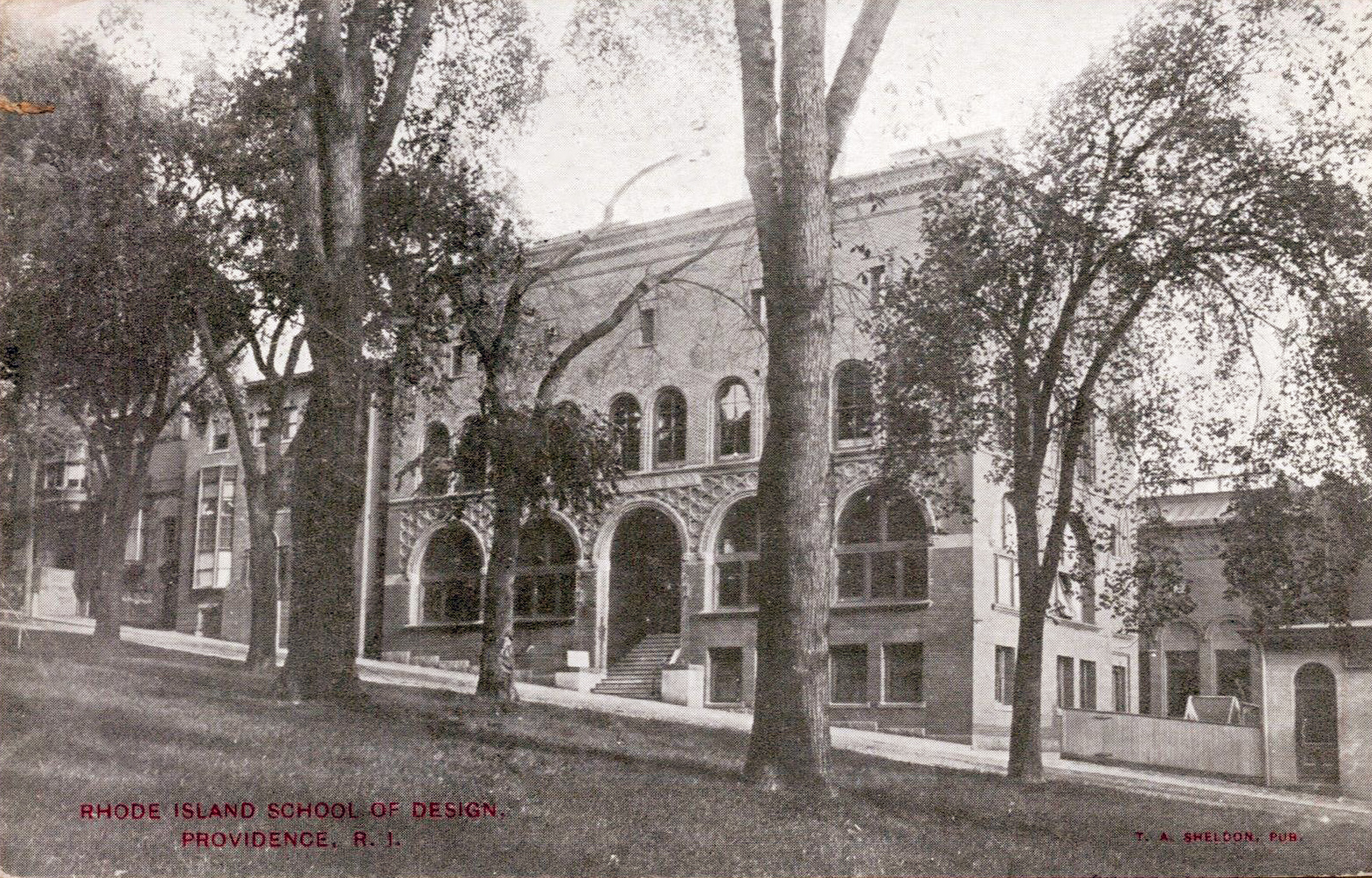
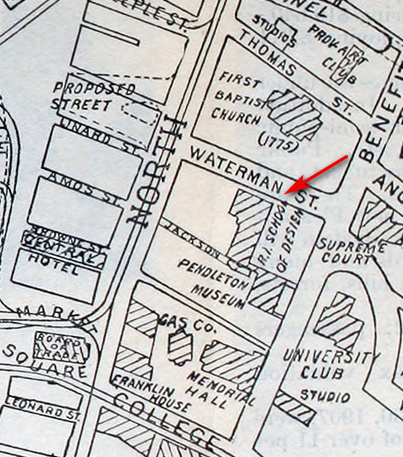
The exterior of the Rhode Island School of Design, Providence, in 1908. Opened on the site in 1893, and known as the Waterman Building, at 11 Waterman St.

When Lovecraft was a young boy, at his own fervent request his parents…

took him in 1897 to see a recently opened exhibit of Greek antiquities at the Rhode Island School of Design

The “entire first floor” was initially dedicated to the public exhibitions, in addition to the adjacent colonial-life Museum house (‘entrance through Waterman St.’) seen on the above map. But in 1897 the construction of the Metcalf exhibition galleries behind the Waterman building was completed. When these new galleries opened, the inaugural show is reported to have been an extravaganza of American and European paintings. But there was also a dedicated Greek and Roman Sculpture gallery with originals, casts and photographs. The opening of the latter gallery was accompanied by… “a course of seven lectures on the History of Greek Art before the students of the Rhode Island School of Design in the Winter of 1897-98” given by the President of Brown University. This Sculpture gallery was presumably what Lovecraft ‘the little Ancient’ saw when it first opened. Possibly it was the same as the sculpture court, seen here, that flanked the entrance to the School’s galleries…

The boy Lovecraft became a “constant” visitor in “1897-8-9″…

before long I was fairly familiar with the principal Grecian myths and had become a constant visitor at the classical art museums of Providence and Boston

Evidently the entrance hall was only a taster and there was far more statuary downstairs. This…

was an enchanted world” for him, with its “basement” museum of Greek and Roman reproduction sculpture.

Of course in Lovecraft’s famous story “The Call of Cthulhu” young Wilcox is… “studying sculpture at the Rhode Island School of Design”.

A later additional Eliza G. Radeke Building was opened for RISD exhibitions at 224 Benefit Street, dropping down the hill at the back. Lovecraft attended its grand opening in late April 1926. That was about four months before he wrote “The Call of Cthulhu”. The new building included a collection of Greek and Roman art, and a large new collection of Greek coins, although I’m uncertain if this was a relocation and augmentation of the original Waterman St. Sculpture Gallery, or if it had contents that would have been wholly new to both Providence and Lovecraft. One imagines the curious Lovecraft peering into the probably-new coin cases, and spotting remarkably tentacular designs on the ancient coins…

← Older posts
Newer posts →


Please become my patron at www.patreon.com/davehaden to help this blog survive and thrive.

Or donate via PayPal — any amount is welcome! Donations total at Easter 2025, since 2015: $390.

Archives

  • February 2026
  • January 2026
  • December 2025
  • November 2025
  • October 2025
  • September 2025
  • August 2025
  • July 2025
  • June 2025
  • May 2025
  • April 2025
  • March 2025
  • February 2025
  • January 2025
  • December 2024
  • November 2024
  • October 2024
  • September 2024
  • August 2024
  • July 2024
  • June 2024
  • May 2024
  • April 2024
  • March 2024
  • February 2024
  • January 2024
  • December 2023
  • November 2023
  • October 2023
  • September 2023
  • August 2023
  • July 2023
  • June 2023
  • May 2023
  • April 2023
  • March 2023
  • February 2023
  • January 2023
  • December 2022
  • November 2022
  • October 2022
  • September 2022
  • August 2022
  • July 2022
  • June 2022
  • May 2022
  • April 2022
  • March 2022
  • February 2022
  • January 2022
  • December 2021
  • November 2021
  • October 2021
  • September 2021
  • August 2021
  • July 2021
  • June 2021
  • May 2021
  • April 2021
  • March 2021
  • February 2021
  • January 2021
  • December 2020
  • November 2020
  • October 2020
  • September 2020
  • August 2020
  • July 2020
  • June 2020
  • May 2020
  • April 2020
  • March 2020
  • February 2020
  • January 2020
  • December 2019
  • November 2019
  • October 2019
  • September 2019
  • August 2019
  • July 2019
  • June 2019
  • May 2019
  • April 2019
  • March 2019
  • February 2019
  • January 2019
  • December 2018
  • November 2018
  • October 2018
  • September 2018
  • August 2018
  • August 2015
  • July 2015
  • April 2015
  • March 2015
  • February 2015
  • January 2015
  • December 2014
  • November 2014
  • October 2014
  • September 2014
  • August 2014
  • July 2014
  • June 2014
  • May 2014
  • March 2014
  • February 2014
  • January 2014
  • December 2013
  • November 2013
  • October 2013
  • September 2013
  • August 2013
  • July 2013
  • June 2013
  • May 2013
  • April 2013
  • March 2013
  • February 2013
  • January 2013
  • December 2012
  • November 2012
  • October 2012
  • September 2012
  • August 2012
  • July 2012
  • June 2012
  • May 2012
  • April 2012
  • March 2012
  • February 2012
  • January 2012
  • December 2011
  • November 2011
  • October 2011
  • September 2011
  • August 2011
  • July 2011
  • June 2011
  • May 2011
  • April 2011
  • March 2011
  • February 2011
  • January 2011
  • December 2010
  • November 2010
  • October 2010
  • September 2010
  • August 2010
  • July 2010

Categories

  • 3D (14)
  • AI (70)
  • Astronomy (70)
  • Censorship (14)
  • de Camp (7)
  • Doyle (7)
  • Films & trailers (101)
  • Fonts (9)
  • Guest posts (2)
  • Historical context (1,095)
  • Housekeeping (91)
  • HPLinks (74)
  • Kipling (11)
  • Kittee Tuesday (92)
  • Lovecraft as character (58)
  • Lovecraftian arts (1,626)
  • Lovecraftian places (19)
  • Maps (70)
  • NecronomiCon 2013 (40)
  • NecronomiCon 2015 (22)
  • New books (966)
  • New discoveries (165)
  • Night in Providence (17)
  • Odd scratchings (984)
  • Picture postals (276)
  • Podcasts etc. (431)
  • REH (184)
  • Scholarly works (1,469)
  • Summer School (31)
  • Unnamable (87)

Get this blog in your newsreader:
 
RSS Feed — Posts
RSS Feed — Comments

H.P. Lovecraft's Poster Collection - 17 retro travel posters for $18. Print ready, and available to buy — the proceeds help to support the work of Tentaclii.

Proudly powered by WordPress Theme: Chateau by Ignacio Ricci.