• About
  • Directory
  • Free stuff
  • Lovecraft for beginners
  • My Books
  • Open Lovecraft
  • Reviews
  • Travel Posters
  • SALTES

Tentaclii

~ News & scholarship on H.P. Lovecraft

Tentaclii

Category Archives: Picture postals

Friday ‘picture postals’ from Lovecraft: Around Brattleboro

05 Friday Jul 2019

Posted by asdjfdlkf in Historical context, Maps, Picture postals

≈ 2 Comments

H.P. Lovecraft’s correspondents were sent not only ‘picture postal’ postcards, but also lightweight brochure-leaflets from specific places. As America’s ‘visitor trade’ grew, in the late 1920s and early 1930s, Lovecraft could pick these leaflets up in stores, museum foyers, YMCA lobbies and the like. Presumably a keen visitor would be permitted to take a handful, if he promised the attendant he would ‘send them on to interested friends’. As Lovecraft became increasingly poor, such small items could have occasionally saved him the cost of buying pictorial postcards.

Above is a 1940 tourist map of the attractions and notable places around the town of Brattleboro. However, the map is identical to that on the reverse of this c. 1930 leaflet…

It may be of use to those trying to follow Lovecraft’s excursions out from the Goodenough farm in West Brattleboro, and the nearby Vrest Orton place. Such overview maps may be especially useful once we get the mammoth volume of Lovecraft’s complete ‘letters to the aunts’, due for publication soon. My guess is that we can probably expect to read there of a good many visits to obscure antiquarian shrines and remote mountain-vistas, all lovingly detailed. Possibly there may also be some mention of the 1927 Vermont floods at Brattleboro, though Lovecraft only saw the floods in pictures…

Lovecraft visited Vermont for the first time in the summer of 1927, returning in the summer of 1928. He did not actually witness the Vermont floods (a real event) [which gave rise to the story “The Whisperer in Darkness”], but they received extensive coverage in newspapers throughout the East Coast, and Lovecraft no doubt heard some first-hand accounts of them from several friends in Vermont including Vrest Orton and Arthur Goodenough”. — S.T. Joshi, A Subtler Magick.

Pictures: the subsiding 1927 floods at Brattleboro.

Readers will recall Lovecraft’s “The Whisperer in Darkness”, opening with lines such as…

… country folk reported seeing one or more very bizarre and disturbing objects in the surging [1927 flood] waters that poured down from the unfrequented hills, and there was a widespread tendency to connect these sights with a primitive, half-forgotten cycle of whispered legend …

Spurred by finding the above Brattleboro map, I went looking for an update on the conservation and restoration of the Goodenough farmstead at Brattleboro. Apparently the farmhouse has a covenant on it which states that it’s to be preserved intact in its original form. The Goodenough Farmstead Trust began in 2004 and they spent $65,000 on the place in 2006. Most likely on the excellent new roof, to be seen below. The last online report from the place appears to be that of the Lovecraft fan Dakota Rodeo and friends, who visited in summer 2014 and found the house looking good but interior works still ongoing…

GEDC2989_zps8777848cPicture: local girls at the farmstead in 2014, visiting for Lovecraft’s birthday.

Also, where exactly is it? Joshi in A Subtler Magick places Orton just outside Brattleboro itself, and states that Goodenough’s farm was “further to the north”. Yet the local historical society has it that Goodenough’s hillside farmstead is on “the Goodenough Road in West Brattleboro”, which would place it west of Brattleboro. Lovecraft himself states that Goodenough… “dwells not much above a mile from Orton’s”, Orton having… “hired a delightful farm some miles out of Brattleboro, in Vermont” (Orton had recently fled New York and the south Windham County house was on a long all-summer lease, not just a week’s holiday-let). Given this, Joshi’s “further to the north” must indicate “to the north” of Orton’s place, not north of the town itself.

While looking for Orton’s actually address I found additional interesting confirmation that that he and Lovecraft would have chimed politically. The author of a 1989 tourist book on Vermont had looked through Orton’s famous mail-order publications and noted their politics…

Vrest Orton, whose tartly conservative political views punctuated the [his] enormously successful mail order catalogue Voice of the Mountains“. — The roadside history of Vermont, 1989.

Voice was issued by Orton’s business the Vermont Country Store, and a collection of his columns were later published as the book The Voice of the Green Mountains: a collection of phillipics, admonitions & imponderables (1979). Orton’s late recollection of Lovecraft, first published 1982, also made a passing remark on Britain’s increasingly sorry state under socialism. This implies that i) his political views had not changed over time, and that ii) his memoir was likely penned some years earlier, perhaps in 1976-79, when Mrs Thatcher had not yet been elected.

But… back to finding the precise location(s) of Goodenough and Orton in the 1920s. If the Goodenough farmstead’s location is the address at which the Goodenough Farmstead Trust is formally registered today (and satellite photography in Google Earth suggests it is, offering the same building layout, roof shape, and arrangement of of the grounds) then that puts it about five miles directly west of Brattleboro itself. This further suggests that Orton’s springwater-fed and oil-lit “eighteenth-century” place may have been in the hills somewhere off Akley Road, about a mile south of the Goodenough farmstead. Orton’s late memoir of Lovecraft actually puts his rented place at “ten miles” from town, but no doubt Orton recalled every hairpin bend and switchback in that tally, as the neighbour’s Ford rattled along the back-roads through the hills. Here is Lovecraft, recalling the journey up into the backroads…

“The nearness and intimacy of the little domed hills become almost breath-taking — their steepness and abruptness hold nothing in common with the humdrum, standardized world we know, and we cannot help feeling that their outlines have some strange and almost-forgotten meaning, like vast hieroglyphs left by a rumoured titan race whose glories live on in rare, deep dreams.”

Picture: Brattlboro is the large town seen along the river on the right of the picture, and Guilford / Old Guilford straddles the road that runs south out of it. The curious line seen marching across the landscape near the farmstead, like an ancient Roman wall, is presumably a forest fire-break to protect the town? Despite being marked on the old tourist map as forest it probably would not have been quite so thickly wooded back then, because there has been massive forest ‘re-growth from farmland’ in the eastern USA since the 1930s, along with a general global greening since the 1990s.

There is a slightly curious place-name puzzle here. Orton’s newspaper report “A Weird Writer Is In Our Midst” (1928) states that Lovecraft’s 1928 visit was at “Guilford”, which the modern maps mark at about a mile and a half south of the centre of Brattleboro. He is “stopping with us in Guilford”, writes Orton in the newspaper. This is apparently confirmed by the title of “Literary Persons Meet in Guilford” Brattleboro Daily Reformer (18th June 1928). And yet Orton’s later memoir of Lovecraft clearly states that the location of the 1928 visit was his rented summer house, near the Goodenough farmstead, and that this was “ten miles from Brattlboro”.

But we know that the “Literary Persons Meet in Guilford” meeting was definitely held at the Goodenough farmstead. The local newspaperman was at the farm in person and reported… “Half a dozen literary persons met for a discussion yesterday at the home of Arthur Goodenough”. Lovecraft himself reported to fellow amateurs that… “there was a literary assemblage of much interest at the poet’s abode”.

The solution to this small riddle must be that, to local people, the place was considered to be part of Guilford. Even though Guilford/Old Guilford was many miles east-away toward the river, through the rolling hills. Indeed, looking more closely at the maps one can see a “West Guilford” area extending out toward the Goodenough farmstead.

Picture: Typical covered bridge and packed-dirt road, of the type then found in Guilford and Brattleboro.

Friday ‘picture postals’ from Lovecraft: The Copp’s Hill Burying Ground

28 Friday Jun 2019

Posted by asdjfdlkf in Historical context, Picture postals

≈ 1 Comment

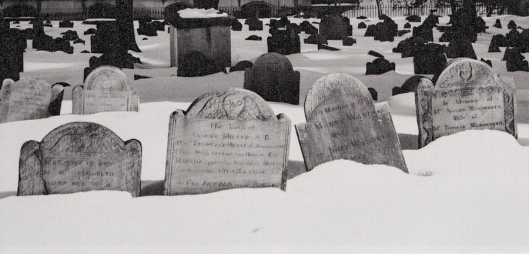
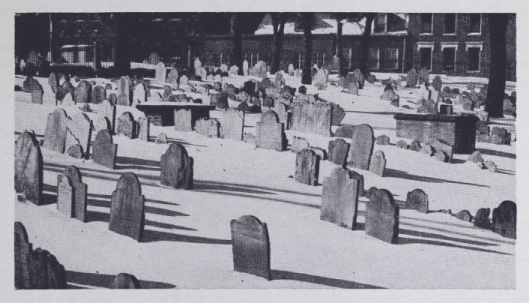
In early 1923 Lovecraft investigated the old North End of Boston and climbed up to the Copp’s Hill Burying Ground, est. 1659—1825…

At present this part of the town is an Italian quarter of the most squalid sort … Thence I proceeded up the steps to that fascinating necropolis the Copp’s Hill Burying Ground. This latter spot hath for me a singular fascination … Here are interr’d some of the most illustrious Colonial dead of the Province, including the Mathers, who are interesting to me from my possession of Cotton Mather’s “Magnalia Christi Americana”. But the chief charm of the scene is in the entire broad effect; the bleak hilltop with its horizon of leaden sky, harbour masts, and Colonial roofs. Over the sod was a thin coat of snow, thro’ which the slabs peer’d grimly whilst black leafless trees claw’d at a sinister lowering sky. … As I beheld the black slate slabs rising ghoulishly above the snow, & cast my glance about at the adjacent chimney-pots, it was difficult to realise that full two centuries have pass’d since the heyday of my particular aera. … In fancy I could conjure up the Boston of the late 17th century with its narrow, hilly, curving streets and quaint wooden and brick houses.

The above is a blend of two letters mentioning the same 1923 visit, one to Galpin and one to Kleiner. Lovecraft saw this old area just in time, as on a later visit in summer 1927 he was disappointed to find that large areas of the old town had been torn down and levelled.

A few years later Lovecraft would have Pickman paint a ghoulish scene here, in “Pickman’s Model”…

Gad, how that man could paint! There was a study called “Subway Accident”, in which a flock of the vile things were clambering up from some unknown catacomb through a crack in the floor of the Boylston Street subway and attacking a crowd of people on the platform. Another shewed a dance on Copp’s Hill among the tombs with the background of today. Then there were any number of cellar views, with monsters creeping in through holes and rifts in the masonry and grinning as they squatted behind barrels or furnaces and waited for their first victim to descend the stairs.


Above we see the side of the Copp’s Hill Burying Ground on the left of the pictures, with the street much as Lovecraft would have encountered it, perhaps photographed in the late 1910s and early 1920s. Even on a winter’s day Lovecraft encountered a small crowd of such urchins outside the Burying Ground, perhaps alerted by others who had seen him climbing through the squalid Italian quarter and up the hill — their juvenile trade was to spout some memorised historical doggerel to many visiting antiquarians and historians, and then demand coins for their ‘services’…

a horde of ragged little ciceroni who surrounded me & blocked my feet whilst spouting history in lifeless, mechanical voices. It was worth a handful of farthings to be rid of these small highwaymen, whose desire to instruct the traveller is not unmixt with a craving after sweetmeats.

It sounds like some of them may have been satisfied with candy from a bag Lovecraft had brought with him. He also always carried a small bag of cat-attracting catnip on such trips.

Friday ‘picture postals’ from Lovecraft: the Cloisters, NYC

21 Friday Jun 2019

Posted by asdjfdlkf in Historical context, New discoveries, Picture postals

≈ 1 Comment

H. P. Lovecraft once wrote to Galpin in 1934…

How are the “yarbs” [medieval-style herb garden] coming along? I enclose something about a similar enterprise. These old cloisters are very familiar to me — indeed, Belnape, Mortonius, & I visited them for the first time not long after our memorable Cleveland sessions of ’22..

Here he alludes to a remarkable architectural assemblage of medieval art in Manhattan. The “Barnard Cloister” had opened to the public in 1914, and was a poetic presentation in a large church-like structure with landscape setting. Attendants were garbed in the habits of medieval monks. This unusual architectural museum then expanded its content in 1926, when taken over by New York’s Met museum. In circa 1927/28 the Met then began to plan a new and larger museum a little further north along the hill, and their new building only finally formally opened in 1938 after Lovecraft’s death. The Met’s new Cloisters presented the collection with a coherent scholarly and curatorial rigour. The place is still open today and a major tourist attraction.

Period map showing subway station for the Cloisters.

The 1938 Cloisters in its landscape context, January 1961, beside the frozen river with ice-floes and with modern housing projects clustering around its forest park. The original Cloisters seems to have been just off the left of the picture, on the same ridge.

Lovecraft’s initial Autumn (Fall) 1922 visit would thus have been to the 1914 Cloisters. Free entry encouraged visits from the Lovecraft Circle despite the very long and tedious subway ride under Manhattan. Lovecraft’s first visit was with a day there with Sonia in 1922, but another was vividly recalled by Frank Belknap Long in his Lovecraft memoir, albeit a memoir written some fifty years later. Long has it that he, Morton and Lovecraft approached the Cloisters in the gloaming dusk, presumably hoping for a night-time candle-light tour perhaps around Halloween-time. It was only in winter that the museum closed at dusk. The group were rather startled to see old crones in black ‘hats’, using giant witch’s besom-brooms to sweep the darkling paths of the wooded grounds…

… we approached over a narrow, winding footpath we were instantly struck by the long and chilling shadows which the trees were casting in the deepening dusk. Then we saw — the witches. Three bent and fragile-looking women, unmistakably well advanced in years, were sweeping up the fallen leaves surrounding the Cloisters with long-handled brooms. There was a twilight glimmer at their backs, and they were wearing what at least from a distance looked like jet-black, conically tapering hats.

12th century doors, a working doorway at The Cloisters.

[Inside…] It was just as impressive as any similar shrine in Europe, with goblin tapestries and illuminated manuscripts vying in interior splendor with wood-carved figures, gilded or unadorned, dating back to the Middle Ages. For the most part the figures were angelic in aspect, but a few were chillingly demoniac with gargoyled features.

Archival material reveals that there were special candlelight evenings at the 1914 Cloisters, and one assumes that it one of these that spurred Lovecraft’s 1922 visit. Regrettably Long’s memoir can’t inform us on that point, as he recalled only the time of day, the forest, the ‘witches’, and the general nature of the exhibits. But evidently there were candle-light nights for the public, and here we see a photograph of one such at the 1914 Cloisters…

Here are some of the more grotesque carvings Lovecraft would have been especially pleased to spot on his visits, as the Cloisters became “very familiar” to him…

While an elevated roof-garden and children-friendly ‘unicorn tapestry’ galleries were added for the 1938 opening of the new building, Lovecraft may have seen early medieval wall murals such as this. Note the figures below the dragon…

There were also illuminated manuscripts at the 1914 Cloisters, because one of the ‘witch’ crones seen by Lovecraft turned out to be the keeper of the illuminated manuscripts. She and her companions wore the habits of the museum attendants. Their ‘black hats’ proved to be old stockings worn over the hair to keep out dust, twigs and insects, while sweeping dry leaves with the giant brooms.

Lovecraft’s 1925 Diary also records a later visit on the evening of June 27th, after he had spent the afternoon exploring Inwood near Long Beach. At this point in time the Met had taken over the 1914 Cloisters, but the new 1926 south wing was not yet open and the Rockefeller collection of religious figurative sculpture was not yet installed. Nor does it appear that the Met’s building work on the 1938 version of the Cloisters was underway by summer 1925.

The Met, having decided to build the new Cloisters, wanted to record the old Cloisters. One of the ways they chose to do this was a short and rather creaky cinema film, which was released in 1928 and is now on YouTube. In this we see something of the original Cloisters as Lovecraft would have known the place…

[youtube https://www.youtube.com/watch?v=8cH5T09cVd0?start=30&w=560&h=315]


Given his 1934 comment to Galpin that “These old cloisters are very familiar to me” we can assume other visits followed those of 1922 and 1925. Perhaps those with good access to Lovecraft’s letters can discover these dates, probably in the early 1930s, and also determine if Lovecraft later visited the (perhaps partly-built and partly-opened) ‘new’ Cloisters which formally opened in 1938. Though a few very scholarly sources say 1934, which may perhaps indicate a difference between a 1934 opening to the public and a 1938 ‘final official’ opening ceremony.


The Bernard Cloisters of New York were not the only cloisters Lovecraft experienced, as he also enjoyed those of Yale (forming from them some conception of the hushed quadrangles of the colleges of Oxford, in his beloved but never-visited England), and he also… “liked the cloistral hush of the Brown University campus, especially the inner quadrangle, where in the deserted twilight there seemed to brood the spirit of the dead generations.” (Lord of a Visible World). Yet, given the timings I’ve outlined above, it seems plausible to assume some influence of the 1914 Bernard Cloisters on elements of “The Lurking Fear” (written November 1922) and “The Rats in the Walls” (written August-September 1923).

This place and Lovecraft’s visits should remind us that Lovecraft was writing his most gothic work at the very tail end of the idea of the gloomy middle-ages. William Morris and Burne-Jones and others had of course done much to lift the idea of the medieval out of the mud, mostly in England, but it was not underpinned by the sort of heavy-duty scholarship needed to shift the idea of the medieval away from the old view of it. Even by the mid 1920s the consensus idea of the medieval in America was of a dark and rancid Church that hated industry and learning, and which shuffled the intelligent off into seclusion as shivering half-starved turnip-munching monks, mad sex-starved nuns, to be religious prisoners in dank dungeons, or (if they were lucky) they got to be ecclesiastic scholars who squabbled over religious trivialities such as the correct cut of a monk’s hair. There were no grand universities or thriving merchant towns, just dank castles lording it over lowly over-taxed peasants. There was no uniform set of traditions, sustained and nurtured across five centuries. There were no long distance trade or pilgrimage routes, no trade guilds, little law, no books and letters moving about Europe, and everyone was more or less stuck fast in their native clay speaking mutually incomprehensible dialects and languages. No-one could read and there was no cheap rush-lighting at night to read by anyway. There was no joyous art and music, yet at the same time people were emotionally incontinent, incapable of restraint. Dark Devilish heresy lurked behind every scraggly hedge, and an Inquisitor listened under every creaking bed. Kings and princes, if not completely mad religious zealots, were pompous, pig-ignorant and warlike.

That false view began to change with educative projects such as The Cloisters from 1914, and many other such efforts gathered steam in the USA by the mid 1920s, and thus we saw the first stirrings of a new and enlightened understanding of the medieval that the educated have today — though it can of course still be found in the gothic-horror vampire-and-werewolf end of popular culture. The counter-reaction may have gone too far, coming in the end to focus on and overly venerate the 12th and 13th centuries as a lost golden-age, but from that scholarly and literary over-correction came creative triumphs such as The Lord of the Rings and others which form the best works of high-fantasy.

Friday picture postals from Lovecraft: Fulton St. near Clinton St., Brooklyn.

14 Friday Jun 2019

Posted by asdjfdlkf in Historical context, New discoveries, Picture postals

≈ Leave a comment

Last week I looked at the corner of Joralemon St. and Clinton St., New York, which led me to look at the geography and demographics of Red Hook in the 1920s. Lovecraft got the demographics and mix of Red Hook right in his description of the place, except in one respect. Having an Irish protagonist in the story, he substituted “Spanish” for “Irish” in his opening description of the place and its people. According to my reading on Red Hook, there was to be a large Spanish-speaking population there, but that came later in time.

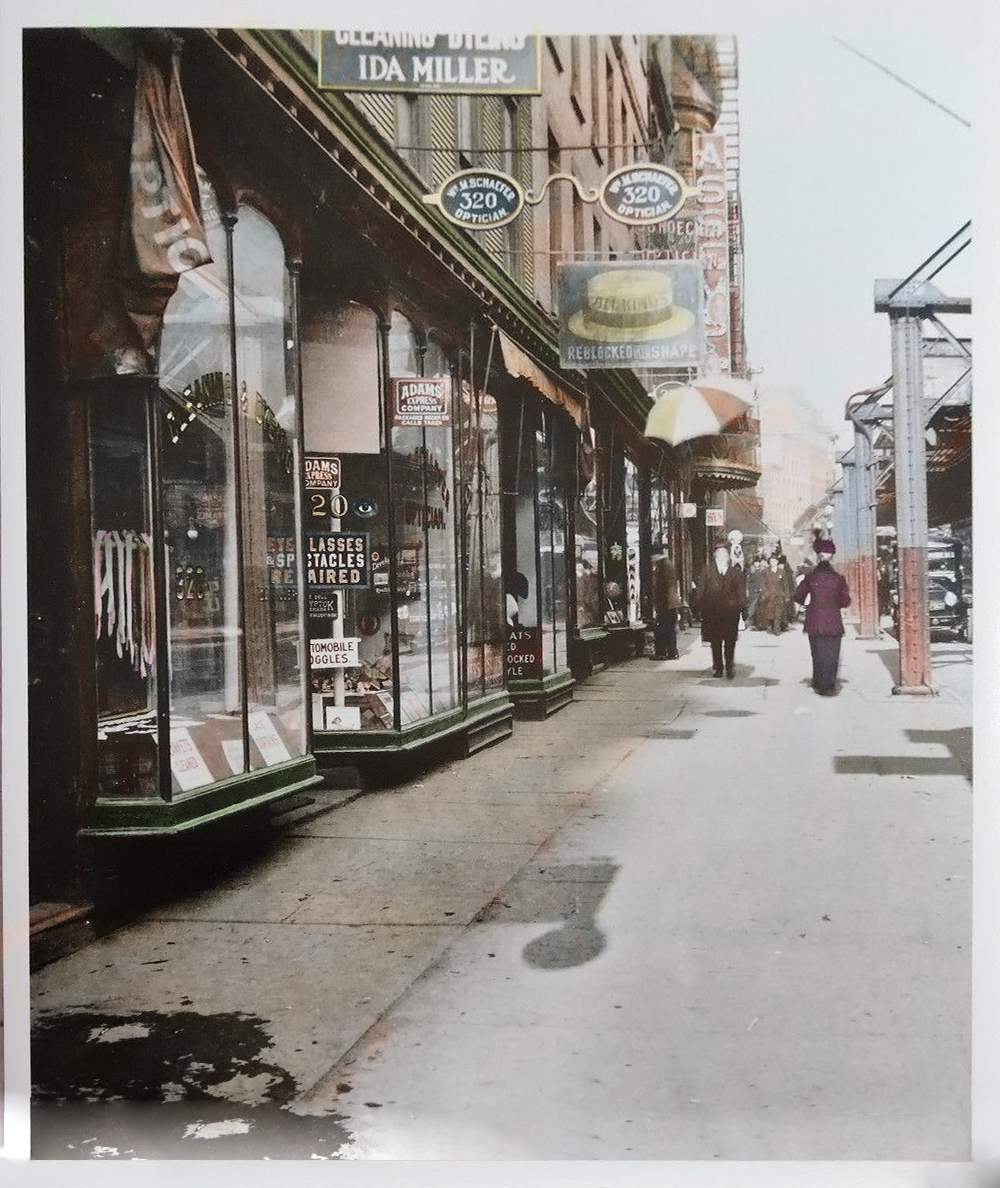
Following my look at Joralemon and Clinton St., here’s a ‘picture postal’ of another nearby scene which I’ve also newly colorised…

Again, we also see an evocative ‘H.P. Lovecraft stand-in’, this time as if walking toward the viewer. The man is not Lovecraft, but one could imagine he might be. We also see 320 and 322 Fulton Street on the left. This spot is thus close to Lovecraft’s dingy apartment on Clinton St., and the two points are marked on this extract from last week’s map…

The lady’s hat might date the picture some years earlier than the mid 1920s. One source says 1907, the other 1915. The scene here is one street over from the Montague Street technical and mercantile branch (1903) of the main Brooklyn Public Library, and I assume the Music Academy was still opposite this library (update, no it had burned down but there was an Art Club). This part of Fulton St. is obviously more salubrious than the adjacent Red Hook, despite the relative proximity to it. There’s a cleaners, an opticians, a hat-blocker, what seems to be an umbrella shop, a novelty shoe shop (according to Directories), the latter being next to “Asseys” (sp?). The “Asseys” sign and canopy might lead one to think it was a theatre or similar. But I can find no trace of such. Possibly it was a private club with large restaurant with dance-floor. Because there was a “Gentlemen’s Cafe and Grill Room” at 308 Fulton St. in 1910, with… “Accommodations for Balls, Banquets, Private Dining Parties and Lodges” and promising to provide the Royal Hungarian Orchestra. One has to wonder though, if this stretch of the street was quite so salubrious a place by 1925/26, given the way that the social status of New York neighbourhoods can rapidly shift over time. But one has to assume that the nearby Library continued to give the place a certain level and type of clientele, in the mid 1920s, which helped to maintain its standing.

The curious steel structure on the right of the picture is part of the famous and once much-loved elevated railway, “the El”. Lovecraft’s friend Rheinhart Kleiner celebrated Fulton Street and the El in this section of his Betjeman-esque poetic ditty “Brooklyn, My Brooklyn”…

   To hear the passing roar above
   Of elevated trains,
   That thrill me as they soar above
   Unnumbered marts and fanes.

   I’d miss the book so pleasingly
   Displayed on Fulton Street;
   The other wares that teasingly
   Remind of things to eat.

By book Kleiner presumably means a large bookshop shop-sign, hanging above the street and done in the shape of a book? In the photo above we see something similar in the shape of eye-glasses…

By fanes Kleiner indicates ‘temple or shrines’, and presumably the word is here used whimsically of the lunch eateries and soda palaces.

In one letter of 15th April 1929 Lovecraft talks of travelling into New York by rail on the… “elevated which I generally employ”, for a return visit. Here is a postcard and archive picture which shows the sort of elevated view he would have enjoyed along Fulton St. The second picture is a record-picture of the Elevated in the heart of Fulton St., Brooklyn, albeit from perhaps 20 years before Lovecraft’s time there.

Travelling in this manner is hugely enjoyable to the observant and keen-eyed type of person, provided one has a good window seat on the correct side of the carriage. One can thus become far more endeared to a place than otherwise, if one were only riding along in heavy traffic or trudging and dodging along at ground level on foot. Cities with elevated and double-decker transport are inherently more ‘likeable’ places.

Lovecraft’s good friend Frank Belknap Long also liked to browse an antiquarian shop on Fulton Street for curios, although (amazingly) it was Lovecraft who in 1922 had introduced Long to the second-hand bookshops of New York, not the other way around. Long went there at least once with Lovecraft…

[Roman coins and] baked-clay Roman lamps, and he [Lovecraft] once helped me pick out magnificent examples of both ‘coinage and lampage’ at an old-coin shop on Fulton Street.” (Dreamer on the Nightside)

Presumably this was the Brooklyn Fulton St., though it could have been its namesake over the river. That said, Long’s memory (of more than forty years prior) is not to be wholly relied on, and the store might even have been in some other street entirely. Scans of old coin-collector journals reveal the name of a well-respected curio and coin dealer dealer on Fulton St., but this name can lead me to no address or picture.

But the opening picture of this post is certainly of the Brooklyn Fulton St., the street in which Lovecraft successfully culminated his epic pursuit of a new suit at a cheap price after his clothes were stolen. That suit store was at 463 Fulton Street, Brooklyn, further up the street-numbering and around the bend from the spot pictured above. Lovecraft also patronised a restaurant off Fulton Street, this being sometimes visited by Lovecraft on Sundays for lunch. There were likely also some bookshops nearby, given the proximity of the technical and business Library, and more were coming — the bookshop of Isei Binkin at 252 Fulton Street may have been at that nearby address from 1932. This was the same Mr. Binkin of the amazing Grill/Binkin collection of Lovecraftania, which emerged in the early 1970s alongside Lovecraft’s reviving reputation.

Probably there are more mentions of ‘Fulton’ in print, but the two key books on Lovecraft in New York are not indexed to street-names. Once again I’m reminded that if one wanted to turbo-charge Lovecraft scholarship, a searchable database of all the letters would surely do that — even if it only supplied Google Books-like snippets in its search results. Surely such a thing would be fully crowd-funded within a day, if championed by Joshi and others?

But even without such a scholarly tool, I generally have the impression that the lower half of Fulton St. was ‘about’ something. It was about making the more aspiring people of this first great city of the modernity feel comfortable and easy, for a relatively-modest but fair price. Whether that was in affordable men’s accessories, cleaning and hat services, Sunday meals and soda/ice-cream palaces, or small items items such as spectacles, umbrellas, unusual shoes, cut-flowers, smoking pipes, and perhaps (later) books. In the upper half, as the streets rose into the 450s and 60s, the stores seemed to have become grander and there were several large and tall department stores.


I should note that there is another Fulton St. to be found just across the Brooklyn Bridge, passing through what is now the Financial District of New York. It was once connected to the Brooklyn Fulton St. by river ferries which had terminals at the foot of the famous Brooklyn Bridge. The ferry service seems to have been discontinued by the mid 1920s, thus severing the two streets. This means that when Lovecraft talks of visiting the Fulton St. Fish Market in a letter, he’s actually across the river and walking around the dockside at the foot of that other Fulton Street…

Some years ago Long and I attempted to explore the Fulton Fish Market section of New York — which is full of quaint scenes and buildings. I don’t know where I left the
lunch I had eaten an hour previously — for I was too dizzy to read the street signs! In the end I managed to stagger out of the stench without actually losing consciousness …” (letter of 1933, Selected Letters IV)

This brief mention implies that this daytime visit was hasty, yet according to Vrest Orton’s memoir of Lovecraft the area was a fairly frequent night-walk haunt of Lovecraft’s (see Lovecraft Remembered) in search of 18th century remains. Possibly the fish-smell was less so in the dead of night, when the boats were away and trawling and the disinfected warehouses awaiting their dawn-landed catch?

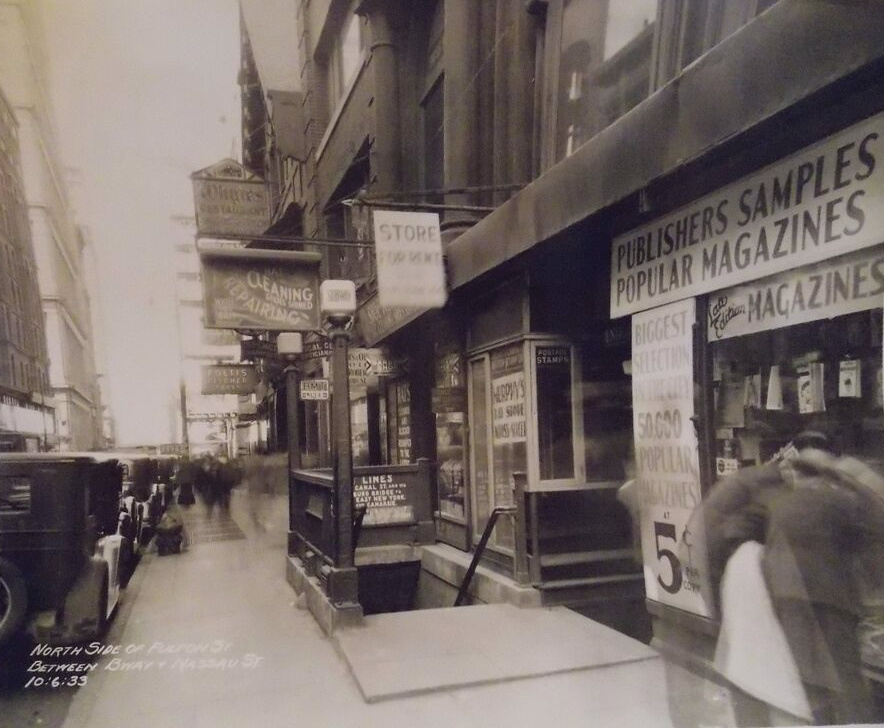
That Fulton St. appears to have subways rather than an “El” railway, and a subway entrance can be seen here in this 1933 picture…

Since we know Lovecraft was also in this other street too, we might again imagine the picture’s scene shifted a few years in time. And that the men looking excitedly in the display-window resemble Lovecraft and Belknap Long — perhaps just hopped up from the subway to visit the “50,000 magazines store” — and seeing familiar names on the cover of a brand-new edition of Weird Tales.

Friday Picture Postals from Lovecraft: on the corner of Joralemon St and Clinton St., NYC

07 Friday Jun 2019

Posted by asdjfdlkf in Historical context, Maps, Picture postals

≈ 2 Comments

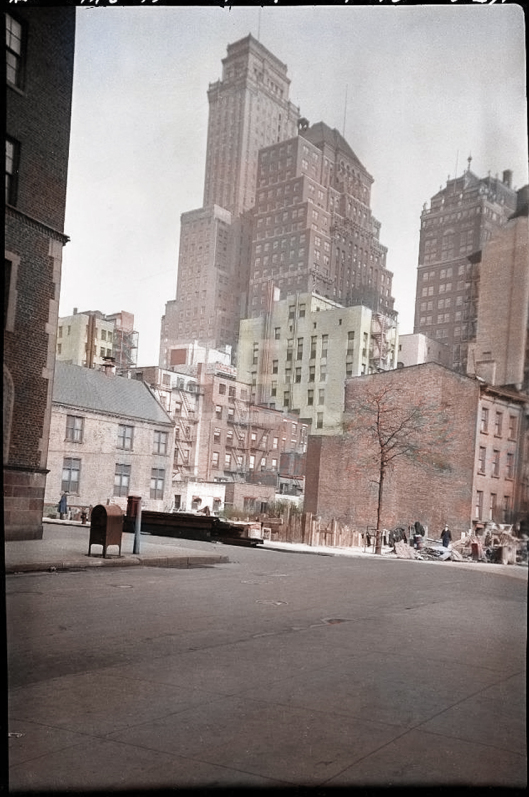
Here we see the corner of Joralemon St and Clinton St., Brooklyn, then on the edge of Red Hook. H.P. Lovecraft lived just a short walk from this spot, in a “dismal hovel” at 169 Clinton St., also right on the edge of Red Hook. During his time here he…

often” ate at “Peter’s in Joralemon St.” (Selected Letters II)

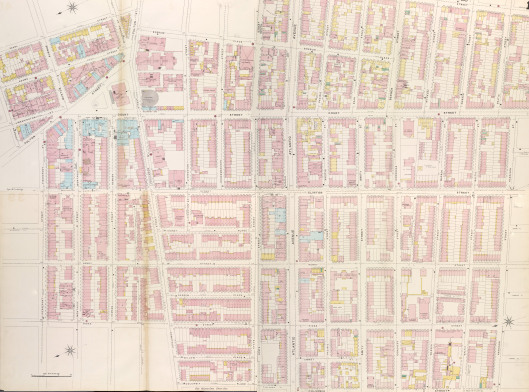
Thus he may have known the corner well, as he often walked down from his apartment and around the corner to eat in a Joralemon St. cafe. Joralemon St. goes both ways from the intersection, as you can see from the map below. Since the precise cafe location is currently unknown, then the direction in which he would have turned off Clinton St. is also unknown.

The photographer was Percy Loomis Sperr, and the date is 22nd February 1930. Which is only a few years after Lovecraft had left.

As for Lovecraft, the man seen walking into the right of the picture, or the man seen on the left contemplating the wasteground, both seem like close stand-ins for him (perhaps they’re Sperr’s bodyguards, which a cameraman with a valuable camera and tripod might need in Red Hook). Although by this date the master was safely back in Providence, and musing on the opening lines of “The Whisperer in Darkness”.


Here’s my useful map for future researchers in this part of Brooklyn. I used Photoshop to combine four such maps, which show building-level numbering and street layout. It’s centred on Lovecraft’s 169 Clinton St. Bear in mind that it’s from 1884, so is only to be used for initial orientation. Specific details for your chosen time period will need to be confirmed by consulting later maps.

It seems that Clinton and Atlantic broadly formed the boundaries of what was then thought of as Red Hook. Which means Lovecraft was living right on its edge. Evidently it was not a salubrious edge. Lovecraft’s decrepit mouse-infested lodgings were noisy, smelly, and the apparently genteel Irish landlady quickly proved to be none too particular about who she took in as lodgers — an adjacent room harboured shifty youths who stole Lovecraft’s clothes and left him only what he was wearing.

Below Columbia St., seen along the very bottom of the map, the long waterfront of sailor-bars and wharfs and warehouses began and ran down for a few blocks before thrusting out into a series of ship-piers. Experts on the waterfront’s history say little online about the 1920s and 30s, but can say that until the public works of the mid to late 1930s there were still shantytowns, open scrubby land and undrained marshland along the waterfront. Eastern parts of Red Hook were also heavily dotted with “weedy undeveloped terrain” on 1924 aerial photography, and a Thomas Wolfe short story of 1936 (which concurs with Lovecraft’s description of Red Hook) would put this area at “Erie Basin”.

Searches of Google Books reveal that, back of this waterfront area, the built-up residential part of Red Hook seen on the above map mostly had a population of poor Italians from the south of Italy, split into dialect groups that had great difficulty comprehending each other. Red Hook also had some large, though possibly dwindling, Irish groups until the later 1930s. Further there were significant numbers of Syrians who were almost all Christians escaping persecution, according to the book An Ethnic and Racial History of New York City — although Lovecraft wasn’t to know that from listening to their “eldritch” music through the walls of his apartment. There were even a few old Norwegians and Finns (classed as “Swedish” in reports), left behind after earlier waves of immigration had left the area c. 1900-1910. Presumably many of these remainers were old sailors and this may especially interest some, in terms of Lovecraft having a Norwegian sailor be central to the plot of The Call of Cthulhu. Mixed in with Red Hook’s two majority populations of Italians and Irish were floating populations of active sailors on shore-leave from all over the world. There was a small permanent Caribbean population in Red Hook at 1920, perhaps families of sailors, and these may be the same as those noted in a 1927 report as being tiny colonies of Porto Ricans and black Brazilians. Mingling among the transient sailors were the many illegal arrivals, spurring occasional raids into Red Hook by the immigration authorities. In “Red Hook” Lovecraft thus appears to have got the demographics right, except that he substituted the Spanish (not yet in Red Hook, at that time) for the Irish. Presumably he made this change because his detective protagonist is Irish.

One academic has claimed in the New England Review that Lovecraft was right about there being Kurds in Brooklyn, the claim being based on the rather idle assumption that the modern Kurdish community has always been there. That is not the case. The current Kurdish community only arrived there in 1975 when the U.S. resettled 700 people. Brooklyn’s Kurdish Library was opened in 1989 and by the early 1990s there was a community of 2,000 (Encyclopaedia of New York City). Thus the modern community, centred on North Gowanus which is now Boerum Hill, cannot plausibly be ‘mapped back’ onto any Kurds Lovecraft might have encountered in Brooklyn in 1925. Indeed, Lovecraft correctly states in “Red Hook” that Gowanus was then home to a relic population of Norwegians. I can add that there had been a failed Sheikh Said rebellion of the Kurds in February-March 1925, and this might just have caused some richer Kurds to try to get to New York City. “The Horror at Red Hook” was written 1st-2nd-August 1925, and thus Lovecraft might had seen and felt a small but noticeable influx of exiled Kurds entering clandestinely into Brooklyn in May-June-July. But that is speculation, and I can find no confirmation of any newly-arrived Kurds in Brooklyn in 1925.

On the area S.T. Joshi remarks, in I Am Providence…

It [Red Hook] was then and still remains one of the most dismal slums in the entire metropolitan area. In the story Lovecraft describes it not inaccurately, although with a certain jaundiced tartness:

‘Red Hook is a maze of hybrid squalor near the ancient waterfront opposite Governor’s Island, with dirty highways climbing the hill from the wharves to that higher ground where the decayed lengths of Clinton and Court Streets lead off toward the Borough Hall. Its houses are mostly of brick, dating from the first quarter of the middle of the nineteenth century, and some of the obscurer alleys and byways have that alluring antique flavour which conventional reading leads us to call “Dickensian”.’

Lovecraft is, indeed, being a little charitable (at least as far as present-day conditions are concerned), for I do not know of any quaint alleys there now.

Photographs show large parts of Red Hook being erased by massive ‘housing projects’ (UK: ‘tower blocks’) in the late 1930s, so the alleys Lovecraft evoked may once have actually existed.


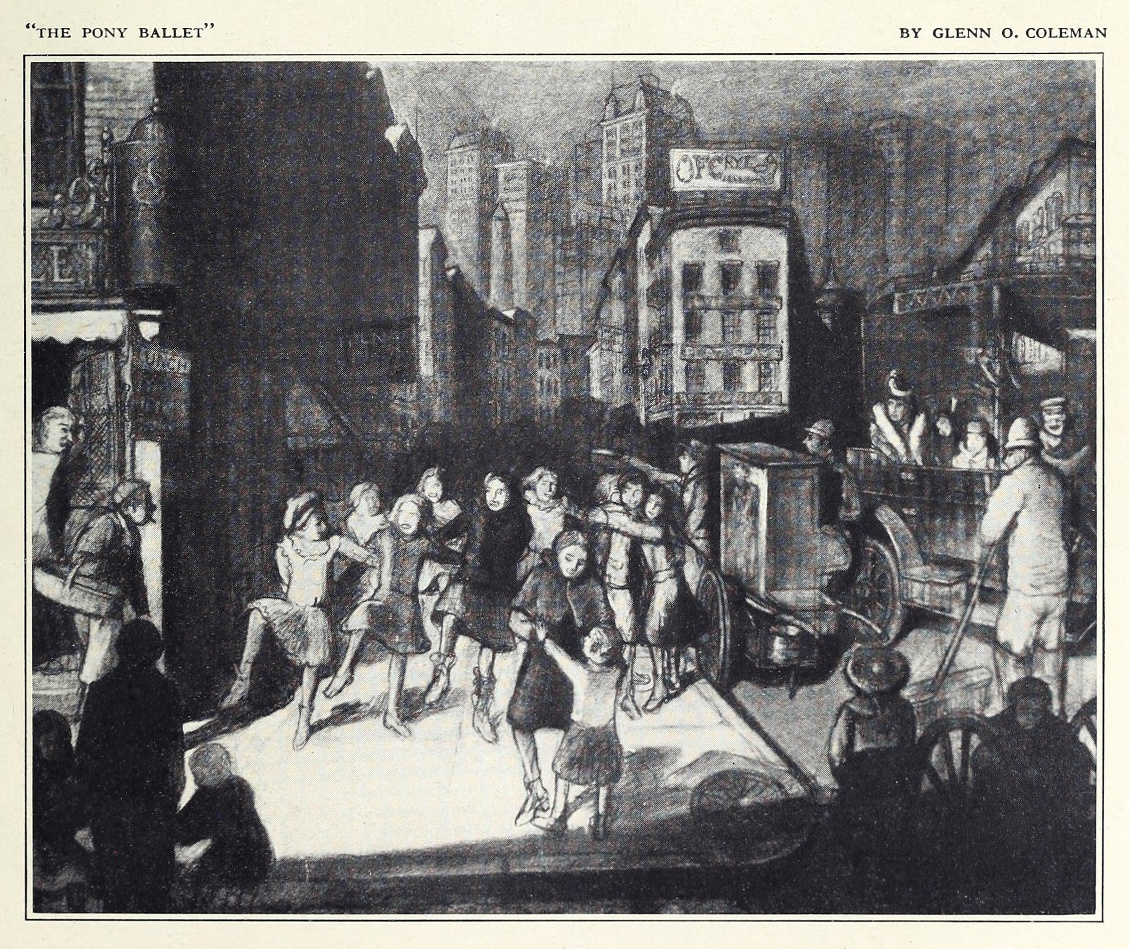
I’ve given the opening picture of Joralemon St. and Clinton St. a new light colorisation. Architectural record photographers such as Sperr tend to prefer very quiet times to make pictures, and we can thus assume that at other times this scene would have been alive with children, food-carts, vehicles, pedestrians, and other obstructions to making a record-picture. Here is a 1923 picture indicative of the sort of Italian/Irish New York street-corner life Lovecraft would have had to weave his way through to reach his cafe. Though one imagines that the affluent lady in the open chauffeur-driven car would have been a rare sight, in that part of New York…


Picture: Glenn O. Coleman, “The Pony Ballet”. A pony ballet was a very high-kicking chorus-girl dance-line, presented on the stage by the younger dancers in a theatre troupe. It usually formed an interlude between acts at a variety theatre.

In terms of the appearance of the streets we should also take into account the extreme weather in New York City during Lovecraft’s time there, which would seasonally have radically changed the nature of the streets. Such as the worst snowstorm in living memory from 1st-3rd January 1925. Lovecraft had barely moved in to his “dismal hovel” at 169 Clinton Street, on 31st December according to the date I have, before the storm hit the city. Then a searing killer heatwave settled on the city in June of 1925. There was a similar but slightly less searing heatwave in July 1926, though by that time Lovecraft had left New York. Worse was to come, as can be seen from this EPA chart, but Lovecraft was able to enjoy these in far more comfort. Indeed, it might be said that without the 1929-37 heatwaves, he would not have lived as long as he did…

Friday Picture Postals from Lovecraft: early silent cinema in Providence

31 Friday May 2019

Posted by asdjfdlkf in Historical context, Picture postals

≈ 2 Comments

Here we see a fine example of an early silent cinema in Providence, The Star Theatre, with its staff and there is even a glimpse of an adjacent fortune-telling caravan.

Local trade journals state this cinema was established 1899, and the cinema history book Silent Film Sound (2007) states that in 1915 the Star in Providence advertised a “New York two dollar show” at “local prices” and that this advert also promised a full orchestral accompaniment for the big movie The Birth of a Nation (1915) — which we know Lovecraft saw in Providence. One wonders if the lads in the centre of the picture served as the orchestra members, and presumably the children worked part-time as ushers, ticket-booth girls, sweepers, bill-posters and the like. There then being little prohibition on child-labour. What appears to be a fortune-telling caravan at the side is also rather remarkable, and media archaeologists may note it as another example of the close association of early cinema with the superstitious and uncanny.

The picture is undated but might be the early years of the 1910s. At this time Lovecraft was in his early 20s and still an avid cinema-goer. Lovecraft said in 1919, in a letter to Galpin…

“I formerly attended the cinema quite frequently, but it is beginning to bore me.”

He would thus have been familiar with this sort of cinema in the 1910s, if not with the Star especially (so far as I know). But, given the information above, there is a possibility that it was here he saw The Birth of a Nation.

The silver screens were not always flickering with Chaplin-esque comedians and melodramatic waifs and thundering cavalry, as nearby Pawtucket had long had a Governor-sponsored programme of educational cinema, on which Lovecraft’s friend and associate Dench commented favourably in his book Motion Picture Education (1917). Interpreters presented a five-minute summary of the scenario and inter-titles, before each silent picture, for audience members who did not yet read English. This was at the grander baroque 1,500-seat Pawtucket Star Theater, which seems to have been involved from the start in the push for educative cinema in Rhode Island. It’s not to be confused with the Providence Star.

The Star’s “Nov 2nd” posters, seen in the picture, proclaim that a “Japanese Troupe” was the vaudeville act during that week. Their name is difficult to read but appears twice and must be Azuma, implying they were Kabuki dancers and performers. Incidentally, a Japanese star was one of Lovecraft’s two favourite actors on the silent screen, the young Sessue Hayakawa. This raises the slightly surreal vision of the staunch Anglophile editor of The Conservative sitting in his seat waiting for a Sessue Hayakawa movie to start, being first entertained by a lively Japanese Kabuki troupe in full costume…

He was after all “prodigiously keen” on such things, as he wrote in a letter…

My admiration of Japanese art — dating from the days when my infant eyes rested upon various screens, fans, & bits of pottery at the old home – has always been prodigiously keen, & this stationery embodies some of its most attractive characteristics. The combination of utter simplicity, perfect harmony, & civilised repose is quite irresistible – & forms something which could never be duplicated [by cultures] outside Japan. The Japanese carry the spirit of art into the smallest details of life more fully than any other people since the Greeks – & it will be an irreparable loss if their newer generations lose the old spirit in an effort to assimilate western traditions.


Here’s the original picture scan without colorisation…

The card’s “early divided back” apparently dates it to 1907-1915. It’s currently for sale on eBay at an exorbitant price and will probably be re-listed after failing to sell.

Friday Picture Postals from Lovecraft: The Seekonk and Blackstone Park

17 Friday May 2019

Posted by asdjfdlkf in Astronomy, Maps, Picture postals

≈ 1 Comment

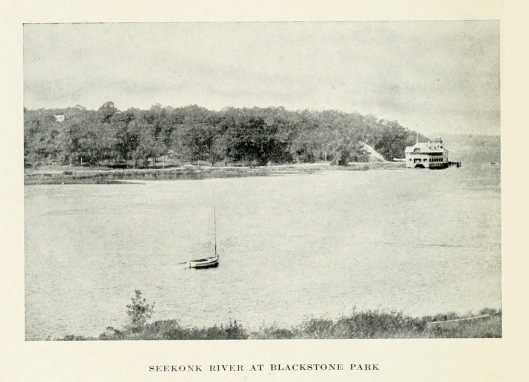
The lower Seekonk shoreline does not seem to have been much photographed for postcards, and there are few postcards of it online and only one of York Pond itself (after the grading and extraction works). This is the largest I have of this particular card.

Here’s H.P. Lovecraft on the Park and shoreline…

“Scarce a stone’s throw from the house lie the nearest parts of that beautiful rustick reservation known as “Blackstone Park” — wherein I have been wont to wander some twenty or more years [i.e. since about age eight]. Here Nature unadorn’d displays a multiplicity of agreeable phases; ravines, groves, brooklets, thickets, & Arcadian stretches of river-bank — for the park borders on the wide & salty Seekonk. The Seekonk is call’d a river, but in truth ’tis but a bay or inlet. The river proper doth not begin till four miles to the north, where (changing its name successively to the Pawtucket & the Blackstone) its fresh streams flow over the mill dam at the Great Bridge of the city of Pawtucket. How beauteous indeed is untainted Nature as beheld in so idyllick a spot as Blackstone Park! […] I think this park would explain why such a born & bred town man shou’d possess such a taste for rural musings & Arcadian themes!

Here’s a Blackstone Park sketch made by Whitman Bailey in 1916. Looking down a sylvan path and ride, toward the glinting of the distant Seekonk.

The young Lovecraft also had a view of the Park and the Seekonk from his home…

“The roof of 598 Engelstrasse is approximately flat, and in the days of my youth I had a set of meteorological instruments there. Hither I would sometimes hoist my telescope, and observe the sky from that point of relative proximity to it. The horizon is fair, but not ideal. One can see the glint of the Seekonk through the foliage of Blackstone Park, and the opposite bank is quite clearly defined.”

One can glimpse a house with a flat roof and just such a view here (from The southern gateway of New England, 1910). The picture-maker looks across at the shore ride, from near Red Bridge…

The shoreline structure seen here is the Boat Club boathouse, thus by looking at maps one can see that the house glimpsed in the trees is likely to be one of those lining Lovecraft’s Angell St.

As one can also see above, the shoreline road was relatively low. No attempt seems to have been made to preserve the shore drive from being covered by the inevitable ten-year winter flood-surge. Indeed, Lovecraft dreamed of such things, but weirdly inverted and horribly revealing rather than covering…

“I was standing on the East Providence shore of the Seekonk River, about three quarters of a mile south of the foot of Angell Street, at some unearthly nocturnal hour. The tide was flowing out horribly — exposing parts of the river-bed never before exposed to human sight. Many persons lined the banks, looking at the receding waters & occasionally glancing at the sky. Suddenly a blinding flare — reddish in hue — appeared high in the southwestern sky; & something descended to earth in a cloud of smoke, striking the Providence shore near the Red Bridge — about an eighth of a mile south on [of?] Angell Street. The watchers on the banks screamed in horror — “It has come — It has come at last!” — & fled away into the deserted streets. [Blind panic ensues] By this time the river-bed was fully exposed — only the deep channel filled with water like a serpentine stream of death flowing through a pestilential plain in Tartarus.” (1920)

There evidently were floods but the natural inundations of winter were brief, expected and subsided. In summer he would often sit all day on the surviving southern bluff above York Pond, reading and writing. In 1927, a letter was headed as from… “High Wooded Bluff Above the Seekonk River – a mile East of 10 Barnes St.” He sometimes even shared his childhood haunt with close friends. Here is an instance from 1927…

“the next day we [he and Cook and Munn] lounged about the Blackstone Park woods beside the Seekonk — agrestick haunt of my earliest infancy, and true genesis of my pastoral soul.”

In a letter of 1934 he remarks…

Almost every warm summer afternoon I take my work or reading in a bag & set out for the wooded river-bank [on the Seekonk] or the fields & woods north of Providence — spending the time till dusk in one or more favourite rustic spots.


A year after Lovecraft passed away, a terrific natural flood struck Providence…

This must surely have also swept up the Seekonk and around his cherished wooded bluff in Blackstone Park, but understandably there seems to be no photo made of the Park shoreline at that time. Evidently the foliage and wildlife of the ponds at that point must be used to such occasional inundations.

Friday Picture Postals from Lovecraft: the lost railway worlds

10 Friday May 2019

Posted by asdjfdlkf in Historical context, Picture postals

≈ 1 Comment

An especially nice view of the main railway station in Providence, showing its relation to the trolley (tram) interchange and park. The design of the cars date it to Lovecraft’s time, perhaps the mid 1930s. In style and mood it evokes Lovecraft’s eventual and joyous return to his home city from his 1920s sojourn in New York, but in its perspective view and sweep it also evokes something of his boyish love of his own home-made miniature railways. And of surveying their layouts and terrains, from just this sort of vantage point.

“The trains fascinated me [as a small boy], & to this day I have a love for everything pertaining to railways.”

He appears to have read vast numbers of early Munsey proto-pulp story magazines that dealt with railroads, including the entire run of Railroad man’s Magazine. This mixed rip-roaring adventure, ‘tall tales of the rails’ from old-timers, true-life accounts and short non-fiction.

One of his own early ‘household and friends’ publications was The Railroad Review. In middle-childhood he made his own systems, seemingly (though not mentioned by him below) in the large coach-house / stable which had previously housed the family carriage and horse…

[Alongside my early love of the 18th century … ] “my parallel fascination with railways & street-cars led me to construct large numbers of contemporary landscapes with intricate systems of tin trackage. I had a magnificent repertoire of cars & railway accessories — signals, tunnels, stations, &c — though this system was admittedly too large in scale for my villages. My mode of play was to construct some scene as fancy — incited by some story or picture — dictated, & then to act out its life for long periods — sometimes a fortnight—making up events of a highly melodramatic cast as I went. These events would sometimes cover only a brief span — a war or plague or merely a spirited pageant of travel & commerce & incident leading nowhere — but would sometimes involve long aeons, with visible changes in the landscape & buildings. Cities would fall & be forgotten, & new cities would spring up. Forests would fall or be cut down, & rivers (I had some fine bridges) would change their beds. […] Horror-plots were frequent, though (oddly enough) I never attempted to construct fantastic or extra-terrestrial scenes. […] There was a kind of intoxication in being lord of a visible world (albeit a miniature one) & determining the flow of its events.”

Such activities are common to many intelligent and craft-minded boys in middle-childhood, but the difference here is the sustained storytelling and development of such over several weeks per miniature layout.

A railroad track in decay famously features in his later work, as the line out of Innsmouth. In this he might be seen as nodding to other writers who had earlier used a ‘follow the railway lines’ plot point in post-apocalyptic settings, but it was more likely just the obvious route of escape required by the story.

Underground tram-ways also feature elsewhere in his work, in either real-world form (“Nyarlathotep”, in which only the subway entrances appear) or in disguised horror-fantasy forms (“The Festival”, in which the descent echoes the manner of going down into a subway in company with a shuffling crowd, whereupon the celebrants then mount a line of indeterminate ‘creature-vehicles’ which arrive, and are carried away into the darkness — much like entering and being carried away by subway cars).

Friday Picture Postals from Lovecraft: Salem Pioneer Village

03 Friday May 2019

Posted by asdjfdlkf in Historical context, Picture postals

≈ Leave a comment

Salem Pioneer Village was and is “the first living history museum in the United States”. It opened in June of 1930, with a full three-acre reconstruction showing visitors what life was like for the colony in 1630.

Lovecraft visited a few years later and wrote of it…

[1933]

“Among the novelties at Salem was a perfect reconstruction of the original pioneer settlement of 1626–30, with the crude shelters, wigwams, huts, & cottages which preceded the building of actual houses of European size, pattern, & solidity. Of course no originals of these rude domiciles survive, but accurate scholarship has been able to fashion pretty definite facsimiles from detailed contemporary accounts. The restored village is situate in a park at the harbour’s edge, amidst a landskip made to look as much as possible like the primal topography of Salem. Not only are the early huts represented, but typical industries like blacksmith-shops, salt works, fish-drying outfits, saw-pits, & the like are faithfully shewn. The whole forms the clearest & most vivid presentation I have ever seen of the very first stage of New-England life, & ought to help anyone to reestablish the true ancestral orientation which these disorder’d times so gravely disturb.

[1933]

“… the climax [of Salem] was the splendid reproduction of the pioneer Salem settlement of 1626 et seq., carefully constructed & laid out in Forest River Park. It consists of a generous plot of ground at the harbour’s edge, painstakingly landscaped & covered with absolutely perfect duplicates of the very earliest huts & houses – dwellings of a sort now utterly vanished. All the early industries are also reproduced – there being such things as an ancient saw-pit, black-smith shop, salt-works, brick-plant, fish-drying outfit, & so on. Nothing else that I have ever seen gives one so good a picture of the rough pioneer life led during the first half-decade of New England colonisation.”

[1934]

“The lore of ‘yarbs’ [herb-lore] is a definite element in the colour of early America, & one of the salient features of the reproduced pioneer village in Salem is a garden where all the traditional species are cultivated, so that the visitor may see them both growing, & hung up on walls & rafters to dry.”

Friday Picture Postals from Lovecraft: Pawtucket / Pawtuxet / Pawcatuck

26 Friday Apr 2019

Posted by asdjfdlkf in Astronomy, Historical context, Picture postals

≈ 1 Comment

Sleepy Pawtuxet. The view looks across the Pawtuxet bridge toward Broad St. Note the electric trolley car nestled in its terminus bay, presumably having arrived from Providence, and the Lovecraft-alike man on the right of the picture walking away from it. Lovecraft had a regular 1906 column in the Pawtuxet Valley Gleaner at about the time of this card (probably photographed c. 1906 or 07), with astronomy articles such as “Is Mars an Inhabited World?”. The card photographer was very unlikely to have caught a 16 year old Lovecraft crossing the bridge to make the trolley connection to Phenix, though he is known to have worn his father’s clothes as might be the case with the man seen here. But the card is indicative of a scene he would have known, had he travelled out to the Gleaner newspaper offices or simply taken an early-springtime walk down that way.

I should clarify a possible point of placename confusion for those reading Lovecraft’s letters. Pawtuxet is not Pawtucket. Pawtucket now appears to be effectively a suburb of Providence, and lies to the north of the city beyond Swan Point Cemetery and at the head of what seems to be the navigable part of the River Seekonk…

… while Pawtuxet is in the far south and just beyond Providence, at the head of a river-valley where that valley meets the Providence River as it starts to meet the ocean. Of the two places Pawtuxet was by far the more sleepy and homey place in Lovecraft’s time. This is confirmed by an author in The Survey of 1922, which gives a vivid flavour of the trolley-ride Lovecraft would have had there…

As the [inexpensive electric trolley] car turns south from Providence, out toward the Pawtuxet Valley, it passes through about nine miles of usual city outskirts. Then suddenly, round a curve, rows of little white clapboard houses appear grouped about a mill close to the sides of the river; and on the hill where once also stood the company store, is the spotless white frame company church. The whole picture is flanked by hills and rolling farm lands. The car has entered “the Valley.” It is a different world. Many inhabitants have never visited the city nine miles away.

Although the Pawtuxet Valley Gleaner offices were out in Phenix, so to visit them from Pawtuxet Lovecraft would then have change trolleys and taken another trolley or bus going west some 12 miles along and deep into the Pawtuxet Valley. I imagine he would taken this more scenic route — Providence – Pawtuxet – Pawtuxet Valley – Phenix, which is only about 21 miles in total. This was apparently one is his mother’s home-places when she was growing up, which was why the Gleaner — the valley’s main paper — was still taken in Lovecraft’s home.

The even sleepier Phenix, circa 1908.

An example of Lovecraft’s column in the weekly paper, 1906…


Later, in the late 1920s and early 1930s, Lovecraft would take friends down to Pawtuxet on the trolley and the place was evidently then known for its fine seafood dinners at the local restaurants. These were presumably on the “shore”, and probably rather affordable given the usual state of Lovecraft’s finances…

On the way back I blew Price [‘treated Price’] to a typical R. I. [Rhode Island] clam dinner at antient Pawtuxet and later stopt at a Waldorf [chain restaurant] to tank up my’self.”

Still another trip was to old Pawtuxet — where, as with Price, I watched Morton eat a shore dinner.

Kirk & his wife passed through Providence on the last lap of a long New England motor tour. I took him to the ancient & unchanged fishing village of Pawtuxet, down the bay.

I imagine that Lovecraft might have been tempted to tantalise his friends while showing them around, by mentioning that Pawtuxet had featured as a substantial setting in his unpublished novel Dexter Ward. Written 1927, the book was not to be published until 1941…

He must likewise have begun to practice an extreme care and secrecy in his graveyard expeditions, for he was never again caught at such wanderings; whilst the rumours of uncanny sounds and manoeuvres at his Pawtuxet farm diminished in proportion. His rate of food consumption and cattle replacement remained abnormally high…

“the creaking of Epenetus Olney’s new signboard … was exactly like the first few notes of the new jazz piece all the radios in Pawtuxet were playing”.


Whipple.org has further useful clarification of the placenames, and warns of a third element of potential confusion, in the article “Pawcatuck, Pawtucket, Pawtuxet: Three Places in Rhode Island?”.

Sadly, the feline-loving Lovecraft never made use of ‘Pawcatuck’ in the kitty sense (one imagines a possible witty word-playing poem on the three Paw-places, re: his inevitable encounters with their paw-padding cats). Though it is deemed the site of ‘faery’ in “Dexter Ward”…

… after a few heralding cards the young wanderer quietly slipped into New York on the Homeric and traversed the long miles to Providence by motor-coach, eagerly drinking in the green rolling hills, the fragrant, blossoming orchards, and the white steepled towns of vernal Connecticut; his first taste of ancient New England in nearly four years. When the coach crossed the Pawcatuck and entered Rhode Island amidst the faery goldenness of a late spring afternoon his heart beat with quickened force, and the entry to Providence along Reservoir and Elmwood avenues was a breathless and wonderful thing despite the depths of forbidden lore to which he had delved.

Friday Picture Postals: Friend’s Beans

19 Friday Apr 2019

Posted by asdjfdlkf in Historical context, Picture postals

≈ Leave a comment

Above: (top) possibly late 1940s judging by the style and use of colour; (bottom) an ‘instant communication’ postcard on 1909, presumably of use to those with very poor handwriting.

Lovecraft once wrote…

Prof. Kittredge of Harvard has written a book of old New England lore based on the Farmer’s Almanack — its contents and history. I have this volume — you really ought to read it! It’s as much a part of a New England education as Friend’s Beans!” — Lovecraft letter to Morton, October 1927.

Beans were a local Boston speciality and were of course a favourite and staple of Lovecraft’s frugal diet…

Fortunately I have reduced the matter of frugal eating to a science, so that I can get by on as little as $1.75 per week by purchasing beans or spaghetti in cans and cookies or crackers in packages.

Although when living alone in New York City it seems he was forced to Heinz beans…

… you take a medium-sized loaf of bread, cut it in four equal parts, & add to each of these 1/4 can (medium) Heinz beans & a goodly chunk of cheese. If the result isn’t a full-sized, healthy day’s quota of fodder for an Old Gentleman, I’ll resign from the League of Nations’ dietary committee!! It only costs 8 cents — but don’t let that prejudice you! It’s good sound food…

One hopes the results were then simmered in a pan or placed in an oven, but I have a feeling that for Lovecraft it was often a cold dish. Especially during the killer heatwave summers New York had at that time.

The choice of Heinz was perhaps because they were cheaper (we tend to forget how expensive food was compared to the cheap abundance of today). Or that Friends’ was not a brand popular in New York City and thus unobtainable there. Many food and restaurant brands were regional rather than national, at that time. Made in Boston, the brand had historical roots which would have appealed to Lovecraft’s regional rootedness…

Note also here the canned bread, presumably canned in much the same way as pemmican.

Incidentally, the book mentioned above by Lovecraft was The old farmer and his almanack. Lovecraft had acquired the 1904 original, not the 1920 edition linked above. The Hartmann letters on astrology show that Lovecraft had had The old farmer and his almanack since shortly after its publication in 1904. Judging by the contents list, one wonders if it occasionally served as an inspiration-mine for Lovecraft…

George Lyman Kittredge (1860-1941) was an expert on aspects of English literary history (Gawain, Shakespeare and others), who later became learned on aspects of the publications of Cotton Mather and the history of New England Witchcraft belief. Kittredge was the sort of person who Lovecraft might have ventured to address by letter on some point of fact, but I’m not aware of him being a Lovecraft correspondent.

Friday picture postals from Lovecraft: the View from Prospect Terrace (ultrawide edition)

12 Friday Apr 2019

Posted by asdjfdlkf in Historical context, Picture postals

≈ Leave a comment

Here’s an ultrawide double-sized fold-out postcard of the View from Prospect Terrace, Providence. This was, of course, a favourite Lovecraft place. Especially when the city and sky burned with a fine sunset. Presumably also in that quiet time when most of the Terrace’s talkative daytime sitters had gone home for their tea, and the evening lovebirds had not yet arrived…

to me the quality of total, perfect beauty [is] a mass of mystical city towers and roofs and spires outlined against a sunset and glimpsed from a fairly distant balaustraded terrace. (Selected Letters III)

This postcard, wide though it is, was obviously cropped from an even wider plate as can be seen here…

The old Providence view from Prospect Terrace…

← Older posts
Newer posts →


Please become my patron at www.patreon.com/davehaden to help this blog survive and thrive.

Or donate via PayPal — any amount is welcome! Donations total at Easter 2025, since 2015: $390.

Archives

  • February 2026
  • January 2026
  • December 2025
  • November 2025
  • October 2025
  • September 2025
  • August 2025
  • July 2025
  • June 2025
  • May 2025
  • April 2025
  • March 2025
  • February 2025
  • January 2025
  • December 2024
  • November 2024
  • October 2024
  • September 2024
  • August 2024
  • July 2024
  • June 2024
  • May 2024
  • April 2024
  • March 2024
  • February 2024
  • January 2024
  • December 2023
  • November 2023
  • October 2023
  • September 2023
  • August 2023
  • July 2023
  • June 2023
  • May 2023
  • April 2023
  • March 2023
  • February 2023
  • January 2023
  • December 2022
  • November 2022
  • October 2022
  • September 2022
  • August 2022
  • July 2022
  • June 2022
  • May 2022
  • April 2022
  • March 2022
  • February 2022
  • January 2022
  • December 2021
  • November 2021
  • October 2021
  • September 2021
  • August 2021
  • July 2021
  • June 2021
  • May 2021
  • April 2021
  • March 2021
  • February 2021
  • January 2021
  • December 2020
  • November 2020
  • October 2020
  • September 2020
  • August 2020
  • July 2020
  • June 2020
  • May 2020
  • April 2020
  • March 2020
  • February 2020
  • January 2020
  • December 2019
  • November 2019
  • October 2019
  • September 2019
  • August 2019
  • July 2019
  • June 2019
  • May 2019
  • April 2019
  • March 2019
  • February 2019
  • January 2019
  • December 2018
  • November 2018
  • October 2018
  • September 2018
  • August 2018
  • August 2015
  • July 2015
  • April 2015
  • March 2015
  • February 2015
  • January 2015
  • December 2014
  • November 2014
  • October 2014
  • September 2014
  • August 2014
  • July 2014
  • June 2014
  • May 2014
  • March 2014
  • February 2014
  • January 2014
  • December 2013
  • November 2013
  • October 2013
  • September 2013
  • August 2013
  • July 2013
  • June 2013
  • May 2013
  • April 2013
  • March 2013
  • February 2013
  • January 2013
  • December 2012
  • November 2012
  • October 2012
  • September 2012
  • August 2012
  • July 2012
  • June 2012
  • May 2012
  • April 2012
  • March 2012
  • February 2012
  • January 2012
  • December 2011
  • November 2011
  • October 2011
  • September 2011
  • August 2011
  • July 2011
  • June 2011
  • May 2011
  • April 2011
  • March 2011
  • February 2011
  • January 2011
  • December 2010
  • November 2010
  • October 2010
  • September 2010
  • August 2010
  • July 2010

Categories

  • 3D (14)
  • AI (70)
  • Astronomy (70)
  • Censorship (14)
  • de Camp (7)
  • Doyle (7)
  • Films & trailers (101)
  • Fonts (9)
  • Guest posts (2)
  • Historical context (1,095)
  • Housekeeping (91)
  • HPLinks (74)
  • Kipling (11)
  • Kittee Tuesday (92)
  • Lovecraft as character (58)
  • Lovecraftian arts (1,626)
  • Lovecraftian places (19)
  • Maps (70)
  • NecronomiCon 2013 (40)
  • NecronomiCon 2015 (22)
  • New books (966)
  • New discoveries (165)
  • Night in Providence (17)
  • Odd scratchings (984)
  • Picture postals (276)
  • Podcasts etc. (431)
  • REH (184)
  • Scholarly works (1,469)
  • Summer School (31)
  • Unnamable (87)

Get this blog in your newsreader:
 
RSS Feed — Posts
RSS Feed — Comments

H.P. Lovecraft's Poster Collection - 17 retro travel posters for $18. Print ready, and available to buy — the proceeds help to support the work of Tentaclii.

Proudly powered by WordPress Theme: Chateau by Ignacio Ricci.