• About
  • Directory
  • Free stuff
  • Lovecraft for beginners
  • My Books
  • Open Lovecraft
  • Reviews
  • Travel Posters
  • SALTES

Tentaclii

~ News & scholarship on H.P. Lovecraft

Tentaclii

Category Archives: Picture postals

‘Picture Postals’ from Lovecraft: Mammoth Cave

26 Friday Jun 2020

Posted by asdjfdlkf in Picture postals

≈ 1 Comment

In early April 1905 a 15 year old H.P. Lovecraft walked down the old hill into town, buffeted and chilled by the unusually windy and snowy season. There he snuggled down in the warmth and silence of the Public Library and spent “days of boning at the library”, as he later said. The word ‘boning’ here being schoolboy shorthand for the elbows-on-the-table hardness of steady study — and perhaps also the dog-at-a-bone tenacity needed to do it.

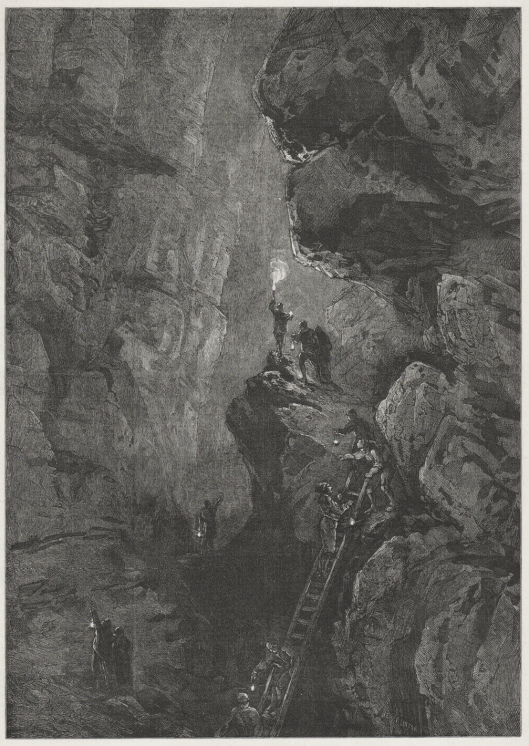
His research subject was the Mammoth Cave in distant Kentucky, a vast and reputedly endless cave system that had already been well-mined by juvenile writers. It was to form the setting of his juvenile tale “The Beast in the Cave”, of which S.T. Joshi states “the finished version dates to April 21, 1905”. While the photographic postcards of the 1920s and 30s were at that point still decades distant, Lovecraft would almost certainly have dug up evocative engravings made in the 1880s and 90s by Edwin Hopper and others…

The Descent

The River Cliffs

On Echo River, with the hint of a lost doorway being discovered.

Cyclopean formations

So far as I know he never visited Mammoth Cave, but he did take a long trip to see the Endless Caverns, which I’ve documented in another post.

‘Picture Postals’ from Lovecraft: a cool ice-cream in a hot Red Hook

19 Friday Jun 2020

Posted by asdjfdlkf in Historical context, Picture postals

≈ Leave a comment

‘Picture Postals’ from H.P. Lovecraft, part of an ongoing series.

Sabrett’s horse-drawn ice-cream cart in Red Hook, Brooklyn, New York City. Also selling coffee, candy etc. On the corner of Bush and Clinton Street, about a mile south of Lovecraft’s room in the notorious Red Hook.

“On December 31, 1924, I established myself in a large room … at 169 Clinton St.”

“Sometimes I get a dime’s worth of ice-cream for breakfast” (said of 1934, but just as likely after his walks in Brooklyn).

“It takes no effort at all [to imagine] that I am still 12 years old, and that when I go home it will be through the quieter, more village-like streets of those days — with horses and wagons, and little varicoloured street cars with open platforms…”

‘Picture postals’ from Lovecraft: the Hayden Planetarium

12 Friday Jun 2020

Posted by asdjfdlkf in Astronomy, Historical context, Picture postals

≈ 1 Comment

H.P. Lovecraft spent Christmas and New Year 1935/36 visiting New York City and, as he told Robert Bloch in a letter, his “high point” stop was the new Hayden Planetarium. This was a just-opened New York marvel, built and fitted out in double-quick time with the aid of the philanthropist Charles Hayden. It had opened on the 2nd October 1935. Those were the days when one could go from drawing-board to opening day in 18 months, even in New York City.

The above leaflet describes the institution as it was in the 1940s, and is just about readable. The top postcard shows a charcoal drawing by Walter Favreau.

The Planetarium had a huge 700+ seat circular projection chamber, and permanent/temporary exhibition galleries on the history of astronomy and the solar system. It was far more than a planetarium, being creatively masterminded throughout by the pioneering cosmic artist and multi-media designer Walter Favreau. As such it was far more than a quick 90-minute in-and-out popcorn show for Lovecraft. It had several giant meteorites on display, and was the sort of place a keen astronomer and science-fiction writer might spend a day and an evening. Lovecraft went twice, and probably lingered. His comment that it “seems to be crowded at all hours” might suggest that at least one of his visits was in the evening.

His fiction writing days were over by this point, having written “The Haunter of the Dark”, but the Hayden Planetarium went on to inspire many others of genius. As Lovecraft told Bloch, the institute was “the most impressive educational device I had ever encountered”. Over the subsequent years and decades it became a vital place for interesting new generations in outer space and the stars, and also provided work for many early space artists. By 1952 it had seen about five million visitors.

Here is Lovecraft in a letter to Galpin of January 1936, describing his two visits…

On two occasions — once with Sonny [Belknap Long] & once with Sonny & Wandrei — I visited the new Hayden Planetarium of the Am.[erican] Museum, & found it a highly impressive device. It consists of a round domed building of 2 storeys. On the lower floor is a circular hall whose ceiling is a gigantick orrery — shewing the planets revolving around the sun at their proper relative speeds. Above it is another circular hall whose roof is the great dome, & whose edge is made to represent the horizon of N.Y. as seen from Central Park.

In the centre of this upper hall is a curious projector which casts on the concave dome a perfect image of the sky — capable of duplicating the natural apparent motions of the celestial vault, & of depicting the heavens as seen at any hour, in any season, from any latitude, & at any period of history.

Other parts of the projector can cast suitably moveable images of the sun, moon, & planets, & diagrammatick arrows & circles for explanatory purposes. The effect is infinitely lifelike — as if one were outdoors beneath the sky. Lectures — different each month (I heard both Dec. & Jan. ones) — are given in connexion with this apparatus.

In the corridors on each floor are niches containing typical astronomical instruments of all ages — telescopes, transits, celestial globes, armillary spheres, &c. — & cases to display books, meteorites, & other miscellany. Astronomical pictures line the walls, &c; at the desk may be obtained useful pamphlets, books, planispheres, &c.
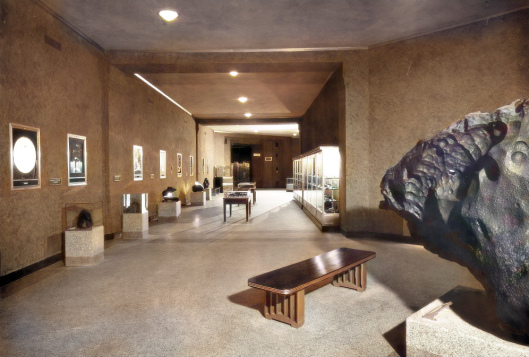
The institution holds classes in elementary astronomy, & sponsors clubs of amateur observers. Altogether, it is the most complete & active popular astronomical centre imaginable. It seems to be crowded at all hours — attracting a publick interest in astronomy which did not exist when I was young.
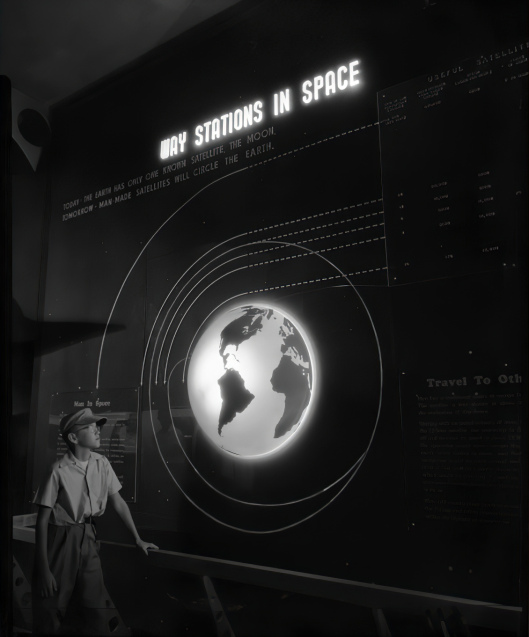
One of the backlit displays of the 1950s.

Doubtless Lovecraft would have thought of how much his grandmother Robie (Rhoby) would have admired such a place…

My maternal grandmother, who died when I was six, was a devoted lover of astronomy, having made that a specialty at Lapham Seminary, where she was educated.

As a boy he inherited her astronomy books and, it seems, some of her equipment.


Lovecraft does not mention the giant hallway paintings, indicating only that “Astronomical pictures line the walls”. One might imagine dull diagrams. But it seems that many were either quite visionary or were early imaginative ‘space art’ in the Chesley Bonestell manner, and by the noted dinosaur and prehistoric artist Charles R. Knight who was here branching out into star mythology. Here we get an idea of the scale of the visionary hallway art, which was apparently also boxed and backlit for added effect.
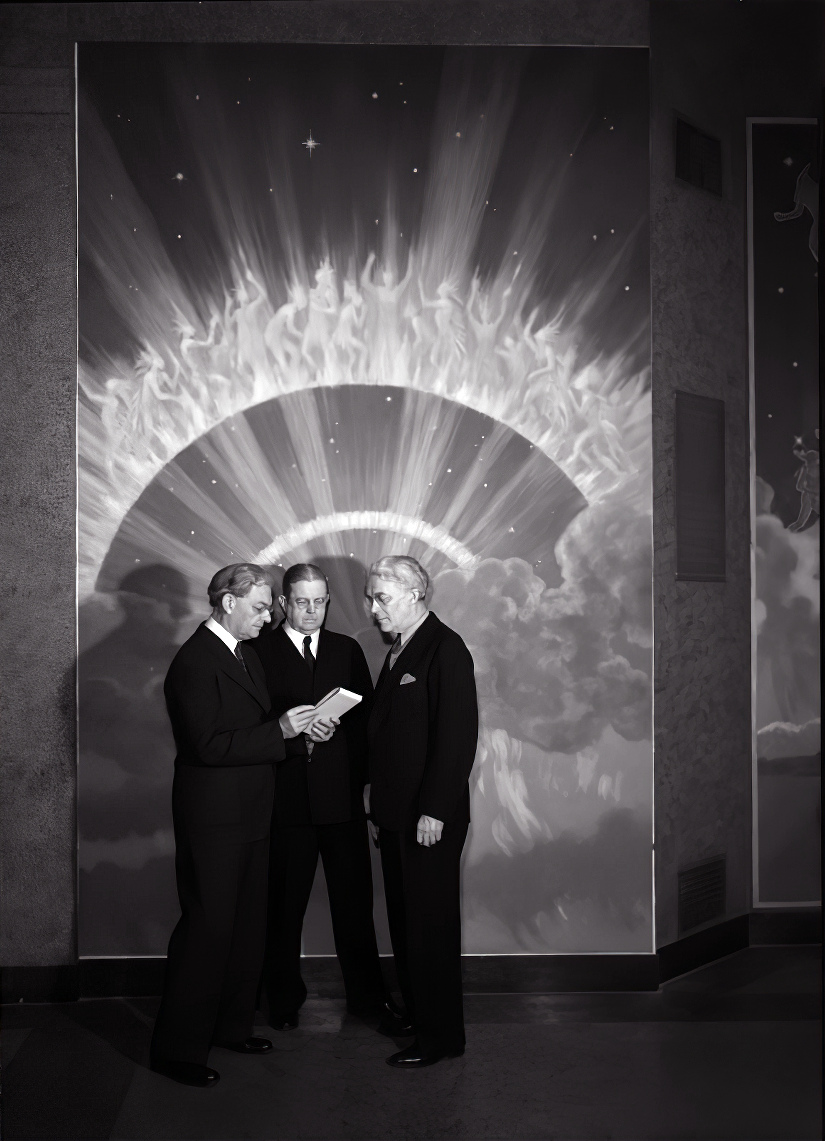
On the right, scientific director of the Hayden Planetarium, Dr. Clyde Fisher. On the left, probably the artist and designer Walter Favreau.

There were apparently others. Lovecraft might have especially relished a large-scale hallway painting made from this 1934 pre-production miniature by Walter Favreau of the ‘Destruction of New York’. The place’s lead designer and artist Favreau was especially interested in presenting cosmic catastrophe, and his planetarium sky-show apparently ended by illustrating five different ways the earth might one day perish. One ending featured a gigantic alien moon hurting toward the earth.
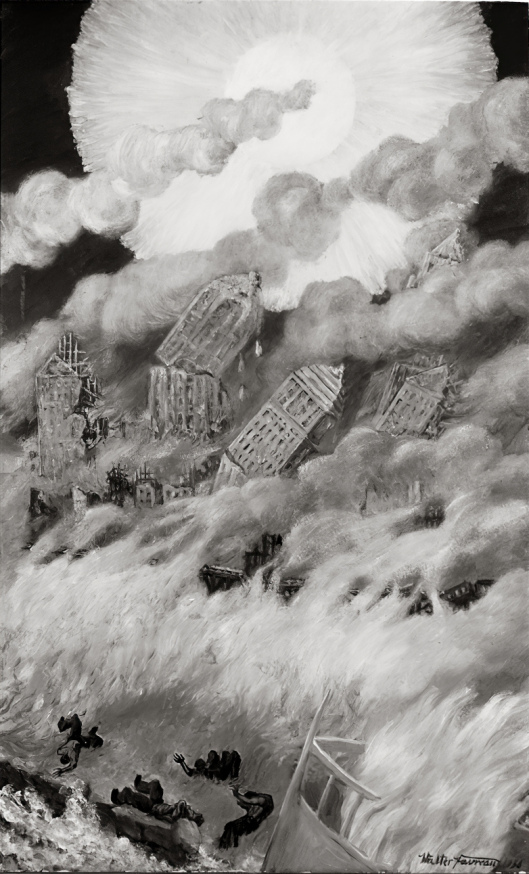
The idea that the sun would suddenly engulf our earth became a replacement for a previous doomsday scenario well-known in Lovecraft’s youth and young manhood. Here is H. G. Wells in 1931, remembering the way that this false scientific consensus be-numbed and hobbled the optimism of the late Victorians and early Edwardians, and indeed the world…

… the geologists and astronomers of that time told us dreadful lies about the “inevitable” freezing up of the world — and of life and mankind with it. There was no escape it seemed. The whole game of life would be over in a million years or less. They impressed this upon us with the full weight of their authority, while now Sir James Jeans in his smiling [book] Universe Around Us waves us on to millions of millions of years. Given as much as that man will be able to do anything and go anywhere, and the only trace of pessimism left in the human prospect today is a faint flavour of regret that one was born so soon.

This is from his 1931 preface to a new edition of his famous book The Time Machine (1895). Wells refers to the idea that the Sun only had a limited store of material to burn, and must inevitably cool as it would use this up before another million years had gone by — and with its depletion the Earth was also forever cooling and would relatively soon become inhospitable to life. Here is the Wells of 1894, noting the consensus of his day…

On the supposition, accepted by all scientific men, that the earth is undergoing a steady process of cooling …” (“Another Basis for Life”, Saturday Review, 22nd December 1894).

Possibly Lovecraft was influenced by this gloomy theory as late as early 1918, as he wrote to Kleiner then that… “In a few million years there will be no human race at all”.

Back home in Providence in the Autumn of 1936 the impoverished and increasingly ill Lovecraft was being misled in a different but no less calamitous way. He laboured at his desk not on new cosmic fiction, but on ‘Suggestions for a Reading Guide’. This being a long and involved general survey which was set to be the concluding chapter of Anne Tillery Renshaw’s Well Bred Speech — Lovecraft was effectively ghost-writing the book from her short chapter outlines for this textbook guide to English usage. He broke his health to get it finished, staying awake for 60 hours at a stretch and eating out of ancient tins unearthed from the back of his pantry. His ‘Suggestions’ chapter was discarded by Renshaw. But he slipped in one paragraph on the need for basic books on astronomy, mentioning the need to own a good star-atlas and planisphere…

The best contemporary star-atlas is Upton’s, but a quicker working knowledge of the constellations can be obtained by the use of a small revolving planisphere, such as is sold for a quarter at the new Hayden Planetarium in New York.

This one is from the Hayden in the 1950s, but they had looked much the same a decade or so earlier…
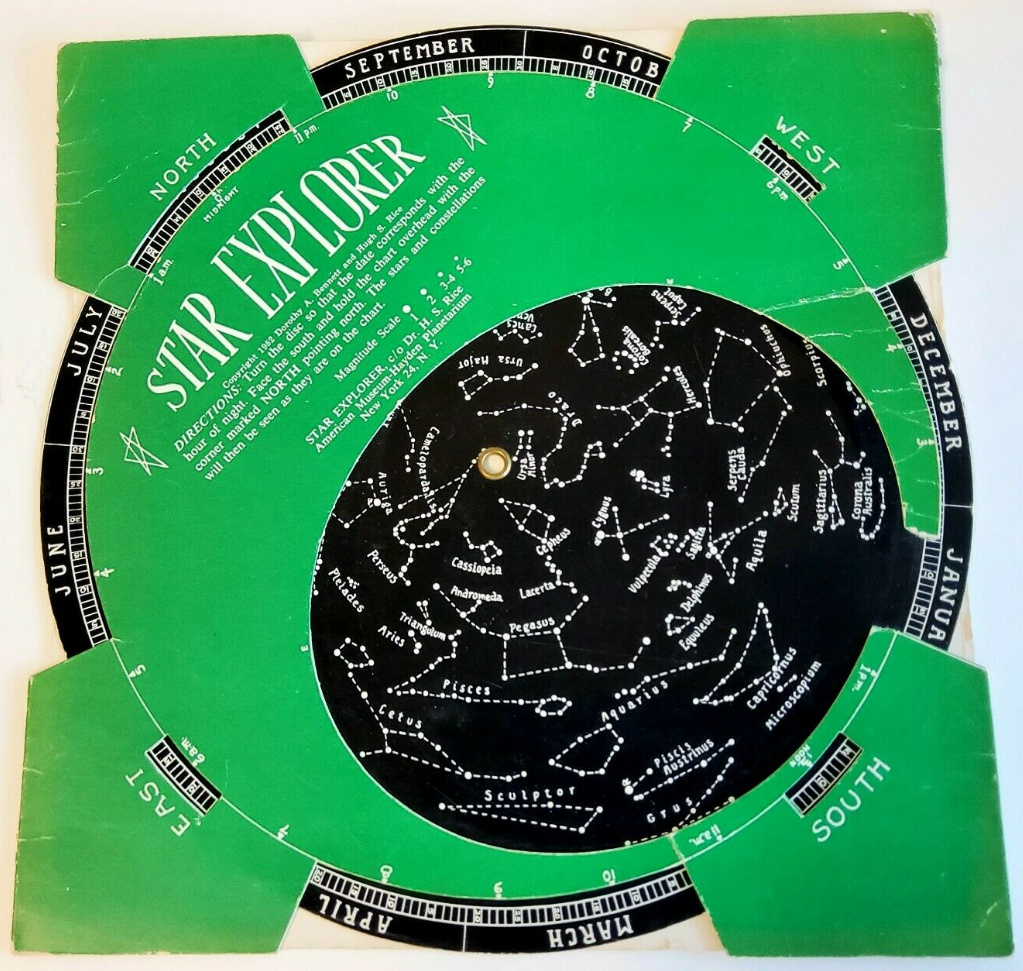
S.T. Joshi notes in I Am Providence…

Lovecraft bought two 25¢ planispheres [at the Hayden] and charitably gave them to [Belknap] Long and Donald Wandrei, so that they would make fewer mistakes in citing the constellations in their stories.

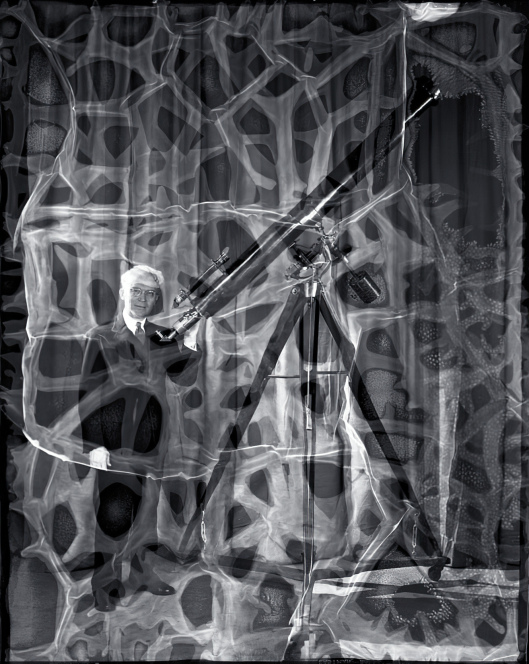
Finally here is the first scientific director of the Hayden Planetarium, Dr. Clyde Fisher. He was also the put-upon general manager for the first two years, but then a professional house manager was brought in and he was given the happier job of Curator of Astronomy. His portrait has since taken on a most Lovecraftian cast. Seemingly through natural decay in the archives, rather than the creeping invasion of cosmic outer entities, but you never know…

Further reading:

* “The Man Who Plays God”, a 1950 Mechanix Illustrated profile of the pioneering artist and designer Walter Favreau who masterminded the creative and presentational aspects of the Hayden Planetarium, including designing the sky-shows.

* More can also be found at the Hayden Planetarium website. It still exists, and welcomes donations in these difficult times. They might also welcome funding to locate and digitise their Sky: Magazine of Cosmic News, which began November 1936. It evidently featured a range of artists, not always purely astronomical. Here is a 1938 edition of Sky responding to the famous War of the Worlds broadcast…

* The current magazine of their parent Museum is Rotunda, which might welcome a good scholarly article on Walter Favreau. Favreau has evidently been utterly forgotten, even by the many assiduous historians of the space arts, space education and early multimedia. He appears to have begun his career as a toy-maker and tinkerer-inventor in New York City in the early 1910s, had a studio in the late 1920s at 20 East 41st Street making scale-models for architects, and was still being referred to as the creative director of the Planetarium in 1952 — when he was busy constructing a 32-foot scale-model of a von Braun moon rocket. One would expect to find him being at least mentioned in the substantial recent history of the form, Theaters of Time and Space: American Planetaria 1930-1970 (Rutgers University Press, 1987, 2005), whose author had a Doctoral Student Grant-in-Aid of Research for sustained work in the Hayden archives. Rather surprisingly this book has no mention of the USA’s leading planetarium artist of the period, though does find space for several sections on ‘planetariums and gender’.

Picture Postals: On Silver River

05 Friday Jun 2020

Posted by asdjfdlkf in Historical context, Picture postals

≈ Leave a comment

“Early in June [1934] I visited a most impressive spot — Silver Springs, some 60 miles from De Land [Florida, home of Robert Barlow. Presumably Barlow was with him.] Here is found a series of placid lagoons … whose floor is riddled with vast pits 30 to 60 feet deep, & covered with curious marine vegetation. In many places divers have encountered the huge bones of prehistoric animals … I saw these varied wonders from a glass-bottomed boat.

Out of the lagoons flows the Silver River, as typical a tropic stream as the Congo or Amazon, with tall palms, trailing vines & moss, & bending cypresses along the swampy banks. Alligators, turtles, & snakes abound, & on either side the jungle stretches away uninterruptedly for miles. … I took a 10 mile launch trip on the river, & could easily have imagined myself in the heart of Africa.” — Lovecraft in Selected Letters IV, page 414.

The leaflet adds the important point that the glass-bottom boats were electric, and therefore relatively silent and thus did not scare the fish away. He also visited New York some months later, to find his friend Belknap Long obsessed by his new hobby of tropical fish-keeping, thus giving another opportunity for close observation of the finny ones.

Evidently there were two types of trip, the “glass-bottom” boat trip and the speedboat “launch” trip of ten miles. Lovecraft talks as if he did both.

One wonders if this trip influenced his decision to set “The Shadow out of Time”, written nine months later, in the prehistoric era?

The ground and swamps were constantly alive with snakes, lizards, and crocodiles, while insects buzzed incessantly amidst the lush vegetation. And far out at sea unspied and unknown monsters spouted mountainous columns of foam into the vaporous sky. Once I was taken under the ocean in a gigantic submarine vessel with searchlights, and glimpsed some living horrors of awesome magnitude. I saw also the ruins of incredible sunken cities, and the wealth of crinoid, brachiopod, coral, and ichthyic life which everywhere abounded.” from — “The Shadow out of Time”.

Bloch, and possibly others, had also sent him pictures of the life-sized dinosaurs from the Chicago World’s Fair of 1933-34.

Dinosaurs as we know them today were then in their first flush of popularity, and Lovecraft also saw lit dioramas of them as models when he visited the Natural History Museum at New Haven, and he came away greatly impressed.

Lovecraft had a second opportunity for a jungle-like river exploration in June 1935, this time more primitive — but also free of things like the bored tour-guides and perpetually gossiping fellow-tourists who can ruin such trips. The second trip happened toward the end of his long final stay in Florida with young Barlow. The building of Barlow’s printing-house hut on his ‘island across the lake’ was finally completed around June 1935. He and Barlow rowed across to the island each day, and his comment that the “trip” made for “good exercise” suggests it was a fair distance. Lovecraft was quite familiar with rowing-boats, having at Barlow’s age made many solo trips up and down his native Seekonk. I’ve also established elsewhere that the Seekonk of the 1900s was a difficult river, thus Lovecraft would have had no fear of pulling across a mere lake (I presume Barlow’s military family had shot out all the alligators). As Lovecraft tells Bloch, he machete-hacked a track through the undergrowth to a road (presumably un-paved) that lay on the far side of the hut’s boat-landing. Possibly that was how the heavy and the noisy printing equipment was moved in, via his new track and perhaps a short raft journey. He and Barlow went on a celebratory expedition…

Bob’s cabin across the lake is now finished … we row across each day … [also] we explored a marvellous tropical river — with leaning palms, sunken logs, twister cypress roots and the water’s edge — etc etc etc — much like the river at Silver Springs which I described to you last year. This aught to make good descriptive material for some tale, some time … jungle stuff, to use as a background for pre-human ruins, & and all that.

Was this river accessible via an outlet from the lake, or perhaps by carrying the lake-boat along Lovecraft’s newly-hewn jungle track and over the road? The area is reported to have become far more well-drained and drier than it was in the mid 1930s, but the current satellite imagery still suggests a possible small winding river across the road, which looks as though it would be accessible with a small boat taken along the new-cut track…

Wherever the rather more rough-hewn river trip was, it was made after the final completion of “The Shadow out of Time”. Thus he never had the chance to use that particular ‘jungle’ experience in fiction. But finding the above quote further confirms my earlier hunch that, had he lived, some of his fiction would have gone in a ‘Solomon Kane in Africa’-like direction, probably set on the liminal frontier where Ancient Rome met the fringes of the African interior. Such a move could have followed on from his several non-cosmic stories that have a wide international spread in their plotting and back-stories, but here projected back in time in such a way that Lovecraft’s full knowledge of the diasporic Ancient Roman world and pagan rites and superstitions could have been brought to bear. Imagine “Rats” re-written for such a setting, for instance. He would also have been able to explore ideas of the decadence and decline of Empires, and degeneration in the face of certain types of environment.

Further reading:

Stephen J. Jordan, “H.P. Lovecraft in Florida”, Lovecraft Studies 42-43 (Summer/Autumn 2001). Now effectively inaccessible — something really should be done about getting the Lovecraft Studies journal online and searchable.

Picture postals: Providence Express

29 Friday May 2020

Posted by asdjfdlkf in Historical context, Picture postals

≈ Leave a comment

A Providence ‘trolley-car’. When Lovecraft refers in letters or a story to a ‘trolley’ or a ‘car’ this is the sort of public passenger vehicle he means. According to local transport buffs, they were green-and-cream in Providence until 1928, so I’ve colourised accordingly.

A Lovecraft dream of November 1927 involved a ‘trolley’…

“… under a grey autumn sky … lit up by a faint moonlight which had replac’d the expiring orb of day. Casting my eyes about, I beheld no living object; but was sensible of a very peculiar stirring far below me, amongst the whispering rushes of the pestilential swamp I had lately quitted. After walking for some distance, I encoun­ter’d the rusty tracks of a street-railway, & the worm-eaten poles which still held the limp & sagging trolley wire. Following this line, I soon came upon a yellow, vestibuled car numbered 1852 … It was untenanted, but evidently ready to start; the trolley being on the wire & the air-brake pump now & then throbbing beneath the floor. I boarded it & looked vainly about for the light switch — noting as I did so the absence of controller handle which implied the brief absence of the motorman. Then I sat down in one of the cross seats toward the middle, awaiting the ar­rival of the crew & the starting of the vehicle.

Presently I heard a swishing in the sparse grass toward the left, & saw the dark forms of two men looming up in the moonlight. They had the regulation caps of a railway company, & I could not doubt but that they were the conductor & motorman. Then one of them sniffed with singular sharpness, & raised his face to howl to the moon. The other dropped on all fours to run toward the car. I leaped up at once & raced madly out of that car & away across endless leagues of plateau till exhaustion waked me — doing this not because the conductor had dropped on all fours, but because the face of the motorman was a mere white cone tapering to one blood-red tentacle….”

Picture postals: “To the madhouse – and step on the gas, Joe!”

22 Friday May 2020

Posted by asdjfdlkf in Picture postals

≈ Leave a comment

A private ambulance of Providence, 1915. This was what Lovecraft must have had always somewhere at the back of his mind in that period, thinking that it might one day soon come to take him away to the asylum…

Lovecraft moves to 66 College Street

15 Friday May 2020

Posted by asdjfdlkf in Odd scratchings, Picture postals

≈ Leave a comment

On 15th May 1933 H.P. Lovecraft moved to his last home at 66 College Street.

Here we look down College Street, from the gates of the Brown Campus. Lovecraft’s pale yellow wooden house was hidden away in a secluded garden courtyard, reached down an unpaved little lane at the shadowy back of the John Hay Library. The Library is the tall white building seen on the right of the picture, and the lane entrance is on the corner — seen just a little ahead and in the centre of the picture.

At No. 66 he had more living space than formerly. This included access to a hoary old loft attic with age-encrusted nooks. Lovecraft also mentions “one of the attic rooms” to Bloch, shortly after moving in, and implies this was ‘shrine’ sized. There appear to have been loft windows (possibly shuttered, see below) in the ‘monitor’ roof, and there was an all round view. I recall reading that Brobst later found a way to open a mysterious attic door or hatchway, which the old gent had been unable to open himself, thus revealing another fine view. Presumably this was a door that gave workmen, chimney-sweeps and window-cleaners access to the roof. One imagines this was westerly-facing, as that would have also enabled a wider view across the sunset city than was obtainable from the small windows.

Some might imagine that this loft then became crammed with Lovecraft’s older and less-read books. In one letter he did anticipate using in in that way. But many of Lovecraft’s family items, and the childhood library of old long-s books, had to be stored in another and more distant loft which had stronger rafters. In 1934 Lovecraft mentioned to Barlow that the old books he had grown up with and inherited were stored in the loft of a friend’s nearby barn. There they had become inaccessible to him, because the removal men’s crates had been jammed between old family furniture and crates of heavy crockery. For those in search of this barn, the likely weight involved surely indicates that the loft’s boards and rafters were rather more substantial that those of 66 College Street. Thus a large and sturdy candidate is surely required for the barn.

What became of this inaccessible loft-library, that had once been so formative for Lovecraft in his isolated early childhood? We can be sure that his personal library retained his cherished old copies of the Spectator, similar works of his beloved 18th century wits and satirists, and the pick of the old library. But as for the rest, it’s uncertain, and Joshi’s Lovecraft’s Library doesn’t seem to offer an easy answer. I’d imagine that the residue of the family library was eventually hauled out of its barn, perhaps in spring 1941 a short while after Mrs Gamwell’s death, and sent down wholesale to be sold via the Dana bookshop in Providence? The interest in crates of mouldering 18th century books was perhaps not high during the Second World War, but some of the choicer items — such as the books once requested in vain by Barlow — may have found their way to appreciative collectors.


My enlargement and colourisation of the above picture…

Picture postals: Brown, the “Annmary Brown Memorial”

30 Thursday Apr 2020

Posted by asdjfdlkf in Historical context, Picture postals

≈ Leave a comment

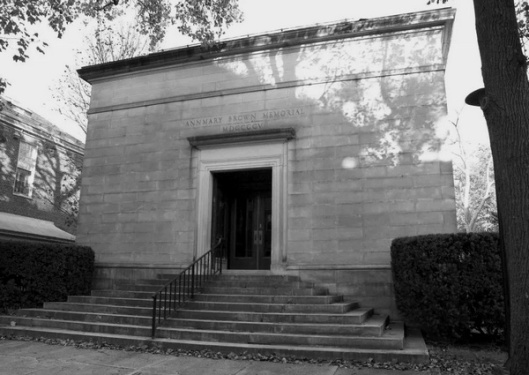
The Barlow letters reveal that H.P. Lovecraft knew the Annmary Brown Memorial, located on a quiet part of the Brown campus.

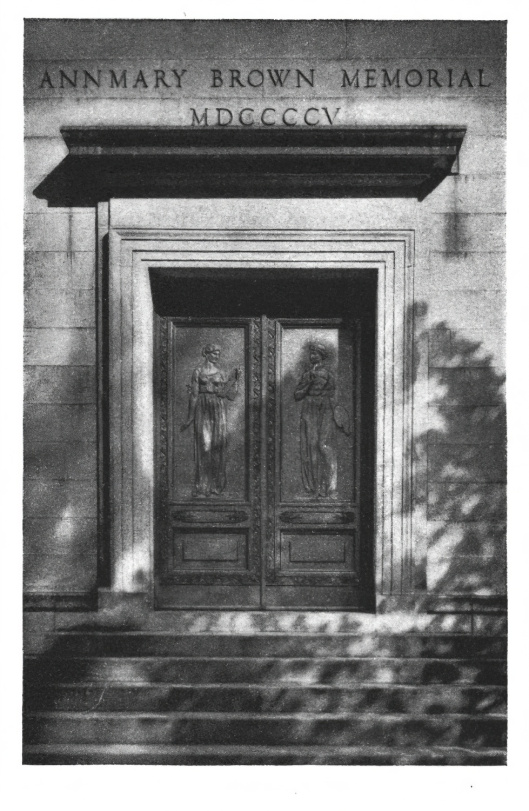
Picture: ‘Literature’ and ‘Art’ on the entrance doors.

The 1907 Memorial is at once a tomb, a 530-volume library of the rarest books from the presses of the first printers (circa 1450-1500, aka ‘incunabula’), and a substantial fine art gallery. Many early woodcuts were apparently also on display, showing their early use in book illustration. A catalogue for the Gallery was issued in 1913, and a descriptive essay book on the Memorial appeared in 1925. The latter evokes the scene as Lovecraft would have enjoyed it, after entering through the doors depicting personifications of ‘Literature’ and ‘Art’…

On a midwinter when a blanket of snow darkens the skylights overhead, the fire burns the brighter on the hearth. A sidelight from the glass doors of the vestibule catches on the burnished goldleaf of the initial letters and illuminated borders in the gallery of early printed books. Some ray will touch the lattice-work and tracery of the gold-bronze door which at the far end of the building leads into the mausoleum where General and Mrs. Hawkins lie entombed. … Like its exterior, the building itself is without embellishment save for the books and pictures with which its walls are lined. The entrance hail, its walls a neutral green, is hung with water-colours and etchings … At the left is the curator’s study with its reference books and cheery fire … an open doorway leads into the galleries, the first of which contains the early printed books. … In the tall glassed-in cases which line the walls of the first gallery, the shelves are made to slant like book rests. On them are laid these “first books”, opened such that their individual characteristics may be studied with ease; and an impressive display they make, their texts as clear and the linen paper almost as immaculate as the day they came from the press. … Venerable as they are, they show few marks of age as they rest content in the light and pure air of their final home. … A surprising number of these early printed books are still in their original bindings, oak boards covered with tooled pigskin or with vellum now taut with age, and in some instances with bosses and clasps still intact.

Picture: The book galleries as Lovecraft would have known them, and almost the same as in a 1908 picture of the same view. Note the Lovecraft-alike man in the next room, viewing the pictures.

Given the 1907 opening date and the original bindings of the books, there is the interesting possibility that such ancient books helped to form the young Lovecraft’s eventual idea of the Necronomicon, at least in terms of what the hoary tome might have looked like.

Offsetting the books was a huge vivid painting by veteran traveller and artist Edwin Lord Weeks. “The Golden Temple” formed a centrepiece of the Gallery section, and depicted the holy temple of the Sikhs. Lovecraft would have seen this work in its prime, as in later decades it was long used as a ‘test canvas’ for teaching student conservators how to clean a painting. The sunlit scene thus became very ‘patchy’, but has recently been painstakingly restored as much as possible.

This picture was accompanied by another large work from Weeks, “Caravan Crossing the Desert”. “Caravan” is not online, but was described in 1916 as being “beautifully executed in high academic style” … “buff sand and the dark blue of the African sky, with vigorous figures of Arabs and camels in the foreground.” One imagines that Lovecraft would have recalled his story “The Nameless City” on seeing such a work, or perhaps Abdul Alhazred.

His ancestral interests in England meant he would also have paused long before Lamorna Birch’s “Cornwall”, in which great windswept clouds are said to race over the Cornish downs. A picture by Adriaen van Ostade of an aged wandering fiddler might have recalled to mind his “Erich Zann”.

That Lovecraft knew the interior of the Memorial is evidenced by his planning to take young Barlow there on a visit to Providence. Barlow was, of course, a fine printer and developing a connoisseur’s taste for papers, bindings and inks. One imagines that the Memorial had also been on the itinerary for some of Lovecraft’s other visitors, at least those who would not feel bored and would benefit from closely observing the bite of type into laid paper, the sheen of oak-gall ink, and the hand-tooling of animal skins. In his time the Memorial was quietly open to the discerning for four days a week, and it was free to enter — an important point for the impoverished Lovecraft.

Picture postals: Brown, the “great clock tower”

24 Friday Apr 2020

Posted by asdjfdlkf in Picture postals

≈ Leave a comment

Here’s a pleasing 1906 sidewalk view of the clock tower at the corner of the Brown campus, much as Lovecraft could have seen it through the trees on various summer night-walks. It was on a corner, and thus accessible for the nocturnal pedestrian to view.

One can imagine what his imagination might have briefly made of it, seen in the dead of a summer’s night, all tree-shadowed in faint moonlight and with a glitter of stars behind it.

The first part of Lovecraft’s tribute “To Klarkash-Ton, Lord of Averoigne” fits such a night-viewing. Lovecraft’s poem was first published in Weird Tales in April 1938…

Lovecraft later lived nearby — ‘just around corner’, in effect — and this tower could also be seen from the upper windows at his last home of 66 College Street…

The main Brown campus with its great clock tower can be seen from our easterly windows

Providence Police Station

17 Friday Apr 2020

Posted by asdjfdlkf in Picture postals

≈ Leave a comment

More possibly-useful photo-reference for Lovecraftian graphic novels set in Providence. The Providence Police Station, of which I’ve never seen a postcard before.

I have several times been in a police station — usually to inquire about stolen property, & once to see the Chief of Police about the banning of a client’s magazine from the stands — but never in the part devoted to cells.” — Lovecraft to J. Vernon Shea, 29th May 1933.

In both these instances this was in New York. He had had all his suits and Loveman’s radio stolen by youths, while living at a squalid rooming house in Red Hook. The magazine was the ‘banned in Indiana’ issue of Weird Tales.

If he ever had cause to step inside Providence Police Station appears to be unknown. The stern frontage and lingering litter/trash does not make it look like the sort of place that would encourage a 14 year old Lovecraft to venture in during Winter 1904/5, to enquire about his lost cat Trigger-ban — though a graphic novel of his life might plausibly include such a scene — the staunch young Lovecraft weaving through the drunks and leering ner-do-wells to enquire about his beloved feline. Nevertheless, the Police Station was no doubt part of his mental geography of his city, both topographically and via the drip-feed of police news headlines he glanced at daily in the local newspaper. He did not actually read the ‘Police News’ pages, as he told his friend Moe in a letter of 1923, but one imagines some of the more front-page headlines of crime were unavoidable.

647 Manton Ave.

09 Monday Mar 2020

Posted by asdjfdlkf in Historical context, Picture postals

≈ Leave a comment

I’ve found the actual street number of the quarry owned by Lovecraft…

DeMagistris, Mariano, Providence Crushed Stone & Sand Co., 647 Manton Ave.

“647” had eluded me in my post on Lovecraft’s Quarry, but doesn’t change my identification of the site…

Having the number may perhaps help someone locate a photo of the place, which was effectively ‘on the other side of Federal Hill’ from Lovecraft.

In the meantime here’s a postcard that’s Rhode Island but not of Lovecraft’s quarry, though it pretty much sums up how I imagine it would have looked…

Also found by chance, the ‘Colour out of Westerly’…

The Carrington House

01 Sunday Mar 2020

Posted by asdjfdlkf in Historical context, Picture postals

≈ Leave a comment

Some pictures of the Carrington House in Providence, which Lovecraft visited in 1936.

The frontage…

And what appears to have been effectively the back…

In the early life of the city the gardens were regarded as among the finest made in Providence…

I can’t get more than a snippet but he mentions the house, and visiting it, to Derleth in both volumes of the Lovecraft-Derleth letters…

… thrown open as public museums … The Carrington house (built 1809[-11]) is less classical in its symmetry, but is remarkably homelike. With its stables, courtyard, coach-houses, & extensive grounds, it forms one of the finest domestic units of the Early-Republic now on exhibition. The estate has been given to the R.I. School of Design …

A repository record of a late letter from Lovecraft to Elizabeth Toldridge, reveals that in 1936 he… “Gives his impressions of the Brown and Carrington mansions which have opened as public museums”. The House opened as a public museum in 1936.

The Office…

On the walls he would have peered into some faded mythic scenes…

This modern use of the same wallpaper shows the scenes…

The back gate on the street, circa the 1940s, where Lovecraft may have emerged after his tour…

← Older posts
Newer posts →


Please become my patron at www.patreon.com/davehaden to help this blog survive and thrive.

Or donate via PayPal — any amount is welcome! Donations total at Easter 2025, since 2015: $390.

Archives

  • February 2026
  • January 2026
  • December 2025
  • November 2025
  • October 2025
  • September 2025
  • August 2025
  • July 2025
  • June 2025
  • May 2025
  • April 2025
  • March 2025
  • February 2025
  • January 2025
  • December 2024
  • November 2024
  • October 2024
  • September 2024
  • August 2024
  • July 2024
  • June 2024
  • May 2024
  • April 2024
  • March 2024
  • February 2024
  • January 2024
  • December 2023
  • November 2023
  • October 2023
  • September 2023
  • August 2023
  • July 2023
  • June 2023
  • May 2023
  • April 2023
  • March 2023
  • February 2023
  • January 2023
  • December 2022
  • November 2022
  • October 2022
  • September 2022
  • August 2022
  • July 2022
  • June 2022
  • May 2022
  • April 2022
  • March 2022
  • February 2022
  • January 2022
  • December 2021
  • November 2021
  • October 2021
  • September 2021
  • August 2021
  • July 2021
  • June 2021
  • May 2021
  • April 2021
  • March 2021
  • February 2021
  • January 2021
  • December 2020
  • November 2020
  • October 2020
  • September 2020
  • August 2020
  • July 2020
  • June 2020
  • May 2020
  • April 2020
  • March 2020
  • February 2020
  • January 2020
  • December 2019
  • November 2019
  • October 2019
  • September 2019
  • August 2019
  • July 2019
  • June 2019
  • May 2019
  • April 2019
  • March 2019
  • February 2019
  • January 2019
  • December 2018
  • November 2018
  • October 2018
  • September 2018
  • August 2018
  • August 2015
  • July 2015
  • April 2015
  • March 2015
  • February 2015
  • January 2015
  • December 2014
  • November 2014
  • October 2014
  • September 2014
  • August 2014
  • July 2014
  • June 2014
  • May 2014
  • March 2014
  • February 2014
  • January 2014
  • December 2013
  • November 2013
  • October 2013
  • September 2013
  • August 2013
  • July 2013
  • June 2013
  • May 2013
  • April 2013
  • March 2013
  • February 2013
  • January 2013
  • December 2012
  • November 2012
  • October 2012
  • September 2012
  • August 2012
  • July 2012
  • June 2012
  • May 2012
  • April 2012
  • March 2012
  • February 2012
  • January 2012
  • December 2011
  • November 2011
  • October 2011
  • September 2011
  • August 2011
  • July 2011
  • June 2011
  • May 2011
  • April 2011
  • March 2011
  • February 2011
  • January 2011
  • December 2010
  • November 2010
  • October 2010
  • September 2010
  • August 2010
  • July 2010

Categories

  • 3D (14)
  • AI (70)
  • Astronomy (70)
  • Censorship (14)
  • de Camp (7)
  • Doyle (7)
  • Films & trailers (101)
  • Fonts (9)
  • Guest posts (2)
  • Historical context (1,095)
  • Housekeeping (91)
  • HPLinks (74)
  • Kipling (11)
  • Kittee Tuesday (92)
  • Lovecraft as character (58)
  • Lovecraftian arts (1,626)
  • Lovecraftian places (19)
  • Maps (70)
  • NecronomiCon 2013 (40)
  • NecronomiCon 2015 (22)
  • New books (966)
  • New discoveries (165)
  • Night in Providence (17)
  • Odd scratchings (984)
  • Picture postals (276)
  • Podcasts etc. (431)
  • REH (184)
  • Scholarly works (1,469)
  • Summer School (31)
  • Unnamable (87)

Get this blog in your newsreader:
 
RSS Feed — Posts
RSS Feed — Comments

H.P. Lovecraft's Poster Collection - 17 retro travel posters for $18. Print ready, and available to buy — the proceeds help to support the work of Tentaclii.

Proudly powered by WordPress Theme: Chateau by Ignacio Ricci.