• About
  • Directory
  • Free stuff
  • Lovecraft for beginners
  • My Books
  • Open Lovecraft
  • Reviews
  • Travel Posters
  • SALTES

Tentaclii

~ News & scholarship on H.P. Lovecraft

Tentaclii

Category Archives: Picture postals

‘Picture Postals’ from Lovecraft: Tentacles over Brooklyn

12 Friday Mar 2021

Posted by asdjfdlkf in Historical context, Lovecraftian arts, New discoveries, Picture postals

≈ 2 Comments

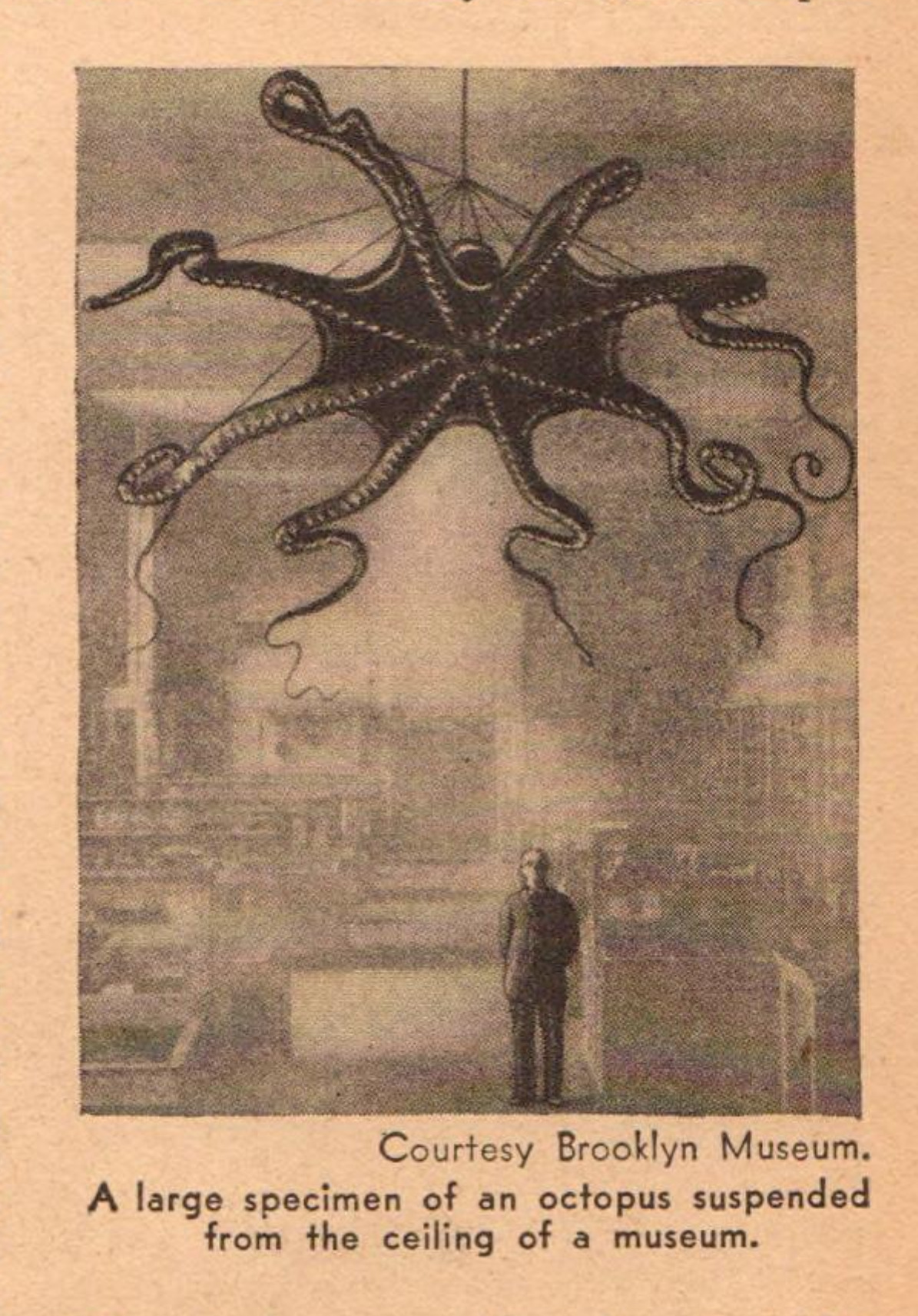
Tentacles in the Brooklyn Museum, 1931. Found while flipping through Science and Invention magazine for March 1931, newly on Archive.org. An initial search suggested there was also a giant squid, as the modern book Brooklyn Museum of Art: Building for the Future talks of their having once been natural history galleries and a specific section for… “Invertebrates housing not only display cases of specimens but also large models of a squid and an octopus suspended overhead”.

The first hall, moved wholesale to another hall and re-opened by 1928. This is as Lovecraft would have known it until c. 1927.

The first question was, did H.P. Lovecraft know the Museum from 1922 onward? Yes, of course he did. He saw it as a tourist first, and then ‘did it’ systematically and thoroughly later in 1922. Its galleries and the adjacent Japanese Gardens became a regular haunt when he was in New York. Another question was, was it always the “Brooklyn Museum” or did it have another or formal name? Indeed it did, being also known as the Brooklyn Institute. Pictures? Yes, here is a rare eye-level card showing it about a decade earlier. Most of the other cards are later, gaudily coloured and vigorously airbrushed.

Were there other attractions there? Well, a big attraction was the cost. Entry was free on most days, and the place was also open in the evening on Thursdays. By circa 1930 he probably knew the place well, but he was also well aware of the new items being accessioned. He did the Museum solo in May 1930, seeing the new ‘Colonial furniture and interiors’ wing which newly offered complete rooms arranged for Lovecraft’s lingering delight. In 1933 he “…did the Brooklyn Museum with Sonny” — Lovecraft letter to Morton, 12th January 1933, when they focussed on the “Dutch” section. I would suspect that this may also have been new.

But what of the tentacles, and the “Cthulhu” period? Regrettably there appears to be a lack of vintage postcards from the Museum, showing the interior, still less the Invertebrates section. Still there is one negative of a record-picture of the Hall of Invertebrates in 1928. Below I have newly enlarged and colorised it. The picture makes the room appear smaller than it was. The cabinets are man-high, not at child-level as they might be today.

1928, after removal from the second floor, east wing, to the first floor, west wing.

The hanging giant octopus was there before “Call of Cthulhu” was written, as confirmed by the book Guide to the Nature Treasures of New York City (1917). Also the giant squid…

Models of the octopus and squid occupy the last wall case at this end of the hall and should be compared with the giant octopus and squid suspended from the center ceiling and the marine painting above.

Thus it would be plausible to suggest that this (and the squid) could have played into Lovecraft’s conception of Cthulhu… “The cephalopod head was bent forward, so that the ends of the facial feelers brushed the backs…”.

1920 saw the addition of a ‘Pacific case’, a fine diorama with glass models. Possibly these were in the closed wooden cases seen at the back of the 1928 photo above. As such the picture below exemplifies the sort of detailed and accurate ‘undersea’ scene available in this Hall.

Here is the full description of what Lovecraft would have seen there circa 1922. This also notes the microscope views and many glass re-creations…

“… invertebrates and plants in the eastern galleries [on the “second floor” until 1927, the on the “first floor, west wing” after that]… the Hall of Invertebrates of the Brooklyn Museum (Room 7 on plan) is next entered, where the sponges and corals, worms, mollusks, crustaceans and other types of animals lacking a backbone (invertebrates) are exhibited.

Among this invertebrates are the sponges and corals, from all parts of the world, are systematically arranged in wall cases on the west, north and south sides of the hall, and in various floor cases special groupings have been made of sponges and corals of particular beauty or interest or of unusual size.

Other invertebrates are specimens of the Protozoa, or one-celled animals, the simplest forms of animal life, are shown in the first floor case on the left (north) side of the hall, by the aid of micro-scopes, and also by enlarged glass models. The sponges are the simplest forms of animals whose bodies consist of more than one cell, for the cells, although arranged in two layers, act each independently. Varieties of lime sponges, glass or silicious sponges and horny sponges are shown, as well as fresh-water, deep-sea and boring sponges, and sponge spicules under the microscope.

Models of coral, showing the anatomy of the polyps and their relation to one another, are seen in the second floor case on the left, which contains also models of the freshwater polyp hydra and other related forms. In the adjacent wall cases, specimens of mushroom, staghorn and brain coral and other forms are shown. A very large specimen of brain coral from the Bahamas and a specimen of staghorn coral, one of the largest pieces of branching coral ever collected, are exhibited in floor cases in the center of the hall.

Among the mural paintings in this hall of the Brooklyn Museum, representing some of the more striking invertebrates as they appear in life, is one depicting a coral reef in a tropical sea, and on the south wall in the center of the hall a large window group shows a coral reef close at hand and the animals that frequent it. Other mural paintings show an octopus at home, the formation of a mangrove swamp and other typical shore scenes of the Atlantic coast. Proceeding down the left side of the hall, the starfish and sea urchin families occupy the next case, and the development and anatomy of starfishes and sea urchins are illustrated by drawings, dissections, models and specimens of various ages. Abnormal specimens and specimens showing regeneration of rays in a starfish also are shown. The various types of sea urchins occupy the eastern side of the case. The worms in the next cases include the serpulid worm of the sea, the horsehair worm and a model enlarged and dissected; the branchiopods, related to both worms and mollusks, are shown here.

Crustaceans, in the next case of invertebrates, are represented by some one hundred species, including the crayfish with an enlarged model of dissection to show the anatomy, and a section of mud from a river bank showing a crayfish group at home, together with crabs, lobsters, shrimps, barnacles, horseshoe crabs and others. In the wall case at this point, the giant spider crab and the locust lobster of Japan, the largest species of living crustaceans, are shown.

The systematic series of shells, which includes characteristic examples of the principal divisions of mollusks and gives a general impression and synopsis of this group of animals at the Brooklyn Museum, is arranged in two floor cases on the right (southern) side of the hall at this (western) end. The largest specimens are in the upper part of the case, and the extensive study collections are arranged systematically in drawers below. Fine specimens of the nautilus and argonaut, representing the higher mollusks, may be seen, also the paper nautilus of Japan; a particularly interesting specimen is the naked mollusk from Naples, which appears to have no shell because the shell is internal.

An exhibit of land snails and of shells from Lake Tanganyika occupies a position in the systematic series of shells and shows specimens of the eggs of marine mollusks. The ship-boring bivalve teredo and its work in destroying ship bottoms are exhibited in the case next on the east; sections of wood show the damage done and method of work, and photographs show the anatomy of the animal. Other boring mollusks are exhibited here also, and in the upper part of the case are habitat groups of the edible snails of southern Europe. An exhibit of pearl shells from the pearl fisheries …

The marine animals of the coast of Long Island and New England, from high tide to a depth of 7,200 feet, form an interesting exhibit in the last floor case on this side. Among the specimens may be mentioned the oyster drill, showing the drilled shells, egg cocoons and stages of growth of the animal, and mounted specimens of the pipefish, sand flea and other shore creatures. Models of the octopus and squid occupy the last wall case at this end of the hall and should be compared with the giant octopus and squid suspended from the center ceiling and the marine painting above.

Passing into the Insect Hall (Room 8 on plan) …”

Ah, the Insect Hall. What monstrous wonders might he have seen through microscopes in there…?

‘Picture Postals’ from Lovecraft: a view of early Providence

05 Friday Mar 2021

Posted by asdjfdlkf in Picture postals

≈ 1 Comment

1914 at Providence Opera house, the Act 1 backdrop for a celebration of Brown University’s 150th anniversary.

1914 at Providence Opera house. S.T. Joshi dates Lovecraft’s regular theatre attendance at 1896 to c.1911-1915 in I Am Providence, and a letter in Letters to Family implies he visited a show there in 1917. So it’s possible the above 1914 show might have be seen by him, assuming it was not a ‘one-night only’ show reserved for the Brown University crowd. Certainly the ‘historic Providence’ aspect would have appealed to him. Probably he also saw the designs given in the local newspaper or magazines, if not exhibited at somewhere like the Art Club.

The new Letters to Family reveals that in his youth he had trodden the very boards of the Opera House. He had “slung from the stage” of the Opera House great slabs of a Shakespeare tragedy, given with “vigorous, orotund delivery”.

Providence Opera House, Gallery entrance on Eddy Street.

On hearing the news of the impending demolition of the Providence Opera house, in spring 1929 he decried the philistinism of a city that could leave itself without a stage fit for “a high-grade play”. He also recalled…

What a second home the old Opera House used to be to me!” — in Letters to Family

I also recall that Lovecraft once spotted his house on a richly painted theatre curtain showing a similar historic vista of Providence. I can’t find the reference offhand, but it was likely at the Opera House.

By 1936 the place had long gone, as he remarked to a young correspondent…

… alas! Indeed, the Opera House was torn down in 1931, & its manager (with a tragic timeliness worthy of the Muse whose temple he had tended) died the following year.

Many years earlier he had recalled this fellow for Kliener…

… we [the family] were acquainted with Mr. Morrow, lessee & manager of Providence’s chief theatre — The Providence Opera House — (he lived directly across the street) so that it was not thought too shocking to let my aunt take me to see something [there, when a boy]” — H. P. Lovecraft, letter to Kleiner dated 16th November 1916.


Incidentally, the indexing of the entry for ‘Providence Opera House’ is slightly astray in the new Letters to Family. Page ‘1026’ should read ‘1028’.

‘Picture Postals’ from Lovecraft: Riverside Drive

26 Friday Feb 2021

Posted by asdjfdlkf in Historical context, Picture postals

≈ Leave a comment

The Riverside Drive scene on the card is almost certainly where we could have tragically lost Lovecraft in 1927, as he explains…

Just about a decade ago I began refusing to take dares beginning with the time a friend challenged me to walk along the foot-wide & not-quite level parapet of upper Riverside Drive in New York, with a 500-foot perpendicular drop to ragged rocks & railway tracks on one side.

“B.P.” usefully summarises the layout in the 1920s…

The first portion of Riverside Drive from 72nd to 85th Street was opened in 1879. Riverside Park terminated at 129th Street. The Riverside Viaduct completed in 1900, bridged the schism between 125th and 135th Streets. […] Above 168th Street Riverside Drive became somewhat rural [and] continued north to 181st Street.

Here we see the railway tracks…

What of Hulyer’s? The map places 60 West 125th Street about a mile south-east from the bridge shown. But it also reveals that this Huyler’s branch was just a half-mile south from Morton’s apartment (which was at 211, West 138 Street). We now know from the Letters to Family letters that there was at least one nightime Kalem Club meeting at Morton’s place. My guess that it was held there because it was high summer, and Morton likely had access to the flat roof of his terrace row (he had a very indulgent landlord). In and around Red Hook there was almost no access to the building roofs, as reported by an official slum report on the gangs of the district. Lovecraft’s 1925 diary also shows there he made at least one solo walk through Harlem to see Morton, and there were likely many other such walks. It’s thus not impossible, in the period when Sonia was helping out financially, that he and Morton could have dropped in on Morton’s best local soda, candy and ice-cream joint, even if it was further into central Harlem. The Huyler’s chain was very successful and appears to have been about the best one could get in terms of such drop-in stores.

Many Lovecraftians will also know the name Riverside Drive because it held a key Lovecraft “shrine” in New York City. This being the gallery of the visionary painter…

good old Nick Roerich, whose joint at Riverside Drive and 103rd Street is one of my shrines in the pest zone.

Maps put the gallery about a mile SW of the bridge seen in the above picture. Incidentally, nearby on the map is Morningside Heights, which explains Lovecraft’s 8th January 1925 telegraphic diary entry…

noon — meet LDC G.C.T. By. Exch. Ch. Art Gal. [Hatho?] Morningside & St Nick Hts. Ham. Gr. El. to G.C.T. Dinner St R. home. Tailor—Laundry Reading

Translated… he returns from the Leeds apartment after leaving there at 4am and walking across the Brooklyn Bridge and mailing some books and postcards on the way home. The next day he rises at noon, and meets “LDC” (Aunt Lillian) at the “G.C.T.” (Grand Central Terminus, aka Station) “By. Exch.” (Baggage Exchange?) some while later. They then visit the “Ch. Art Gal.” (City? Art Gallery). If “Hatho” indicates an unknown word, it could be a visit to Sonia’s “Hat House”, her hat store? The weather is presumably good and so they make for Riverside Drive bridge and walk a mile down the “Morningside” riverside section to see “St. Nick”, this being Nick Roerich and his gallery. The “Hts.” may be a mis-transcription for Mts, indicating Roerich’s mountain paintings. Then “Ham. Gr.” (Harlem to see Morton?, Greenwich Village?). Then they take the “El.” (elevated line) back to Grand Central Station and have a dinner there. They then take the “St. R.” (street railway, in contrast to the ‘elevated’) home. Lovecraft sorts his clothes in need of tailoring (his aunt had likely pointed out something in need of fixing) and for the laundry-service bag, and then he reads into the night.

Placing the three points on a map (bridge, Morton, the gallery) suggests that, once he was at Morton’s place, it would then be natural to walk with Morton a mile to the west through what is now marked as “West Harlem” to reach the Riverside Viaduct bridge. From the “Heights” there he and Morton could walk a mile south down the pleasant Riverside Drive (alongside the Hudson River) to reach Roerich’s gallery, and he knew that section of the route well enough to make it a prime walk with his aunt in January 1925. Possibly he and Morton occasionally walked on 2.5 miles down the same riverside, to reach McNeil’s Hell’s Kitchen district — possibly enabling a visit to McNeil. Though I’m not sure how salubrious the riverside walk would then have been, once it was south of 72nd Street, and how safe to then walk from the waterfront into Hell’s Kitchen. Public transport from the Roerich gallery might have been the safer option.


I’ve also found another card of a possible eatery. Safely back in Providence, Lovecraft no doubt dropped in at least once to sample the new “Franklin Spa”. This had been built while he was away in the big city (see the “1926” emblazoned on its frontage). It was about a quarter-mile south of the Public Library, in an area now swept away by a new concert hall.

‘Picture postals’ from Lovecraft: Jean Libbera

19 Friday Feb 2021

Posted by asdjfdlkf in New discoveries, Picture postals

≈ Leave a comment

From a 1934 letter by Lovecraft…

… in a freak show (Hubert’s Museum in W. 42nd St.) in New York [he saw in 1925] “Jean Libera” [sp. Libbera …]. So far as I know, he is still living and on exhibition. [In 1930] “I chanced to mention the matter [of the story “Cassius”] to my old friend Arthur Leeds of New York, who has had the extensive dealings with freaks and other amusement enterprises. Fancy my surprise when he told me that he knows Libera well — that the man’s real name is Giovanni Libera, that he is an Italian of great intelligence, that he is interested in everything weird, and that (believe this or not — it’s actual truth!!) he is especially fond of my work in Weird Tales!!!!

Jean Libbera and his large ‘twin’, quite gruesome when unclothed.

I’ve found an ad that shows that Libbera played Coney Island for the summer season of 1925, therefore Lovecraft’s visit to Hubert’s (aka Hubert’s Dime Museum) must have been either January-March or October-December of 1925.

In the Wandrei letters Lovecraft remarks that his friend Arthur Leeds had become associated with a human freak show. Possibly this one, though there was also likely another on Coney Island and I’ve found he also ran one in Chicago. More on that tomorrow.

There’s a book on the Museum as it was in the 1950s and 60s, Hubert’s Freaks. One can pick it up on eBay fairly cheaply. The site appears to have been on Times Square, then notorious for sleaze and set to grow ever more so into the 1970s and 80s… before the big Zero Tolerance clean-up of the early 90s.

‘Picture Postals’ from Lovecraft: the Courthouse

12 Friday Feb 2021

Posted by asdjfdlkf in Picture postals

≈ Leave a comment

This week, another in the long series of posts that have investigated Lovecraft’s College St. I was going to hold off from posting pictures of the Courthouse Buildings at the foot of College St., Providence. Partly because it doesn’t seem the most exciting place in the world, and he may well never have set foot in it. But also because I was still unsure of what exact routes Lovecraft habitually took from the hill to the city-centre. Even when he lived in College St., was it a regular sight for him? Some scholars say he walked into town one way, some another.

But then I read Lovecraft commenting on the old courtyard at the back of the buildings a little down from the Courthouse, in the new Letters to Family books. His aunts had both sent a fine drawing of this courtyard, cut from a local newspaper or magazine (see my earlier blog post on this courtyard). Lovecraft then remarked, in 1924, that he had climbed up the hill that way “thousands” of times. And this was before he even lived at No. 66, a little further up the hill.

Thus, while he may well have descended from College Hill into the commercial district by a different route (longer and more scenic, perhaps varying by season) and thus avoided the very foot of College St., it sounds to me like he often returned up the hill by the shortest and most direct way. That would be logical, if he were returning carrying groceries and library books.

He would thus have been walking on the side of the street opposite the Courthouse, and had a good view of the building across the relatively quiet street intersection. His side was the obvious side of College St. to choose to walk on, as it would avoid Brown University students. By tradition the students were supposed to go up and down the hill on the Courthouse side of the street, so as to give the other side to residents. He would also avoid tripping over any undesirables that might be loafing on or milling around the Courthouse steps. Thus, the building would have presented itself to him as a fine landmark on his starting to ascend the hill and return home, whatever he may have thought about its architectural merits.

Here are some indicative views of the exterior. First we see the wider context. The ascent of College Hill is ahead, and the Courthouse a little way up on the right of the picture. The date is 1905, but it was fundamentally unchanged for several more decades.

Now the camera is sited a little way up College Street and the cameraman looks across at the Courthouse frontage from a side-street. College St. runs across the picture from left to right.

Here we see why the above ethereal picture was made in winter. In summer the same view was obscured by trees, as you can see in the picture below — which also provides the best glimpse of the slanted louver-boards on the belfry pinnacle. More on those later.

An artist has no such problem with foliage, and can artfully restrain the trees. Below is Henry J. Peck’s pen-study of the Courthouse frontage, before 1927 and most likely 1924-26. There is now apparently a need for a litter-bin (trash-bin) on the corner, although it might be an American post-box (Post Office mailing-box) of a type unknown to me.

In the end I needn’t have worried about if he actually habitually observed the building as he walked up and down College St., or if he came back up from the commercial district in such a way as to approach it face-on. Because it turns out that at No. 66 he saw it every day, or at least an evocative bit of it. The Courthouse appears briefly in Lovecraft’s late tale “The Haunter of the Dark”…

At sunset he would often sit at his desk and gaze dreamily off at the outspread west — the dark towers of Memorial Hall just below, the Georgian court-house belfry, the lofty pinnacles of the downtown section, and that shimmering, spire-crowned mound in the distance whose unknown streets and labyrinthine gables so potently provoked his fancy.

Thus the belfry structure must have been visible from the windows of his room at 66 College Street, and it can plausibly be said to have helped inspire a key setting in “The Haunter of the Dark”…

the black tower” with “the smoke-grimed louver-boarding

Possibly more of the Courthouse tower could be seen from up in the monitor-roof attic of his house at No. 66, which had a thin line of windows and an old west-facing door to the exterior roof-space. This door was opened for Lovecraft by Brobst, who found a way to spring the intricate locking mechanism that held fast the cobwebbed door.

‘Picture Postals’ from Lovecraft – Rhode Island at night set

05 Friday Feb 2021

Posted by asdjfdlkf in Night in Providence, Picture postals

≈ Leave a comment

Following on from last week’s ‘Providence at Night’ set, I see there was also a series of night postcards that ranged more widely across the island. These had a different format and often a rather more sinister Lovecraftian feel…

‘Picture Postals’ from Lovecraft – Providence at night set

29 Friday Jan 2021

Posted by asdjfdlkf in Night in Providence, Picture postals

≈ Leave a comment

Inspired by Lovecraft’s choice of a Providence at night postcard (see last week’s ‘Picture Postal’) I found similar cards. They were mostly seemingly issued in the early/mid 1920s.

His choice of card.

‘Picture Postals’ from Lovecraft: 17th November 1931

22 Friday Jan 2021

Posted by asdjfdlkf in Historical context, Night in Providence, Picture postals

≈ 4 Comments

Currently up for sale at Abebooks, a lesser Lovecraft postcard. Judging by the 10.30pm postmark, it was likely written on the evening of 17th November 1931, and then posted with others after a night stroll. Assuming he was at home at Barnes Street, this raises the interesting question of exactly where the nearest pick-up mailbox (with a late 10.30pm collection) was and how far he would have to walk from his home?

On the card “HPL” writes a brief note…

He congratulates Coates on the recent edition of Driftwind, and the frontispiece of the frequent little magazine which shows what sounds like a view of Montpelier, Vermont. Lovecraft seems to imply rapid change may be happening there and that the picture may have changed? This is not the view in question, if wide view it was, but it is perhaps indicative…

Lovecraft was at that moment very interested in how small isolated towns might change and perhaps for the worse. On his desk lay the pages that would become the famous story “The Shadow Over Innsmouth”, set to be complete two weeks later on about 1st/2nd December 1931. This concern fitted well with the mood of the times, as the third winter of the Great Depression began to grip the nation.

On the card Lovecraft then supposes that Paul Cook, fellow amateur and leading collector of weird books, will be visiting Coates at Thanksgiving 1931. Thus implying that Lovecraft has not had any letter recently from either to confirm this point. Lovecraft alludes to his own usual winter hermitage with the final line… “If it were mid-July I’d surely [join?, enjoy?] him!” and thus assumes that Coates is well aware of his aversion to cold… and to a Vermont winter in particular.

The front of the card is not show or described at Abe. But it was published by the Berger Bros. of Providence, suggesting a view of Providence. Indeed it was… a quick search found the front on the seller’s own store as a good scan, and it shows the new Industrial Trust Building at night.

The November issue of Driftwind was 44 pages including a “Check List of Publications of Driftwind Press”, including H.P. Lovecraft’s The Materialist Today, later to become one of the rarest of Lovecraft’s publications. Issues of Driftwind earlier in the year had been the first to publish sonnets from the Fungi From Yuggoth cycle, and more would follow.

Friday ‘Picture Postals’ from Lovecraft: a tramp steamer in Brooklyn

15 Friday Jan 2021

Posted by asdjfdlkf in Picture postals

≈ Leave a comment

This week, a picture by Charles Wheeler Locke showing a typical ‘tramp steamer’ at the Brooklyn dockside, New York City, in 1925. It has the distinctive clusters of cargo cranes, which appear to be typical of its class.

Lovecraft’s “The Horror at Red Hook”, written in high summer 1925, features the Brooklyn dockside at Red Hook and just such a freight-carrying steamer…

[New York police detective Malone had discovered] “They had come in steamships, apparently tramp freighters, and had been unloaded by stealth on moonless nights in rowboats which stole under a certain wharf and followed a hidden canal to a secret subterranean pool beneath a house.”

“Then the tramp steamer claimed all attention. A boat put off, and a horde of swart, insolent ruffians in officers’ dress swarmed aboard the temporarily halted Cunarder. They wanted Suydam or his body — they had known of his trip, and for certain reasons were sure he would die.”

Friday ‘Picture Postals’ from Lovecraft: the Art dept.

08 Friday Jan 2021

Posted by asdjfdlkf in Historical context, Picture postals

≈ Leave a comment

This week, an addition to my 2014 posts “I used to be a water-colour fiend” and Lovecraft’s new library, 1900, and also to my recently peek into the Providence Art Club.

A good and extremely well coloured look at the entrance to the Art Dept. located in the Providence Public Library.

This is as Lovecraft, then aged 16, would have encountered it in 1906.

Friday ‘picture postals’ from Lovecraft: gone, but not forgotten…

11 Friday Dec 2020

Posted by asdjfdlkf in Picture postals

≈ Leave a comment

This week on ‘Picture Postals’, a fine early-1970s modernist-gothic view. It shows the site of what had been H.P. Lovecraft’s home at 66 College Street, Providence, R.I. His house would have been seen in the left of the picture, had it still been standing there, about where the large elevated box extrusion is.

Friday ‘picture postals’ from Lovecraft: the Strand, Providence

04 Friday Dec 2020

Posted by asdjfdlkf in Historical context, Picture postals

≈ Leave a comment

Last week’s ‘Picture Postal’ post on the Providence Art Club incidentally had Lovecraft mentioning that, on returning home to Providence from what he called ‘the pest zone’ of New York City, he visited the Art Club and…

In the evening a cinema show at the good old Strand in Washington Street completed a memorable and well-rounded day.” (Selected Letters II).

Here is a fine picture of the “good old Strand”, which I’ve lightly colorised…

Actually it was not so “old”, even by American standards. It had opened in summer 1915 as a dedicated movie theatre, with variety-theatre stage facilities that were also used for public talks (the Rhode Island National Guard gave a talk at the Strand Theatre in the early days of the war). Lovecraft had patronised it much in its first few years, enjoying the early silent films shown there. The house guaranteed that, once inside, its patrons would find a… “wonderful, big, beautiful place – and the shows presented will be fine always.” This was in an era of hand-cranking and movies were often shown at too great a speed, were jerky or the film mangled in the projector and bits had to be cut out. One could even find that the film was simply not the one that had been paid for. There were also the common problems of ventilation and heating. The Strand presumably did not tolerate such lapses.

What might Lovecraft have seen playing? The visit appears to have been on the very evening of his return to Providence. That was Saturday the 17th of April 1926.

One imagines that, after escaping the ‘pest zone’ of New York City, the Italian movie The Last Days of Pompeii might have been deemed suitable if a little heavy. Another possible foreign candidate is Lotte Reiniger’s debut The Adventures of Prince Achmed, the world’s first animated feature and made in silhouette animation. But neither had yet been released in America.

Several more 1926 movies likely to appeal to Lovecraft had not yet been released, such as Mary Pickford’s major swamp-horror Sparrows, Faust, The Sorrows of Satan, and the horror The Magician. Similarly the New England historical movie The Scarlet Letter was not released until August, and the grand failure Old Ironsides not until December.

There was no Chaplin movie that year, though The Gold Rush (June 1925) could still have been playing if fronted with a more recent comedy short.

Most likely are The Sea Beast (a Moby-dick adaptation) which had been an enormous hit in January and February, along with the lavish Ben-Hur: A Tale of the Christ, but if either was still playing in a large main house several months later must be debatable. However, spring-summer 1926 seems an especially sparse time in terms of quality movies and my guess is that these two might have become a “double-bill” aiming to keep seats filled. The other possibility is the Douglas Fairbanks pirate-adventure vehicle The Black Pirate, released in early March, which de Camp later suggested as a R.E. Howard inspiration. This seems to me the most likely movie seen by Lovecraft, as he may have seen the other two while in New York City. Brisk and engaging, it’s now thought of as one of the most watchable surviving swashbucklers of the 1920s and can be had in a restored technicolour version as originally shown. The strong ‘love angle’ would also have had an appeal for his aunts.


Incidentally, search for this post revealed the supposedly mighty Google Search doing the dumbest word-substitution…

← Older posts
Newer posts →


Please become my patron at www.patreon.com/davehaden to help this blog survive and thrive.

Or donate via PayPal — any amount is welcome! Donations total at Easter 2025, since 2015: $390.

Archives

  • February 2026
  • January 2026
  • December 2025
  • November 2025
  • October 2025
  • September 2025
  • August 2025
  • July 2025
  • June 2025
  • May 2025
  • April 2025
  • March 2025
  • February 2025
  • January 2025
  • December 2024
  • November 2024
  • October 2024
  • September 2024
  • August 2024
  • July 2024
  • June 2024
  • May 2024
  • April 2024
  • March 2024
  • February 2024
  • January 2024
  • December 2023
  • November 2023
  • October 2023
  • September 2023
  • August 2023
  • July 2023
  • June 2023
  • May 2023
  • April 2023
  • March 2023
  • February 2023
  • January 2023
  • December 2022
  • November 2022
  • October 2022
  • September 2022
  • August 2022
  • July 2022
  • June 2022
  • May 2022
  • April 2022
  • March 2022
  • February 2022
  • January 2022
  • December 2021
  • November 2021
  • October 2021
  • September 2021
  • August 2021
  • July 2021
  • June 2021
  • May 2021
  • April 2021
  • March 2021
  • February 2021
  • January 2021
  • December 2020
  • November 2020
  • October 2020
  • September 2020
  • August 2020
  • July 2020
  • June 2020
  • May 2020
  • April 2020
  • March 2020
  • February 2020
  • January 2020
  • December 2019
  • November 2019
  • October 2019
  • September 2019
  • August 2019
  • July 2019
  • June 2019
  • May 2019
  • April 2019
  • March 2019
  • February 2019
  • January 2019
  • December 2018
  • November 2018
  • October 2018
  • September 2018
  • August 2018
  • August 2015
  • July 2015
  • April 2015
  • March 2015
  • February 2015
  • January 2015
  • December 2014
  • November 2014
  • October 2014
  • September 2014
  • August 2014
  • July 2014
  • June 2014
  • May 2014
  • March 2014
  • February 2014
  • January 2014
  • December 2013
  • November 2013
  • October 2013
  • September 2013
  • August 2013
  • July 2013
  • June 2013
  • May 2013
  • April 2013
  • March 2013
  • February 2013
  • January 2013
  • December 2012
  • November 2012
  • October 2012
  • September 2012
  • August 2012
  • July 2012
  • June 2012
  • May 2012
  • April 2012
  • March 2012
  • February 2012
  • January 2012
  • December 2011
  • November 2011
  • October 2011
  • September 2011
  • August 2011
  • July 2011
  • June 2011
  • May 2011
  • April 2011
  • March 2011
  • February 2011
  • January 2011
  • December 2010
  • November 2010
  • October 2010
  • September 2010
  • August 2010
  • July 2010

Categories

  • 3D (14)
  • AI (70)
  • Astronomy (70)
  • Censorship (14)
  • de Camp (7)
  • Doyle (7)
  • Films & trailers (101)
  • Fonts (9)
  • Guest posts (2)
  • Historical context (1,095)
  • Housekeeping (91)
  • HPLinks (74)
  • Kipling (11)
  • Kittee Tuesday (92)
  • Lovecraft as character (58)
  • Lovecraftian arts (1,626)
  • Lovecraftian places (19)
  • Maps (70)
  • NecronomiCon 2013 (40)
  • NecronomiCon 2015 (22)
  • New books (966)
  • New discoveries (165)
  • Night in Providence (17)
  • Odd scratchings (984)
  • Picture postals (276)
  • Podcasts etc. (431)
  • REH (184)
  • Scholarly works (1,469)
  • Summer School (31)
  • Unnamable (87)

Get this blog in your newsreader:
 
RSS Feed — Posts
RSS Feed — Comments

H.P. Lovecraft's Poster Collection - 17 retro travel posters for $18. Print ready, and available to buy — the proceeds help to support the work of Tentaclii.

Proudly powered by WordPress Theme: Chateau by Ignacio Ricci.