• About
  • Directory
  • Free stuff
  • Lovecraft for beginners
  • My Books
  • Open Lovecraft
  • Reviews
  • Travel Posters
  • SALTES

Tentaclii

~ News & scholarship on H.P. Lovecraft

Tentaclii

Category Archives: New discoveries

Friday Picture Postals from Lovecraft: The Italian quarter in Providence

24 Friday May 2019

Posted by asdjfdlkf in Historical context, New discoveries

≈ 1 Comment

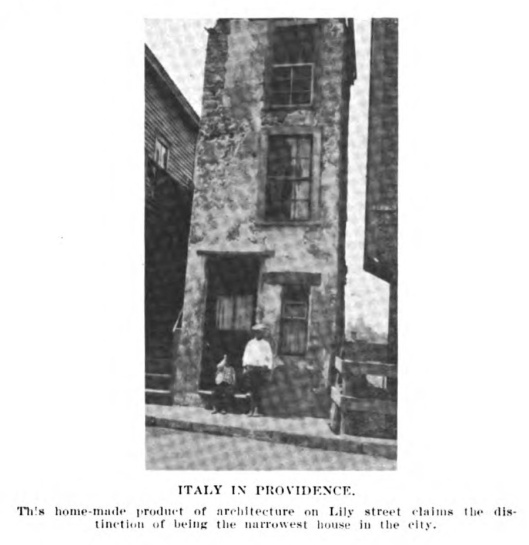
Pictures of Providence’s Italian quarter in the 1910s-30s are rather scarce, at least online. There is one above, and below I show three more from prior to 1921. These are badly scanner-moired, but are here newly-exposed to search-engines.

This district of Providence was also known locally as ‘Little Italy’, ‘the Italian Quarter’, and the Federal Hill district. It was settled by a large wave of Italian immigrants after 1890. Italian shops, Italian cafes, Italian banks, and other facilities were quickly established there, and the Italians gradually displaced an existing Irish population which was moving on and up in the world.

Lovecraft could see this district from his windows, in his later years…

The [new] study also has 2 west windows, at one of which I am now sitting, gazing across the roofs of the ancient hill to a strip of far horizon & a distant steeple on Federal Hill 2 miles away.

“Federal Hill (the Italian quarter) as seen 2 miles away from my window is really quite a mysterious & picturesque sight — with the dark bulk & spire of St. John’s rising against the remote horizon…”

Lovecraft set his substantial late story “The Haunter of the Dark” (1935) on Federal Hill…

From his few local acquaintances he learned that the far-off slope was a vast Italian quarter […] he came finally upon the ascending avenue of century-worn steps, sagging Doric porches, and blear-paned cupolas which he felt must lead up to the long-known, unreachable world beyond the mists. There were dingy blue-and-white street signs which meant nothing to him, and presently he noted the strange, dark faces of the drifting crowds, and the foreign signs over curious shops in brown, decade-weathered buildings. Nowhere could he find any of the objects he had seen from afar; so that once more he half fancied that the Federal Hill of that distant view was a dream-world never to be trod by living human feet. Now and then a battered church facade or crumbling spire came in sight, but never the blackened pile that he sought. When he asked a shopkeeper about a great stone church the man smiled and shook his head, though he spoke English freely. As Blake climbed higher, the region seemed stranger and stranger, with bewildering mazes of brooding brown alleys leading eternally off to the south. He crossed two or three broad avenues, and once thought he glimpsed a familiar tower. Again he asked a merchant about the massive church of stone, and this time he could have sworn that the plea of ignorance was feigned. The dark man’s face had a look of fear which he tried to hide, and Blake saw him make a curious sign with his right hand.
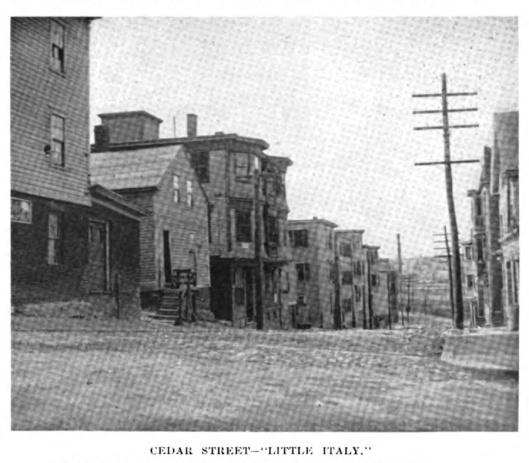
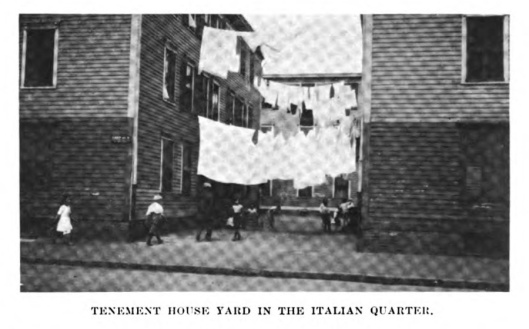
The pictures are of obvious relevance to the setting of “The Haunter of the Dark”, but look also at that weirdly thin house. Is there a possible inspiration for “Erich Zann”, in this home-made structure? Probably not, as “Zann” was written 1921, at which time Lovecraft may not have yet had his first boots-on-the-ground encounter with the district.

He toured the place in the expert company of his local friend Eddy, as Selected Letters Vol. 1 has…

I decided to have Eddy guide me thro’ the vast and celebrated Italian quarter — Federal Hill — which I had heard him so often describe and as quainter even than the Boston Italian quarter …

Sadly I can’t get more than this snippet from this now very expensive book, and thus can’t determine the date for this letter. But Selected Letters Vol. 1 goes up to 1924. [Update: yes, he got to know Eddy after the writing of “Zann”]

At dusk on a day in April 1926, at the end of one of his rambling exploratory walks in the city…

[the walk] introduced me to a tangle of horrible and infinitely alluring alleys of blackness in the Federal Hill Italian quarter

This must indicates just his discovery of the tangle of alleys, rather than the entire district, since he had already seen it with Eddy a few years earlier. Presumably he thus realised that he had not seen everything there in his tour with Eddy. He returned there in June 1926, and made an initial full exploratory walk of Federal Hill, during which he appears to have encountered the large churches for the first time…

Last Saturday “did” Mount Pleasant, Davis Park, and Federal Hill — and was astonished by the great Italian Churches.

But the remarkable thin house (seen above) was featured in the local press circa 1919. So he might have encountered pictures of it, prior to writing “Zann”…

The houses were tall, peaked-roofed, incredibly old, and crazily leaning backward, forward, and sidewise. […] at last I came upon that tottering house in the Rue d’Auseil, kept by the paralytic Blandot. It was the third house from the top of the street, and by far the tallest of them all. (“Erich Zann”)

That said, he could have been equally inspired by any number of prints (Samuel Prout and his ilk) and postcards of ancient streets in old European cities, or descriptions thereof in literature.

While he may have encountered some of the Hill’s residents on his walks, he had also known them elsewhere. For instance a member of the Providence Amateur Press Club, a group of aspiring young writers who Lovecraft had attempted to tutor and encourage, had lived on Federal Hill. The lad in question seems to have been a holdover of its former Irish population, who would by then have been well into the process of moving on and up as they assimilated into American life. (There was also a fruit pedlar who used to come to Lovecraft’s house on Angell St., Manuel Arruda, but the name suggests he was Spanish or Portuguese rather than Italian).

During the U.S. prohibition of alcohol, Lovecraft indulged in a bit of whimsy about the district in one letter. He joked with a friend that he might acquire there a local case of bootleg whisky, not for himself but to ship to Weird Tales editor Farnsworth Wright (to help steady his physical jitters induced by Parkinson’s disease)…

I feel tempted to unearth a local bootlegger [and] Providence’s Italian quarter is a miniature Chicago of hootch, gang wars, and rackets!

This was indeed the state of affairs there under the Morelli mafia gang, which had been allowed to become established from 1917. But apparently today Federal Hill, Providence, is said to have some of the most “funky” hipster-ish sort of places in the city, and yet to have also successfully retained an Italian character. That may be a bit of quiet online booster-ism, but I haven’t encountered anything to contradict such statements.


Lovecraft’s taste-buds may also may have led him to patronise the cheaper end of the Italian restaurant trade in Providence. He wrote…

[I] Like Italian cooking very much — especially spaghetti with meat and tomato sauce, utterly engulfed in a snowbank of grated Parmesan cheese.

Living in the notorious Red Hook in New York City in the mid 1920s, and forced by poverty to rub shoulders with jail-hardened gangsters and petty hoodlums in the cafes there, he often took his meals at…

John’s — the Italian joint around the corner in Willoughby St.
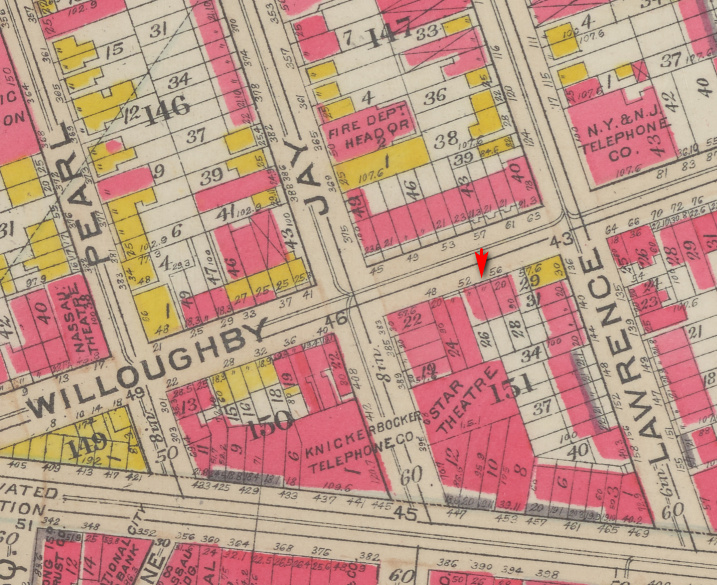
The above show two views of the same Jay and Willoughby interaction on Willoughby St., Red Hook, with one and possibly two corner cafes visible. The dates of the pictures are 1927 and 1928, and while the cafe(s) may not actually be John’s, the environment seen is closely indicative. Note that the theatre offers a “Burlesk” (burlesque) girlie show.

Once returned to his beloved Providence, we might assume that Lovecraft was even more open to trying out any new “Italian joint” “feed station” that looked suitable and cheap and yet able to attain a ‘New York quality’.

Protected: Lincoln Woods explored

23 Thursday May 2019

Posted by asdjfdlkf in Historical context, Maps, New discoveries

≈ Enter your password to view comments.

This content is password-protected. To view it, please enter the password below.

Protected: Providence Art Club Interior

22 Wednesday May 2019

Posted by asdjfdlkf in Historical context, New discoveries

≈ Enter your password to view comments.

This content is password-protected. To view it, please enter the password below.

Lovecraft’s Public Library

19 Sunday May 2019

Posted by asdjfdlkf in Historical context, New discoveries

≈ Leave a comment

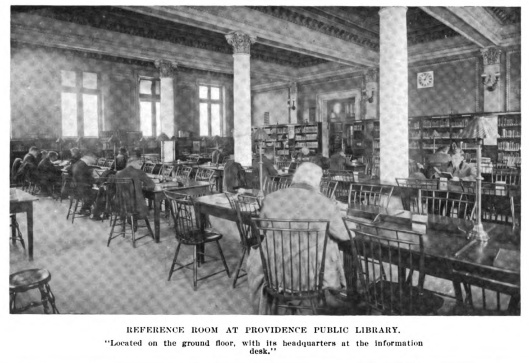
My new-found picture of the reference section of the Providence Public Library, in use by patrons. Published April 1916, so perhaps made 1915. It’s from one of the early Google Books scans and has bad un-correctable moire. I can’t get it larger or less fuzzy.

One could almost imagine that the lad seen on the far right of the picture is a 25 year-old H.P. Lovecraft. The hair-parting and the look of the ear are both correct. Lovecraft’s obvious lantern jaw might be there, but it might not. Lovecraft wore eyeglasses at this time, but it’s difficult to tell if this lad is wearing glasses or not. The feature that suggests this may not be the young Lovecraft is the dark shade and cut of the collar on his camel coat or jacket, which thus becomes two-tone — this being rather too jaunty and not sober enough for his known tastes in menswear. Although we do know that in 1915 Lovecraft became enamoured of ‘the dandy’, a figure he later associated with Edwardian frock-coats and their velvet collars, so who knows now if that phase of his interests temporarily affected his taste in clothing?

Still, even as a ‘stand in’ this young man is a close match, and thus very indicative of Lovecraft’s undoubted youthful presence in the room at other times.


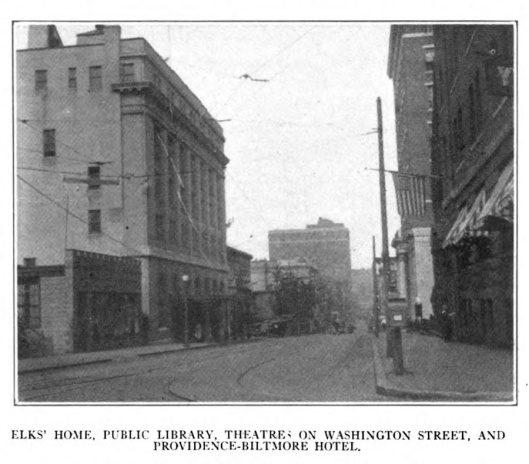
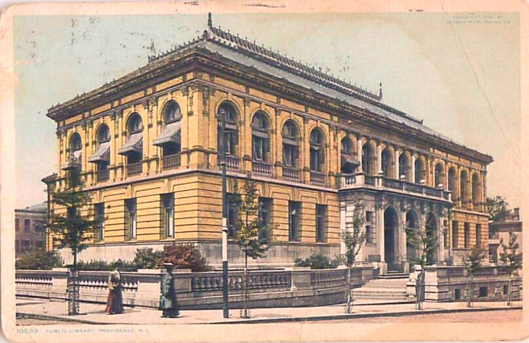
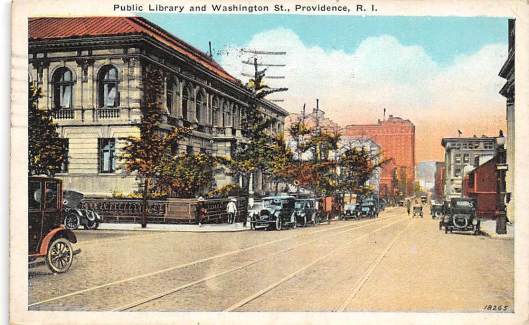
I also found a later picture of the Public Library exterior in its urban context. The library is in the middle-distance on the left, with the Biltmore Hotel in the far distance, and what looks like a small theatre in the foreground on the left. One can just about see that there were young trees around the library, by circa the early 1920s.

The trees can be better seen here in cards. They look fine at the start when small, but look rather spindly and struggling circa 1927…

The Grill collection and the location of the Binkin bookshop

12 Tuesday Mar 2019

Posted by asdjfdlkf in Historical context, New discoveries

≈ Leave a comment

Douglas A. Anderson’s A Shiver in the Archives has a good new article on The H.P. Lovecraft Collection of Jack Grill and (later) Irving Binkin.

According to Wetzel, Grill “collected HPL photos, letters written to and by HPL; he interviewed HPL acquaintances, visited many of the Middle Atlantic and New England towns to which HPL had made antiquarian tours, and accumulated many other odds and ends of Lovecraftiana.” An odd, shy man, Grill wished he was “a writing fellow,” but his only writings were letters — in an execrable hand-writing, without paragraphs and mostly without dates.

The collections was purchased by Binkin in New York…

Having seen the photographs [of Lovecraft in the collection], Binkin realized that Lovecraft had been a regular customer at his bookstore, just off Red Hook in Brooklyn, over forty years earlier.

Wetzel, in his memoir of Grill, quotes a letter from Grill (circa June 1957) stating he’d acquired unpublished stories by Hazel Heald, “The Basement Room” (5 pages) and “Lair of the Fungus Death” (25 pages), from Heald herself.

Given the clunky titles, I’d expect that the Heald stories were not ones revised by Lovecraft.

But the Binkin bookshop is an interesting new point of street-level data about Lovecraft’s time in New York City in the 1920s. One wonders if an address can be pinned on it and a photo found?

54 Willoughby Street (1961 —)

A Directory of the early 1980s lists “Binkin’s Book Center, 54 Willoughby Street, Brooklyn”. The address is off Fulton St. and certainly fits the description of “just off Red Hook in Brooklyn”. A Bargain Hunter Guide of 1990 noted that “Binkin’s is the oldest bookstore [in the city]”. There is however a problem in assuming that this was always his location. For the Antiquarian Bookman for 1961 has…

“IRVING BINKIN. NEW LOCATION — ENTIRE BUILDING – FIVE FLOORS OF BOOKS. BINKIN’S. BOOK. CENTER. 54 Willoughby St., Brooklyn”

Thus it appears he only moved there circa 1961. Where Wally Dobelis remembered him in the 1960s…

Irving Binkin, in the back of Brooklyn Heights and the courthouse, on Willoughby Street, had a four-story building, the ground floor of which was devoted to making a living. Irving’s heart was really in ballroom dancing, of which he was a champion. He liked to go to Hispanic dances, and had a small Spanish book stock for his dance partners. Upstairs, he held residues of good Brooklyn estates, unpriced and unevaluated, books, paintings and ephemera. After much negotiating, Irving had decided that we were trustworthy and would not stuff our pockets, and could be permitted to make selections and bring them down for pricing. Irving was not knowledgeable, but prided himself on being able to divine, from our body language, things about the value of our selections. It did work out, since he asked for our scholarship, and we were not out to steal high value items for pennies. It was fun. I found some Elihu Vedder lithographs…

Hunting this erroneous location, however, did lead me to two evocative photos from the fringes of Red Hook…

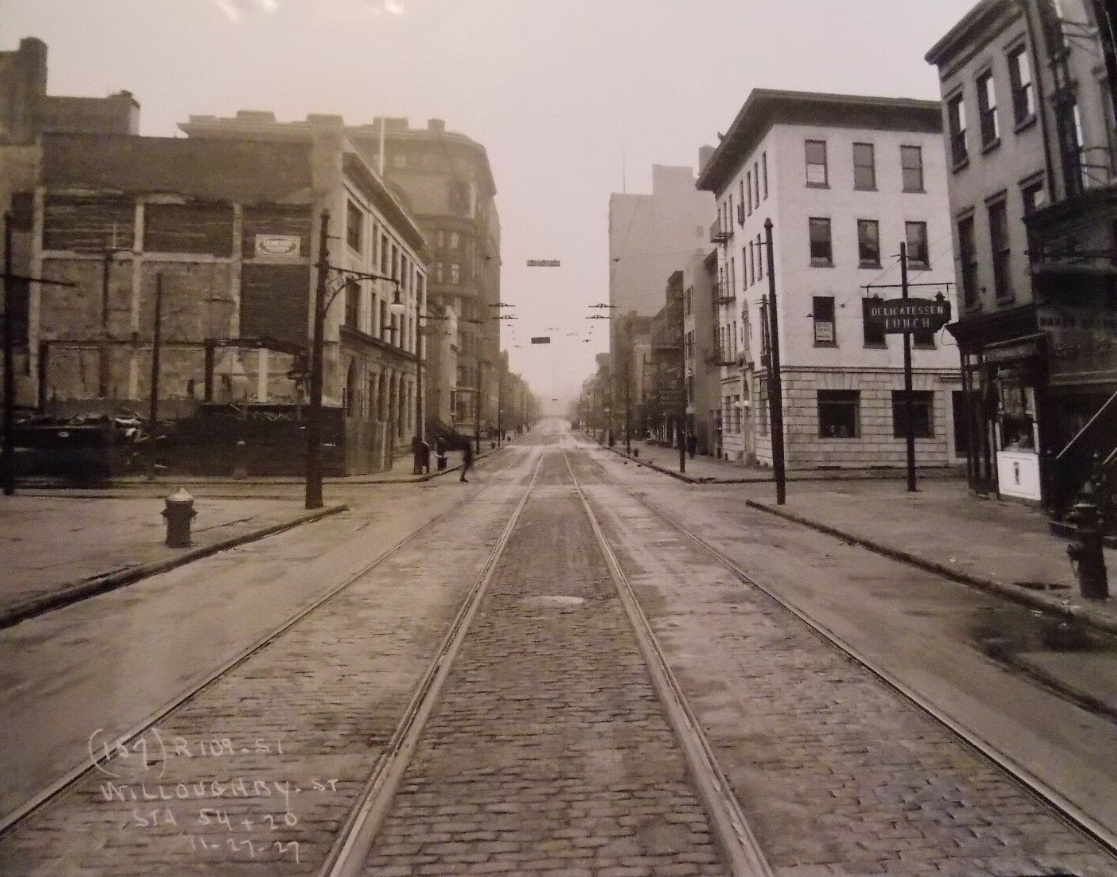
This eBay picture is from 1927, looking east along Willoughby with No. 54 ahead in the near middle-distance on the right of the street…

The sign on the far right states “Baked Beans”, a Lovecraft staple. He refers in his letters to “Red Hook’s modestly priced bean-bureaus”. A 1928 photo of Jay and Willoughby shows the same distinctive building on the corner, and the cafe and its distinctive corner-sign on the other corner…

We know that Lovecraft frequented a cafe on this street…

John’s — the Italian joint around the corner in Willoughby St.

We can also see that this picture is looking down Jay St toward the Star Theatre as seen on the map, and the theatre is advertising Burlesque girlie shows with its signage. This picture and its identification as ‘Jay’ clearly confirms the location of the other 1927 photo and that it just-about shows No. 54 in the middle distance on the right.


162 Pierrepont Street (later 1950s-1961)

However, we must step back further in time to Binkin’s earlier book store. This was on Pierrepont Street, the address given by Book Dealers in North America, 1956. Photographs of this store dated 1958 are on the Brooklyn Historical Society website. Obviously he was getting ready for his move to Willoughby Street, appearing to be a ’25-cents a book’ guy and thus generating a big low-cost stock that he could sell for higher prices at Willoughby Street in a few years’ time…

But again it’s hazardous to assume that this was the same as the store he had since the early 1930s.

We do however know that Lovecraft’s best friend Samuel Loveman knew Binkin. Also in the book trade, Loveman evidently once had a copy of Clark Ashton Smith’s poems Ebony and Crystal (1922). This is currently for sale by L.W. Currey and “a presentation inscription by Samuel Loveman, the book’s dedicatee, to bookseller Irving Binkin is present on the title page.” However, what date this book might have been gifted has to be uncertain. Perhaps the 1930s, when Binkin first set up in the book trade? Or perhaps a friendly gift in the 1970s, on rescuing the Grill collection? We shall probably never know.


252 Fulton Street.

A kind credit in Richard Morris’s scholarly book Reading Finnegans Wake (1959), and a book trade directory entry, shows that he was at 252 Fulton Street before Pierrepont Street…

The Bookshop of Isei Binkin
252 Fulton Street.

Fulton Street is of course a name well known to those who have read up on Lovecraft in New York in the 1920s, and especially his epic pursuit of a new suit at a cheap price. The dedication usefully give us Binkin’s Jewish name, which may help someone to track down where exactly he was selling books in Brooklyn, and thus where he might have been patronised by Lovecraft.

One ad Binkin placed stated that his business was “Established 1932”. So even if the 252 Fulton Street address in Brooklyn is his first such store, that would mean that Lovecraft would not have been a frequent customer there in the 1920s when he was living in New York.

And even here we can’t quite even be sure that this was where Binkin was trading from 1932 to perhaps the mid 1950s when Morris knew him. Until circa 1913 the address appears to have been a cheap and rather notorious flop-house hotel for sailors. Then after the War it appears to have been renovated into apartments and boutique shops. For instance, the American Florist for 1922 has… “S. Mastir, 256 Fulton Street, Brooklyn. We found in addition to his fine stock of cut flowers, an excellent collection of palms and other foliage plants.”

Thus a book store there from 1932 onward seems not unlikely. We know from Frank Belknap Long that the antiquarian shops along Fulton Street were not unknown to Lovecraft… “[Roman coins and] baked-clay Roman lamps, and he [Lovecraft] once helped me pick out magnificent examples of both ‘coinage and lampage’ at an old-coin shop on Fulton Street.” (Dreamer on the Nightside) Although it might be that this was the other Fulton St., to be found across the Brooklyn Bridge.


Of course, it is just possible that Binkin was ’embroidering history’ after he purchased the Grill collection, and was only claiming that he remembered having Lovecraft browsing in his shop back in the 1920s or 30s. Possibly he mis-remembered circa 1970 and another customer conveniently ‘morphed into Lovecraft’ in his memory, when hazily recalled over the distance of more than 40 years. But then there is also the possibility that Belkin had started in the book trade in the mid 1920s as a youthful assistant in someone else’s book store, and it was from that period that he genuinely remembered Lovecraft’s distinctive face.

A likely inspiration for Lovecraft’s Akeley?

09 Saturday Mar 2019

Posted by asdjfdlkf in Historical context, New discoveries

≈ Leave a comment

In Lovecraft’s “The Whisperer in Darkness” (1930), Henry Wentworth Akeley is the man who engages in investigative photography and phonograph recording of the alien Mi-go in “the wild domed hills” of Vermont.

What appears to have been overlooked by Lovecraftian scholars is that there really was an Akeley doing rather similar work, and that he had died only a few years previously. This Akeley had been world famous, a great ‘living hero’ to the boys of America. Thus the readers of Weird Tales would not have failed to make a connection between the real Akeley and Lovecraft’s Akeley.

Akeley with his field camera.

Carl E. Akeley (1864-1926) was a staff explorer of the New York Museum of Natural History, and he went on extended scientific / hunting expeditions to explore the jungles of Africa. Like Lovecraft’s Akeley, frustrated with the inadequacies of traditional methods of recording field-work, Carl E. Akeley famously turned to new technologies to record both animals and ethnographic material. He became well-known among field workers for inventing the ‘Akeley Film Camera’ (1915). This was a one-man tripod camera designed ‘from the ground up’ to be portable when travelling on foot. It came complete with easy-loading film canisters for near-instant set up and filming. Twin-lenses enabled a framed and focussed preview of what was being recorded on film. The researcher could thus instantly tell if the object being filmed was going out of focus, and subtly adjust the main lens accordingly.

Admittedly Lovecraft’s Akeley uses only a mundane Kodak camera able to do ‘time exposures’, of the sort Lovecraft himself owned…

His reply came almost by return mail; and contained, true to promise, a number of kodak views of scenes and objects illustrating what he had to tell. Glancing at these pictures as I took them from the envelope, I felt a curious sense of fright and nearness to forbidden things; for in spite of the vagueness of most of them, they had a damnably suggestive power which was intensified by the fact of their being genuine photographs—actual optical links with what they portrayed, and the product of an impersonal transmitting process without prejudice, fallibility, or mendacity.

Another photograph — evidently a time-exposure taken in deep shadow — was of the mouth of a woodland cave…

Yet Carl E. Akeley also made many audio phonograph recordings, one of which has even slowed down and claimed by a Lovecraftian prop-maker to be ‘the’ phonograph recording of the Mi-go made by Lovecraft’s Akeley.

He doesn’t appear to have been inventive in portable phonograph technology, but his work can be seen in his ‘Akeley Camera’ patent applications from the 1910s and 20s…

He is also credited with having invented modern taxidermy as such, since he was an avid big-game hunter in Africa in the golden age of such things and wished to preserve the trophy heads. Which in a way gives perhaps a slight satirical edge to the ending of “The Whisperer in Darkness”, in which Akeley himself becomes a ‘trophy head’, expertly preserved and set to be shipped to Yoggoth.

Carl E. Akeley’s invention of a useful field camera partly emerged from this big-game hunting, since as an intelligent man he probably realised that the big-game hunting era of the 1920s would not last indefinitely. He is on record in the mid 1920s writing that he wanted to encourage a new generation of ‘camera hunters’ alongside the ‘gun hunters’…

… camera hunters appeal to me as being so much more useful than the gun hunters. They have their pictures to show — still pictures and moving pictures — and when their game is over the animals are still alive to play another day. Moreover, according to any true conception of sport — the use of skill, daring, and endurance in overcoming difficulties — camera hunting takes twice the man that gun hunting takes.” — Carl E. Akeley, In Brightest Africa (1927).

He knew what he was talking about as he had made such documentaries, and in 1921 filmed the first documentary sequences of living gorillas in the wild, using his special field camera. Later the Komodo Dragons were given the same treatment with an Akeley Camera (Lovecraft later also saw the Komodo Dragons in captivity in New York). Given documentary material like this, undoubtedly shown in cinema newsreels in Providence, and the hero-worship of Akeley to be found in magazines such as Popular Science, it seems to me inconceivable that Lovecraft would not have been aware if the implications of naming his ethnographic folklorist photographer/recorder “Akeley”. Nor, thus, of the final section in which he has Akeley himself become a preserved ‘trophy head’ akin to those of the big-game hunters of the 1920s.


An exhibition, “Mr Akeley’s Movie Camera” is on now at the Field Museum in Chicago and closes 17th March 2019.

Cthulhu in the Library?

12 Saturday Jan 2019

Posted by asdjfdlkf in Historical context, Lovecraftian arts, New discoveries

≈ 1 Comment

From William Gerold’s b&w photobook College Hill; a photographic study of Brown University in its two hundredth year (1965). Gerold seems unaware of Lovecraft — and anyway couldn’t have photographed 66 College St. circa 1960-65, H.P. Lovecraft’s old house, as it had been moved from the site in 1959. Though he photographed some of the architectural details and sculpted animals and suchlike, and along the way managed to record this Cthulhu-idol like detail from the John Carter Brown Library (1904) at Brown University.

“My aunt is well acquainted with Mr. Champlin Burrage, an Oxford man, who is librarian of the John Carter Brown library at Brown. (I hope to meet him very soon.)” — letter from Lovecraft to Rheinhart Kleiner, April 1917.

Circa 1910 postcards of the Library frontage…

“Exhibitions to which the public are welcome are held throughout the year [at the JCB Library]” (1916).

And how it looked by the 1940s, becoming grow-over…


Update: Another photo has surfaced. This ironwork Cthulhu was not inside but outside the Library.

Lovecraft encounters a maker of bas-reliefs in Salem

06 Sunday Jan 2019

Posted by asdjfdlkf in Historical context, New discoveries

≈ 1 Comment

Readers will of course remember the mysterious bas-relief in “The Call of Cthulhu”. Interestingly, Lovecraft had a memorable encounter with a professional maker of bas-relief tablets in Salem, just a few years before. No dragon-squid-octopus clay tablets were involved, but he met the artist and discovered that they shared a mutual interest in the weird and macabre.

The local artist was Sarah W. Symonds (1870-1965) aka Sarah Symonds. Lovecraft had seen her bas-relief plaque of Marblehead on an earlier visit, but had then been penniless and unable to buy it. In mid-February 1923 he returned to Salem. It was a memorable winter visit to a Salem with snow on the ground and bitter winds blowing o’er the hilltop burying-grounds. On this chilly visit to Salem he did have money to spend, and thus he returned to the “Symonds Shop in Brown-Street” [Bray House, 1 Brown St., abandoned and derelict by the 2000s] in search of her “haunting plaque of Marblehead”. Thus we know he visited her here, and not at her tourist focused harbour gift-shoppe in Turner Street.

The shop in later years.

A younger Symonds in her studio, circa 1904 when she launched her business?

He intended to purchase the Marblehead plaque together with one of… “the Salem Witch House, brooding under its horrible overnourished oak tree” [which] “now adorn my walls, and I gaze with a shudder at that Witch House glowering under its terrible oak-horror stalks there.” Most likely the plaque was this one…

“… and by rare good fortune [I] discover’d the artist herself in charge [of the shop, seen above]. Mistress Symonds is a plain, stoutish, elderly person who brilliantly refutes the fallacy of some little boys I know, that artists must be decadent, bohemian, hecktick, dissipated idiots; for to a genius of the most undoubted sort, she adds the homely and wholesome personality of an old New-England conservative aristocrat. She has dwelt always at Salem in the conventional manner of an old Salem gentlewoman, and lives in a house that knew the tread of an ancestor’s buckled shoes. When I enter’d the shop she knew who I was, for her clerk had describ’d me as one who not only admir’d the bas-reliefs but loved all things old and weird. And thereupon I struck an ideal fountain of antique Salem lore, for Mistress Symonds has hunted up every ghost and ghoul in the town, and is on familiar terms with most of the daemons. In 1692 she wou’d have been hung as a witch, but in 1923 she is safe in expressing an undying devotion to Poe and all that is antient and sinister. From her I learnt of new sources of wild tales […] Thence conversation inclin’d toward weird tales, and I mention’d that I had written some. [Her plaques] now adorn my walls, and I gaze with a shudder at that Witch House glowering under its terrible oak-horror stalks there. And beside it rise the mad maze of gables, vanes, and chimney pots that form hoary Marblehead! Truly, my travels have come home with me, for the scenes live poignantly in those vividly fashion’d bas-reliefs.”

Lovecraft’s description of his (now lost) Marblehead plaque suggests a wide panorama of Marblehead’s roof-scape, but may have been either a close-up or a wider view akin to these…

But the sparse online pictures of Symonds’s work that has come up for sale recently suggests only a few twee doorways and lane scenes for Marblehead. Symonds was a savvy businesswoman and she had a very long career. I’d suspect that her earlier work from the Poe-loving era of 1915-1925 is quite rare in terms of coming up for sale, in comparison to the chintzier 1945-65 work she appears to have made for her hotel-lobby booth in Salem and the ‘hotel trade’.

Lovecraft also purchased two small circular ‘witch plaques’ as presents for his aunts. One of the larger oblong witch plaques by Symonds shows the same figure as was on the small medallions the aunts acquired.


Lovecraft’s vivid letters clearly show that his Salem experience became part of the basis for his story “The Festival”. They are also interesting for their winter timing. This shows Lovecraft could set off on his travels in a bitter mid-winter, and trek about in such weather, if he really wanted to and if he felt well enough. But there may have been another reason. My guess is that Salem in the summer was insufferably rammed with tourists, and thus midwinter was the optimal time for an antiquarian gentleman to visit.

[In Salem] “I several times paused to stroke cats, which abound in all parts of the town; whether or not left there by witches, none may say. At last I reached bleak Boston-Street on the western rim of the town, and walkt north toward Gallows-Hill. Here the houses were greyer and more uncommunicative, and the cold wind made sounds I had not before notic’d. A very old man told me where to find the approach to Gallows-Hill, and hobbled beside me a while as if knowing that I was, like himself, in some way strangely linkt to the spectral past. When the ascent became steep he left me, but not without hinting that Gallows-Hill is not a nice place to visit at night.

On and on I climb’d, crunching under my heavy over-shoes the crushed, malignant snow. The wind blew and the trees tossed leaf-less branches; and the old houses became thinner and thinner. […] overhanging gables and latticed windows which told me that they had been standing there when the terrible carts rattled with their doomed load from the gaol in Federal Street. Up…. up… up…, Damn that wind — why can’t it sound less articulate?

At last I was on the summit, where in the bed rock still lurk the iron clamps that held the witch gallows. It was getting on in the afternoon, and the light was reddish that glow’d over all the outspread town. It was a weird town in that light, as seen from that hill where strange winds moaned over the untenanted wastes on the westward. And I was alone on that hill in that sepulchral place, where the allies of the devil had swung… and swing… and hurled out curses on their executioners and their descendants. […]

Silently I descended past the leering houses with their centuried small-paned bleary windows, and as I did so my fancy brought vividly to my eyes a terrible procession going both up and down that hill beside me — a terrible procession of black-cowled things bearing bodies swathed in burlap. And so ample were the cowls, that I could not see the face of any of the things…. or whether they had any faces.”

Friday ‘picture postals’ from Lovecraft: Cross Plains

07 Friday Dec 2018

Posted by asdjfdlkf in New discoveries, Picture postals

≈ Leave a comment

Did Lovecraft ever receive ‘picture postals’ from R. E. Howard, dropping through the mailbox in Providence? Perhaps. Although Cross Plains, Texas, does not seem to have been the sort of place one would make a postcard of — unless perhaps one could do something artistic with sagebrush and cattle and a sunset. But if they did once make such things as postcards, then it seems that a view of the town bank and main row of stores might have been the standard ‘town view’…

Rogers photo, 1920s, newly repaired and colourised.

I had a dig around on Archive.org and found the town’s water-tower, as seen behind the stores in the above picture, in full-length and in detail. One can see figures standing on the top railing and sitting on the bottom struts, for scale…

Friday “picture postals” from Lovecraft: Crown Hotel

16 Friday Nov 2018

Posted by asdjfdlkf in New discoveries, Picture postals

≈ 1 Comment

“She [Sonia] visited Lovecraft in Providence on 4-5 September, staying at the Crown Hotel.” — S.T. Joshi, I Am Providence.

“Having entertained Lovecraft and his aunt for lunch at the Crown Hotel, Sonia suggested inviting several leading amateurs [to town]…” — L. Sprague deCamp, Lovecraft: A Biography.

One wonders if Sonia treated Lovecraft to a ‘Deep One’ ice-cream sundae at the Hotel’s ‘Deep Sea Cocktail Lounge’, in lieu of something alcoholic… though perhaps it wasn’t opened until the 1930s…

George Julian Houtain in the movies

12 Monday Nov 2018

Posted by asdjfdlkf in Historical context, New discoveries

≈ Leave a comment

I’ve found another interesting little nugget about the connections of the Lovecraft Circle with the movie business in New York City. Arthur Leeds had been in the movies there, and Everett McNeil (who Leeds employed at one time) had been an experienced screenwriter. Now I find that George Houtain was also once in the movie business. He was an amateur journalism colleague who later published Lovecraft ‘shocker’ stories in Home Brew. But only a few years earlier he was head of Gray Seal Productions, before the industry moved west. This appears to be a new discovery.

Not only that, but Houtain employed another Lovecraft colleague in 1919…

“Dench Joins Gray Seal, Inc. President George Julian Houtain announces the appointment of Ernest A. Dench” “Mr. Dench will handle the special publicity of the Gray Seal stars, who include Myrtle Stedman, Wheeler Dryden, Grace Harte and Richard Turner.” — Moving Picture World (March 1919).

Wheeler Dryden, you’ll recall, attended a number of meetings of the Kalems with Lovecraft. Motion Picture News (April 1919) reported that Dench resigned this “special publicity” role after a few weeks, due to taking an extended trip back to England…

Dench must have either primed the files with some stories before he went, or returned soon, as an article by him in favour of Gray Seal appeared in Photo-Play Journal (July 1919). It reveals the address of Gray Seal…

Gray Seal Productions made a number of movies with the comedy star Wheeler Dryden, Chaplin’s half-brother. Dryden reportedly made 26 comedy shorts for Gray Seal in 1919. Myrtle Stedman was an “old time” star, having “been associated with the industry since its earliest days”, and presumably played older women. Grace Harte was a young society girl who was a “find” of Houtain’s. Richard Turner was the leading man and also a production supervisor.

It appears the company may have been named for a memorable gangster/crime movie character, “The Gray Seal” (1916). The brand doesn’t appear to have survived the industry’s move to the west of America. Houtain, along with Leeds, Dench and McNeil stayed in New York City. As mentioned above, Wheeler was Charlie Chaplin’s brother and is known to have attended many meetings of Lovecraft’s circle, the Kalem Club in the mid 1920s. So it appears that he also stayed and was in New York at least in 1925/26, but Chaplin historians may know more about his movements at that time.


The above adds to my “How did H.P. Lovecraft come to know McNeil?” section in my book Good Old Mac, on the life and work of Everett McNeil.

Lovecraft and The Raven

07 Wednesday Nov 2018

Posted by asdjfdlkf in Films & trailers, Historical context, New discoveries

≈ Leave a comment

In a late September 1919 letter H.P. Lovecraft singled out “Henry B. Walthall” as a silent cinema star he held to be “above the rest”, the only other being the young Japanese star Sessue Hayakawa.

Walthall possess tragic potentialities all too seldom utilised on the screen. His part in the “Birth of a Nation”, though a leading one, failed to do him justice. He could create a sensation if some of Poe’s tales were dramatised — I can imagine him as Roderick Usher or the central character in “Berenice”. No one else in filmland can duplicate his delineation of stark, hideous terror or fiendish malignancy. — Lovecraft.

What movies would Lovecraft likely have seen Walthall in? The annotations in the volume of Galpin letters suggests only… “Judith of Betthulia [1914, Biblical melodrama], Avenging Conscience [1914, horror-drama, Poe], and Birth of a Nation [1915, family drama, war-epic].”

Avenging Conscience was based on Edgar Allan Poe stories, and featured Walthall playing Poe himself.

But a quick look at Walthall’s filmography suggests that Lovecraft might also have been thinking of “The Raven” (1915, Essanay), a remake of a lost 1912 D.W. Griffith short. The expanded 1915 version was a major ‘melodramatic bio-pic’ movie of Edgar Allan Poe, and Walthall again played Poe.

Lovecraft may have been impressed by what were reported (in the 1915 movie press) to be uncanny double-exposure FX scenes such as Poe fighting a duel with himself, dream-levitating, and by the general visual inventiveness of the sets. Also with the fact that it been filmed in an exact life-sized reproduction of the interior of Poe’s home in Fordham, built on a stage-set after Essanay sent an architect to take the exact measurements. Lovecraft would likely have been less impressed by what is said to be a curt re-write of Poe’s life history, including giving him a thirty-five year old Virginia.

Apparently the movie was immensely popular, and Lovecraft would almost certainly have seen it despite its biographical shortcomings. Perhaps it was too popular, as movie buffs note that there was no screen representation of Poe for many decades afterwards. Originally running as much as 80 minutes (six reels, lost), there’s an approx. 40 minute survival which appears to have been crudely butchered for length and which is now on a 2007 DVD. It’s not currently on Archive.org or YouTube.

← Older posts
Newer posts →


Please become my patron at www.patreon.com/davehaden to help this blog survive and thrive.

Or donate via PayPal — any amount is welcome! Donations total at Easter 2025, since 2015: $390.

Archives

  • February 2026
  • January 2026
  • December 2025
  • November 2025
  • October 2025
  • September 2025
  • August 2025
  • July 2025
  • June 2025
  • May 2025
  • April 2025
  • March 2025
  • February 2025
  • January 2025
  • December 2024
  • November 2024
  • October 2024
  • September 2024
  • August 2024
  • July 2024
  • June 2024
  • May 2024
  • April 2024
  • March 2024
  • February 2024
  • January 2024
  • December 2023
  • November 2023
  • October 2023
  • September 2023
  • August 2023
  • July 2023
  • June 2023
  • May 2023
  • April 2023
  • March 2023
  • February 2023
  • January 2023
  • December 2022
  • November 2022
  • October 2022
  • September 2022
  • August 2022
  • July 2022
  • June 2022
  • May 2022
  • April 2022
  • March 2022
  • February 2022
  • January 2022
  • December 2021
  • November 2021
  • October 2021
  • September 2021
  • August 2021
  • July 2021
  • June 2021
  • May 2021
  • April 2021
  • March 2021
  • February 2021
  • January 2021
  • December 2020
  • November 2020
  • October 2020
  • September 2020
  • August 2020
  • July 2020
  • June 2020
  • May 2020
  • April 2020
  • March 2020
  • February 2020
  • January 2020
  • December 2019
  • November 2019
  • October 2019
  • September 2019
  • August 2019
  • July 2019
  • June 2019
  • May 2019
  • April 2019
  • March 2019
  • February 2019
  • January 2019
  • December 2018
  • November 2018
  • October 2018
  • September 2018
  • August 2018
  • August 2015
  • July 2015
  • April 2015
  • March 2015
  • February 2015
  • January 2015
  • December 2014
  • November 2014
  • October 2014
  • September 2014
  • August 2014
  • July 2014
  • June 2014
  • May 2014
  • March 2014
  • February 2014
  • January 2014
  • December 2013
  • November 2013
  • October 2013
  • September 2013
  • August 2013
  • July 2013
  • June 2013
  • May 2013
  • April 2013
  • March 2013
  • February 2013
  • January 2013
  • December 2012
  • November 2012
  • October 2012
  • September 2012
  • August 2012
  • July 2012
  • June 2012
  • May 2012
  • April 2012
  • March 2012
  • February 2012
  • January 2012
  • December 2011
  • November 2011
  • October 2011
  • September 2011
  • August 2011
  • July 2011
  • June 2011
  • May 2011
  • April 2011
  • March 2011
  • February 2011
  • January 2011
  • December 2010
  • November 2010
  • October 2010
  • September 2010
  • August 2010
  • July 2010

Categories

  • 3D (14)
  • AI (70)
  • Astronomy (70)
  • Censorship (14)
  • de Camp (7)
  • Doyle (7)
  • Films & trailers (101)
  • Fonts (9)
  • Guest posts (2)
  • Historical context (1,095)
  • Housekeeping (91)
  • HPLinks (74)
  • Kipling (11)
  • Kittee Tuesday (92)
  • Lovecraft as character (58)
  • Lovecraftian arts (1,626)
  • Lovecraftian places (19)
  • Maps (70)
  • NecronomiCon 2013 (40)
  • NecronomiCon 2015 (22)
  • New books (966)
  • New discoveries (165)
  • Night in Providence (17)
  • Odd scratchings (984)
  • Picture postals (276)
  • Podcasts etc. (431)
  • REH (184)
  • Scholarly works (1,469)
  • Summer School (31)
  • Unnamable (87)

Get this blog in your newsreader:
 
RSS Feed — Posts
RSS Feed — Comments

H.P. Lovecraft's Poster Collection - 17 retro travel posters for $18. Print ready, and available to buy — the proceeds help to support the work of Tentaclii.

Proudly powered by WordPress Theme: Chateau by Ignacio Ricci.