Protected: Friday ‘picture postals’ from Lovecraft: Finding Bolton
23 Friday Aug 2019
Posted in Historical context, Maps, New discoveries, Picture postals
≈ Enter your password to view comments.

23 Friday Aug 2019
Posted in Historical context, Maps, New discoveries, Picture postals
≈ Enter your password to view comments.
20 Tuesday Aug 2019
As mentioned here a few weeks ago, here is H.P. Lovecraft’s story “The Cats of Ulthar” (1920) with my full annotations. This is being issued for the first time today, to celebrate Lovecraft’s birthday.

“The Cats of Ulthar” annotated as a 20-page PDF.
The Adobe Caslon Pro and Garamond fonts have been embedded in the PDF, so you should have no problems with font substitution. For those who like print, simply use any imposition-capable printer driver to print this as a 5-sheet fold-ready booklet. Fold up, then slip it between card covers… and ideally have your resident kitty make a paw-print on the card cover in the blood of a Zoog.
16 Friday Aug 2019
The cutting:
This week I open the Friday ‘Picture Postals’ post with a magazine cutting. There are postcards in this post, but they come later. The cutting is: Muriel Eddy, “H. P. Lovecraft, gentleman”, a letter and memoir of Lovecraft. Published in Thrilling Wonder Stories, June 1948. The magazine’s editor leads straight into the letter without division, which was presumably his house-style…

I don’t see this item under “Eddy, Muriel” in either The Lovecraft Encyclopedia or the Comprehensive Bibliography. A Google Books search for “H. P. Lovecraft, gentleman” comes up empty, as does a general Google search. de Camp doesn’t have it in the bibliography of his 1975 biography, nor does he discuss its claims.
I don’t see either biographer examining Muriel Eddy’s claim that, during his “embryo” years, the young Lovecraft dropped in on Arthur Eddy’s second-hand bookstore on Weybosset St. Nor even mentioning that Lovecraft had easy access to a large local used bookstore, with a friendly proprietor, which I find rather surprising. The same is true for The Lovecraft Encyclopedia, there being no mention in it of either uncle Eddy or his store.
Initial confirmation:
The RIAMCO Collection of Lovecraft has the following catalogue entry, which offered me some initial quick confirmation:
Lovecraft, Howard P. [letter to ] to Wandrei, Donald.
Undated, with envelope postmarked Jul. 31, 1931. Headed: “Nether Crypts – Lammas-Eve” only. Enclosed is a clipping from The Providence News-Tribune [22 Jul 31] about Arthur A. Eddy, proprietor of Eddy’s Bookstore on Weybosset Street in downtown Providence.
I note that the initial ‘A’ is erroneous, as trade directories have ‘E’. I further note that the July 1931 run of this newspaper appears to have otherwise been allowed to perish from the historical record.
This first hit showed me that the uncle and the store did indeed exist and were known to Lovecraft. The mid 1931 date of the clipping might suggest a retirement-date or death-date for the uncle, and if it still exists to be read this clipping may have more information on the old bookseller? Perhaps even a picture of the interior? I don’t have access to the Wandrei letters (in the expensive Mysteries of Time and Spirit, and soon the forthcoming H. P. Lovecraft: Letters with Donald and Howard Wandrei), so I don’t know if there’s mention of the Eddy store in that particular letter. Presumably the clipping was sent because Lovecraft was fond of the old fellow, though it doesn’t necessarily follow that he knew the store as far back as the “embryo” ‘mystery years’ of 1908-1916.
Lovecraft did visit the store:
My thanks to Chris Perridas, though, who once looked at the Munn visit to Providence, and thus quoted two letters which reveal the store was still going in 1928 and Lovecraft was frequenting it…
[31st July 1928 to Wandrei]
I trust Munn has by this time looked you up. He was here yesterday, & we had a very pleasant session – went down to Eddy’s Bookstore & nosed around until he found an old story by Camille Flammarion in some 1893 Cosmopolitans.[4th August 1928 to Derleth]
… when Munn and I were in Eddy’s bookshop Monday, (this Eddy is uncle of the C. M. Eddy, Jr who writes for W.T.). We met the venerable Joseph Lewis French, editor of the anthology “Ghosts, Grim and Gentle”. He is a quaint, peppery-voiced old codger of 70.
Getting the address and store history:
A directory of 1919 puts uncle Eddy’s address at 260 Weybosset St…


With an address I was then able to get the outline of the store history. A 1914 automobile trade journal recorded that “The local branch of the B. F. Goodrich Co. has been removed from its former location at 260 Weybosset”, though another journal announced that this was a partnership with a local rubber tyre company, and thus the 1914 item may simply indicate the removal of the national franchise. Goodrich Co. was a national chain that sold vehicle tyres. Polk’s Providence directory later listed Avery Piano in the ground-floor frontage at 260, selling pianos, sheet music, music teaching aids, and musical replaceables such as strings. If the premises had once been a Goodrich car-tyre sales/fitting/showroom place, then it presumably had the sturdy showroom floor and street-frontage roll-out ramp needed to later hold heavy pianos, plus a large dry cellar for tyre storage and parts — suitable for later use as a nice dry bookstore. That would be my guess. More certain is that such a bookstore would have benefited from the passing musical clientele, and would be a natural fit with a piano store. One then imagines that Lovecraft might have often heard the hasty scraping of a violin or random tinkling of a piano, coming faintly through the ceilings as he browsed the ancient books. “The Music of Erich Zann” springs to mind…
I heard strange music from the peaked garret overhead … I was haunted by the weirdness of his music. Knowing little of the art myself, I was yet certain that none of his harmonies had any relation to music I had heard before…
Publishers Weekly may indicate the date of change from a tyre store to pianos / used-books. Its edition of 21st April 1917 also usefully confirms Muriel Eddy’s claim of the book store’s large size, by stating “20,000 volumes in stock”. It further suggests that there had been an earlier Eddy store in Providence…

Given this hint I then found the American Library Annual of 1912 and 1913-14, which gave the store’s earlier address as 852 Broad Street.

Broad Street is very long and runs up from the south and at its most northerly end becomes Weybosset. Most probably the new piano store invited uncle Eddy to move further up along the same street, much closer to the commercial heartland at 260 Weybosset, in order to bring suitable additional passing-trade to their own store. 852 Broad Street is probably way too far down into South Providence for the young Lovecraft to have known of it, although if it had a prominent street frontage then he could have noticed it on tram journeys down to Pawtuxet.
The International Directory of Second-hand Booksellers and Bibliophile’s Manual for 1894 gave me an even earlier address at 100 Gallup St.

100 Gallup Street is a small residential house in Lower South Providence, and may have been uncle Eddy’s home address. No date of establishment is given by this 1894 Directory, as it is for the other two, so it seems likely he first started the book-selling from a residential property in the early 1890s.
100 Gallup Street is not near the Eddys, who lived on Second Street over on the other side of the river.
Testing Muriel Eddy’s other claim of night-opening hours:
Given all the above, it seems that Muriel Eddy’s coy hint of “embryo” years for Lovecraft’s night visits to 260 Weybosset does not mean the mystery years of 1908-1916, but must mean springtime of 1917 onward. There is a slim chance he once visited Eddy’s store way down at 852 Broad Street, but he must surely have heard the spring 1917 news of the opening of the new used bookstore at 260 Weybosset. A store with 20,000 volumes no less, and located two streets over from the Public Library. In fact, one can envision him as being the first to jangle the doorbell on the opening day morning. By 1929 he wrote of the “1500 or so books I possess” in his personal library at home and, despite the wonders of the New York stores, one wonders how many of these had come via uncle Eddy. By the time he moved house in 1933, he had 2,000 books.
What of Muriel Eddy’s claim of night opening? Well, directories place the musician’s union office and several newspaper offices on Weybosset St. and around the corner. Daily newspapermen and dance-hall musicians were then semi-nocturnal, often working well past midnight (see the first half of Some Like it Hot for a portrait of the life of jobbing musicians), which may have made it viable for a bookstore that also carried newspapers and magazines to open at night on certain evenings of the week. If the piano store above were open late on ‘dance nights’, to supply emergency strings and minor repairs to the many dance-hall and theatre musicians, then the bookshop below might also have opened very late. By the 1930s Avery also sold advance tickets for big Boston concert performances, another reason to be open in the early evenings at times when show-going crowds were strolling past to the nearby theatres.
Nor is it impossible that, once Lovecraft was bringing amateur and bookish friends to Providence, some special night openings might have been arranged for him by an obliging proprietor in the 1920s. Indeed, there is clear evidence that Lovecraft could introduce some really ‘high rollers’ to uncle Eddy in the late 1920s…
[Lovecraft expects] “as guest the amiable James Ferdinand Morton, who in the next four days will probably do to our local mineral quarries what Cook did to Eddy’s bookshop” [i.e. will ‘mine them out’] (Lovecraft to Talman)
Cook was a major book-collector at that time, termed by some in Lovecraft’s circle as “The Colossus of the North”. I then found further details on Cook and Eddy in Selected Letters II…
Cook has been down twice this autumn — once on the 15th and 16th of October, and again last Sunday. On each occasion we have made trips to Eddy’s (Arthur E. Eddy, uncle of the celebrated theatrical man and weird author whom you had the inestimable honour of meeting) Book Store — Cook nearly buying the old fellow out, and I purchasing a good deal more heavily than my purse and recent custom would ordinarily justify. I am now trying to complete my family file of the Old Farmer’s Almanack… Eddy evades the Sabbath closing [Sunday closing] law by keeping his shop door locked and admitting customers individually as they knock.”
So, there were special arrangements for liked customers, and at odd times too. Such clandestine opening was probably facilitated by the cellar location, and also usefully indicates that access was not dependent on the piano store above being open. Sunday opening also indicates that uncle Eddy was not a religious man in the later 1920s.
Is there a deeper Eddy connection here?:
One even wonders if it was this uncle who introduced Lovecraft to the Eddys in summer 1923? On this S.T. Joshi writes in I Am Providence…
But how did Lovecraft come into contact with the Eddys at all? There is some doubt on the matter.
Joshi then rightly finds the fanciful 1960s claims of Muriel Eddy on the matter to be very questionable (she claimed then, and only then, that they had known Lovecraft and his mother from circa 1918, and that the Eddys had been amateurs published in The Tryout etc). But Joshi remains puzzled as to how it actually happened. I can now suggest that the bookseller offers a simple and plausible mechanism for this:
i) Lovecraft, newly interested in pulps and seen to be browsing old examples of such in Eddy’s store, explains to the bookseller that he’s just had five stories accepted by Weird Tales circa June 1923. He naturally bemoans ‘the torture of typing’ that he must now endure, in order to see these stories actually published.
ii) The bookseller mentions that his nephew writes stories like that, indeed just last year he had landed a ghost story in Action Stories. This nephew lives in the city, and quite near to Mr. Lovecraft. Then the old bookseller figures Eddy and his wife could use any paid typing work Lovecraft might care to send their way. He swiftly writes out the address and hands it to Lovecraft.
iii) Lovecraft then feels obliged to contact the Eddys, but is perhaps cautious of social entanglements quite so close to home. Especially with those living in what he regards as a somewhat down-at-heel neighbourhood located just across the river. Also, he does not want to damage his relationship with a good local bookseller by ‘getting off on the wrong foot’ with his nephew. Thus he seeks only to sign up the Eddys for the amateur journalism movement. But after a few such letters, and a few phone calls, he decides to stroll over the bridge and meet them in person.
That would be my theory.
Other evidence for Lovecraft and Weybosset Street:
A 1918 letter to Kleiner suggests another reason Lovecraft might have regularly visited Weybosset late at night or in the very early morning after all-night walking. Drugs (for his aunts as well as himself) and a vital tram-stop…
the corner of Dorrance & Weybosset Streets, which is adorned & distinguished by a pharmaceutical emporium — that is, commonly speaking, a drug-store. This is the southeast corner — where you wait for the local stage-coach, or street-car, as such things are called nowadays. [this being the vital tram-stop for Lovecraft, to and from his home]
Here, in two cards, is a day-night comparison of the same stretch of Weybosset…


There are a few other mentions of Weybosset in the materials I have access to. Lovecraft mentioned to Galpin that the stationary store… “Neilan in Weybosset Street always charges me fiendish rates for my [typewriter] paper”. That was the Neilan Typewriter Exchange, 43 Weybosset (Prop. Francis H. Neilan), which adds just a little more data to the story of Lovecraft’s typewriter. Sonia also stayed at a hotel on Weybosset when she first came to Providence. Much later in life Lovecraft also regularly had cheap food from the Weybosset Pure Food Market.
Was this bookstore also mentioned in her 1945 memoir?
What of the 1948 date on the above letter? Sadly I’ve never seen Muriel Eddy’s 1945 memoir, despite S.T. Joshi having written that… “The first memoir [1945] seems on the whole quite reliable”. Until 2019 this item (titled “Howard Phillips Lovecraft”) was available in the booklet Rhode Island on Lovecraft (1945) and the booklet The Gentleman from Angell Street (2001), both duplicated in Lovecraft Remembered other than this memoir. But the 1945 memoir is now also in the new Ave atque Vale: Reminiscences of H. P. Lovecraft (2019) — which I have yet to obtain. Thus, her 1945 memoir has escaped my perusal until now. I’d be obliged if someone with access to it might tell me if the 1948 letter above adds anything to it or not. Ditto for the Wandrei letter of “Jul. 31, 1931”, the other item I don’t have access to.
Update: I’ve now seen Muriel Eddy’s 1945 memoir in A Weird Writer, and it makes no mention of the bookshop or the uncle. I still need the “Jul. 31, 1931” Wandrei letter and cutting.
The above 1948 letter appears to have been overlooked by Lovecraftians and thus has some interest today. And has more interest than if it was from the 1960s.
Note also that the Eddys published a similarly titled “H.P. Lovecraft Esquire: Gentleman”, but that was a 6-page duplicated item of the 1960s.
Did the bookstore’s surroundings also have some interest for Lovecraft?:
Uncle Eddy’s shop was not far from the Public Library, about two streets over. But more interestingly in terms of atmospherics, nephew Eddy evidently knew the ancient back-alleys behind his uncle’s bookshop. These went threading down from the back of Weybosset toward the docks. He introduced these to Lovecraft in the heavy fog of 22nd November 1923…
There are [in the city of Providence] whole sections in which I had never set foot; & some of these we [Lovecraft and Eddy] have begun to investigate. One southwesterly section I discovered from the 1777 powder-horn map … Not a stone’s throw from that 1809 Round-Top church that I shew’d you [at 300 Weybosset St., just down from the bookstore on the same side], lies the beginning of a squalid colonial labyrinth in which I moved as an utter stranger, each moment wondering whether I were indeed in my native town or in some leprous, distorted witch-Salem … there was a fog, & out of it & into it again mov’d dark monstrous diseas’d shapes … narrow exotick streets and alleys … grotesque lines of gambrel roofs with drunken eaves and idiotick tottering chimneys … streets, lines, rows; bent and broken, twisted and mysterious, wan and wither’d … claws of gargoyles obscurely beckoning to witch-sabbaths of cannibal horror in shadow’d alleys that are black at noon … and toward the southeast, a stark silhouette of hoary, unhallowed black chimneys and bleak ridgepoles against a mist that is white and blank and saline — the venerable, the immemorial sea”. (Heavily abridged from a letter to Morton, 5th December 1923)
It would be natural for Eddy to have used his uncle’s bookshop as a base from which to depart and return, on explorations in this “squalid colonial labyrinth” section of the city.
What of today?
When last heard of 260 Weybosset had become the “Gallery Flux”, and a few former local art students note it on their online resumes. Though it seems to have vanished as a gallery in recent years. If someone still has the keys (RISD?) they may be interested to learn that one H.P. Lovecraft once regularly haunted their art-space cellar, musing there on old and hoary books. Avery Pianos is actually still there at ground level at 254-258, although in what seems to be a rebuilt ‘1990s olde-style’ frontage. But one can still see the two blocks of four tyre-shaped street hatches, which presumably let down to the cellars below, the blocks being today embedded in the sidewalk and sealed with concrete. Perhaps sets of four Goodrich tyres were once jacked up out of these openings to street level, before 1917, hence their unusual shape and configuration? I’d guess these may later have held sturdy iron grids of glass blocks, to let a little light down into uncle Eddy’s cellar bookstore? One can’t help thinking of the cellar in “The Shunned House”…
the dank, humid cellar … with only a thin door and window-pierced brick wall to separate it from the busy sidewalk.

Here is a postcard showing the same location, seen over on the extreme right of the card. For orientation, note the same distinctively domed building on the street-corner.

This shows that the current ‘1990s olde-style’ frontage is fairly close to the old look of c. 1905, just a bit shorter and with an inverted roof overhang.
Update: I’ve now seen the detailed biographical introduction on the Eddy family in the Eddy collection The Loved Dead And Other Tales (2008). No mention is made there of uncle Eddy. I’ve now also seen Muriel Eddy’s 1945 memoir in A Weird Writer, and it makes no mention of the bookshop or the uncle. In the latter book, Joshi’s introduction has the Eddy family living in “North Providence” at the time they allegedly first met Lovecraft in person — obviously we need a year-by-year address list for the Eddys, to use to test the veracity of the various memoirs and Muriel’s often-embroidered versions of the truth.
02 Friday Aug 2019
Posted in Historical context, New discoveries, Picture postals
This week, a set of hand-drawn postcards sent to Lovecraft. My thanks to the Brown University repository.

From 16th November 1926 Frank Belknap Long began to send a ‘comic-strip by postcards’ to his good friend H.P. Lovecraft. Having recently escaped the ‘pest zone’ of New York City, and recovered his wits, the master thus found one ‘episode’ per day being slipped through his letter-box in Providence from New York. While Long’s art is crude, the biographical and professional insights are of some interest. The final card is not addressed or stamped, so may have been delivered in person or enclosed inside a letter.

1. Randolph Carter and the Priests of Baal-Naplong. While attempting to escape Baal-Naplong (New York?), HPL is caught up on the city’s wall and hangs there ‘invert’ and upside down. He utters vital sentences which are cut in the sword battle between Frank Belknap Long (wielding the Scimitar of Sophistication) in battle against Weird Tales / Farnsworth Wright (wielding, curiously, the Sword of Modernism. Perhaps the irony was intended?).

2. Randolph Carter defies the daemons of Baal-Naplong. Having escaped the city of Baal-Naplong, HPL is perused by daemons from that city. He wields the sword of Puritan Ethics against various monsters, which represent literary, critical and artistic tendencies. He appears to wear a Puritan-style hat.
3. Randolph Carter pursued by an Octopus — that is more shoggoth than octopus. HPL had become rather plump during his early stay in New York, but later took to a ‘reducing’ diet and often this veered near to starvation.

4. Randolph Carter goes in for Genealogy. This may suggest family history as an activity that HPL found solace in when he first returned home from New York City, as he had in the mystery years after 1908. It may also hint that Long was aware that HPL’s family tree was not as blue-blooded as he might have wished for.

5. Randolph Carter indulges in a slight altercation. In Providence Cemetery he battles a “Dr. Calef” for possession of a manifesting spirit. The reference is to Robert Calef, author of More Wonders of the Invisible World (1700).

6. Top: The spirit of Ivan Lampisz, deemed a long-dead medieval poet by the gravestone inscription seen in the previous card, seems to engage in some sort of personality transference with Randolph Carter, which thus enables Lampisz to be released from the spirit world. Lampisz ascends and is welcomed by the higher poetic spirits of Baudelaire, Shelley and Swinburne.
Bottom: Randolph Carter defends the 18th Century. Revivified and rid of the spirit, Carter arises and defends himself and his ugly Georgian Cyclops (i.e. Georgian poetry) against another risen spirit of the graveyard, the Spirit of Eternal Loveliness.

7. Finally, Randolph Carter is seized by three ghouls (Flaming Youth / Victorianism / the 20th Century) and taken by them to the top of a church tower to be dismembered. Lesser horrors (ghost, winged hound or ‘The Hound’ or perhaps a gargoyle, large snake) appear to be circling the church.
A quote from Poe, “The Bells” concludes: “They that dwell up in the steeple, all alone … They are neither man nor woman”. This seems a rather curious choice of emphasis, from the original…
And the people -ah, the people –
They that dwell up in the steeple,
All alone,
And who tolling, tolling, tolling,
In that muffled monotone,
Feel a glory in so rolling
On the human heart a stone –
They are neither man nor woman –
They are neither brute nor human –
They are Ghouls
In Long’s choice is there a subtle inference that HPL risks becoming such a ‘third sex’ or ‘intersex’ type, “neither man nor woman”? Which was how homosexuality was vaguely understood and framed, in 1926, following the reception of the new Hirschfeldian sexology from Berlin. A few months earlier Lovecraft had referred to his close friend Samuel Loveman, a gay man, “if Samuelus isn’t a flaming youth still, for all his barren pole and uncertain equator”. The “pole” and “equator” here are presumably allusions to Loveman’s balding head and slightly expanding paunch. This was said in a June 1926 letter to Long. Had Long looked up the discreet allusion apparently being proffered (in a discussion on poetry) then he could only have found it in Shakespeare…
To flaming youth let virtue be as wax
And melt in her own fire. Proclaim no shame
When the compulsive ardour gives the charge
Perhaps then the apparent not-so-subtle warning offered by Long’s last card was the whole point of the comic strip? Did Long somehow fear that if Lovecraft remained “all alone” and yet also under the sway of the “flaming youth” (Loveman) by correspondence and poetry, then there was a risk that certain latent platonic tendencies might somehow be encouraged to flower in the master? And with “no shame”, too? That the final card had to be delivered in person or inside a letter, rather than risk one of the aunts seeing it in the morning mail, does seem to enhance the likelihood of “neither man nor woman” being intended to have a personal as well as poetic meaning.
Note that Lovecraft did refer to Long as a “flaming youth” a couple of times. But that was four years later, in 1930, and the context shifted the meaning much more toward ‘flaming young fool’. Lovecraft was at that point chiding Long for not having written a ‘dinosaur egg hatches’ story, back when Lovecraft had suggested it to him and no-one else had yet written one.
24 Wednesday Jul 2019
Posted in Historical context, New discoveries
Lovecraft must surely have noted this letter from his beloved Marblehead in Weird Tales for August 1926.

The idea of the high lonely house which “overlooks the ocean”, and in which the inhabitant opens the pages to let in weird imaginings, rather resembles Lovecraft’s “The Strange High House in the Mist”. Which was written 9th November 1926.
I can find nothing about a John Paul Ward in terms of his later activities. But it would be delicious to imagine that, perhaps one summer’s day in 1927, he might have had a knock at the door and found Mr. Lovecraft standing there proffering a personal copy of his new story (Weird Tales having turned the tale down in July 1927).
In 1931, recalling his vague ensemble of inspirations for the topography of the story, Lovecraft noted that “Marblehead has rocky cliffs — though of no great height — along the neck to the south of the ancient town.” (Selected Letters II). The house of a “J.M. Ward” is marked on an 1884 Map of Marblehead, out on ‘the neck’ near the lighthouse, facing out to the wild sea and in exactly the right position to be the home of the writer of such a letter. Could J.M.’s son or grandson have been J.P. Ward who wrote to Weird Tales, and perhaps inspired an H.P. Lovecraft story?


We know Lovecraft had been out on the Neck before summer 1927, since it is implied in a July 1927 letter to Moe about taking Wandrei there…
“took the ferry across to the Neck, where Wandrei communed with his beloved and newly-discover’d sea from the rugged cliffs. You didn’t visit the Neck…” (letters to Moe, page 154).
 Lighthouse on the Neck, showing the scale of the sea-cliffs there.
23 Tuesday Jul 2019
Posted in Historical context, Kittee Tuesday, New discoveries
Celebrating H.P. Lovecraft’s interest in our fascinating felines.

Louis Wain, “The Cats’ Party”. Unknown date, but perhaps 20 years before “Ulthar”. Original was perhaps in colour?
Early in Lovecraft’s Commonplace Book, item #11…
“Odd nocturnal ritual. Beasts dance and march to musick.”
Later used in “Ulthar”, minus the musick…
“… little Atal, the innkeeper’s son, vowed that he had at twilight seen all the cats of Ulthar in that accursed yard under the trees, pacing very slowly and solemnly in a circle around the cottage, two abreast, as if in performance of some unheard-of rite of beasts.” — H.P. Lovecraft, “The Cats of Ulthar”.
Wain was enormously popular and there was a 1-shilling Louis Wain’s Annual each Christmas in Great Britain from 1901 (Lovecraft aged 11) onward, interestingly. And Lovecraft was of course a great cat-lover. Though, so far as I’m aware, Lovecraft never mentions Wain.

16 Tuesday Jul 2019
Posted in Historical context, New discoveries
A small unsolved mystery has long lurked in the text of “The Dunwich Horror”. The name “Buzrael” is used by the Rev. Abijah Hoadley when evoking the source of one of the “cursed Voices”. These Voices having been heard coming from under the ground near Dunwich Village, and thus preached against by Hoadley in a fateful sermon of 1747.
Joshi’s Annotated Lovecraft deems the name invented, and his Penguin Classics edition of Lovecraft states the same. Klinger follows, stating “unknown”.
I can now reveal that the name was invented, but not by Lovecraft. He took the daemonic name “Buzrael” from the satirical squit “The Funeral of Benedict Arnold” (Anon, 7th Oct 1780), in which the devil is deemed to have written a letter to congratulate his daemon emissary Buzrael (this being the infamous traitor Benedict Arnold) for subverting America. This letter was deemed to have been plucked from Arnold’s dying hand before the flames took it, and duly published as a public duty in the Pennsylvania Packet.
Lovecraft would have known this satiric letter from reprints in one of several standard early American history books, such as A Short History of the American Revolution. The earliest I can find it reprinted is in the collection Diary of the American Revolution: from newspapers and original documents (1860).
The name of course evokes ‘Buz—’ as in ‘buzzing’, thus lending itself easily to the idea of ‘strange noises’. The real Hoadley was the intellectual spark who lit the flame which led to the armed revolution in New England, and a man vehemently written against by Pope and Swift — as I reveal in my fourth book of Lovecraft in Historical Context essays. I can see no further connection between the real Hoadley and the real Arnold, although in this transitional period of Lovecraft’s writing the idea of linking the devil and the American Revolution was obviously on Lovecraft’s mind. For instance, as S.T. Joshi has noted of “Dexter Ward” (written 1927)…
the threat of Curwen and his unholy alliance with the devil becomes, according to Lovecraft’s retelling, the first spark of the American Revolution.
21 Friday Jun 2019
Posted in Historical context, New discoveries, Picture postals
H. P. Lovecraft once wrote to Galpin in 1934…
How are the “yarbs” [medieval-style herb garden] coming along? I enclose something about a similar enterprise. These old cloisters are very familiar to me — indeed, Belnape, Mortonius, & I visited them for the first time not long after our memorable Cleveland sessions of ’22..
Here he alludes to a remarkable architectural assemblage of medieval art in Manhattan. The “Barnard Cloister” had opened to the public in 1914, and was a poetic presentation in a large church-like structure with landscape setting. Attendants were garbed in the habits of medieval monks. This unusual architectural museum then expanded its content in 1926, when taken over by New York’s Met museum. In circa 1927/28 the Met then began to plan a new and larger museum a little further north along the hill, and their new building only finally formally opened in 1938 after Lovecraft’s death. The Met’s new Cloisters presented the collection with a coherent scholarly and curatorial rigour. The place is still open today and a major tourist attraction.
 Period map showing subway station for the Cloisters.
 The 1938 Cloisters in its landscape context, January 1961, beside the frozen river with ice-floes and with modern housing projects clustering around its forest park. The original Cloisters seems to have been just off the left of the picture, on the same ridge.
Lovecraft’s initial Autumn (Fall) 1922 visit would thus have been to the 1914 Cloisters. Free entry encouraged visits from the Lovecraft Circle despite the very long and tedious subway ride under Manhattan. Lovecraft’s first visit was with a day there with Sonia in 1922, but another was vividly recalled by Frank Belknap Long in his Lovecraft memoir, albeit a memoir written some fifty years later. Long has it that he, Morton and Lovecraft approached the Cloisters in the gloaming dusk, presumably hoping for a night-time candle-light tour perhaps around Halloween-time. It was only in winter that the museum closed at dusk. The group were rather startled to see old crones in black ‘hats’, using giant witch’s besom-brooms to sweep the darkling paths of the wooded grounds…
… we approached over a narrow, winding footpath we were instantly struck by the long and chilling shadows which the trees were casting in the deepening dusk. Then we saw — the witches. Three bent and fragile-looking women, unmistakably well advanced in years, were sweeping up the fallen leaves surrounding the Cloisters with long-handled brooms. There was a twilight glimmer at their backs, and they were wearing what at least from a distance looked like jet-black, conically tapering hats.

 12th century doors, a working doorway at The Cloisters.
[Inside…] It was just as impressive as any similar shrine in Europe, with goblin tapestries and illuminated manuscripts vying in interior splendor with wood-carved figures, gilded or unadorned, dating back to the Middle Ages. For the most part the figures were angelic in aspect, but a few were chillingly demoniac with gargoyled features.
Archival material reveals that there were special candlelight evenings at the 1914 Cloisters, and one assumes that it one of these that spurred Lovecraft’s 1922 visit. Regrettably Long’s memoir can’t inform us on that point, as he recalled only the time of day, the forest, the ‘witches’, and the general nature of the exhibits. But evidently there were candle-light nights for the public, and here we see a photograph of one such at the 1914 Cloisters…

Here are some of the more grotesque carvings Lovecraft would have been especially pleased to spot on his visits, as the Cloisters became “very familiar” to him…


While an elevated roof-garden and children-friendly ‘unicorn tapestry’ galleries were added for the 1938 opening of the new building, Lovecraft may have seen early medieval wall murals such as this. Note the figures below the dragon…

There were also illuminated manuscripts at the 1914 Cloisters, because one of the ‘witch’ crones seen by Lovecraft turned out to be the keeper of the illuminated manuscripts. She and her companions wore the habits of the museum attendants. Their ‘black hats’ proved to be old stockings worn over the hair to keep out dust, twigs and insects, while sweeping dry leaves with the giant brooms.
Lovecraft’s 1925 Diary also records a later visit on the evening of June 27th, after he had spent the afternoon exploring Inwood near Long Beach. At this point in time the Met had taken over the 1914 Cloisters, but the new 1926 south wing was not yet open and the Rockefeller collection of religious figurative sculpture was not yet installed. Nor does it appear that the Met’s building work on the 1938 version of the Cloisters was underway by summer 1925.
The Met, having decided to build the new Cloisters, wanted to record the old Cloisters. One of the ways they chose to do this was a short and rather creaky cinema film, which was released in 1928 and is now on YouTube. In this we see something of the original Cloisters as Lovecraft would have known the place…
[youtube https://www.youtube.com/watch?v=8cH5T09cVd0?start=30&w=560&h=315]
Given his 1934 comment to Galpin that “These old cloisters are very familiar to me” we can assume other visits followed those of 1922 and 1925. Perhaps those with good access to Lovecraft’s letters can discover these dates, probably in the early 1930s, and also determine if Lovecraft later visited the (perhaps partly-built and partly-opened) ‘new’ Cloisters which formally opened in 1938. Though a few very scholarly sources say 1934, which may perhaps indicate a difference between a 1934 opening to the public and a 1938 ‘final official’ opening ceremony.
The Bernard Cloisters of New York were not the only cloisters Lovecraft experienced, as he also enjoyed those of Yale (forming from them some conception of the hushed quadrangles of the colleges of Oxford, in his beloved but never-visited England), and he also… “liked the cloistral hush of the Brown University campus, especially the inner quadrangle, where in the deserted twilight there seemed to brood the spirit of the dead generations.” (Lord of a Visible World). Yet, given the timings I’ve outlined above, it seems plausible to assume some influence of the 1914 Bernard Cloisters on elements of “The Lurking Fear” (written November 1922) and “The Rats in the Walls” (written August-September 1923).
This place and Lovecraft’s visits should remind us that Lovecraft was writing his most gothic work at the very tail end of the idea of the gloomy middle-ages. William Morris and Burne-Jones and others had of course done much to lift the idea of the medieval out of the mud, mostly in England, but it was not underpinned by the sort of heavy-duty scholarship needed to shift the idea of the medieval away from the old view of it. Even by the mid 1920s the consensus idea of the medieval in America was of a dark and rancid Church that hated industry and learning, and which shuffled the intelligent off into seclusion as shivering half-starved turnip-munching monks, mad sex-starved nuns, to be religious prisoners in dank dungeons, or (if they were lucky) they got to be ecclesiastic scholars who squabbled over religious trivialities such as the correct cut of a monk’s hair. There were no grand universities or thriving merchant towns, just dank castles lording it over lowly over-taxed peasants. There was no uniform set of traditions, sustained and nurtured across five centuries. There were no long distance trade or pilgrimage routes, no trade guilds, little law, no books and letters moving about Europe, and everyone was more or less stuck fast in their native clay speaking mutually incomprehensible dialects and languages. No-one could read and there was no cheap rush-lighting at night to read by anyway. There was no joyous art and music, yet at the same time people were emotionally incontinent, incapable of restraint. Dark Devilish heresy lurked behind every scraggly hedge, and an Inquisitor listened under every creaking bed. Kings and princes, if not completely mad religious zealots, were pompous, pig-ignorant and warlike.
That false view began to change with educative projects such as The Cloisters from 1914, and many other such efforts gathered steam in the USA by the mid 1920s, and thus we saw the first stirrings of a new and enlightened understanding of the medieval that the educated have today — though it can of course still be found in the gothic-horror vampire-and-werewolf end of popular culture. The counter-reaction may have gone too far, coming in the end to focus on and overly venerate the 12th and 13th centuries as a lost golden-age, but from that scholarly and literary over-correction came creative triumphs such as The Lord of the Rings and others which form the best works of high-fantasy.
14 Friday Jun 2019
Posted in Historical context, New discoveries, Picture postals
Last week I looked at the corner of Joralemon St. and Clinton St., New York, which led me to look at the geography and demographics of Red Hook in the 1920s. Lovecraft got the demographics and mix of Red Hook right in his description of the place, except in one respect. Having an Irish protagonist in the story, he substituted “Spanish” for “Irish” in his opening description of the place and its people. According to my reading on Red Hook, there was to be a large Spanish-speaking population there, but that came later in time.
Following my look at Joralemon and Clinton St., here’s a ‘picture postal’ of another nearby scene which I’ve also newly colorised…
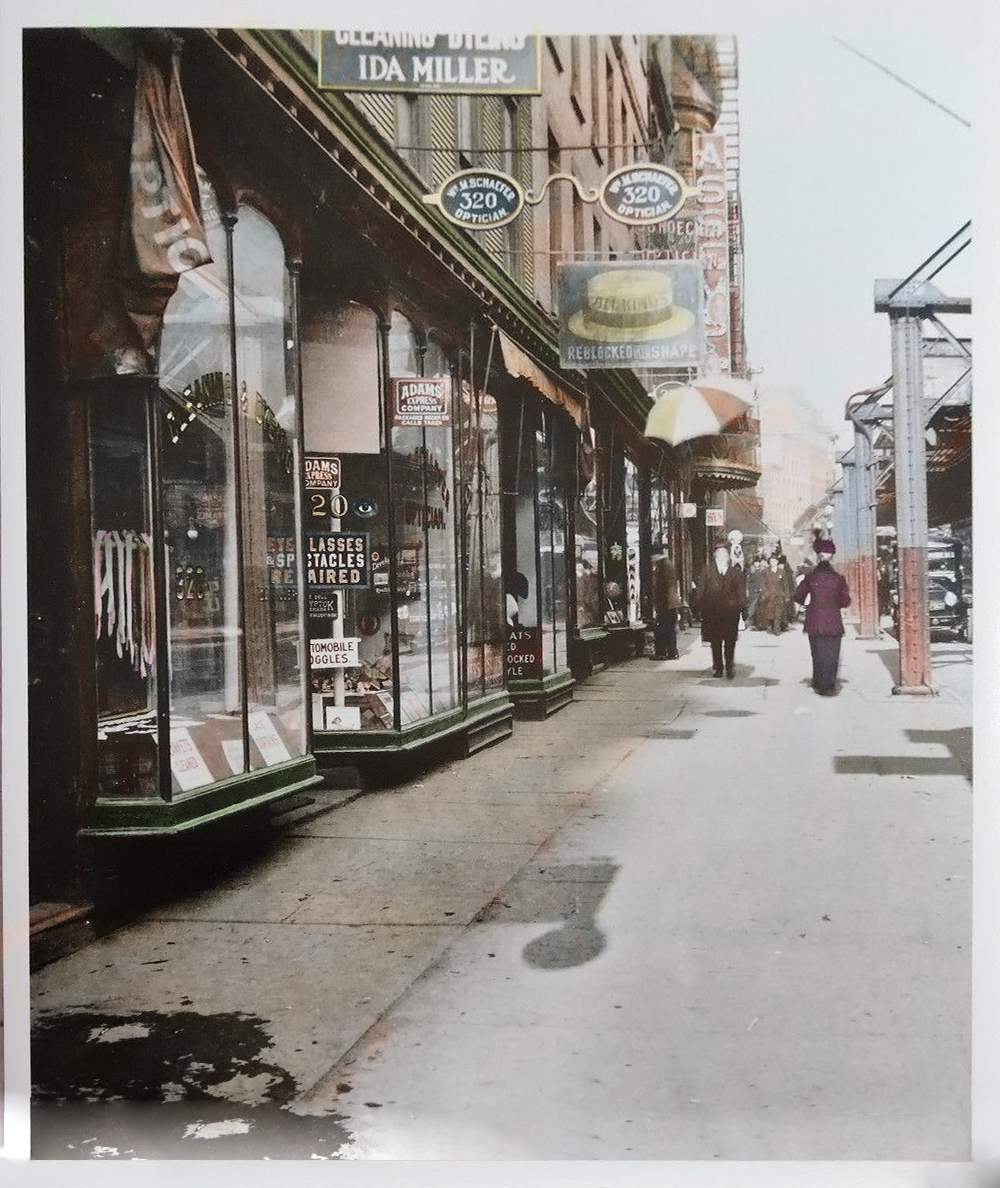
Again, we also see an evocative ‘H.P. Lovecraft stand-in’, this time as if walking toward the viewer. The man is not Lovecraft, but one could imagine he might be. We also see 320 and 322 Fulton Street on the left. This spot is thus close to Lovecraft’s dingy apartment on Clinton St., and the two points are marked on this extract from last week’s map…

The lady’s hat might date the picture some years earlier than the mid 1920s. One source says 1907, the other 1915. The scene here is one street over from the Montague Street technical and mercantile branch (1903) of the main Brooklyn Public Library, and I assume the Music Academy was still opposite this library (update, no it had burned down but there was an Art Club). This part of Fulton St. is obviously more salubrious than the adjacent Red Hook, despite the relative proximity to it. There’s a cleaners, an opticians, a hat-blocker, what seems to be an umbrella shop, a novelty shoe shop (according to Directories), the latter being next to “Asseys” (sp?). The “Asseys” sign and canopy might lead one to think it was a theatre or similar. But I can find no trace of such. Possibly it was a private club with large restaurant with dance-floor. Because there was a “Gentlemen’s Cafe and Grill Room” at 308 Fulton St. in 1910, with… “Accommodations for Balls, Banquets, Private Dining Parties and Lodges” and promising to provide the Royal Hungarian Orchestra. One has to wonder though, if this stretch of the street was quite so salubrious a place by 1925/26, given the way that the social status of New York neighbourhoods can rapidly shift over time. But one has to assume that the nearby Library continued to give the place a certain level and type of clientele, in the mid 1920s, which helped to maintain its standing.
The curious steel structure on the right of the picture is part of the famous and once much-loved elevated railway, “the El”. Lovecraft’s friend Rheinhart Kleiner celebrated Fulton Street and the El in this section of his Betjeman-esque poetic ditty “Brooklyn, My Brooklyn”…
To hear the passing roar above
Of elevated trains,
That thrill me as they soar above
Unnumbered marts and fanes.
I’d miss the book so pleasingly
Displayed on Fulton Street;
The other wares that teasingly
Remind of things to eat.
By book Kleiner presumably means a large bookshop shop-sign, hanging above the street and done in the shape of a book? In the photo above we see something similar in the shape of eye-glasses…

By fanes Kleiner indicates ‘temple or shrines’, and presumably the word is here used whimsically of the lunch eateries and soda palaces.
In one letter of 15th April 1929 Lovecraft talks of travelling into New York by rail on the… “elevated which I generally employ”, for a return visit. Here is a postcard and archive picture which shows the sort of elevated view he would have enjoyed along Fulton St. The second picture is a record-picture of the Elevated in the heart of Fulton St., Brooklyn, albeit from perhaps 20 years before Lovecraft’s time there.


Travelling in this manner is hugely enjoyable to the observant and keen-eyed type of person, provided one has a good window seat on the correct side of the carriage. One can thus become far more endeared to a place than otherwise, if one were only riding along in heavy traffic or trudging and dodging along at ground level on foot. Cities with elevated and double-decker transport are inherently more ‘likeable’ places.
Lovecraft’s good friend Frank Belknap Long also liked to browse an antiquarian shop on Fulton Street for curios, although (amazingly) it was Lovecraft who in 1922 had introduced Long to the second-hand bookshops of New York, not the other way around. Long went there at least once with Lovecraft…
[Roman coins and] baked-clay Roman lamps, and he [Lovecraft] once helped me pick out magnificent examples of both ‘coinage and lampage’ at an old-coin shop on Fulton Street.” (Dreamer on the Nightside)
Presumably this was the Brooklyn Fulton St., though it could have been its namesake over the river. That said, Long’s memory (of more than forty years prior) is not to be wholly relied on, and the store might even have been in some other street entirely. Scans of old coin-collector journals reveal the name of a well-respected curio and coin dealer dealer on Fulton St., but this name can lead me to no address or picture.
But the opening picture of this post is certainly of the Brooklyn Fulton St., the street in which Lovecraft successfully culminated his epic pursuit of a new suit at a cheap price after his clothes were stolen. That suit store was at 463 Fulton Street, Brooklyn, further up the street-numbering and around the bend from the spot pictured above. Lovecraft also patronised a restaurant off Fulton Street, this being sometimes visited by Lovecraft on Sundays for lunch. There were likely also some bookshops nearby, given the proximity of the technical and business Library, and more were coming — the bookshop of Isei Binkin at 252 Fulton Street may have been at that nearby address from 1932. This was the same Mr. Binkin of the amazing Grill/Binkin collection of Lovecraftania, which emerged in the early 1970s alongside Lovecraft’s reviving reputation.
Probably there are more mentions of ‘Fulton’ in print, but the two key books on Lovecraft in New York are not indexed to street-names. Once again I’m reminded that if one wanted to turbo-charge Lovecraft scholarship, a searchable database of all the letters would surely do that — even if it only supplied Google Books-like snippets in its search results. Surely such a thing would be fully crowd-funded within a day, if championed by Joshi and others?
But even without such a scholarly tool, I generally have the impression that the lower half of Fulton St. was ‘about’ something. It was about making the more aspiring people of this first great city of the modernity feel comfortable and easy, for a relatively-modest but fair price. Whether that was in affordable men’s accessories, cleaning and hat services, Sunday meals and soda/ice-cream palaces, or small items items such as spectacles, umbrellas, unusual shoes, cut-flowers, smoking pipes, and perhaps (later) books. In the upper half, as the streets rose into the 450s and 60s, the stores seemed to have become grander and there were several large and tall department stores.
I should note that there is another Fulton St. to be found just across the Brooklyn Bridge, passing through what is now the Financial District of New York. It was once connected to the Brooklyn Fulton St. by river ferries which had terminals at the foot of the famous Brooklyn Bridge. The ferry service seems to have been discontinued by the mid 1920s, thus severing the two streets. This means that when Lovecraft talks of visiting the Fulton St. Fish Market in a letter, he’s actually across the river and walking around the dockside at the foot of that other Fulton Street…
Some years ago Long and I attempted to explore the Fulton Fish Market section of New York — which is full of quaint scenes and buildings. I don’t know where I left the
lunch I had eaten an hour previously — for I was too dizzy to read the street signs! In the end I managed to stagger out of the stench without actually losing consciousness …” (letter of 1933, Selected Letters IV)
This brief mention implies that this daytime visit was hasty, yet according to Vrest Orton’s memoir of Lovecraft the area was a fairly frequent night-walk haunt of Lovecraft’s (see Lovecraft Remembered) in search of 18th century remains. Possibly the fish-smell was less so in the dead of night, when the boats were away and trawling and the disinfected warehouses awaiting their dawn-landed catch?
That Fulton St. appears to have subways rather than an “El” railway, and a subway entrance can be seen here in this 1933 picture…
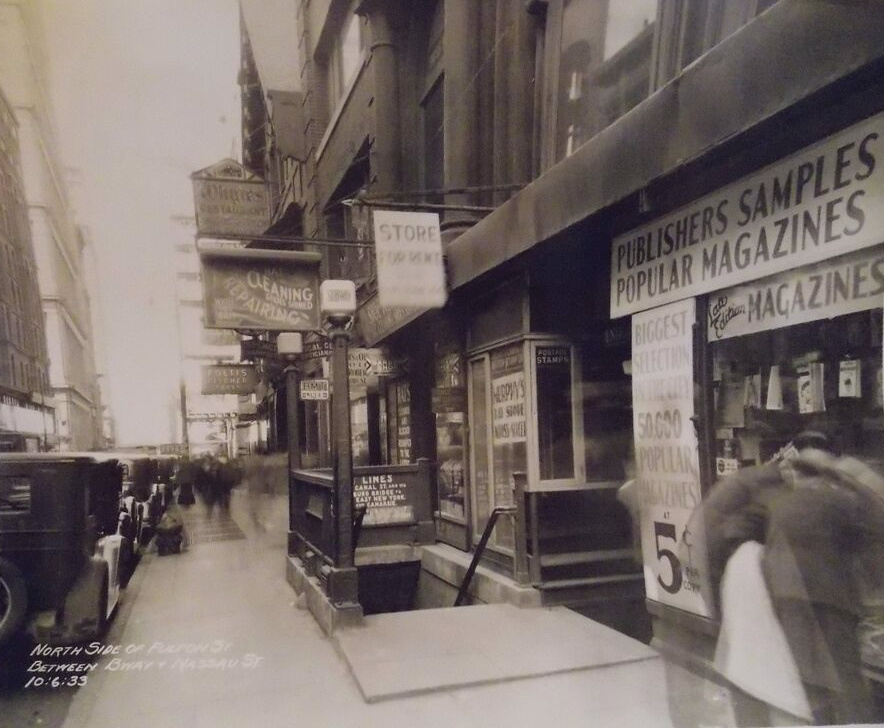
Since we know Lovecraft was also in this other street too, we might again imagine the picture’s scene shifted a few years in time. And that the men looking excitedly in the display-window resemble Lovecraft and Belknap Long — perhaps just hopped up from the subway to visit the “50,000 magazines store” — and seeing familiar names on the cover of a brand-new edition of Weird Tales.
13 Thursday Jun 2019
Posted in Historical context, New discoveries
Two new discoveries.
1) A photograph exists of the interior of the shop where Lovecraft culminated his epic hunt through New York, seeking a new affordable suit after his clothes were stolen. The date of the photograph is likely perfect, too.
A trade journal named The Clothier and Furnisher, seemingly in its 1925 volume, which has a long profile article on The Borough Clothiers store in Fulton Street, which was Lovecraft finally bagged his $25 suit. Hathi has a scan of three 1925/26 volumes, but these are on copyright lockdown for another few years and can’t be had even with a VPN.

Finally he seemed to come across just what he wanted—except that the coat only had two buttons. This was at the Borough Clothiers in Fulton Street in Brooklyn. Lovecraft was shrewd in dealing with the salesman: he said that he really wanted only a provisional suit until he could get a better one, therefore implying that he might buy another suit from the place later (not mentioning that it might be more than a year before he did so); the salesman, accordingly, consulted with a superior and showed him a more expensive suit but priced it at only $25. Lovecraft, putting the thing on, found that it “vastly delighted me,” but the absence of the third button gave him pause. He told the salesman to hold the suit while he checked more shops. The salesman told Lovecraft that it was unlikely he could get a better deal anywhere else, and after examinations of several more stores Lovecraft found that this was the case; he went back to Borough Clothiers and bought the suit for $25. (S.T. Joshi, I am Providence).
Perhaps someone with access to the archives of the New York libraries might be able to get a copy of the picture from the paper archives?
2) With some keyboard twiddling I managed to get the actual address from the Google Books copy, in a snippet:
the store operated under the name of The Borough Clothiers, at 463 Fulton Street, Brooklyn, is …
So far as I’m aware, this is the first time that scholars of Lovecraft’s life have known the actual address. A small point, yet it may lead to the emergence of a 1920s photo of the exterior as well as the interior.
12 Wednesday Jun 2019
Posted in Historical context, New discoveries, Odd scratchings
≈ Enter your password to view comments.
10 Monday Jun 2019
Posted in New discoveries, Scholarly works
The Pulp Super-Fan reviews Windy City Pulp Stories #19, the substantial 2019 program book for the convention and trading fair.
This year the focus is on the pulp writers, editors, and publishers from the Chicago area.
Th Farnsworth Wright section has the 1933 profile of him I posted here in April (I had no idea they were going to include it in the programme book). But there’s also much more on the other editors and publishers from the Windy City.
