• About
  • Directory
  • Free stuff
  • Lovecraft for beginners
  • My Books
  • Open Lovecraft
  • Reviews
  • Travel Posters
  • SALTES

Tentaclii

~ News & scholarship on H.P. Lovecraft

Tentaclii

Category Archives: New discoveries

HPLinks #18 – Lovecraft and relativity, Lovecraft’s political evolution in Spanish, a Canton discovery, and more…

19 Thursday Dec 2024

Posted by asdjfdlkf in HPLinks, Lovecraftian arts, New discoveries, Scholarly works

≈ Leave a comment

HPLinks #18.

* A new Wormwoodania post, “Remembering Scott Connors”, the Clark Ashton Smith and weird fiction scholar who has recently passed away. Related is last week’s news that S.T. Joshi intends to spend 2025 writing the long-awaited Clark Ashton Smith biography, a book Connors had apparently started but was unable to bring to publication.

* The Papers of Sonia H. Davis blog surveys 2024’s accomplishments in producing valuable new data and scholarship about Lovecraft’s wife.

* New on Archive.org, a scan of Marion Zimmer Bradley’s Fantasy Magazine for Winter 1992, with the lead article being the memoir “H.P. Lovecraft Meets Fafhrd and The Gray Mouser” by Fritz Leiber.

* The Fossils website has a new “scan of the article “The Phenomenon of H.P.L., a ten-page biography of H.P. Lovecraft by Helen V. Wesson originally published in The Fossil for July 1957.”

* Now free on YouTube, S.T. Joshi’s presentation “Lovecraft and the Physicists: Coming to Terms with Relativity and Indeterminacy”, given at the recent ‘Lovecraft et les sciences’ conference in France. Two hours, but the length is partly due to the lack of an AI insta-translator. Thus there are many pauses needed for manual translation.

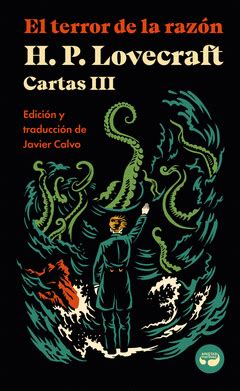
* A third Lovecraft book of translated letters for Spanish readers, El Terror de la Razon. Cartas III (2024), new from publisher Aristas Martinez. The blurb reveals that the first section flows around the idea of… “‘The Terror of Reason’, his ideas about humanity and the cosmos that he disseminated in his most famous stories [and fashioned into] visionary thought that would later inspire a new generation of posthumanist philosophers”. Then the second part of the book focuses on the evolution of the man’s political ideas and ideals, in his own words. I’d hope there are copious footnotes enabling younger readers with no personal experience of the 20th century to (for instance) distinguish national socialism from soviet socialism, and to know what a ‘blackshirt’ was, etc. e.g. when he signs off “Yrs for the blackshirt march on Washington” — Lovecraft to Galpin, July 1934.
* New from Brazil in open-access, a Spanish-language journal article with the translated title ‘Gods, Monsters, Aliens: Lovecraft and the Post-Human’.

* The free bundle of Lovecraft tales, specially set up for deep textual analysis with a computer, is now available as lovecraftr version 1.2 (December 2024).

* Further to my July 2024 post on “that Canton madhouse”, Tentaclii reader Luke has written to say that he’s spotted a possible state institution at Canton (this being the Canton to be seen from a tall railway viaduct, when on the rail route from Providence to Boston). This was the ‘Industrial School for Crippled and Deformed Children’, later the ‘Massachusetts Hospital School’. Opened in 1907 and continuing to the present day, located on an 160-acre slope going down to meet the large local lake then called ‘Reservoir Pond’. Lovecraft had written “I shall plan my cousin’s escape from that Canton madhouse”. Yet this real place was not a “madhouse”, but rather an institutional residential hospital with vocational training (farm work, craft workshops etc) for ages 2 to 20. This possibility is certainly worth considering. But, so far as I can see, the location and relatively low-rise appearance (compared to the vast castle-like state madhouses of the time) suggests it may not have made much of an impression on passing rail travellers, even if it could have been seen from a train window…
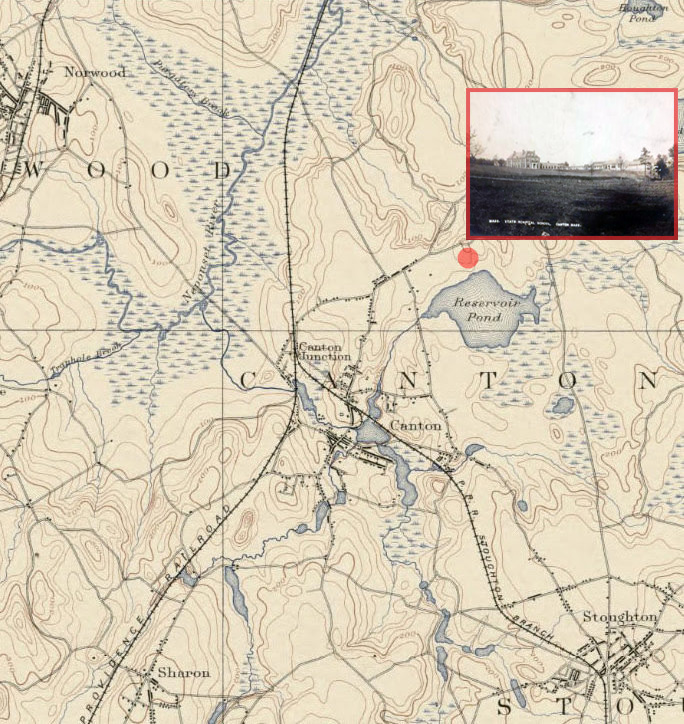
Note that Luke plausibly observes that the use of “poor little cousin” indicates that the Innsmouth-tainted cousin may have been sent away when a child. He was “little” but then “I had not seen him in four years”, and then a few more years pass before the rescue plan. All of which suggests a boy of perhaps 12 or 13 at the time of the rescue. A boy who would not yet have been transferred to an adult institution. Thus, to find the key state institution for “deformed” children at the real Canton is certainly intriguing.

* A new Skull Session podcast interview with Will Murray… “Will Murray and I discuss his long and varied career writing for Marvel Comics and magazines” and the influence of Lovecraft.

* It’s official, there will be a “4k restoration” version of the Re-Animator movie, complete with bubbling vats of newly-brewed extras. Likely to appear in early April 2025, and to ship with a 150-page book. The much-loved 1985 comedy movie adapted Lovecraft’s Home Brew magazine shocker-serial “Herbert West: Reanimator”.

* In Denmark in August 2025, a three-day conference on ‘Otherworldly Entertainment’…

Today, videogames continue to be one of the biggest platforms for horror, magic, gothic, and occult entertainment, even outperforming cinema and television. Despite [this deep reach into] broad audiences, [the topic] remains severely understudied.

* A paying Lovecraft-related job for a “Dark and mysterious painterly illustrator” wanted for the early stages of a commercial project. Predictably it’s a ‘rush job’ and over Christmas and New Year too. But the offer looks quite serious and there should be just enough time. Sadly the application is by a “super detailed and borderline complicated form” (‘exit stage-left: half the creatives in the room, screaming…’, etc).

* Tartarus Press on the T. Lobsang Rampa books. I recall these being prominent on home bookshelves, as a young child. Not my own shelves, as I never read the Rampa books. But it’s fascinating to learn now that the supposed mystical Tibetan lama who peeped out at me from the book-cases as a child, was… “in fact the son of a plumber from Plympton in Devon [southern England] called Cyril Hoskin”. He became a sometime fitter of corsets, sometime photographer, in the dreary greyness of post-war London. After his first 1956/57 best-seller…

with each subsequent book, Rampa casually shared his knowledge of astral travel, civilisations on Venus, UFOs, etc. One of his books was even meant to have been dictated to him by his cat.

The newspaper expose didn’t matter. He just went into full character for the rest of his life, claimed ‘reincarnation’ and much else… and credulous readers still lapped it up. Tartarus is now seeking anyone who can help with the research for a new full biography of this strange and strangely popular Englishman.

* Islands magazine recommends a visit to an “Underrated Literary Gem Filled With Rare Finds In Rhode Island”. This being the John Hay Library in Providence. Along with the huge Lovecraft collection, evidently the visitor can find there what sounds like one of the world’s finest collections of miniature toy soldiers, and for the especially ghoulish… four books bound in human skin.

* And finally, at the Grolier in New York City, “Imaginary Books: Lost, Unfinished, and Fictive Works”. Their exhibition runs until 15th February 2024. The Necronomicon is, regrettably, represented by a rather naff plastic ‘joke’ case (supposedly holding ye dreadfull tome).


— End-quotes —

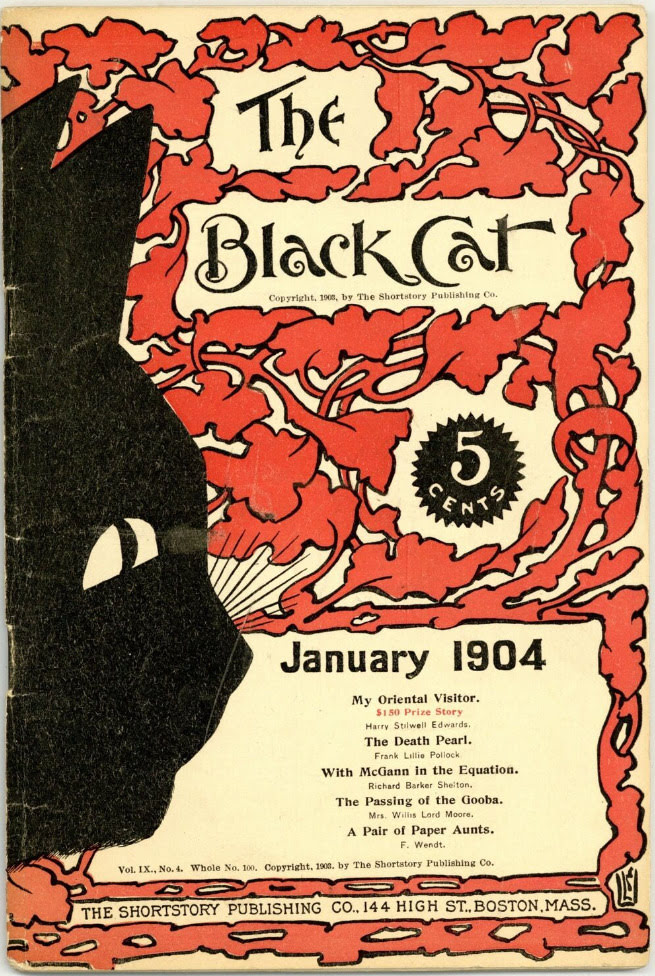
“Hope ya kin get your Black Cat file [i.e. a complete ‘reference file’ run of a past magazine]. I used to buy that reg’lar-like, and recall the swell weird stuff it had.” — Lovecraft to Morton, 23rd February 1936.

“I have been re-reading [your new story] “Marsh-Mad” — & the more I analyse it the better I like it! I shall make every effort to get this in the official organ [but, if not then it] is far too good to waste on any but a first-rate paper! Try it on the Black Cat.” — Lovecraft to Galpin, 29th August 1918.

“Once again I’ve followed a Mortonian [Morton] tip, as I did when sending “Dagon” to the Black Cat and “The Tomb” to the Black Mask and have slipped Weird Tales five of my hell-beaters” — Lovecraft to Morton, May 1923.

We know Lovecraft began to “notice” the magazine Black Cat in 1904, but I know of no scholars able to pinpoint the exact date at which he ceased to buy or read the title.
Maxfield’s, at Warren

19 Friday Jul 2024

Posted by asdjfdlkf in New discoveries, Picture postals

≈ 2 Comments

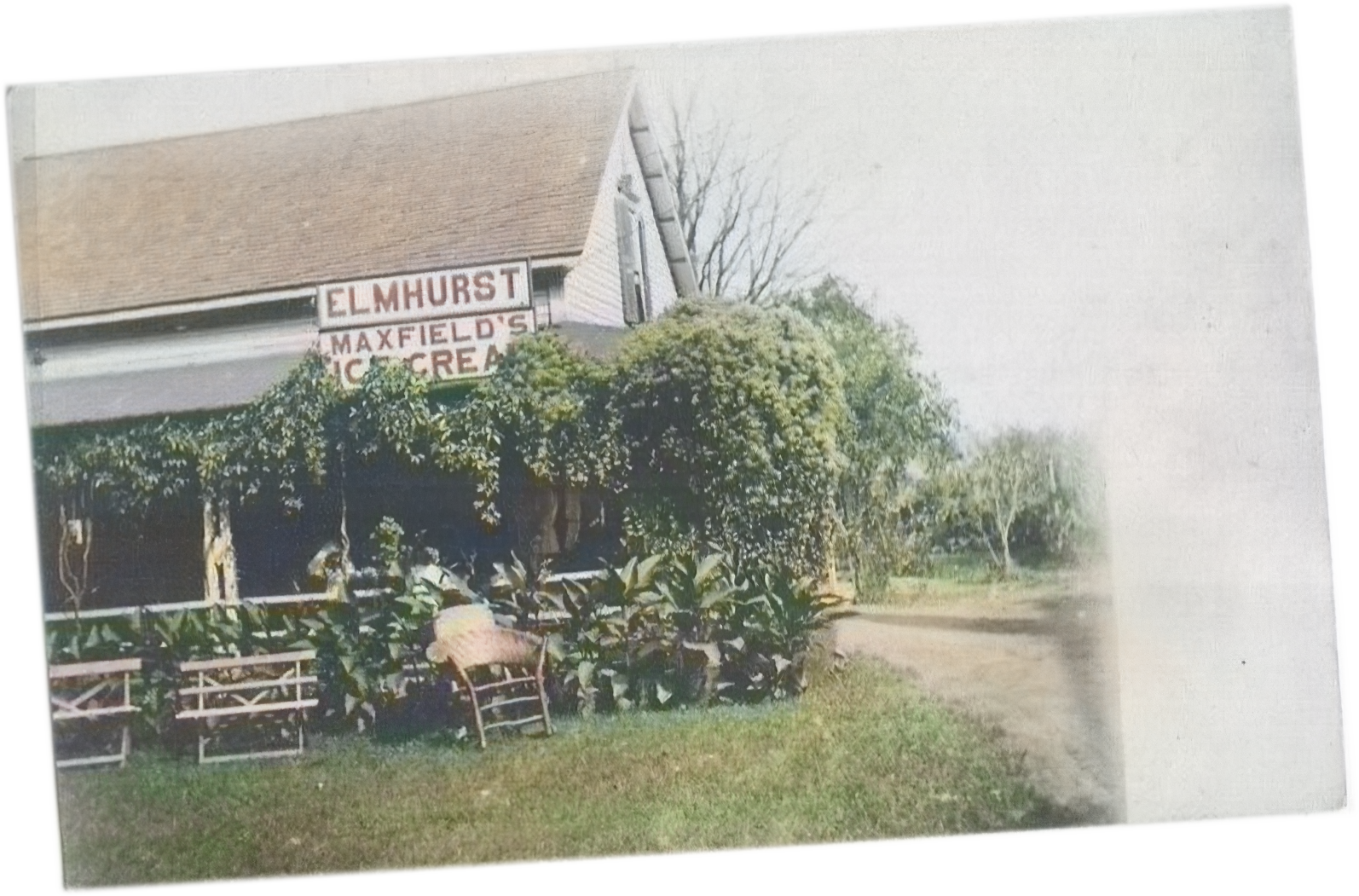
I had little hope of ever finding a picture of Julia A. Maxfield’s ice-cream parlour, which was something of a repeating rural venue for the Lovecraft circle. But one has popped up at last. I’ve here colourised it. The card is still available, for a hefty price, on eBay.

Saturday morning all three of us went to Colonial Warren — down the east shore of the bay — and staged an ice-cream eating contest at the celebrated emporium of Mrs. Julia A. Maxfield — an aged matron of antient Warren lineage who has won fame by serving more flavours of ice cream than any other purveyor either living or dead. There are twenty-eight varieties this season, and we sampled them all within the course of an hour.

The game was, in the course of one hour…

Each would order a double portion — two kinds — and by dividing equally would ensure six flavours each round. Five rounds took us all through the twenty-eight and two to carry. Mortonius [Morton] and I each consumed two and one-half quarts, but Wandrei fell down toward the last. Now James Ferdinand and I will have to stage an elimination match to determine the champion!”

There were a number of visits and other contests…

Another time we visited the colonial seaport of Warren, down the East shore of the bay — incidentally stopping at a place (quite a rendezvous of our gang) where 28 varieties of ice cream are sold. We had six varieties apiece — my choices being grape, chocolate chip, macaroon, cherry, banana, and orange-pineapple.

Then back home via […] ancient Warren […] at which latter place we paused at the famous Maxfield’s (a rendezvous of Morton, Cook, & other visitors of mine) for a dinner consisting entirely of ice cream – a pint & a half each. HPL: chocolate, coffee, caramel, banana, lemon, strawberry.

After digesting Warren’s quiet lanes and doorways we went across the tracks to Aunt Julia’s, where we tanked up on twelve different kinds of ice cream — all they’re serving at this time of year [March]. The antient gentle-woman, of course, was not there – since (as I wish to gawd I could) she spends all her winters in Florida — but the bimbo in charge was very pleasant, and we got quick service since we were the only customers.

American Biography (1924) confirms the at-or-near 71 Federal Street location. At Warren…

is where ‘Elmhurst’, famous for Mrs. Maxfield’s ice cream, is located on Federal Street.

However the 1932 Providence Directory has it on Narragansett Av. There were likely several different ways of approaching it. Today Federal Street looks like a fine place, but seems too short in terms of numbering. Perhaps it once ran on, and would thus have given us a No. 71? Narragansett Av. also seems gone, but one wonders if it once ran along the shoreline and Federal Street ran on to meet it? But it would probably take a local sleuth to pinpoint the location and say if the building survives.

As for Lovecraft’s ice cream craving, it began early, if the evidence of its use in his seminal poetry is anything to go by. In his early comic/cosmic poem “The Poe-et’s Nightmare” (1916)…

Each eve he sought his bashful Muse to wake
With overdoses of ice cream and cake

The 1925 telegraphic diary has plentiful of mentions of ice cream in New York City.

By 1934 ice cream has become something of a staple meal on his travels south. June 1934, in Charleston…

Still on 20¢ a day for food, but off the canned stuff. Morning — 5¢ cup of ice cream. Evening, 10¢ bowl of Mexican chili and another 5¢ cup of ice cream.” […] I “frequently make a full meal of it (and nothing else) in summer.

December 1936. Ice-cream now a costly luxury, as poverty deepened. But still…

Occasionally, of course, extravagant additions [to one’s meagre diet] occur — such as […] a chocolate bar or ice cream at an odd hour [… and yet] the old man still lives — in a fairly hale & hearty state, at that! Oddly enough, I was a semi-invalid in the old days when I didn’t economise. Porridge? Not for Grandpa!


His ice cream cravings were such that in “The Exiles”, a Ray Bradbury ‘Mars’ story after Lovecraft’s death, Bradbury portrays the Martian Lovecraft as an ice cream-aholic…

Lovecraft hurried to a small icebox which somehow survived this red furnace and brought forth two quarts of ice-cream. Emptying these into a large dish he hurried back to his table and began alternately tasting the vanilla ice and scurrying his pen over crisp sheets of writing paper. As the ice-cream melted upon his tongue, a look of almost dreamful exultancy dissolved his face; then he sent his pen dashing. “Sorry. Really, I am awfully busy, gentlemen, Mr. Poe, Mr. Bierce. I have so many letters to write.” […] The writing man tried another delicate spoonful of the cold treasure. There were six empty vanilla ice-cream boxes piled neatly on the hearth from this day’s feasting. And the ice-box, in the quick flash they had seen of its interior, contained a good dozen quarts more.

Mansions of Madness

02 Friday Feb 2024

Posted by asdjfdlkf in New discoveries, Picture postals

≈ Leave a comment

When in Providence Lovecraft greatly enjoyed visiting nearby Newport, although the trip involved a long and sometimes chilly boat trip. One of the attractions of the place was its antiquities and perhaps its many grand mansions. Including a monstrous castle which could have come straight from one of Lovecraft’s tales…

The vast structure was however wryly called a “Cottage” by the inhabitants of this isolated shoreline castle. It was demolished in 1924, but Joshi has Lovecraft visiting Newport as early as 1915. He also went to Newport with Sonia just prior to the New York years, which gave rise to the joint tale “The Horror at Martin’s Beach”. The above mansion was still there at that time. In the tale such structures offer a key setting…

It was in the twilight, when grey sea-birds hovered low near the shore and a rising moon began to make a glittering path across the waters. The scene is important to remember, for every impression counts. On the beach were several strollers and a few late bathers; stragglers from the distant cottage colony that rose modestly on a green hill to the north, or from the adjacent cliff-perched [Wavecrest] Inn whose imposing towers proclaimed its allegiance to wealth and grandeur.

Now, Lovecraft’s “Inn” is hardly rustic, since it is described as having an ornate balcony and a “sumptuous ballroom” inside. It operates as a very upmarket “hotel”. The setting is then similar to that of the mansion on the postcard. More so when one knows that this real-world monstrous “Cottage” castle was apparently adjacent across the water to a far more alluring “cottage colony” of writers, as in the story. The name is also similar, the mansion being dubbed ‘Breakwater’ in reality, and ‘Wavecrest’ in the tale. All this suggests that the postcard shows the setting of a Lovecraft tale, albeit a joint tale.

There are two illustrated books on the topic, free on Archive.org, A Guidebook to Newport Mansions and Newport mansions: the Gilded Age, each giving views inside such structures as survived into the 1980s.

Lovecraft’s eyes

26 Friday Jan 2024

Posted by asdjfdlkf in New discoveries, Picture postals

≈ 1 Comment

There’s a new and interesting scientific wrinkle on Lovecraft and ‘fear of the dark’. You’ll recall that Lovecraft had darkish hazel-brown eyes. A new pre-print research paper from Liverpool in the UK tested the “Effect of iris pigmentation of blue and brown eyed individuals” of European descent, in terms of their low-light vision. They found that…

Blue eyed individuals were identified to have significantly better ability to see in lower lighting

… after a short adaptation period. In other words, after a short time of ‘letting your eyes get used to the lowering light’. The authors suggest that the already-known susceptibility of blue eyes to ‘straylight'(*) is the likely cause, providing just…

enough luminance to provide blue-eyed individuals with a visual advantage to make out shapes

… with relative speed in lowering-light environments. Such as hunting at dusk. This seems plausible, though note that the study has a small sample size.

But the implications for Lovecraft is that as an adult he saw darkness as more of a ‘void’ than he might have done if he really had been a blue-eyed Nordic type. Although in 1923 he joshed with the Mediterranean-favouring Belknap Long in a letter that he was really a Nordic, and thus entitled to imagine himself…

a comrade of the wolves, and rider of nightmares — aye — I speak truly — for was I not born with yellow hair and blue eyes — the latter not turning dark till I was nearly two, and the former lasting till I was over five? Ho, for the hunting and fishing in Valhalla!

Thus, there may have been a ‘double impact’ here for Lovecraft in early childhood. An imaginative tot’s intense fear of the dark exacerbated by his blue eyes, until the age of two, due to good perception of subtle shapes in the dark. Then a strong and perhaps sudden lessening of this ability, leading to the increasingly imaginative child’s fear that the terribly phantasmal shapes were still there in the dusk, but were now dangerously unseen…

Their hand is at your throats, yet ye see Them not; and Their habitation is even one with your guarded threshold.” (Necronomicon).

You’ll recall also Lovecraft’s early fear of the dark. Evidenced by the lengths his grandfather went to, to try to cure the boy of it. Also his love of cats, friendly creatures able to see relatively easily in the very low light.


* straylight — “light that enters the eye but does not reach the retina in a focused manner”

Alice Hamlet of Boston

29 Sunday Oct 2023

Posted by asdjfdlkf in New discoveries

≈ Leave a comment

Deep Cuts examines what can be known about the lost Lovecraft correspondent Alice M. Hamlet, and finds a good photographic portrait. She was a Boston concert pianist and a keen amateur journalist.

I see the New England Piano Teachers’ Assoc. still holds an annual Alice Hamlet Competition, presumably named after her and in her memory. They may be interested in knowing about the pictures of her?

Pictures of Eddy’s bookshop on Weybosset

18 Friday Aug 2023

Posted by asdjfdlkf in New discoveries, Picture postals

≈ 1 Comment

At the risk of boring regular readers of Tentaclii, here are four more glimpses of the ‘Uncle Eddy’ bookshop on Weybosset in Providence. Readers of the Lovecraft Annual 2022 will recall my detailed article which revealed the bookselling uncle of Eddy Jr., a firm “favorite” for the book collectors in Lovecraft’s circle whenever they visited Providence. The largest used bookshop in Providence, for many years. In the article I was only able to furnish a bit of a poor picture-postcard…

I’ve since found four more glimpses of the site. Though only glimpses, not a straight-on picture of the doorway to the cellar bookstore.

First, an early image of the site (here outlined in red) from the archives of the Providence Public Library. Two distinctive domes are clearly seen. The nearer one on the far-left, and in the distance the old Beneficent Congregational ‘Round Top’ Church. These provide useful orientation.

Next a detail from another Public Library picture. Here we look the other way, and see only the distinctive domed building on the corner. Again, the doorway is outlined in red.

Next we again look toward the Round Top church. The bookstore entrance, or what would later be a bookstore, is obscured by a street fountain.

Here we look toward the Crown Hotel, and can just see the same distinctive dome on the corner building. The entrance is again obscured, by what might be a short telegraph pole.

While looking for pictures I did however stumble on a rare good front-view of a Providence ‘news-stand’ store, and in what might be the early 1920s. The Narraganset Smoke Shop, probably in Dorrance Street since an adjacent/above sign (seen on the wider picture) for “T.H. D’Arcy, Engraver” leads me to 86 Dorrance Street. Just around the corner from Weybosset Street. This hole-in-the-wall magazine, tobacco and candy store looks a likely prospect for a fellow wanting to bag a copy of the curious new magazine called ‘Weird Tales’. Here newly colourised.

John Carter Brown Library

28 Friday Apr 2023

Posted by asdjfdlkf in New discoveries, Picture postals

≈ Leave a comment

This week on ‘Picture Postals from Lovecraft’, a very fine glass-plate view of the John Carter Brown Library at Brown. This is an “other gate” on the university, the better known one being the Van Wickle Gates near Lovecraft’s last home at No. 66 and at which Lovecraft posed for photos.

No, it’s not a Library of Congress picture. This one came from spotting a stray eBay listing of a discarded print from some picture library. There was no watermark and it was a good scan at 1600px. I’ve here colourised, cleaned and enlarged x2.

I’d previously spotted that an ironwork Cthulhu-a-like was recorded in a 1965 book of b&w art-photographs of the Brown campus. This was located outside the John Carter Brown Library, but is not clearly seen on the above picture.

It formed part of the moulding at the foot of the lamp-posts outside the Library, and above we see one of what appears to have been three faces surrounding the base. The new colour picture now adds further context to this discovery. The lamp-posts can be seen, and these face(s) were not right down on the sidewalk/floor where they might be overlooked. Rather, they terminated in the elevated marble stair-posts and would thus have been visible to all who ascended the steps and then passed by. Including one Mr. H.P. Lovecraft.

Their elevation and original situation can also be seen here. That they were topped with ‘Moon’ globes might also have tickled Lovecraft’s fancy…

Notes on The Conservative – April 1915

07 Tuesday Mar 2023

Posted by asdjfdlkf in Astronomy, Historical context, New discoveries

≈ Leave a comment

Notes on The Conservative, the amateur journalism paper issued by H.P. Lovecraft from 1915-1923.

Part One: the April 1915 issue.

This first issue opens with a poem. The casual peruser might at first dismiss this poem as a comedic effort for the amusement of amateur journalists, since it has do with spelling, printers and the sort of prickly reviewer who delights in the public revelation of small errors in typesetting and spelling. In a way, that is what it is. Yet just 15 lines into the poem, Lovecraft’s key future-themes of madness, knowledge and language emerge strongly. While out walking he encounters a scholarly “sage” made raving mad by his own scholarship. Out of a desire for some relief from complex language and thought, this madman has devised a ‘simple spelling’ system in which errors are not to be considered errors. Lovecraft buys into this one-man cult and thus becomes abandoned in his writing, until his “amorphous letters pass as language pure”.

The wartime essay “The Crime of the Century” follows, an essay relatively well-known to Lovecraftians and evidence for his close alignment with the common race-thinking and terminology of the time. Collected Essays 5 has one footnote for it, on the “Thomas Henry Huxley” who was one of the first to grasp and endorse Darwin’s principles of evolution. In passing Lovecraft also appears to endorse the theory that the Viking-discovered Vinland (“Vineland”) was indeed located in New England or thereabouts. Such ideas and their ideological hinterland are still contentious today, as evidenced by the recent removal of this picture from the walls of the National Gallery in Oslo1 due to its ‘colonialist’ political incorrectness…

Christian Krohg’s “Leif Erikson discovers America” (1872).

The Krogh painting was itself a replacement for a painting (originally on the museum’s grand staircase) banished because deemed even more politically incorrect.2. This was “The Ride of Asgard” (Asgardsreien) (1872) by Peter Nicolai Arbo. All this reminds one that the defunct political and ethnographic commonplaces of Lovecraft’s youth still have a curious power to induce fear, even today. It is not to be found only in his horror stories and darker poetry.

In a note immediately following the essay Lovecraft, expecting attacks, wittily warns his would-be critics that he has closely studied both Pope’s Dunciad and…

Paul J. Campbell’s ‘Wet Hen’

The latter was a quarterly humour magazine which bore a customarily risque cover, being produced by the journalism fraternity of the University of South Dakota. I assume Lovecraft had it by mail via amateur contacts, possibly editor Campbell himself, of whom no trace can be found. It was presumably mailed in a plain brown wrapper, the rules on the U.S. mail then being rather strict. If Lovecraft was indeed a subscriber in 1915 then it had a long run, because mention of this quarterly can be found right through into the 1950s. It is not online except in very occasional eBay listings, though the University’s Archives & Special Collections has it in archival boxes — if anyone wants to spend a merry hour hunting for unknown Lovecraft letters or perhaps even a jaunty poem or two. Wet Hen looks to be similar to Home Brew, to which Lovecraft would later contribute.

Lovecraft then introduces his readers to the newest UAPA recruit and his boyhood friend Chester P. Munroe. While Lovecraft is still “secluding himself amidst the musty volumes of his library”, Chester has grown into a man of the world and is living in South Carolina. The reader learns that Chester would write stories at the Slater Avenue school they both attended, and he later wrote “an unpublished novel”. His “charming younger brother” Harold is now Deputy Sheriff of Providence County, which gives Lovecraft an interesting early connection with the local police (even though he never read the police report pages in his local newspaper).

Lovecraft next admires Leo Fritter’s astronomical-philosophical essay on “The Spiritual Significance of the Stars” in the amateur journal Woodbee. Again, this is not online. One assumes no taint of astrology was to be found in this essay. Since elsewhere in The Conservative Lovecraft endorses Fritter for the role of UAPA President.

Lovecraft reports he has read Dench’s new booklet “Playwriting for the Cinema”, finding it “terse and readable”. The full title is Playwriting for the Cinema: dealing with the writing and marketing of scenarios (1914). No scan is online, but one can discover it to be a substantial 76-page booklet. Both Arthur Leeds and Everett McNeil were professional scenario writers in the movie business, then centred in New York City. Over a decade later Dench will become one of the lynch-pins who brings together the Lovecraft Circle in New York City, including Leeds and McNeil.

Lovecraft greatly admires J.H. Fowler’s poem “The Haunted Forest”, encountered in the British amateur journal Outward Bound. It…

shows a marvellous and almost Poe-like comprehension of the dark and sinister

This poet was the schoolman, anthology editor and de Quincey expert John Henry Fowler (1861-1932). I can find no volume of his own poetry. Conan Doyle may have poked fun at him in the classic mystery story “The Secret of Goresthorpe Grange” (1883), and if so then this hints that (at age 22) he was becoming known among writers and publishers for his interest in such things…

J.H. Fowler & Son, Dunkel Street, suppliers of mediums to the nobility and gentry; charms sold — love-philtres — mummies — horoscopes cast.

In The United Amateur, Lovecraft expands on the poem…

The Haunted Forest”, a poem by J.H. Fowler, is almost Poe-like in its grimly fantastic quality. We can excuse rather indefinite metre when we consider the admirably created atmosphere, the weird harmony of the lines, the judicious use of alliteration, and the apt selection of words. “Bird-shunned”, as applied to the thickets of the forest, is a particularly graphic epithet. Mr. Fowler is to be congratulated upon his glowing imagination and poetical powers.

I see that Lovecraft much later slips this same wording into his story “The Haunter of the Dark”…

… what might still be lurking in the bird-shunned shadows?

  1.   “Storm blows around art banished to the new National Museum’s cellar”, Norway’s News in English, 20th February 2023. ↵
  2.   Peter Nicolai Arbo and Artistic Hybridity in the Nineteenth-century (2018), page 58 ↵

A new short yarn by Lovecraft’s friend Everett McNeil

02 Thursday Mar 2023

Posted by asdjfdlkf in New discoveries

≈ Leave a comment

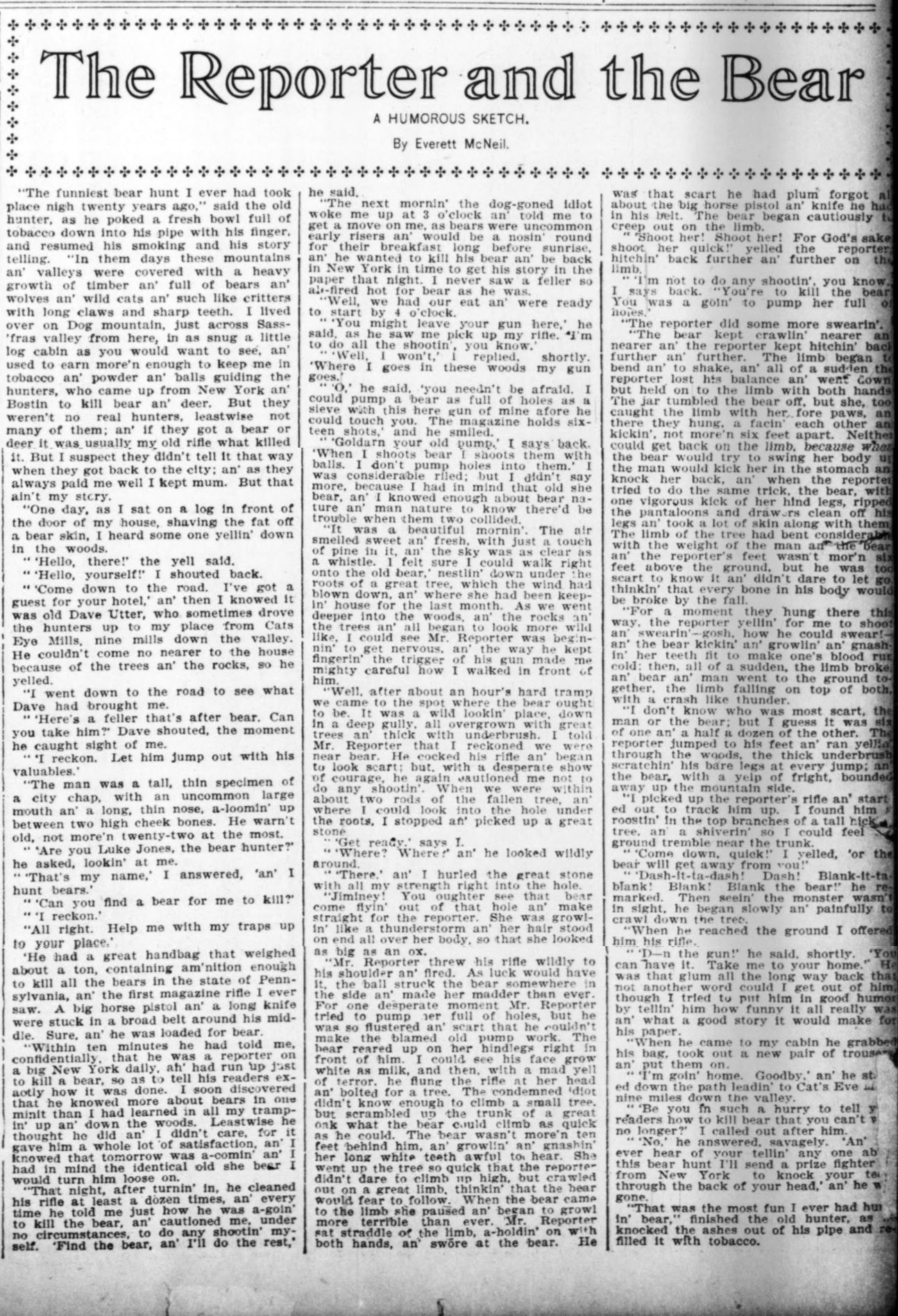
I found a new short yarn by Lovecraft’s friend Everett McNeil. Sadly it’s not an unknown fantasy to add to those in his Dickon Bend-the-Bow and other Wonder Tales, but rather one of his early wry ‘backwoods America’ yarns titled “The Reporter and the Bear”. It appeared in The Atlanta Constitution for 2nd July 1899, and has popped up now because Archive.org has been ingesting newspapers on microfilm. Thankfully it’s readable. In my biography of McNeil, Good Old Mac (2013) I listed this as known but not seen…

The Reporter and the Bear”, Salt Lake Herald, July 1899

Now it can be read again.

New drawings by Lovecraft

29 Tuesday Nov 2022

Posted by asdjfdlkf in Lovecraftian arts, New discoveries

≈ 1 Comment

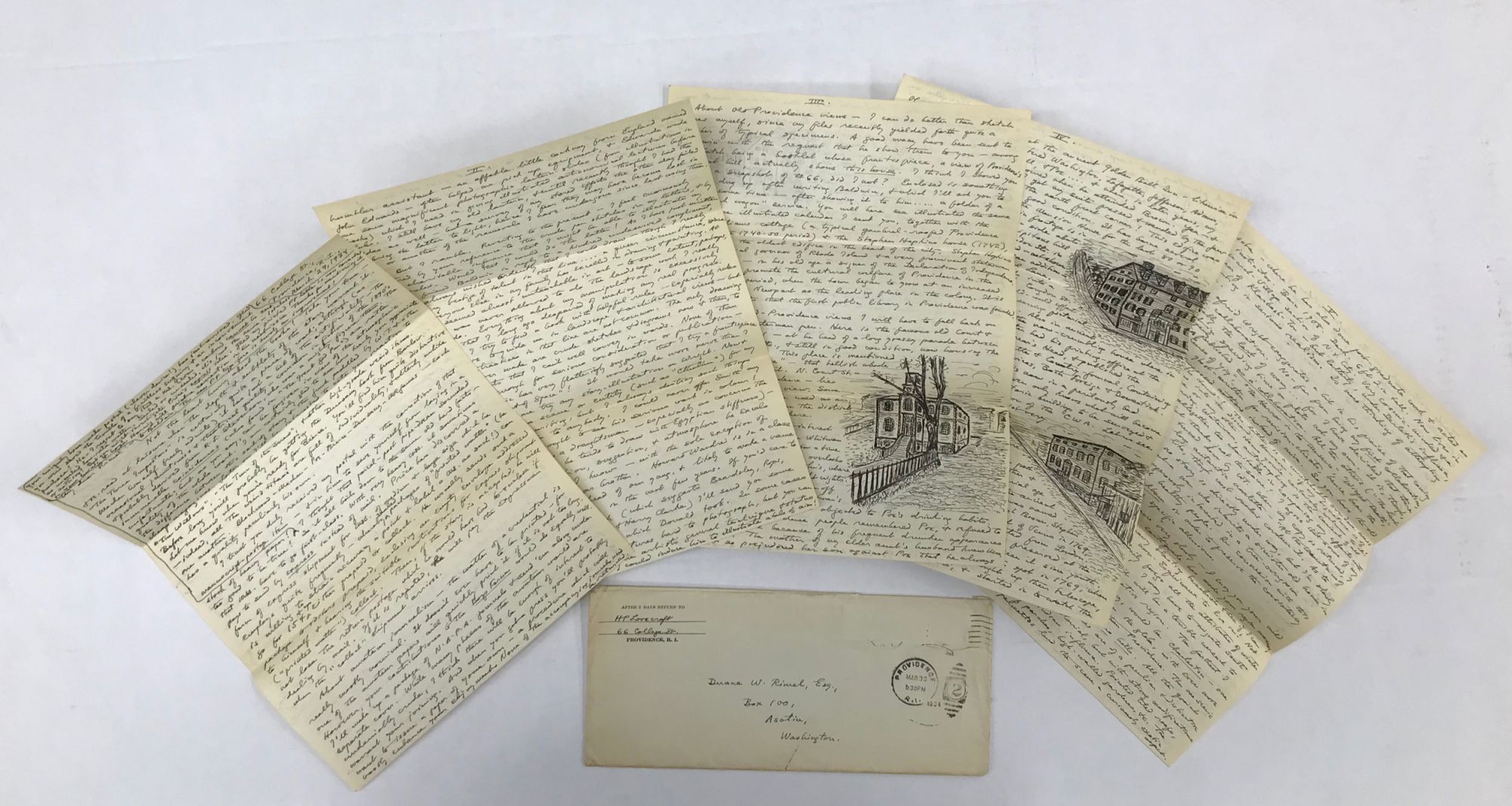
A Lovecraft letter to Duane W. Rimel, now for sale from L.W. Currey.

10 pages on both sides of 5 sheets, closely written and incorporating 7 pen and ink drawings of old Providence architecture, dated 29th March 1934, signed “Yours most sincerely — H.P. Lovecraft.

The description makes no mention of Letters to F. Lee Baldwin et al. There the text of the letter appears to be published complete, and it matches the Currey description. But the “7 pen and ink drawings” are not shown with the letter in the book. Nor are the drawings found with the letter as partially published in Selected Letters IV.

Three of the pictures can be seen in the above Currey listing picture.

Grandpa Tibbles

15 Tuesday Nov 2022

Posted by asdjfdlkf in Kittee Tuesday, New discoveries, Scholarly works

≈ 2 Comments

Lovecraft derived his pseudonym ‘Lewis Theobald Jr.’, later ‘Grandpa Theobald’ and variants, from the pioneering but much put-upon Shakespeare scholar Lewis Theobald (1688-1744). I’ve now discovered a curious thing relating to this choice.

The discovery occurred this way. I was looking at the early medieval talking-fox cycle Reynard the Fox as a source for Tolkien. Part of the evidence is found in one early version of Tolkien’s “The Tale of Tinuviel”, in which the hero is enslaved by the evil Melko’s lieutenant (“he was in Melko’s constant following”) who is a demon cat called Tiberth, Prince of Cats (“whom the Gnomes have called Tiberth”). This name is very similar to the central tom-cat character in the long and often ribald Flemish tale of Reynard the Fox — Tibert (Flemish). In Dutch Tybert; Old French Tibert; English Gilbert via Chaucer and his translation of the French Tibert; and then the name roots back via philological methods to the Germanic Theobald.

Skeat has… “I take Tybalt to be a shorter form of Theobald, which again is short for Theodbald … The A.S. [Anglo-Saxon] form is Theodbald, which occurs in Beda, [Bede] Hist. Eccl, book. i. c. 34.” (Skeat, Notes on English etymology). The American Century dictionary concurs with… “Thibault, a form of Theobald“.

So, these words were once the common descriptor for a male cat, most likely a dominant and bold one with a long tail. Now, I wonder if Grandpa Theobald knew that?

We can be certain that Lovecraft knew his Pope, and indeed he had minutely studied The Dunciad. He would then have been well aware of the character of Tibbald, the dunce poet in Pope’s Dunciad. We see him in the lines…

    in Tibbald’s monster-breeding breast,
sees gods with demons in strange league engage

That sounds very suitable then, for a Lovecraft pseudonym, on these lines alone. The lines are explicated with the pointed footnote… “Lewis Tibbald (as pronounced) or “Theobald (as written) … He was Author of some forgotten Plays, Translations, and other pieces.” The poem’s lines continued on, describing Tibbalt sitting without any supper but surrounded by his library of books and unable to pawn them. He is thus at that very moment selected by a goddess as the most suitable earthly candidate for the ‘Throne of Dullness’, and he ascends to the throne after being initiated by her. Nothing is said by Pope of the connection of the name with cats, and apparently Reynard the Fox was something of a forgotten wonder-of-literature in England until a grand popular revival in the 1850s. In Pope’s time Gilbert or gib-cat was the English name for a male cat, also starting to have the implication of castrated (as society became less rural and thus randy tom-cats became less welcome, in terms of keeping up the local cat population in order to remove mice and rats). Thus if Pope did know the connection of the name with Reynard’s tom-cat, he doesn’t say.

So there’s no evidence there that Lovecraft knew Theobald was the root of a name for a cat. However Lovecraft wrote once to his friend Moe as “Grandpaw Tibbald”, suggesting he was well aware of the Tibbald – Theobald crossover in Pope. He evidently expected Moe to see the allusion, and perhaps even groan at the cat-pun in paw.

Though Lovecraft would also have known that in Shakespeare the character Tybalt is jokingly called ‘Prince of Cats’, ‘good King of Cats’ and ‘rat-catcher’ in Romeo and Juliet. One might then assume he had seen some footnote that explained this obvious allusion and connected it to the variant cat names. According to Lovecraft’s Library (3rd Ed.) Lovecraft owned three Shakespeare editions: Halliwell, 1860; Richard Grant White, 1883-84; William J. Rolfe, 1898. Could any of these have explained things in a note? Halliwell does not note the phrases, and nor does White. Rolfe does, with…

“Prince of cats: Tybert is the name of the cat in Reynard the Fox. Steevens quotes Dekker, Satiromastix, 1602: “tho’ you were Tybert, the long-tail’d prince of cats;” and Have with You, etc.: “not Tibalt, prince of cats.” As St. notes, Tibert, Tybert, and Tybalt are forms of the ancient name Thibault.”

Close, but not quite. We still have to assume that Lovecraft knew Thibault = Theobald. This seems likely, but I can find no firmer evidence that he did. Possibly he just associated Theobald with the common old English personal name, which meant people|bold, shorthand for something akin to ‘prince who boldly defends his people’.

The cat-name survives today in the form of the affectionate name Tibbles, and we can thank Pope for pointing out that this (as Tibbald) was once the correct English pronunciation of Theobald. Thus a suitably historical, and also rather mellifluous, name for a Lovecraftian cat today would be ‘Theobald Tibble’. The ‘s’ being omitted because modern, and also because cats do not care to hear ‘s’ sounds.

Notes on ‘Letters with Donald and Howard Wandrei’, part three

14 Friday Oct 2022

Posted by asdjfdlkf in Historical context, New discoveries, Picture postals

≈ Leave a comment

Notes on the book Letters with Donald and Howard Wandrei, part three.

We open with letters from early 1934.

p. 314. Lovecraft hears his friend Morton, the mineralogist and Paterson museum-keeper, giving a radio lecture on dinosaurs. Morton speaks on each 3rd Monday on “station WOOA”.

p. 326. Lovecraft has a kernel idea for a story involving “an oddly heiroglyphed grave” which was later surmounted and pinned down by a giant boulder.

p. 320. He suffered “measles at 19 and chicken-pox at 25.”

p. 332. Relevant to the writing of “Whisperer”. “I cannot do serious writing away from my books and familiar setting.” See my previous notes-post for this book, for reasons why it might have been something of an experiment for him. Being written piecemeal and while on his summer travels.

p. 335. He stays on the cheap “Rio Vista” in St. Augustine, Florida “on the bay front”. “Canned beans as a heavy staple” in order to economise, and “cutting my food bill down to a minimum”. He had stayed there before, for two weeks in May 1931, with the 67-year old Dudley Newton, a person “about whom we know nothing” according to S.T. Joshi’s biographies. This card gives a flavour of the “bay front”, and “120 Bay Street” is the address I found for the hotel on one Lovecraft letter. In the 1950s it had 71 rooms.

Lovecraft spent a week here in mid August, in the “quiet” hotel…

Am now in ancient St. Augustine — at the same quiet hotel I patronised in 1931. Staying a week — an utterly fascinating town!

Quiet it may have been, but it may also have had a somewhat strong sea smell. Here we see a bit further along the Bay St. sea-wall, in a 1950s slide which reveals what older postcards hide — the shore at low tide…

Despite postcards of the place rather struggling to find many examples of the picturesque, there is an impressive old shoreline fort and Lovecraft adored the rest of this sleepy “city founded in 1565” by Spaniards. Later, after a rather blood-soaked defence of the fort against the French, it was populated and made into a city by Spanish labourers from the lovely but poor island of Minorca, along with some Italians and Greeks. It was a city that Lovecraft felt to be the product of “an elder, sounder, & more leisurely civilisation”.

Who was the Dudley Newton with whom Lovecraft spent two weeks in 1931? He was not Dudley Newton (1845-1907) who was a local architect in Newport, Lovecraft’s favourite local resort. The dates don’t match, as Joshi has Newton as (1864–1954). Find a Grave has a “Dudley C. Newton”, died 1954 in Brooklyn, New York City. He was an amateur in the UAPA at the time Lovecraft joined, though according to an edition of The Fossils he does not appear to have produced his own amateur paper. My 2013 research suggested he was a senior millinery buyer and procurer of Parisian silk-flowers (for hats and bonnets), working on Fifth Avenue in New York City. Thus he could also have professionally known Lovecraft’s hat-making wife in the 1920s. In his retirement — one assumes the two weeks in St. Augustine in May 1931 may have aligned with this at age 67 — he appears to have devised and sold daily crossword puzzles to at least one newspaper.

p. 336. Lovecraft regrets that he keeps on narrowly missing seeing the movie Dr. Caligari, which was evidently circulating in Rhode Island. Later, in early 1937 shortly before his death, he manages to see it at last in a local film season. These screenings must have been some of the last cinema shows that he saw.

I attended a series of film programmes at fortnightly intervals under the auspices of the Museum of Modern Art, among which were The Cabinet of Dr. Caligari, one reel of The Golem, Hands, and a number of minor pieces from the pre-war cinema.

His opinions on these are not also recorded, just the fact that he had at last seen them on the screen. There is no “Museum of Modern Art” in Providence, so he presumably meant the New York MoMA institution, which had recently opened a Film Library and new Projection Room, and was evidently also offering touring shows to New England cities. This means there may be a programme listing in their online archives. Indeed there is, and here it is. “Film in Germany: Legend and Fantasy”…

We now know the full programme for some of Lovecraft’s last cinema viewings, though we still can’t tell which reel of The Golem he saw. Although it seems that, the reels having been packed up and shipped to Providence, Lovecraft’s local screenings were then staggered “fortnightly”. Probably late January and through into February 1937, since the New York “Programme One” premiere was on 9th-10th January 1937. My guess is that each local fortnightly screening was probably augmented in Providence by a short talk and slides — since we know that one of the Brown lecturers was a strong enthusiast for the new film-art at that time. He was also a local Lovecraft acquaintance. I would imagine that Brown was the venue, although it may have been RISD. Perhaps there was a later New York “Programme Two” in the spring that also travelled to Providence, but by then Lovecraft was gone.

p. 338. He was still taking the New York Times, along with the local Providence papers, or perhaps his aunt was paying for it and he also read her NYT. Possibly only a Saturday edition?

p. 355. “Jake’s Wickenden St. joint has reopened”, early September 1936. “I haven’t eaten there yet”. Recent research by Ken Faig Jr. suggests that he never did.

p. 357. “Good old [Arthur] Leeds — ever young despite the existence of grown children somewhere in the dim Chicago background!”

p. 359. Lovecraft senses, but never sees, other Weird Tales readers in Providence… “there must be some, since copies [of WT] eventually vanish from the [news-]stands”.


Back to the end of 1934, for the start of the Petaja letters.

p. 387. While in Paris, Galpin studied music under Vincent d’Indy.

p. 395. Lovecraft reveals some details of the intensive study of olde London he had once undertaken via maps and books. “I am virtually certain [i.e. in my mind] of the shabby and potentially mysterious character of the small streets in Southwark just back of the Bankside waterfront.” The alleys have since been swept away, but they survived into the era of photography and the A London Inheritance blog has indicative pictures of the lost Bankside alleys. They apparently feature heavily in the classic non-fiction book The Elizabethan Underworld.

p. 396. In a survey of “weird material […] Kipling and F. Marion Crawford both come definitely in, for their few weird tales are both typical and important.” There are a number of Kipling collections in that line, and Crawford had a Wandering Ghosts story collection as early as 1911.

p. 406. Lovecraft suggests some invented names for the lad to use, “Yabon, Nagoth, Zathu”.

p. 407. Lovecraft was also in correspondence with a “young man named John D. Adams”, a poet.

p. 428. April 1935. Lovecraft states he had read the book The Last Home of Mystery (1929) “some years ago”. This being… ‘Adventures in Nepal together with accounts of Ceylon, British India, the Native States, the Persian Gulf, the Overland Desert Mail and the Baghdad Railway. Illustrated with a Map and with many Photographs by the Author’. Apparently a bit of an old-school travel writing classic, and the author — a military intelligence man — appears to have many perceptive and informed observations on the local beliefs and lore. The copyright date is 22nd March 1929. So Lovecraft probably read the book circa April 1929 – 1931, by the sound of it. Too late to have influenced Dream-quest.

p. 429. Lovecraft found that the April 1935 issue of Weird Tales had a story by Bernal… “which embodies an idea I had meant to use”. This tale involves “the next development in radio” and “the man who was two men”.

p. 436. Telepathy is “not outside the realm of possibility”, and Lovecraft notes (without approving) the “very recent change of mind” of Freud in favour of telepathy.

p. 449. August 1935. Yes, “the plot of that Chaugnar story came from a suggestion of mine”. Frank Belknap Long has created the alien Chaugnar Faugn, and presumably “Horror from the Hills” (1931, Part One and Part Two) is then the story. A book survey of vampire tales states it has “a plot that staggers the imagination”, and we know it also incorporated Lovecraft’s “Roman dream” letter. And, by the sound of it, some “plot” suggestions from the master. Curiously there appears to be no YouTube or other accessible audio reading of this Weird Tales appearance. There was later a 1963 book version from Arkham House, which may be preventing audio versions? I’m uncertain if the book was expanded and revised, though one blurb does note “expanded for book publication”.


That’s not the end of the book of letters, so there’s still some more to come.

← Older posts


Please become my patron at www.patreon.com/davehaden to help this blog survive and thrive.

Or donate via PayPal — any amount is welcome! Donations total at Easter 2025, since 2015: $390.

Archives

  • December 2025
  • November 2025
  • October 2025
  • September 2025
  • August 2025
  • July 2025
  • June 2025
  • May 2025
  • April 2025
  • March 2025
  • February 2025
  • January 2025
  • December 2024
  • November 2024
  • October 2024
  • September 2024
  • August 2024
  • July 2024
  • June 2024
  • May 2024
  • April 2024
  • March 2024
  • February 2024
  • January 2024
  • December 2023
  • November 2023
  • October 2023
  • September 2023
  • August 2023
  • July 2023
  • June 2023
  • May 2023
  • April 2023
  • March 2023
  • February 2023
  • January 2023
  • December 2022
  • November 2022
  • October 2022
  • September 2022
  • August 2022
  • July 2022
  • June 2022
  • May 2022
  • April 2022
  • March 2022
  • February 2022
  • January 2022
  • December 2021
  • November 2021
  • October 2021
  • September 2021
  • August 2021
  • July 2021
  • June 2021
  • May 2021
  • April 2021
  • March 2021
  • February 2021
  • January 2021
  • December 2020
  • November 2020
  • October 2020
  • September 2020
  • August 2020
  • July 2020
  • June 2020
  • May 2020
  • April 2020
  • March 2020
  • February 2020
  • January 2020
  • December 2019
  • November 2019
  • October 2019
  • September 2019
  • August 2019
  • July 2019
  • June 2019
  • May 2019
  • April 2019
  • March 2019
  • February 2019
  • January 2019
  • December 2018
  • November 2018
  • October 2018
  • September 2018
  • August 2018
  • August 2015
  • July 2015
  • April 2015
  • March 2015
  • February 2015
  • January 2015
  • December 2014
  • November 2014
  • October 2014
  • September 2014
  • August 2014
  • July 2014
  • June 2014
  • May 2014
  • March 2014
  • February 2014
  • January 2014
  • December 2013
  • November 2013
  • October 2013
  • September 2013
  • August 2013
  • July 2013
  • June 2013
  • May 2013
  • April 2013
  • March 2013
  • February 2013
  • January 2013
  • December 2012
  • November 2012
  • October 2012
  • September 2012
  • August 2012
  • July 2012
  • June 2012
  • May 2012
  • April 2012
  • March 2012
  • February 2012
  • January 2012
  • December 2011
  • November 2011
  • October 2011
  • September 2011
  • August 2011
  • July 2011
  • June 2011
  • May 2011
  • April 2011
  • March 2011
  • February 2011
  • January 2011
  • December 2010
  • November 2010
  • October 2010
  • September 2010
  • August 2010
  • July 2010

Categories

  • 3D (14)
  • AI (70)
  • Astronomy (70)
  • Censorship (14)
  • de Camp (7)
  • Doyle (7)
  • Films & trailers (101)
  • Fonts (9)
  • Guest posts (2)
  • Historical context (1,095)
  • Housekeeping (91)
  • HPLinks (67)
  • Kipling (11)
  • Kittee Tuesday (92)
  • Lovecraft as character (57)
  • Lovecraftian arts (1,622)
  • Lovecraftian places (19)
  • Maps (70)
  • NecronomiCon 2013 (40)
  • NecronomiCon 2015 (22)
  • New books (966)
  • New discoveries (165)
  • Night in Providence (17)
  • Odd scratchings (984)
  • Picture postals (276)
  • Podcasts etc. (430)
  • REH (181)
  • Scholarly works (1,463)
  • Summer School (31)
  • Unnamable (87)

Get this blog in your newsreader:
 
RSS Feed — Posts
RSS Feed — Comments

H.P. Lovecraft's Poster Collection - 17 retro travel posters for $18. Print ready, and available to buy — the proceeds help to support the work of Tentaclii.

Proudly powered by WordPress Theme: Chateau by Ignacio Ricci.