A long newspaper review by Michael Dirda, of S.T. Joshi’s history of supernatural fiction, Unutterable Horror.
Utterances on the Unutterable
29 Sunday Sep 2013
Posted in New books

29 Sunday Sep 2013
Posted in New books
A long newspaper review by Michael Dirda, of S.T. Joshi’s history of supernatural fiction, Unutterable Horror.
23 Monday Sep 2013
Posted in New books, Scholarly works
New interview by Marcha, in Spanish, with the Lovecraftian philosopher Fabian Luduena Romandini…
“the recent appearance of his latest book, devoted to H.P. Lovecraft [H.P. Lovecraft, la disyuncion en el ser] and published by Hecho Atomico Ediciones, 2013, offers a new and unsettling gateway [95 pages] to his latest work. This work in progress, we can tell already, is among the most original and poignant in contemporary philosophy.”

22 Sunday Sep 2013
Right-wing intellectual and novelist Alex Kurtagic reviews S.T. Joshi’s I Am Providence.
21 Saturday Sep 2013
Posted in New books, Scholarly works
My 2013 Lovecraft Annual has yet to arrive, but Wilum Pugmire has perused a copy and winkled out a nugget ‘o news, on a new S.T. Joshi volume…
“The Variorum Lovecraft, to be publish’d by Hippocampus Press in four volumes. […] could begin publication as early as next year, I hope to present all the relevant textual variants for all the stories that Lovecraft wrote over his short literary career. […] may include the printing of passages from handwritten or typed manuscripts (chiefly the former) that were excised as Lovecraft was writing the story or as he performed a subsequent revision of it.”
Sounds like the ideal candidate for an interactive electronic edition?
17 Tuesday Sep 2013
Posted in Historical context, New books, New discoveries
New on the Kindle store at Amazon, David Acord’s The Other Mr. Lovecraft: A True Story of Tragedy and the Supernatural From H.P. Lovecraft’s Family Tree
“In this original [10,000 word] non-fiction monograph, author David Acord (When Mars Attacked: Orson Welles, The War of the Worlds and The Radio Broadcast That Changed America Forever) shines a light on a forgotten aspect of Lovecraft’s family tree: the troubled life of his [father’s] cousin Frederick [1850-1893], a once-prosperous businessman in 1890s New York City. When Frederick committed suicide in [6th Oct] 1893, it caused a sensation, with wall-to-wall coverage in all of the major papers, including The New York Times. His death triggered a pitched battle over his estate and revealed a secret romance with one of the most beautiful actresses in America [May Brooklyn], who took her life several months later. After her death, a tragic story of grief, spiritualism and obsession with the supernatural was revealed.”
I haven’t yet seen this new work, but the blurb seems factually correct. Although I suspect any spiritualist aspect of the case may be a new discovery(?). How much H.P. Lovecraft knew of the truth of the case is not known, or even if he knew of it at all. Those were the pre-microfilm and pre-Web days when even yesterday’s newspapers were hard to get hold of, still less the newspapers from twenty years before. But there may well have been family stories around the event.
Frederick Lovecraft was a treasurer of Palmer’s theater in New York, and May Brooklyn was its leading lady. Shortly before his death he had lost around $100,000 in…
“numerous schemes which loaded him down with worthless stocks” … “Day by day he grew worse and was finally seized with nervous prostration. Mr. Lovecraft’s delusion was that all his money was gone and that he was a poor man. Col. Kearney went over his friend’s fund account and found $60,000 of his fortune remained, but it was impossible to get Lovecraft to believe this.” (Evening Star, October 27 1893).
Possibly this $100k was the bulk of money he had in the jewellery trade, as he was also… “a partner in the firm of Williamson & Co., 26 Union Square, and a director in the Essex Watch Co.” (Jewelers’ Circular and Horological Review, 1893). The New York Times stated that “he owned outright” Williamson & Co. which was a “jewelry manufacturing concern”. Perhaps he also felt he had let down, or even ruined, other men involved in one or more of these jewellery businesses? Was his cousin, Winfield — Lovecraft’s father — perhaps even one of those men, since there was a vague memory that he had once worked in jewellery? Winfield had gone mad in April 1893, six months before Frederick Lovecraft’s suicide.
His 1894 probate hearing concurred with the diagnosis of acute depression…
“He seemed to be in a very depressed condition,” said Dr. Robertson. “He took no interest apparently in anything that was transpiring, when spoken to, he answered in monosyllables, He was exceedingly pale, and complained of insomnia and nervousness. He said he was hardly able to attend to his business.” Dr Robertson said that Lovecraft was “suffering from melancholia, following delusions.
“What was the condition of his eyes?” asked a lawyer. “Were they vacant or full of life as in ordinary men?”
“I couldn’t tell. I could hardly induce him to look up. He kept his head bowed down. Everything indicated acute melancholia.”
I wonder if the author of this new monograph has discovered that Frederick Lovecraft’s “warm personal friend” in the theatre, Mr. W.B. Palmer, also committed suicide by the same method as Frederick, two years later in early September 1895?

12 Thursday Sep 2013
Posted in New books
900 pages of Centipedal goodness! Yes, Amazon is now listing H.P. Lovecraft

Also due soon, according to S.T. Joshi’s blog (18th June 2013), are similar Centipede volumes of…
“Edgar Allan Poe; Algernon Blackwood; William Hope Hodgson; Dennis Etchison; John Metcalfe; Sax Rohmer; Robert W. Chambers; J. Sheridan Le Fanu; E.F. Benson (2 vols.); W. C. Morrow; Carl Jacobi”
12 Thursday Sep 2013
Posted in Historical context, New books, Scholarly works
Here’s a new PDF edition of RK – Rheinhart Kleiner: A Memoir. A new annotated version of a mimographed pamphlet first issued by James Guinane in 1951. My special thanks to Dennis Weiler for generously acquiring a copy of this scarce booklet, and for emailing me the scans needed to make this new annotated version.
I’ll get this on Archive.org soon too, although yesterday they were down all day for maintenance.
02 Monday Sep 2013
Posted in New books
News of S.T. Joshi’s forthcoming book of collected essays. At least the title: it’s to be called Lovecraft and a World in Transition: Collected Essays on H.P. Lovecraft, and is currently weighing in at 620 pages!
30 Friday Aug 2013
Posted in New books, Scholarly works
The H.P. Lovecraft double-issue of the Books at Brown journal is now available free from Brown University. The beautifully printed and scarce 242-page journal/book is now a free 212Mb PDF digital facsimile with OCR.

Indeed, the university now has the entire run of their Books at Brown journal online for free, among which are Lovecraft-relevant PDF copies of Vol. 26, Vol. 25, and Vol. 11, 1-2. Note also that Vol. 27, 1979, has a short “Notes on the Collections: The Prose and Poetry of Clark Ashton Smith”.
19 Monday Aug 2013
Available now, and just in time for your flight to NecronomiCon 2013. The Amazon Kindle ebook of my latest Lovecraft in Historical Context: a fourth collection. Buy the book on Amazon USA or on Amazon UK, or the other national Amazon websites. It has a linked table-of-contents, and a fully-linked “round trip” endnotes system.
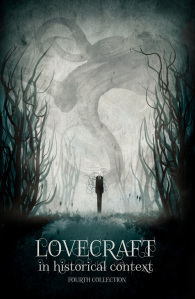
Please note: I’ve had to remove the Arthur Leeds story from this ebook version, since Leeds has no firm death-date. Which means Leeds might still be in copyright, and so Amazon’s caution on copyrights would have prevented publication.
To compensate for the loss of the Leeds story, buyers of the ebook version instead get Lovecraft’s story “The Lurking Fear” — annotated by me with 8,000 words of new scholarly annotations.
You can also obtain my new book by mail as a paperback.
16 Friday Aug 2013
Posted in New books, Scholarly works
Robert H. Waugh (ed.), Lovecraft and Influence: His Predecessors and Successors (Studies in Supernatural Literature series), Scarecrow Press, 2013.
I was kindly sent a free paper copy of this book for review. The book is a slim 200-page case-bound hardback, printed on-demand by Lightning Source on quality archival paper, and with a useful complete index of titles and authors. Endnotes are used for each essay, and the microscopic font used for these could have usefully been made a little larger. I only spotted one typing error in the book. The cover is pleasingly designed, which makes a nice change from most Lovecraft books. I read all the essays once, and read some two or three times.

Lovecraft got God! Well, not quite. But he did sometimes slip in a few references to the King James Bible, and he was not averse to loosely inverting or gleefully perverting a Bible story. This occasional influence is the subject of the opening essay, by the accomplished Bible scholar and Lovecraftian Robert M. Price. Price provides a useful, if partial, survey of the Biblical references in Lovecraft’s fiction. For those lacking access to Price’s work, now to be found mostly on eBay in costly used copies of his Crypt of Cthulhu fanzine or the now-defunct and un-digitised Lovecraft Studies journal, this essay may prove a useful introductory summary. Price discusses Bible references in “The Dunwich Horror” (messiah and crucifixion parallels) and “The Colour out of Space” (parallels with the Bible story of Lot), and sees further parallels in six other stories. It seems a pity that Price omits “The Lurking Fear”, in which the theme of the Prodigal Son is both obvious and inverted, and in which there is a covert use of exactly 140 years (the Biblical “four generations”) as the given period for the Martense family devolution. Several of Price’s suggested connections seemed a little tenuous to me. I found it difficult to believe, for instance, that the cultists of “The Call of Cthulhu” (1926) were modelled on the Baptist Millerist prediction of apocalypse for 1843-44. Why the Baptists, and not the Mormons (Christ was coming back in 1891), the Jehovah’s Witnesses (feverishly predicting the apocalypse five times between 1914 and 1925), or even the apocalypse panics said to have been spurred by Halley’s Comet in 1910? Or simply the more general apocalyptic strains in Christianity, or even the mystical variety of Judaism which Lovecraft literally rubbed shoulders with in the used bookshops of New York City (on the latter see the fragment “The Book”, for instance).
J.D. Worthington looks at the 18th century and specifically at the stylistic influence of the Georgian and Queen Anne period on Lovecraft’s fiction. Steele and Johnson are briefly identified as key early influences. Pope is treated more fully, in terms of his influence on Lovecraft’s early poetry and as a general early philosophical influence. But Worthington concludes of Lovecraft’s fiction that Pope’s influence… “may be less that has generally been thought”. Addison is briefly discussed in terms of the influence on Lovecraft’s view-of-life and of manners, via Lovecraft’s reading of The Spectator (1711-14). Sir Samuel Garth’s masterful translation of Ovid’s Metamorphoses is pointed out as a long-lasting influence on Lovecraft, in that it was a key text which provided him with classical myths in an elegant and alluring translation. In this, Garth’s influence must have mingled with that of Hawthorne’s books of children’s tales from antiquity. Swift is discussed as an influence, with Swift’s blunt attitude to religion being detected in Lovecraft. While much of Swift’s influence is detected in the poetry and the more combative amateur journalism, an attempt is made to pin Swift to Lovecraft’s fiction. A scatological incident of Yahoo shit-throwing in Swift’s Gulliver’s Travels is highlighted. But could this incident really have birthed Lovecraft’s gelatinous monsters, then reached down the decades to trigger the invention of the shoggoths? I was doubtful about that. Worthington concludes that while Lovecraft’s poetry was stultified by the 18th century influence, he also spied there the potential for a bracing alliance of monster-filled myth and anti-religious satire.
James Goho provides some starting pointers in relation to Lovecraft and the American Gothic, while noting that this is a category into which literary academia apparently deems it difficult to fit Lovecraft. Cotton Mather is said to “haunt” Lovecraft, with the Magnalia Christi occasionally popping up as a sort of quasi-Necronomicon. But I found it hard to see how Mather could have been linked to Lovecraft’s use of the “cult of degenerate Esquimaux” in the story “The Call of Cthulhu”, other than perhaps via the hazy and hateful idea of Indian origins in Mather (“probably the Devil decoyed those miserable savages”). Mather and Hawthorne are said to have influenced Lovecraft by directing him to the reality of the past, in terms of its effects on the present. Goho does not mention Charles M. Skinner’s Myths and Legends of Our Own Land, or oral folklore, both of which Lovecraft borrowed from to help shape his fiction. Yet Charles Brockden Brown is suggested as a possible influence, a writer of bleak sensational novels of human savages and degenerates in the American landscape of the 1700s. However, no evidence is presented that Lovecraft knew of Brown before 1922, when he only acquired a short excerpt from Brown’s novel Weiland (included in Vol.9 of the multi-volume Lock and Key Library anthology, which it seems Lovecraft had found cheap and complete in New York City). We then move to Melville, where the reader learns that… “Melville’s influence on Lovecraft is on a broad scale”. I look forward to reading a future book on this obviously monumental subject, since it has so far only given us about four essays. Beirce’s newspaperman-bleakness and horrible “sense of inevitable doom” are noted, and then Goho rapidly works through a few more commonly-cited authors — only to conclude these had a very slight influence on Lovecraft’s fiction.
Donald R. Burleson outlines Hawthorne’s alleged influence on Lovecraft, and in this he follows Cannon’s short essay on the subject published in the 1980s. Burleson immediately discounts Hawthorne’s pervading sense of “unpardonable sin”, as being “virtually meaningless” to the atheist Lovecraft. Burleson might have considered that a tainted heredity, understood within a eugenics framework such as the four-generation family degeneration theory, might have operated in a similarly ‘unpardonable’ manner. Burleson reminds readers that Hawthorne’s A Wonder-Book for Girls and Boys (1852) and Tanglewood Tales for Boys and Girls (1853) usefully served to introduce Lovecraft to palatable versions of Greek and Roman myth and its associated monsters. He repeats his long-standing claim that Lovecraft’s reading of Hawthorne’s Notebooks “as early as 1919”, and the interesting basic proto-Necronomicon story-germ to be found therein (17th Oct 1835) of… “An old volume in a large library, — every one to be afraid to unclasp and open it, because it was said to be a book of magic.” Burleson points to Hawthorne’s regional fiction as providing a template for a… “gloomy ancestral connection with the north-east”, then focuses down on Hawthorne’s spectral personification of the exteriors of old houses. This naturally leads to a discussion of the shared motifs in The House of the Seven Gables (1851) and Lovecraft’s “The Shunned House” (1924). Several other somewhat tenuous parallels between the authors are pursued, none being very convincingly nailed down.
Alex Houston tackles the influence of Poe, noting the bequeathing of the signature baroque style, and of characters who are subordinated to story. Lovecraft also took the monologues of Poe’s characters, but he expanded them so as to tell of the actions of others within the story. In this I would argue he also found an acceptable way to bring into modern fiction something of the old archaic ‘ring composition’ method of fairy-tale telling in oral cultures, in which stories are nested within each other in a complex and mirrored pattern. Lovecraft’s expanded monologues are also said to serve as vehicles by which he slowly reveals cosmic and transcosmic horrors.
Darrel Schweitzer contributes a lively and detailed chronological essay on the influence of Dunsany on Lovecraft. Schweitzer notes that Lovecraft adopted from Dunsany’s stories: the use of subtle suggestiveness; his cleanly poetical phrasing; and a craftsman’s stress on internal rhythm. The latter being something that (my guess) must surely have arisen from oral culture, then still a living folk tradition in rural Ireland, and from regularly reading the King James Bible aloud. Schweitzer notes that Lovecraft did not transfer Dunsany’s vivid use of metaphor into his own stories, something which I might add could have overburdened an already rich style. Schweitzer finds interesting the fact that both authors were outdoorsmen, given to a sense that nature cares little for humanity — while also paradoxically longing for the lost summer idylls of their childhood. To which I might add that each, in their own special way, was a very British outdoorsman. Meaning men culturally tuned to be attentive to subtle landscape-moods amid the fleeting and fickle nature of the weather, while also appreciating how the long winter damp and darkness can be used to cultivate imaginative inner landscapes by the fireside. They were also hunters over territories, each in their own way: Dunsany the aristocrat hunting living animals in landscapes; while Lovecraft (deprived by poverty of his rightful stag and grouse) hunted antiquities set amid complementary aesthetic landscape-impressions.
Gavin Callaghan has written recently (in Lovecraft Annual) on the Sherlock Holmes stories as a possible inspiration for Lovecraft. Here he confines himself to the influence of the Munsey proto-pulps. He notes Lovecraft’s tales are rather short, compared to the rambling cent-a-word epics found in the Munsey magazines. The collective themes of proto-pulp and early science fiction are suggested as offering Lovecraft an early framework: lost cities in the inner-earth, usually with entrances under volcanoes or at the poles; ape-men and cannibals contrasted with ‘noble’ savages; sinister hypnotic Orientals or crazed devil worshipers involved in human sacrifice; eccentric scientists inventing new machines or gas; humans sent to other dimensions or the planets; malign meteors and comets. Callaghan notes Lovecraft’s inversion of the conventional jut-jawed hero of the pulps (conveniently losing the tedious female ‘love interest’ in the process, I might add), while he kept the then-pervasive racial framework of ‘savagery vs. civilisation’. Edgar Rice Burroughs is suggested as a key influence in this regard, especially relevant to Lovecraft’s ape-related stories such as “Facts Concerning the Late Arthur Jermyn and His Family”. The Tarzan series is suggested as a literary source for the idea of a proto-language shared by both apes and men. George Allan England is suggested as the source of the idea of ‘bestial degeneration’, both individual (ape-blood transfusions into humans) and collective (‘The Horde’ in the tedious post-apocalyptic Darkness and Dawn trilogy 1912-14, man-beasts which England hints are descended from blacks). Although one suspects these ideas could be traced back to some earlier point, and perhaps to popular scientific discussions. A more probable influence is suggested: of Burroughs’s John Carter of Mars on The Dream-Quest of Unknown Kadath. Callaghan sees Lovecraft’s later longer stories as arising from a slow return to the old proto-pulp Munsey themes of his boyhood.
T.R Livesey looks at the influence on Lovecraft of invasion narratives in early science-fiction, but he opens with… “it is hard to say what invasion stories Lovecraft may have read; none of the obvious examples appear in his library”. Followed by detailed recountings of The Battle of Dorking, The Riddle of the Sands, and The War of the Worlds. There is also a short discussion of the seminal Edison’s Conquest of Mars (1898), an ‘Edisonade’ which it seems rather more probable that Lovecraft actually read — since he was an avid fan of the author Garrett P. Serviss in his youth.
The book then shifts gears and starts to look at the influences that Lovecraft may have had on others after his death. The first of these essays is by Norm Gayford, offering a close textual comparison of the fiction of Lovecraft with that of his young “Sonny” Frank Belknap Long, usefully buttressed by points drawn from their joint correspondence. Long’s late novel Journey Into Darkness is treated to a detailed analysis. In contrast to Lovecraft, Long’s characters appear to be able to “feel healed”, “reappreciating their humanity, regaining it” at the end of their ordeals. There is an interesting discussion of Lovecraft’s “sense of futility” late in his life, and how this served to prevent much new writing.
S.T. Joshi then ably tackles Lovecraft’s influence on Ramsey Campbell. Joshi steps through this influence in chronological order, demonstrating the gradual divergence from Lovecraft, and the absorption by the late 1960s of the master’s finer points. At that point Campbell then publically ‘dropped’ Lovecraft, evidenced via comments in a 1969 interview. His early attempts at finding his own voice are called “forced” by Joshi, but by the late 1970s he started to publish fiction that still merits the coveted Joshi Stamp-of-Approval. Joshi then skips to 1994, when Campbell made a return to straight Lovecraft pastiche, before tracing various fleeting uses of Lovecraft’s ideas in the novels Midnight Sun and The Hungry Moon.
The volume’s editor, Robert H. Waugh, faces down the big one: Lovecraft’s influence on science-fiction. Interestingly, I discovered here that Arthur C. Clarke has a chapter in his autobiography in which he discusses his reading of Lovecraft. Waugh traces Clarke’s own fictional seriousness to the similar seriousness he found in Lovecraft’s later work, then he carefully outlines the other uses Clarke made of Lovecraft’s later works. These included mixing hard science with “reverent awe” on a cosmic scale, while including touches of speculation on the transcosmic. Next Waugh examines Fritz Leiber. Then Lovecraft’s influence on Philip K. Dick is detected in terms of: claustrophobic environments in an unclean world; characters with fragile egos and psychic dysfunction; scepticism; and paranoia.
Michael Cisco usefully surveys the similarities and differences between Lovecraft and William S. Burroughs, after quickly reporting finding no hard evidence of actual influence (Burroughs made a couple of jokey references to Lovecraft in passing, and that’s it). This is an exemplary study which illuminates Lovecraft by proxy, and it is worth reading even if you think you have no interest in Burroughs. The reader learns about both men’s approaches to: science; the nature of reality; evolution; the value and defence of civilisation; and the distorted politics of their times. The essay will form a solid foundation stone for anyone writing on the subject in future.
John Langan examines Lovecraft and Stephen King. Langan begins with a concise survey of King’s various comments on Lovecraft, then looks for any thematic borrowings. He quickly finds that the only real focus available is on what he calls the “animal sublime” in King, and tries to relate this to Lovecraft. “The Rats in the Walls” is discussed over four pages, leading to the conclusion that Lovecraft may have showed King how an “animal humanity” could be spooked up in a story.
The book ends with an essay by Steven J. Mariconda. Here the reader will learn almost as much about Lovecraft as about Thomas Ligotti. Readers will be well aware that both Lovecraft and Ligotti use disorder and irrational “irrealism”, anchored in Poe, but perhaps not so aware of the role of the fin de siecle symbolist poets in this. Mariconda highlights the symbolist inheritance that inspired writings on… “visions, dreams and madness”. This claim is underpinned by a clear reference to the historical debate which was had over symbolism within amateur journalism during the early 1920s, something of which I would like to hear more in The Fossil in the future. The claim is also underpinned by a fascinating short discussion of the key role played by Alfred Galpin and Samuel Loveman in carefully guiding the noted poet Hart Crane through the symbolist poets, seemingly in a systematic manner, in 1922 (Kleiner gives his own account of helping Crane with the French decadents in Lovecraft Remembered). Galpin and Loveman are, of course, names that Lovecraftians will usually associate with the Lovecraft circle. The implication of this new finding is a suspicion that Lovecraft was similarly informally educated about the symbolist poets, and at around the same time in mid/late 1922. If so, it seems the influence was not long-lasting: in 1923 Lovecraft forcefully warned Long off imitating the… “little tinkling sophistication of petit-maitre Frenchmen” (Selected Letters I, p.260) and felt that European decadence as a movement led inevitably to… “a sickly, decadent neo-mysticism”.
Mariconda goes on to discuss Ligotti’s “J.P. Drepeau”, “Spectacles in the Drawer”, and “Greater Festival of Masks”. This leads into a short discussion on technique, and on the attitudes of Lovecraft and Ligotti to the European surrealist writers. In a letter (given undated in the essay, but actually March 1937 to Morton) Lovecraft felt the surrealists to be fresh and likely to revive art (literature and painting were then much more intertwined than they are today), but he felt that without a coherent story to hold it together a parade of unfiltered mental imagery was likely to be trivial and hollow. Ironically the literary surrealists under Breton agreed with him on this point, and by that date they had thrown out their old experimental techniques and were instead seeking to reconcile literature with leftist political action.
Though somewhat uneven in quality, this is a volume that may be useful to academics and students who are starting out with Lovecraft. It may be especially useful to advanced university students who are required by their thesis supervisor to pair Lovecraft with another author. The book’s long-term value to independent Lovecraft scholars, given its hefty $75 list price, seems a little more doubtful. I didn’t learn a great deal about Lovecraft that was new to me, but I did find some topics neatly summed up and clarified.
August 2013.
12 Monday Aug 2013
A curious regional British anthology has been announced: Cthulhu Cymraeg: Lovecraftian Tales From Wales, from the Welsh SD Publications. Due in the Autumn.

