La musica di Erich Zann e altri racconti
02 Tuesday Jul 2019
Posted in Lovecraftian arts, New books
02 Tuesday Jul 2019
Posted in Lovecraftian arts, New books
29 Saturday Jun 2019
Posted in New books, Scholarly works
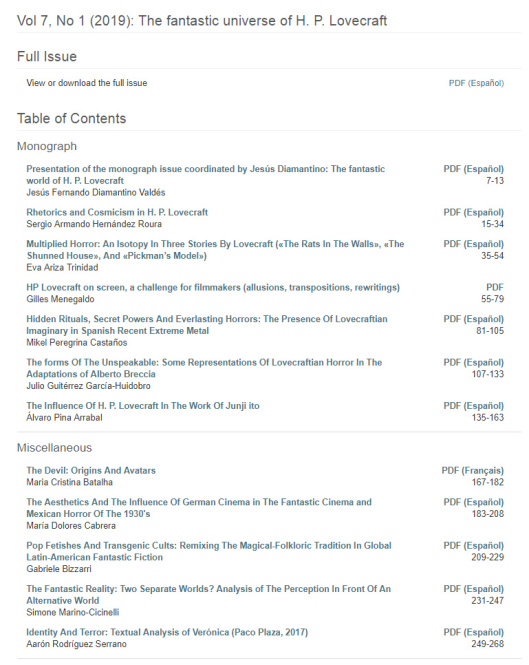
Brumal, Vol. 7, No. 1 (2019), the special issue on “The fantastic universe of H.P. Lovecraft”. Public open access, and online now in full. Only the paper “H.P. Lovecraft on Screen” is in English. The editors’s introduction doesn’t (on translation) appear to be a summary of the papers, but on clicking through you’ll find that each paper’s record page has an English abstract.

22 Saturday Jun 2019
Posted in New books, Scholarly works
S.T. Joshi and Sarnath Press have released a new expanded edition of Joshi’s book The Modern Weird Tale: A Critique of Horror Fiction. As he writes on his blog…
This is a substantial expansion of my Modern Weird Tale (2001), restoring the cuts — specifically, the chapters on Les Daniels, Dennis Etchison (whose own passing occurred only a few weeks ago), and David J. Schow, along with introductory passages to sections II, IV, and V — that my publisher, McFarland, required me to make.
The new expanded version is titled Weird Fiction in the Later 20th Century and is available as low-cost Kindle ebook as well as in paperback.
16 Sunday Jun 2019
Posted in New books
The paperback of Michel Houellebecq’s H.P. Lovecraft: Against the World, Against Life (1991 in French) can be had for a few pounds/dollars in its 2000s Gollancz English edition, the 100-page essay being here heavily padded by the publisher to 256 pages with a couple of stories and a friendly fannish-looking cover added.
But the original 150-page English-translation hardback seems well out-of-print and has ascended to Collector-land…
Now, newly-listed for pre-order is a new 150-page hardback edition from Cernunnos, set for 3rd September 2019 and with a new cover. When the paperback is still widely available and cheap, why a reprint? My guess is they’re catering for continuing demand from university libraries, who want stout hardbacks on their shelves.
For those unfamiliar with the glittering catacombs of French intellectualism, I should note that Houellebecq can’t be thought of as a political philosopher or even a straight critic in the refined French style. He’s more what one what might call a gloomily poetic and provocative observer of his depressive times, and presumably in France he goes down well among those infected with their curious strain of gloomily nihilistic and largely gestural intellectualism. That said, the Lovecraft book was his first, and his breakthrough. It was written at the behest of the editor of Nouvelle Revue de Paris, to be one of the editor’s series of books for the high-end publisher Le Rocher. Thus Houellebecq had something to prove to a stern French literary establishment, the most perceptive of whose members knew a thing or three about Lovecraft by the late 1980s. I’ve read Against the World, Against Life in the unofficial Mackay translation. Houellebecq gets the broad biographical detail right, and weaves it with the fiction in an entertaining manner, and as such an undergraduate would definitely benefit from the essay as a short introduction which makes a dozen or more stimulating debating points. One can see why universities might deem the book suitable for degree courses.
But, despite this presumed need for rigour in writing a first ‘breakthrough’ book circa 1989/90, there appears to have also been a certain level of speed involved. In the text Houellebecq admits in passing that he doesn’t have access to the Letters, and seems to be working from memory in places. The Miskatonic Debating Club & Literary Society review usefully checks the book’s endnotes and finds them lacking…
… for all his assertions that he was forced by the constraints of the essay format to check his facts and cite his sources, he actually doesn’t. Most of what he says is supported by citations but some of it isn’t. Reading his Notes in the back of the book, the translator Dorna Khazeni lists many instances where throwaway references within the text attributed to HPL or others cannot be located, even after cross-checking with S.T. Joshi, who seems to have all of Lovecraft at his fingertips.
Update: the reprint just keeps getting pushed back and back, and at Jan 2020 is now well into 2020. I assume the expected library orders have not been flooding in…

15 Saturday Jun 2019
Posted in New books, Odd scratchings
Great news, another 900-page slab from Neal Stephenson (Snow Crash, Anathem) has landed on the bookstore shelves. Any new book by Stephenson is always an event. And with Stephenson, unlike other authors, you know that the book’s not that’s big because it’s been padded with blah.
At the meta level Fall, or Dodge in Hell is reported to be a sci-fi / fantasy mash-up, which I have no problem with, but even today such books do have a tendency to raise the hackles of defensive reviewers on ‘both sides’ of fandom. More mainstream readers may hanker for an abridged version, in these busy days. But, skimming the reviews, it seems that those who like it find it an enjoyable romp and not a slog despite the length.
From what I can gather from the initial reviews, by lightly skimming the plot mentions… a Seattle-based multi-billionare dies and is cryogenically frozen. He later ‘wakes’ to find the freezing paid off and he’s been uploaded to a digi-world of eternal digi-life. But, rather than a glittering post-human techno-topia that’s ‘The Present Re-made, Shinier and Sexier’… he apparently finds that the new world inevitably falls out along ingrained mythic high-fantasy lines, akin to Tolkien and Milton.
There are several covers for the book. The main one makes it look like one of those generic serial-killer horror books, and has a clipart crow and humdrum typography to boot. What were the publishers thinking of, there, as a cover for such a major author? But the ebook has an absolutely superb cover, one of the best I’ve seen in the last few years…
I very rarely “read in ebook and also skim”, and I certainly wouldn’t for a fine book like Stephenson’s earlier Anathem. But given the length here, and ‘virtual world’ themes that I don’t personally find all that alluring, I’m thinking that skimming may be a preferable alternative to what is going to be a very long audiobook.
14 Friday Jun 2019
Posted in New books, Scholarly works
Newly listed at Hippocampus, Lovecraftian Proceedings No. 3 (June 2019). This is the book of some of the many papers given at the Armitage Symposium at NecromiCon 2017.
Looking interesting to me, after filtering the table-of-contents past the 2017 abstracts book, are…
* Ian Fetters, “Lovecraft’s Dark Continent: At the Mountains of Madness and Antarctic Literature”.
* Heather Poirier, “H. P. Lovecraft and the Dynamics of Detective Fiction”.
* Nathaniel R. Wallace, “The Cosmic Drone of Azathoth: Adapting Literature into Sound”.
12 Wednesday Jun 2019
Posted in New books
The H. P. Lovecraft Cat Book now has a page on hplovecraft.com with a full contents list, including precise details re: the number of letters…
The Cats of New York (excerpts from 21 letters)
Old Man (longer excerpt from one letter)
The Kappa Alpha Tau (excerpts from 34 letters including “[Anthem of the Kappa Alpha Tau]”)
Musings of an Ailurophile (excerpts from four letters to Marian F. Bonner)
Extracts from Letters (excerpts from 50 letters)
So that’s 110 letters, a good haul. No Amazon listings for it, yet. Let’s hope there will be an ebook at some point, too.
11 Tuesday Jun 2019
Posted in New books, Scholarly works
The review journal Dead Reckonings #25 has been published in paper. The issue’s Web page says “Spring 2018”, but the cover says “Spring 2019” and the journal’s catalogue page has an eta for arrival of “June”. So I’m guessing the Web page should read “June 2019”.
Of Lovecraftian interest, among the contents:
* “A Look Behind “The Challenge from Beyond””, by Michael D. Miller.
* “Weird Fiction and Decadence”, the S. T. Joshi review of the important new mainstream academic book Weird Fiction in Britain 1880–1939.
* “Sesqua Valley’s Weirdest Inhabitant, Wilum Pugmire”, by David Barker.
* “Weird Fiction in the 21st Century: A Conversation with S. T. Joshi”, by Alex Houstoun.
* “Some Notes on Call of Cthulhu and Other Lovecraftian Video Games” by Geza A. G. Reilly.
Possibly the journal is also on Amazon. But they annoyingly mix books titled “Dead Reckoning” into results for a specific search for “Dead Reckonings”. Meaning that I’m not inclined to trawl through the resulting stew of dross to discover if the journal is listed there.
08 Saturday Jun 2019
Posted in Historical context, New books
I’m pleased to see that Frank Belknap Long’s memoir of Lovecraft, Dreamer on the Nightside is now available as a Kindle ebook via Amazon. This is the new Wildside Press ebook edition, previously only available via a convoluted checkout on their website.
06 Thursday Jun 2019
Posted in Lovecraftian arts, New books, Odd scratchings
S.T. Joshi’s blog has updated with an illustrated report on “A Trip to France”, made to promote the French translation of his monumental Lovecraft biography. Among much else, he ventured down into the Catacombs of old Paris…
Traversing this site was a suitably grisly experience for a devotee of the weird and macabre.
Suitably primed, he later discovered the young artist Laurent Gapaillard, who does epic architectural prints in the Piranesi and Prout style, and from my cursory searches seems to be known in France for his book illustration and concept art for videogames.
The French ‘Lovecraft & Sonia’ play Howard, Mon Amour is being translated to English, and Joshi hopes to find a publisher for it.
Also, Joshi has had a copy of his The H. P. Lovecraft Cat Book in print. The hardcover first edition has sold out already.
03 Monday Jun 2019
Posted in Historical context, New books, Scholarly works
I’ve found an open access PhD thesis titled Prophets of Decline (2003), which has two chapters relevant to understanding the historical context for Lovecraft’s reception of Spengler in the America of the later 1920s…
Once returned to Providence…
Lovecraft began in the late 1920s to develop his notions of the decline of the West — notions that his reading of Oswald Spengler’s great work on the subject only helped to clarify and develop. (S.T. Joshi, I Am Providence).
From a Lovecraft letter of 1926…
Recently I saw a review of Spengler’s ‘Decline of the West’ — which will make splendid discussion-matter with Mortonius [James Morton]. Did you see it — in the New York Post?
This must be the front-page review by the anti-communist John Cournos, “Is Our Civilization Doomed? No Chance Of Survival — Says Spengler” The New York Post Literary Review supplement, 29th May 1926. (Now un-findable online, and it seems there’s no microfilm of this title at libraries before 1934?).
The Prophets of Decline thesis thus offers what are effectively two ‘free bonus’ appendices, in a digestible thirty pages, for readers of S.T. Joshi’s book on Lovecraft’s intellectual life The Decline of the West (now a very affordable and cleanly formatted ebook on Amazon). The chapters are quite dense and have some typos, but are admirably concise and focused. They outline Spengler’s initial reception in America, and then the changed perceptions there of Spengler in the 1930s — as the civil war within socialism raged and both communism and fascism twisted the ways he was portrayed and understood. Part of the problem on the right was that Spengler did not endorse Hitler. He had also supported those purged in 1934, and because of this was subject to a campaign of vilification by the Nazi Party.
As for the rest of the thesis it tells the larger story of the reception by journalists and intellectuals of the alarmist doom-mongers of 1896-1961, and as such provides useful background for better understanding the doom-mongers of the 1970s and 80s.
31 Friday May 2019
Posted in New books, Scholarly works
The revised and expanded ebook of my Strange Country: Sir Gawain in the moorlands of North Staffordshire, an investigation is now available on Amazon. Sir Gawain and the Green Knight, you’ll recall, is one of the most famous supernatural tales in English literature.
This book offers a concise overview of the existing Gawain research relating to North Staffordshire, and then adds a wealth of new detail and facts drawn largely from previously overlooked sources. The case is clearly made that one of the most famous works of English literature belongs to North Staffordshire. Obvious new candidates for both the Gawain-poet’s patron and the Gawain castle are suggested, and these are found to fit naturally and almost exactly when compared with the expected dates, castle features, dialect location, social status and life-story. A wealth of surrounding detail is also explored, such as: the history and role of the King’s Champion; English contacts with full-blooded paganism during the Prussian crusades; the two lavish courts at Tutbury; and the history of the Manifold Valley. This ebook is well illustrated and copiously referenced with linked round-trip footnotes.
This should now be considered the definitive edition of my book, which until now it has been available in paper from Lulu. It’s had a number of additions and yet another round of close proof-reading.
The book follows my equally successful sleuthing on the trail of the real identity of the Time Traveller from H.G. Wells’s The Time Machine, arising from a study of Wells’s formative time spent in Stoke-on-Trent and North Staffordshire. I hope to also have an ebook edition of my ‘young H.G. Wells’ book available sometime later in 2019. Having cracked, to my satisfaction, both the Time Traveller and the Gawain-castle, the next book will be a far larger one that explores the young Tolkien and Earendel in intellectual and historical context. This will also have something to say about the local connections, but mostly Birmingham, since for Tolkien the Staffordshire topography came a little later and was more incidental to his intellectual development.