Super Lovecraft art from Runa Rosina, from her new series “Das Ding auf der Schwelle” (acrylic on toned paper). T’would make someone a fine book cover…


08 Tuesday Jul 2014
Posted in Lovecraftian arts
Super Lovecraft art from Runa Rosina, from her new series “Das Ding auf der Schwelle” (acrylic on toned paper). T’would make someone a fine book cover…
06 Sunday Jul 2014
Posted in Lovecraftian arts, Odd scratchings
Complete scans of certain 1937-39 Weird Tales editions, with ads…
Weird Tales, Jul 1937 (Poem, “To Virgil Finlay”, also Clark Ashton Smith’s poem “To Howard Phillips Lovecraft”)
Weird Tales, Oct 1937 (“The Shunned House”)
Weird Tales, Dec 1937 (“Polaris”)
Weird Tales, Feb 1938 (“From Beyond”)
Weird Tales, Mar 1938 (“Beyond the Wall of Sleep”, Francis Flagg’s poem “To Howard Phillips Lovecraft”)
Weird Tales, Jul 1938 (Poem, “The Messenger”)
Weird Tales, Nov 1938 (“The Nameless City”)
Weird Tales, Apr 1939 (“The Wicked Clergyman”, “The Curse of Yig” credited to Bishop)

04 Friday Jul 2014
Posted in Lovecraftian arts
Banned Books Week will this year focus on comics…

02 Wednesday Jul 2014
Posted in Lovecraftian arts, Podcasts etc.
Atlanta Radio Theatre Company report they have a new studio, and post an .mp3 sample to prove that “The Call of Cthulhu” radio adaptation is really on its way…
“It’s hard to believe that we started this production all the way back in 2010. Another casualty of our notoriously long production schedule – BUT! There is starlight at the end of the tunnel! The production is nearly finished and will certainly be released this year and we are excited about ARTC Studio, which should put an end to these interminably long wait times for new material from us.”
29 Sunday Jun 2014
Posted in Lovecraftian arts
Lovecraft was a big fan of the silent movies in 1915, being able to go whenever he felt well enough (in constrast to the theatre, where one had to book and pay in advance). One of the major movies on show that year was The Raven (Essanay/V-L-S-E, six reels), a stylised biopic of Poe. Predictably for the times, it was light on the horror and heavy on the combination of romance and alcoholism. But Lovecraft can hardly have missed it, when it appeared in cinemas in early November 1915.

Very scratched and blurry, but just about watchable on YouTube…
The Raven 1 of 4
The Raven 2 of 4
The Raven 3 of 4
The Raven 4 of 4
28 Saturday Jun 2014
Posted in Lovecraftian arts
“The Horla” by de Maupassant, read by Gregg Margarite (.mp3 link, 25Mb).
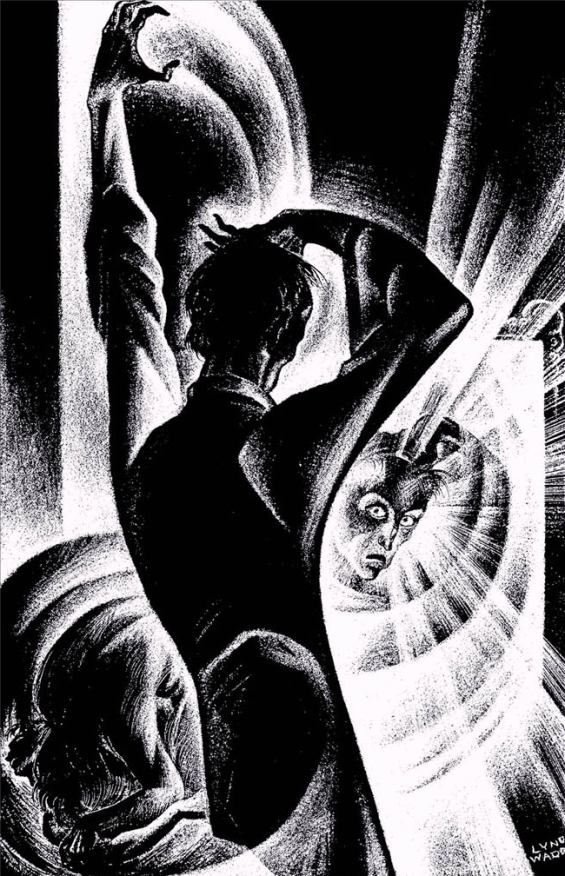 “The Horla” illustration, by Lynd Ward.
Lovecraft was first pointed toward the French author de Maupassant (1850-1893) by W. Paul Cook. Cook made a passing mention of the author in the introduction to Lovecraft’s seminal “Dagon” (November 1919 issue of The Vagrant). Although it appears that Lovecraft strongly resisted Cook’s urgings…
“Cook and McDonald are trying to get me to read de Maupassant and Flaubert, who are by me untouched, but I’ll tell them to go to O. Dear! [meaning, expletive deleted]” (Lovecraft letter to Galpin, 30th Sept 1919)
The influence of “The Horla” on Lovecraft’s “The Call of Cthulhu” is something which is commonly assumed by scholars (see Steven J. Mariconda, S.T. Joshi) but which can’t quite be proven. In that, even though he mentions the story in his famous “Supernatural Horror in Literature”, a mention there is not always an indication that he had actually read the work in question. But if he did read the story, then Lovecraft must have done so prior to the summer of 1925 (the plotting of “Cthulhu”) or the late summer of 1926 (the writing of “Cthulhu”).
Lovecraft may have read the story when reading through the massive multi-volume The Lock and Key Library: classic mystery and detective stories of all nations (1909), having acquired a cheap used set in 1922 while browsing New York City’s used book stores. The assumption would then be that he very probably read the story in the winter of 1922 or the spring of 1923. However he may have read it much earlier via the Providence Public Library, either in The Lock and Key Library or the 1890 anthology The Continental Classics: Volume XV. Modern Ghosts. The most likely time for the young Lovecraft to have read the story was as he emerged from his intense immersion in the Munsey proto-pulps and tried to move toward ‘real’ literature, so perhaps around 1913/14. Of course it is also possible that by the early 1920s Lovecraft had simply forgotten any boyhood reading of that particular story. It may have been just one of many youthful thrills that were lost to memory amid his omnivorous reading, which had ranged from the entire run of Railroad man’s Magazine and all of Sherlock Holmes through reams of dense 18th century satire in the original long-S texts.
“The Horla, or Modern Ghosts” was included in translation in Volume 5 of the Lock and Key Library. Yet perhaps Lovecraft still disdained the French at the end of 1922 (see the riposte to Cook, quoted above, and note that in 1923 Lovecraft forcefully warned his friend Long off imitating in poetry the… “little tinkling sophistication of petit-maitre Frenchmen”). But even a glance at the first paragraph of “The Horla” might have inclined him to read on into the tale, in his newly purchased Lock and Key Library. Since the sentiments found there profoundly mirror Lovecraft’s own…
I like this part of the country; I am fond of living here because I am attached to it by deep roots, the profound and delicate roots which attach a man to the soil on which his ancestors were born and died, to their traditions, their usages, their food, the local expressions, the peculiar language of the peasants, the smell of the soil, the hamlets, and to the atmosphere itself.
Even if he had somehow entirely skipped the volume of French stories in the enormous Lock and Key, and had forgotten any youthful reading of it in the Providence Public Library, Lovecraft may have read the story later in the New York City libraries. So we might imagine him perusing, amid the blissful hush that gave refuge from the hell of the city, Boyd’s The Collected Novels and Stories of Guy de Maupassant. Of which the volume “The Horla and Other Stories” (Vol. 12) had just seen U.S. publication in April 1925, and so was presumably catalogued and on the reference-only shelves by the summer of 1925. That volume may even have been available for informal loan via Kirk’s bookshop. In February 1925 Kirk’s diary states …
“Don’t read any Maupassant other than the Ernest Boyd translation. It’s all there is. Any other is junk.”
Kirk presumably echoed this vehment sentiment in his conversations with the Lovecraft circle, which may have pointed Lovecraft toward the new book. Such a reading would have been undertaken in connection with Lovecraft’s research for the first version of the long survey essay “Supernatural Horror in Literature”. “The Horla” is described there thus — although I admit I’m uncertain if the following quotes come from the first (1927) or the second edition (1933) of the essay:
“Of these stories “The Horla” is generally regarded as the masterpiece. Relating the advent to France of an invisible being who lives on water and milk, sways the minds of others, and seems to be the vanguard of a horde of extra-terrestrial organisms arrived on earth to subjugate and overwhelm mankind, this tense narrative is perhaps without a peer in its particular department; notwithstanding its indebtedness to a tale [“What Was it? A Mystery”, also included in Lock and Key] by the American Fitz-James O’Brien for details in describing the actual presence of the unseen monster.”
“the brilliant young Irishman Fitz James O’Brien (1828-1862) […] he who gave us What Was It?, the first well-shaped short story of a tangible but invisible being, and the prototype of de Maupassant’s Horla;”
This latter mention, if from the 1927 version of “Supernatural Horror in Literature”, would seem to confirm that Lovecraft had actually read “The Horla”. A reading of “The Horla” by Lovecaft at that time would certainly put it very close to the genesis of “The Call of Cthulhu”, as has been suggested by Steven J. Mariconda is his essay “On The Emergence Of Cthulhu” (to be found in his new book Art, Artifact, and Reality).
In 1926 Lovecraft also noted de Maupassant’s short “On The River” (1876), including it in his list of works that he meant to mention in a future revised edition of “Supernatural Horror in Literature” (for the list, see Collected Essays 5, p.234). Presumably Lovecraft had noted it being published in English translation in the U.S. anthology Ghosts Grim and Gentle, published 18th Sept 1926. Or perhaps in one of the volumes in Boyd’s de Maupassant series The Collected Novels and Stories. This late noting of “On The River” suggests Lovecraft never saw “The Horla”‘s first U.S. appearance in the 1890 Modern Ghosts anthology, since there it had been paired with “On The River”.
In later letters — of 1929 and 1932 and 1934 — Lovecraft implies, very much in passing, that he had read much of de Maupassant. But the name was only being included in his general sort of ‘my suggested programme of educative reading’ advice to correspondents — not always a good indication of what Lovecraft had actually read and absorbed, but rather of what he though would be useful for others to read. In a 1930 letter Lovecraft frankly admits that de Maupassant bores him “acutely after brief doses” (Lord of a Visible World, p.212), so perhaps he never really absorbed much more than “The Horla” and “On The River”. I’m certainly not very conversant with de Maupassant either, but a brief perusal of his bibliography does suggest that it contains an enormous amount of non-macabre stories written on conventional commercially-saleable topics (such as tangled domestic upsets in upper-class Paris, occasionally mingled with glimpses of the city’s equally grotesque underclass).
Note that there are in fact three versions of “The Horla” in French, the two most significant being a shorter 1887 magazine version (which apparently had a doctor later finding evidence to confirm the madman’s story), and the longer version apparently published as the lead story in a book collection (also 1887). The Lock and Key English version is the longer one, and that is the version used for Gregg Margarite’s audio reading linked above. There was also the very earliest version, titled “Lettre d’un fou” (1885), little more than a brief letter purporting to be from a madman. This ends with the narrator seeing monsters in the mirror (“And in this mirror, I begin to see crazy pictures, monsters, hideous corpses, all kinds of appalling animals, atrocious beings, all those incredible visions that haunt the minds of fools…”) which sounds vaguely like the ending of Lovecraft’s “The Outsider”. But according to the encyclopaedia Science Fiction: the early years the very short “Lettre d’un fou” was never translated into English, and so could not have influenced Lovecraft. The monster-in-mirror scene in “The Horla” is however, highly developed, and so one wonders what influence it might have had on Lovecraft — “The Outsider” was not published until 1926, and Barlow once hinted that a new ending was tacked on at some point (see entry in An H. P. Lovecraft Encyclopedia).
On the evidence of this story de Maupassant certainly seems to have remarkable general similarities to Lovecraft (strong atheism, vivid landscape depiction, the profound link of the gentry with one home place, the unseen realm and its possible role in madness, hints of extraterrestrial beings which care little for humanity, an unreliable narrator who may be mad). It would be interesting to learn if these are specific to this late de Maupassant story, or if they occur strongly in his other macabre work. At first glance, it appears to me that — apart from madness — these themes may be specific to this one story.
But “The Horla” is basically a story in the folk tradition of spirit possession/attack (of an ancient chest-squatting type common in the folklore of the 19th century), made a little more modern by hints at an extraterrestrial origin for the spirit. Lovecraft had written “Beyond The Wall of Sleep” with a very similar idea — including the extraterrestrial origin — way back in January 1919 which was long before he read de Maupassant.
“The Horla” is told in letters, but these are chronological and from one person. So there is almost nothing of “Cthulhu”‘s piecing together of many fragments, nor of the fragmented and jumbled time-lines — other than that the narrator briefly tells the reader he has read an item of belated news (of a plague of very similar spirit possessions happening in Brazil). The spirit is deemed by the narrator to be extraterrestrial, and perhaps part of a terrible invasion of the earth. Yet unlike “Cthulhu” the spirit’s name is: only heard once; it is not heard in dreams; the voice is not ‘calling’; and the naming concerns only the mind of one person, not many. In “The Horla” there is simply a difficult attempt by the narrator to recall the name to memory while awake…
“what does He call himself — the — I fancy that he is shouting out his name to me and I do not hear him — the — yes — He is shouting it out — I am listening — I cannot — repeat — it — Horla — I have heard — the Horla — it is He — the Horla — He has come! —”
There are also interesting parallels of “The Horla” to other Lovecraft stories. “The Dreams in the Witch House” reflects the way that the spirit in “The Horla” nightly creeps ever-closer to the sleeper. Various Lovecraft stories involve transient possession of a human by a malign being, although one could probably find a clutch of instances of this in 19th century proto-SF and the Munsey pulps. Both ideas were anyway quite common in folk tales and folk beliefs. One further slight parallel with Lovecraft is the invisibility of the being, and the attempt to contain it, as in “The Dunwich Horror”.
27 Friday Jun 2014
Posted in Lovecraftian arts, New books
A new Kickstarter, for The Collectors’ Book of Virgil Finlay. Finlay was the artist who created the famous portrait of Lovecraft as an 18th century gentleman.

25 Wednesday Jun 2014
Posted in Lovecraftian arts
H.P. Lovecraft impersonator Leeman Kessler brings his Ask Lovecraft show to the stage, July 2nd-13th at the Toronto Fringe Festival. Location…
In the Tent space in Artist Alley, behind Honest Ed’s
Gulp… I do hope they give him good air conditioning. Wearing a suit and tie in a stuffy tent in high summer is not likely to be comfortable, unless the finale of the show is dissolving into a Lovecraftian puddle.

25 Wednesday Jun 2014
Posted in Films & trailers, Lovecraftian arts
The Tea with Morbius blog’s Guide to Lovecraftian Themes in Doctor Who.


Hey ones are The Curse of Fenric; The Impossible Planet; The Web Planet; Spearhead From Space; The Abominable Snowman, and the above link has many more.
24 Tuesday Jun 2014
Posted in Lovecraftian arts, Scholarly works
Open Call for Papers 2014 for The Comics Grid: journal of comics scholarship. Deadline: 31st October 2014.

24 Tuesday Jun 2014
Posted in Lovecraftian arts
Now that’s a Lovecraftian mug…

24 Tuesday Jun 2014
Posted in Lovecraftian arts
Just posted, a six-minute trailer for the movie The Dreamlands…
[youtube https://www.youtube.com/watch?v=zEiC4a6PLcI?rel=0&w=560&h=315]