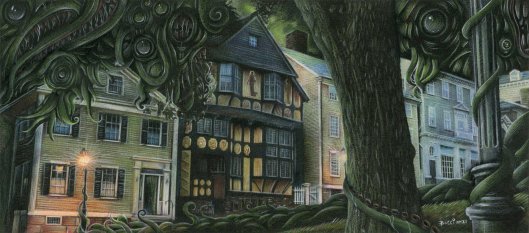
If… Lovecraft had become pals with his neighbours in the Alpha Delta Phi fraternity house…
Picture: Klye C. Bridgett.
06 Thursday Aug 2015
Posted in Lovecraftian arts
If… Lovecraft had become pals with his neighbours in the Alpha Delta Phi fraternity house…
Picture: Klye C. Bridgett.
05 Wednesday Aug 2015
Posted in Lovecraftian arts

Lovecraft’s headstone in a fold-up papercraft form.
04 Tuesday Aug 2015
Posted in Lovecraftian arts, Maps
That was quick! The Providence Journal newspaper has all its finalists online for the 2015 Lovecraft short story competition.
02 Sunday Aug 2015
Posted in Lovecraftian arts, NecronomiCon 2015
Cybernetic Singing Slime Mold. Which definitely needs to make a guest appearance at NecronomiCon, I’d suggest…
29 Wednesday Jul 2015
Posted in Lovecraftian arts
Poster for the forthcoming Stockholm H.P. Lovecraft Festival V…
28 Tuesday Jul 2015
Posted in Lovecraftian arts, NecronomiCon 2015
25 Saturday Jul 2015
Posted in Lovecraftian arts, Scholarly works
The University of Iowa Special Collections & University Archives now has a Tumblr. Simply being able to use the world’s most unusable Web service is pretty awesome in my view, but it gets even more awesome — this particular Tumblr is dedicated to their ongoing work in digitising the vast James L. “Rusty” Hevelin Collection — vintage pulps, rare fanzines, fan convention materials and science fiction books. The collection is being unboxed, shelved and methodically scanned with library-quality scanners. It’s my understanding that professional practice means that the covers and tables-of-contents of each issue are first scanned, to serve as a sort of locational/visual index to the collection.
22 Wednesday Jul 2015
Posted in Films & trailers, Lovecraftian arts
Die Farbe (“The Color Out of Space”), apparently one of the best film adaptations of Lovecraft, has just been released on a limited edition Blu-Ray of 1,000 copies by BrinkVision.
“Critics have called this H.P. Lovecraft adaption one of the most faithful Lovecraft films ever made. It has screened at over 50 film festivals worldwide, winning awards and receiving praise from critics and Lovecraft fans alike.”
Behind-the-scenes featurette.
Effects and concepts featurette.
Lost scene.
15 language subtitles.
Faux newspaper cover insert.
…and more.
16 Thursday Jul 2015
Posted in Historical context, Lovecraftian arts
The Tellers of Weird Tales blog has a new historical article on “Whip-poor-wills in weird fiction”.
Picture: Book illustration by ‘Sigrid’, for Lovecraft’s “The Dunwich Horror”.
15 Wednesday Jul 2015
Posted in Films & trailers, Lovecraftian arts
I’m pleased to say I’ve now seen the 6.5 hour TV adaptation of Jonathan Strange & Mr Norrell, treating it as a giant movie, and without reading the novel first. I can thoroughly recommend this excellent BBC adaptation.
There is much here to interest and entertain Lovecraft fans, both visually and intellectually. Although I see no direct or very obvious influence from Lovecraft. Instead Strange & Norrell taps into and recombines the Gothic novel (in the freshest way) with English fairy stories. It then lightly dabs on some inverted English ‘King Arthur lies sleeping’ myth, sprinkles a few touches of Middlemarch, and dumps in a bushel of magicians. It’s a successful mix, and thankfully manages to portray the occult without even a whit or a sniff of the inverted Christian pantomime exemplified by the tired old Crowley-ite / Dennis Wheatley tradition. The TV adaptation of Strange & Norrell is also refreshingly very light on gratuitous gore (other than a few war scenes), on plot-stopping bed-hopping romance, and on the sort of tedious 15-minute monologues on aberrant psychology that pad out Game of Thrones.
The closest possibility of a Lovecraft influence seems to be The Case of Charles Dexter Ward, which has many parallels with Strange & Norrell; practical magicians; reanimation; the long search for the reason for a character’s madness, and a few other close parallels I won’t reveal for fear of spoiling the plot of Strange & Norrell. Other apparent similarities are probably simply due to Lovecraft being a devout Anglophile — which means that both works tapped into the same English tradition of early modern magic (see my “What could Lovecraft and his circle have known of Doctor John Dee?” in Historical Context 3).
One might also idly point to “The Outsider” and the conception of monster-at-the-ball. But I’ve pointed out elsewhere that Lovecraft and Poe had a macabre historical inspiration and were anyway likely also resting on earlier fairy tales. The slight architectural similarity between “The Outsider” and Strange & Norrell could equally well arise from the first two books of Mervyn Peake’s Gormenghast trilogy, or real-life Gothic architecture in general. Or, in its magical connections and location, even certain aspects of Hogwarts.
There is of course a very strong similarity to the use of mirrors in Lovecraft & Whitehead’s “The Trap” (see my “Mirrored : reflections on Lovecraft’s reflections” in Historical Context 3), and even to the particular contents of the HPL/Whitehead mirror. But the lineage of the basic underlying mirror-world idea can be traced back to Alice and then to chapter 13 of Phantastes by George MacDonald and possibly beyond.
Incidentally, those interested in the English fairy tale tradition (yes, we do have one) after viewing Strange & Norrell, should see Joseph Jacobs’s 1890s collections English Fairy Tales (audio) and More English Fairy Tales (audio).
13 Monday Jul 2015
Posted in Lovecraftian arts, Podcasts etc.
A new podcast called Screenplay Archaeology opens with Episode 1: Guillermo del Toro’s At the Mountains of Madness.
Picture: Adam Lee.
13 Monday Jul 2015
Posted in Lovecraftian arts, Scholarly works
The Moore Lovecraft Comics Annotation Index is annotating Alan Moore’s new Providence series as it episodically appears. And doing it very well indeed, it seems (I’ll be saving my own read of Providence until the book is published in its entirety).