Snagged from an eBay listing. I like this take on the Chtulhu idol. Apparently a prop made for a LARP.



18 Friday Jan 2019
Posted in Lovecraftian arts
Snagged from an eBay listing. I like this take on the Chtulhu idol. Apparently a prop made for a LARP.
18 Friday Jan 2019
Posted in Lovecraftian arts
This post is a follow-on from last week’s Friday ‘Picture Postals’ from Lovecraft: Rhode Island School of Design.

Rhode Island School of Design’s Pendleton Museum was an annexe to its main galleries and a favourite Providence spot for Lovecraft. It was a ‘must-see’ stop on the tour of the town given to his visitors, partly because entrance appears to have been free. The interior appealed greatly to Lovecraft because it was a faithful recreation of a Colonial era house. It was said to have been based on the Edward Dexter house in arrangement.
Pendleton House” [opened 1906] … “sedulously maintained in order to give the visitor a faithful picture of Georgian interiors as they really were.” — Letter from Lovecraft to Kleiner, 1919.
Attached to the [Waterman St.] museum proper is a perfect reproduction of a colonial mansion, containing the finest collection of American colonial furniture in the world.” — Letter from Lovecraft to Galpin, 9th August 1936.


When Lovecraft talks about a perfect Colonial interior, this is the sort of exemplar he has in mind at the level of the upper-classes. Albeit in richly plain colours, creams and warm polished woods, brass and flashes of gold gilding, rather than the dour black and white seen here.
Pendleton Museum or Pendleton House had its public ‘entrance through Waterman St.’, rather than its own frontage. Visitors would have had to walk through the Rhode Island School of Design galleries in order to reach it.

It was set to be matched with a long-anticipated Colonial style courtyard garden, but this was delayed again and again until finally the plans for it were drawn up in 1933, and the Garden was eventually realised until 1934. One assumes that Lovecraft was likely to have attended the opening event for the Garden, but I don’t know of any record of that.
17 Thursday Jan 2019
Posted in Lovecraftian arts, Scholarly works
New and public from the School of Music at Ohio State, “Musical Affect and Embodiment: Fear, Threat, and Danger in the Music of The Lord of the Rings“…
recent research in music perception, speech prosody, and animal ethology was reviewed to create a list of musical techniques that might communicate fear and threat. […] Musical analyses of the soundtrack accompanying the Nazgul demonstrate abundant use of these and other factors […] in the context of the soundtrack to The Fellowship of the Ring.
Those who are unfamiliar with Tolkien, or who are unable to get past Bombadil or The Council of Elrond in the first part, may not readily associate him with horror. But he has many such elements and does them very effectively. In The Lord of the Rings there are The Black Riders, the Barrow Wight, the flying Nazgul, the tentacular Lurker in the Lake, the Balrog, Moria, the Dead Marshes, the Way of the Dead, Shelob, Sam in the high pass above Mordor, and Mordor itself. There are also horror elements in Merry’s account of the Ent attack on Isengard, the attack on Crickhollow, the battle of Helm’s Deep, and several encounters with wargs. Forests also have their eerie elements.
The essay looks specifically at the early scenes on Weathertop, and includes a handy table of the conclusions of previous research on the matter…

17 Thursday Jan 2019
Posted in Lovecraftian arts
Vintage cassette audiobooks, currently on eBay (not from me) along with “The Lurking Fear” in the same format.


15 Tuesday Jan 2019
Posted in Films & trailers, Lovecraftian arts
The short film “Miskatonic 1927” in full, a selection for the H.P. Lovecraft Film Festival 2018. “H.P. Lovecraft & Clark Ashton Smith begin an English translation of the dreaded tome The Necronomicon.”
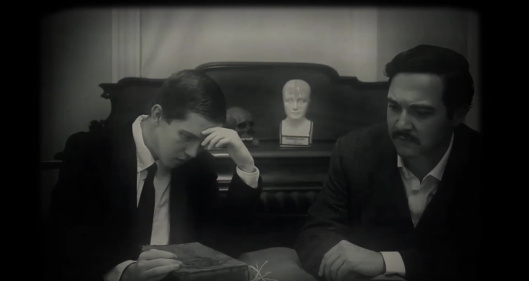
12 Saturday Jan 2019
Posted in Historical context, Lovecraftian arts, New discoveries
From William Gerold’s b&w photobook College Hill; a photographic study of Brown University in its two hundredth year (1965). Gerold seems unaware of Lovecraft — and anyway couldn’t have photographed 66 College St. circa 1960-65, H.P. Lovecraft’s old house, as it had been moved from the site in 1959. Though he photographed some of the architectural details and sculpted animals and suchlike, and along the way managed to record this Cthulhu-idol like detail from the John Carter Brown Library (1904) at Brown University.

“My aunt is well acquainted with Mr. Champlin Burrage, an Oxford man, who is librarian of the John Carter Brown library at Brown. (I hope to meet him very soon.)” — letter from Lovecraft to Rheinhart Kleiner, April 1917.
Circa 1910 postcards of the Library frontage…


“Exhibitions to which the public are welcome are held throughout the year [at the JCB Library]” (1916).
And how it looked by the 1940s, becoming grow-over…

Update: Another photo has surfaced. This ironwork Cthulhu was not inside but outside the Library.

11 Friday Jan 2019
Posted in Historical context, Lovecraftian arts, New books, Scholarly works
I see that Sargasso #2 and Sargasso #3 have appeared since I noted #1 in summer 2013. Sargasso: journal of William Hope Hodgson Studies, is the quality scholarly journal devoted to Hodgson.

A scholarly article in #2 may be of tangential interest to Lovecraft scholars. A full review of #2 usefully summarises…
Scott Conner’s ‘Dust and Atoms: The Influence of William Hope Hodgson on Clark Ashton Smith’. The long-held belief that ‘The Night Land’ [1912] was a major influence on Smith’s Zothique stories is more or less conclusively disproved by the evidence that he hadn’t read any Hodgson books until two years after the first Zothique tale [1932] was published. On the other hand, Scott Conner provides very convincing evidence that ‘The House on the Borderland’ [1908] was definitely a great influence on the writing of Smith’s story, ‘The Treader in the Dust’ [1935].
Lovecraft himself only made… “the discovery, in the summer of 1934, of the forgotten work of William Hope Hodgson.” (I Am Providence, S.T. Joshi) and felt the work was rather conventional in terms of the philosophy it worked in. Lovecraft considered that…
He is trying to illustrate human nature through symbols & turns of idea which possess significance for those taking a traditional or orthodox view of man’s cosmic bearings. There is no true attempt to express the indefinable feelings experienced by man in confronting the unknown. … To get a full-sized kick from this stuff one must take seriously the orthodox view of cosmic organisation — which is rather impossible today.
10 Thursday Jan 2019
Posted in Lovecraftian arts
The Case of Charles Dexter Ward as a manga book. From 2012, 256 pages, and nice art evoking charcoal and engravings. Possibly not all pages have art, as it may be a short adaptation + the original text.


09 Wednesday Jan 2019
Posted in Lovecraftian arts
From Peru, and presumably intended for Carnival time there, the Mascara Lovecraft (a life-sized Lovecraft mask, for wearing). The price seems to convert from the Peruvian Peso P to U.S. $ at about $40. I didn’t go looking but I’m guessing they might be importing from the larger Carnival market in Brazil, so you may also be able to find them available elsewhere in Latin America?

They also have a Poe mask…

05 Saturday Jan 2019
Posted in Lovecraftian arts
Now available to my Patreon patrons, a picture of Marblehead at sunset, in my cleaned and adjusted b&w version. It should be printable at large size, such as a 12-inch wide print. The technical details are: 3,700 pixels at 300dpi, as a .JPG, saved at 100% with no compression.

Lovecraft was of course greatly enamoured of Marblehead at sunset, and while there are some postcards this is perhaps the best artistic picture of such and dates from Lovecraft’s time. The seagulls even resemble night-gaunts! Patrons also get the colour original public domain version (partially cleaned by me), which they can tweak and sharpen to their own tastes. Artists may even want to have a go at replacing the sail boat with a newly-risen Tentacled One. There’s a white dot in the sky on the left which I’ve left uncleaned, as I think it’s a star emerging from the sky.
05 Saturday Jan 2019
Posted in Lovecraftian arts, New books
I see that Richard Corben’s recent Poe and Lovecraft horror adaptations are set to be collected in French translation as L’antre de l’horreur, with a “large format” print book due for publication by Panini on 9th January 2019. According to one blurb this edition…
Contains the U.S. comics Haunt of Horror: Edgar Allan Poe #1-3 and Haunt of Horror: Lovecraft #1-3, previously published in a Marvel collection [Haunt of Horror, 2008] and three unreleased comics.

An Amazon review usefully explains that his Lovecraft strips were only very loose and basic adaptations…
Contains a [comics] story loosely ‘inspired by’ Poe or Lovecraft in the comic medium followed by the original text [of Poe or Lovecraft].
Useful to know, as it’s the Lovecraft art that many will probably be buying this for rather than for the potted stories, which they’ll already know well. In that case you might be looking at the 112 pages stated for the 2008 book by Amazon, and expecting to get 112 pages of Corben art. But it sounds like you might get a lot less art.
I see that Amazon currently has Marvel’s collected Lovecraft English-language volume of 2008 as a $10 used print hardcover, or individually as $2 Kindle ebook downloads: #1, #2 and #3.

01 Tuesday Jan 2019
Posted in Lovecraftian arts
A new blog article on “Borges, Lovecraft, and Metaphysical Horror”. Be warned, there are huge plot-spoilers for Borges, in so far as he has plots.
Borges actually explores hidden knowledge [and its implications] … Borges’ horror is [thus] the culmination of Lovecraft’s program
Previously on Tentaclii:
“Lovecraft to Borges: cities in deserts”; “Borges leitor de Lovecraft”; “The Necronomicon seen from the Aleph: pseudo-intertextuality in Lovecraft and Borges”; and “Mathematical Monstrosity: Lovecraft’s geometry, Borges’s infinity, and beyond”.