Protected: Breccia art
15 Sunday Nov 2020
Posted in Lovecraftian arts
≈ Enter your password to view comments.

15 Sunday Nov 2020
Posted in Lovecraftian arts
≈ Enter your password to view comments.
12 Thursday Nov 2020
Posted in Lovecraftian arts, Odd scratchings
I’d always been vaguely put off the Call of Cthulhu RPG’s “Dreamlands” supplement by its naff current cover. Partly because the cover recalls for me the boredom engendered in a boy by C.S. Lewis’s show-stopping The Voyage of the Dawn Treader (I think it was that one, in Narnia series), rather than the creepy wonders of encountering Lovecraft’s Dreamlands. And then there’s that awful garish typography and equally off-putting subtitle: Roleplaying Beyond the Wall of Sleep. When did “Beyond the Wall of Sleep” enter the Dreamlands canon? Nothing about the cover invites confidence in the likely contents.

But who knew there was this older cover, which makes the thing look very much more appealing and is a nice bit of Lovecraftian art in its own right…


Anyway, if you want to check out the CoC Dreamlands as it currently stands (with Gazetteer, creature guide and map, as well as RPG adventures), there’s no need to pay silly collector prices for it. The 2011 printing is currently available in print for $10 at the Chaosium site, although shipping is extra.

Here’s a peek at the contents for the two books and map found in the original box…


04 Wednesday Nov 2020
Posted in Historical context, Lovecraftian arts
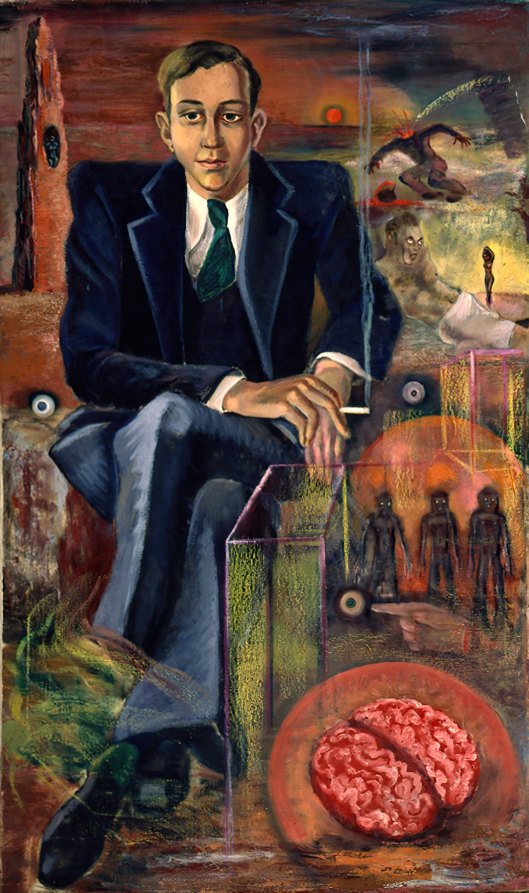
“Author with Dreams”, a circa 1936-46 painting of Donald Wandrei (and his personal dream-world) by Clement B. Haupers.
31 Saturday Oct 2020
Posted in Lovecraftian arts
For Halloween, Stanley Chaplin’s “Cornish Litany” series of monster postcards. Apparently there are 12 designs in total, in b&w and colourised variants. The Litany is said to be traceable back to the 15th century, and to be chanted by superstitious Cornishmen and women to ward off the night-spirits.
0.

1.
Missing
2.

3.

4.

5.

6.

7.

8.

9. B&W.

9. Colour

10.
Missing.
11.

12.

29 Thursday Oct 2020
Posted in Lovecraftian arts, Scholarly works
Providence’s Brown University has a fully-funded PhD opportunity in Music and Multimedia Composition, which may be of interest to those making Lovecraftian music or sonic environments…
Students have access to the department’s Multimedia and Electronic Music Experiments (MEME) studios, and the university’s Granoff Center for the Creative Arts. These specialized research facilities house recording studios, electronics shops, project studios, exhibition and performance spaces. … faculty specialties in technoculture, sound studies, copyright, improvisation and timbre.
22 Thursday Oct 2020
Posted in Lovecraftian arts
Newly up for sale, an original art board for Marvel’s Journey into Mystery, specifically the Gene Colan teen-friendly Lovecraft adaptation of “The Haunter of the Dark”.

Also a nice page of ‘Kirby Cosmicism’ from Thor, where in the pencilled margin notes you can see the synopsis and thus ‘the Marvel Method’ at work. For speed, Stan Lee and Jack Kirby would verbally spitball a plot outline, and Lee would jot it down into a basic synopsis. Jack would go away and pencil the pages to the synopsis, then Lee would come back in and ‘write to the art’ — often directly onto the boards.

Both boards are at nostalgicinvestments which has a website that’s just too annoying to link to, with weird rapid auto-refresh of pages that can’t be cured even by disabling Javascript and CSS.
21 Wednesday Oct 2020
Posted in Historical context, Lovecraftian arts
Following my recent stroll down the old College Street, I found another drawing of the archway near the foot of College Street, this time by Providence artist Whitman Bailey and from 1914. Not in my Whitman Bailey ebook collection, which is available at the previous link.

17 Saturday Oct 2020
Posted in Lovecraftian arts, New books
A Portuguese translated Tales collection from Lovecraft, to be published from Martin Claret, 28th October 2020. It’s one of three such volumes but their page for these is broken, which doesn’t inspire confidence. Still, a very pleasing and clever cover for the first such book.

The bicycle is there because the young Lovecraft was a keen cyclist to about 1908, then it most likely became sporadic, and he marks 1913 as the terminal date for his giving up cycling altogether. For adults to cycle in Providence was not the “done thing” at that time.
15 Thursday Oct 2020
Posted in Lovecraftian arts, New books, Scholarly works
A new book, seemingly coming from an occultist perspective, Dark Magic: H.P. Lovecraft, Starry Wisdom and the Contagion of Fear…
explores the contagious qualities of Lovecraft’s tales, with their embedded sense of dread and their dismantling of human reason, and how they have propagated in the near century after his death … the infectious qualities of Lovecraft’s ideas are seen to parallel virology, mass infection, and the fraying state of the human psyche during times of pandemic.

Which blurb leads me to coin the new word “cultifectious”:— the quality had by a certain type of culture that is highly infectious and communicable, but not mere mass-market pop-fluff or some passing propaganda of-the-moment. It carries within it a complex nexus of elements that organically connect things usually divided — low and high culture, the deep past and the cosmic future, or ancient and modern science. Its infectiousness thus comes partly from being connected to ‘the genuine’ at both ends of one of those divisions, and by bringing these lightly into play with each other. Because it has something genuine woven through it, it may be difficult to make into a mass audience commodity unless brutally shorn of many of its intrinsic qualities. Instead it persists and spreads among initiates as a potent ‘cultic’ form of culture. It does not usually, however, gather about it the more oppressive hierarchical apparatus of ‘a cult’ in the religious sense. It naturally fascinates, rather than ponderously recruits.
14 Wednesday Oct 2020
Posted in Lovecraftian arts
The Lovecraft Arts & Sciences store in Providence has updated their store page and appears to have the “Map of Lovecraft’s Providence” by Jason Eckhardt currently in stock.

Also Eckhardt’s illustrated booklet Off the Ancient Track for $10 (yes, the revised 2013 edition).
12 Monday Oct 2020
Posted in Lovecraftian arts, Scholarly works
Call for papers: Religion and Horror Comics. Deadline for abstracts: 1st December 2020. For a volume of the Religion and Comics academic book series, published by Claremont Press. The planned book appears not to be open-access.

11 Sunday Oct 2020
Posted in Historical context, Lovecraftian arts
An October question has arrived from one of my Patreon patrons.
What did HPL think of the artist Henry Fuseli?
There is not generally a lot to say about H.P. Lovecraft and art. A master he was, but not of practical visual art-making. He had aunts who were long-standing members of the local Art Club, and they could apparently produce a pleasing canvas of a seascape or similar Rhode Island scenes. But he could only produce fairly crude sketches, though these are not without some naive charm. Had he been trained from boyhood to draw, he might have produced passable pen-sketches of cherished scenes. He might even have later branched out into Mervyn Peake-like gothic ink drawings. But he both felt and knew that he had no talent for it, and at that point in time landscape and architectural photography was not a viable alternative picture-making option for him. He was an impoverished amateur, who made do with a box-camera and simple snaps developed at the local drug-store. This is not to say that he did not appreciate a silver-handed artistic talent in others, and indeed he encouraged it in his more hesitant young correspondents such as Dwyer and Barlow among others. Nor did his lack of ability mean that he was unable to appreciate fine art, though we can perhaps assume he lacked the very subtle eye of the practising visual artist.
What then of the painter Fuseli? He is referred to by name in Lovecraft’s “Pickman’s Model” (1926)…
I don’t have to tell you why a Fuseli really brings a shiver while a cheap ghost-story frontispiece merely makes us laugh.
This must refer to Fuseli’s masterwork “The Nightmare” (1781). The picture became so famous and well-reproduced, as both painting and its engraving by Thomas Burke (1783), that it was able to be very easily parodied and also alluded to in literature. There is a very vague claim that it may have inspired Shelley, and thus Shelley’s Frankenstein. This claim falls apart, as soon as one starts to dig into its footnotes. A much firmer example is found in two uses by Lovecraft’s idol Poe. There are a set of paintings in Poe’s “The Fall of the House of Usher” that are similarly compared to Fuseli…
If ever mortal painted an idea, that mortal was Roderick Usher. For me at least, in the circumstances then surrounding me, there arose out of the pure abstractions which the hypochondriac contrived to throw upon his canvas, an intensity of intolerable awe, no shadow of which felt I ever yet in the contemplation of the certainly glowing yet too concrete reveries of Fuseli.
Later in the tale there is a similar manifestation of a ‘dream terror’, as if from out of the paintings…
An irrepressible tremor gradually pervaded my frame; and, at length, there sat upon my very heart an incubus of utterly causeless alarm. Shaking this off with a gasp and a struggle, I uplifted myself upon the pillows, and, peering earnestly within the intense darkness of the chamber…
The allusion to the painting is subtle, but the setting is the same and would have promoted connoisseurs of the macabre to recall the famous “The Nightmare”. Lovecraft could also have recognised the more explicitly-named allusion to the painting in Poe’s “The Black Cat”…
I started, hourly, from dreams of unutterable fear, to find the hot breath of the thing upon my face, and its vast weight — an incarnate Night-Mare that I had no power to shake off — incumbent eternally upon my heart!”
These are likely the uses that Lovecraft sought to echo in his own “Pickman’s Model”, almost perhaps more in homage to Poe rather than for an avid fondness for the works of Fuseli. Since Lovecraft mentions Fuseli in no letters that I have access to, other than in a passing generic list given to Mrs Toldridge.

Yet, could Lovecraft have seen “The Nightmare” in its original? Let me quickly trace some of the history of the original picture. It seems that Fuseli, though of Swiss origin and name, had to all intents become an Englishman. This would have endeared him to Lovecraft even more, and it must then explain why the famous painting long remained in and around my own area, first at Ashbourne on the southern edge of the Derbyshire Peak, and later at the nearby county-town of Stafford. Local genius and future-visionary Erasmus Darwin saw it and wrote famous macabre poetry on the painting. This is a rather pleasing discovery for a localist like myself to make, and such data might one day find its way into a future story. But by 1950 the picture was gone. Post-war socialist death-duties and other punitive taxes were wracking and wrecking the stately homes, and it was sold and shipped to the USA. The original painting is apparently now in Detroit, USA, which seems a rather suitable resting place.
The above digital version is not ideal, but the quality of online reproductions is generally abysmal — and at least here one can see what’s going on in the picture. Including the dressing-table mirror and a trace of tell-tale blush on the cheek of the sleeping maiden. Note also the strong likeness to the squatting shape of Lovecraft’s Cthulhu idol.
There appears to have been no loan exhibition of any Fuseli to Boston or New York during Lovecraft’s lifetime. Thus it seems certain that Lovecraft knew the picture only as a good reproduction. However, there is a complicating factor. Fuseli also painted several other versions.
In a version destroyed in the infernos of the London Blitz during the Second World War, but whose likeness was captured in an engraving by William Raddon (1827), the demon-imp’s impact is lessened by having him look questioningly at the sheepish horse, and having the distinct shadow of a cat. The whole scene takes on a comedic self-parodic cast…

By 1810 Fuseli has his demon-imp escaping nightmare-woken women on the horse, by leaping out of the window astride the horse’s back. One suspects that Fuseli by this point had become rather fed-up of his famous painting, and was beyond even subtle self-parody. He was just playing it for laughs, to amuse friends. Possibly this picture also gives us a hint of the very large amount of items that his prudish widow heaped onto a bonfire shortly after his death.

One deep-diving art historian remarks that the famous demon-imp became a mere owl, in a version painted by Fuseli at age 80.
Thus my feeling is that what Lovecraft alludes to in “Pickman’s Model”, and what he assumes Poe also knew, was the version he would have seen in fine form in engravings — such as the one in Erasmus Darwin’s famous The Botanic Garden. We know that Lovecraft had an 1805 ‘sampler’ of the best of this long work, called Beauties of the Botanic Garden, and also an 1880 biography of Erasmus Darwin. In which case he would have been interested enough to peruse the complete poetic works, had he encountered the volumes in somewhere like Boston or perhaps even Providence. Had this been the 1799 edition, then on page 126 of Part Two (“The Loves of the Plants”) he would have seen a fine engraving of perhaps the best version of the famous work…

This plate faces and also illustrates the climax of a macabre section of the poem set at Wetton in the Manifold Valley in North Staffordshire, which was also (though Erasmus knew it not) the setting for the climax of the famous supernatural tale Sir Gawain and the Green Knight. Here is this version of the picture in paint, albeit in black and white…

Lovecraft may not have seen the connections with old European folklore, re: chest-squatting imps as folk explanations for sleep paralysis, or the water-horse (on which, to get past all the pagan parroting and modern mumbo-jumbo, see Stromback’s excellent “Some Notes on the Nix in the Older Nordic Tradition”, 1970, which is also comparative).
The paintings bear comparison with some other of Fuseli’s works. For instance in a study for “Prospero, Miranda, Caliban and Ariel”, the demon-imp and the dreaming girl are akin to Shakespeare’s Caliban and a swooning Miranda (Miranda here being just pencilled-in)…

In “Milton Dictating to His Daughter”, the blind Milton has a face akin to the original horse complete with blind eyes, and the long flowing drapery and Blake-like limbs of the girl is also similar…

There is another reference to Fuseli in Lovecraft’s fiction, in “The Colour out of Space”…
All the farm was shining with the hideous unknown blend of colour; trees, buildings, and even such grass and herbage as had not been wholly changed to lethal grey brittleness. The boughs were all straining skyward, tipped with tongues of foul flame, and lambent tricklings of the same monstrous fire were creeping about the ridgepoles of the house, barn and sheds. It was a scene from a vision of Fuseli…
This implies that by March 1927 Lovecraft had seen more of Fuseli than engravings or b&w reproductions of “The Nightmare”. Such works were most likely encountered in the public and personal libraries of New York City during his stay there, either as good reproductions or perhaps even as originals in the museums. What might the pictures have been? Well, it’s very difficult to see the full range of Fuseli’s work in the macabre and supernatural, and very easy to come away from any one old book unimpressed. But put them together and you start to glimpse how impressive he would be in this area if such works were collected together. I’d suggest what’s needed is a blockbuster 21st century exhibition of such works, in due course, hint hint…
So it’s currently difficult to say what Lovecraft saw in New York City. But perhaps this engraved faery picture might give a hint at the sort of ‘swirling’ painted work that Lovecraft had in mind in “The Colour out of Space”.

Or perhaps the background of Fuseli’s witch-sabbat “The Night Hag” also gives us a glimpse…

The other hints of influence are to be found in two entries in Lovecraft’s Commonplace Book of story-ideas…
Very late in 1923
#106. A thing that sat on a sleeper’s chest. Gone in morning, but something left behind.
Early 1924
#119. Art note — fantastick daemons of Salvator Rosa or Fuseli (trunk-proboscis).
From this, I suspect, eventually came Lovecraft’s Brown Jenkin in “Dreams in the Witch House” (1932)…

Further reading:
* Nicolas Powell, Fuseli: The Nightmare, Viking Press, 1973.
* Sleep Paralysis: Night-Mares, Nocebos, and the Mind-Body Connection, Studies in Medical Anthropology, 2011.